Unlocking Global Talent: Spain's Blue-Collar Work Visas for Employers in 2026
As a Spanish employer in sectors like construction, agriculture, manufacturing, or logistics, you're no stranger to labor shortages. By hiring internationally, employers gain access to reliable, motivated talent while providing them pathways to long-term residency boosting retention.
This guide, covers the essentials: types of visas, required documents, and the application process. Whether you're scaling up for peak seasons or filling permanent gaps, these tools empower compliant, efficient hiring.
Types of Blue-Collar Work Visas
Spain's 2026 framework prioritizes employer-sponsored visas for low-skilled and unskilled roles, focusing on sectors with verified shortages (e.g., via SEPE's national list). Key types include:
1. General Work Visa (Cuenta Ajena)
Ideal for ongoing blue-collar positions like electricians, plumbers, factory operators, or warehouse staff. This permit combines work and residence authorization, valid for one year initially and renewable up to four years. It's tied to your company, with no labor market test required if the role is on the shortage list. After five years, workers can apply for long-term residency (10 years validity for those over 30). Family reunification is possible after the first year, enhancing appeal for stable hires.
2. Seasonal Work Visa
Perfect for temporary blue-collar needs in agriculture (e.g., fruit pickers), tourism (e.g., maintenance crews), or transport (e.g., delivery drivers). Valid for up to nine months in a 12-month period, it requires a fixed-term contract and proof of return home. Exempt from full labor tests in shortage sectors, this visa supports bilateral agreements with countries like Morocco or Latin America for quick recruitment. While not a direct residency path, it allows transitions to general visas for repeat hires.
These options align with 2026's integration pathways, offering flexibility for workers with 2+ years of experience and easing your sponsorship duties.
Benefits for Employers
Sponsoring blue-collar workers through Spain's work visas delivers tangible advantages, helping you navigate labor shortages and scale efficiently:
Benefits for Employees
Highlighting these perks to potential hires makes your job offers irresistible, improving application rates and loyalty:
Documents Required
Preparation is employer-led to minimize delays. All non-Spanish documents need apostille (Hague Convention) and sworn Spanish translations. Fees range from €60–€200, varying by nationality and type.
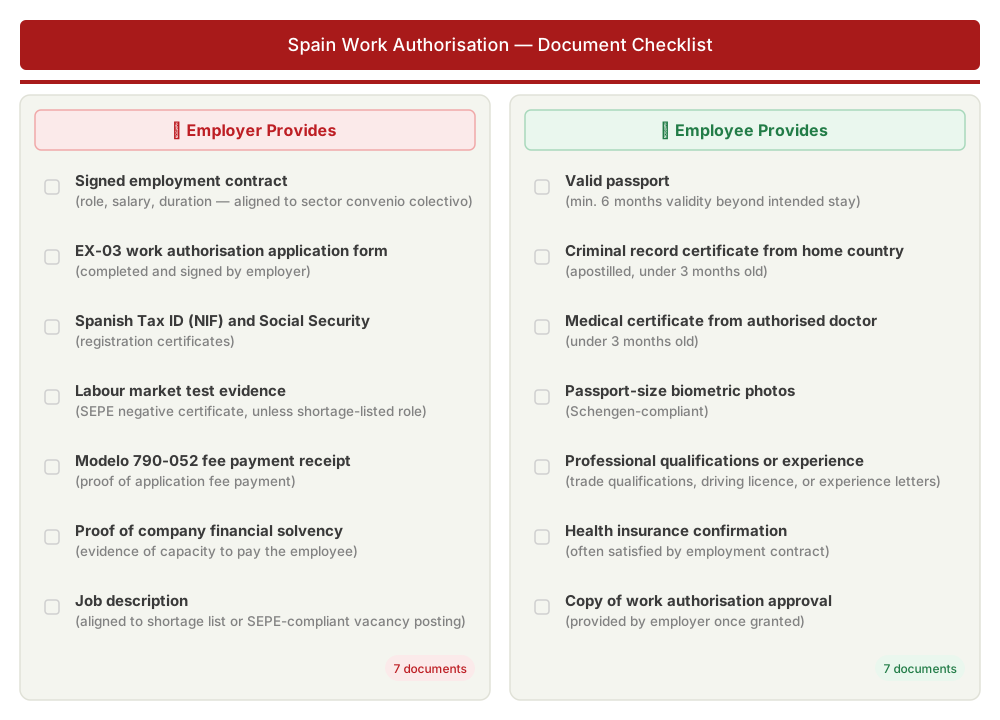
Employer-Side Documents (for Work Authorization)
Here is the 2026-updated version with current regulatory framing and salary references adjusted to reflect annual minimum wage updates:
- Employment Contract: Signed by both parties, detailing salary (minimum aligned with Spain’s 2026 national minimum wage — approx. €1,134/month in 14 payments or equivalent annual gross), job duties, duration, and working conditions in line with the applicable collective bargaining agreement (convenio colectivo).
- Labor Market Test Evidence (if not shortage-listed): If the role is not included in the official shortage occupation list published by the Public Employment Service (SEPE), employers must provide proof of a 15-day job posting via Servicio Público de Empleo Estatal (SEPE) demonstrating no suitable EU/EEA candidates were available.
- Company Documentation: Spanish Tax ID (NIF), Social Security registration certificate, and financial documentation proving the company’s economic capacity to employ and pay the foreign worker.
- Application Form: EX-03 form for residence and work authorization submitted to the relevant immigration office (Oficina de Extranjería).
- Government Fee Payment: Form 790-052 (work authorization fee), typically ranging between €80–€200 depending on contract type and duration.
Candidate-Side Documents (for Visa)
- Valid Passport: 6–12 months validity beyond stay, with copies.
- Passport Photo: Recent, Schengen-compliant.
- Medical Certificate: From an authorized doctor, confirming no public health risks (e.g., no polio or Ebola); under 3 months old.
- Criminal Record: Clean certificate from home country and last 5 years' residences, apostilled, under 3 months old.
- Qualifications/Experience Proof: CV, trade certificates, or 2+ years' letters for skilled blue-collar; driving license for drivers.
- Health Insurance: Full coverage (€30,000 minimum) for Schengen area, often via contract.
- Visa Form: National D-type, plus accommodation proof (e.g., lease) for seasonal.
- Work Authorization Copy: From your application.
Application Process
The employer-driven process takes 1–3 months, with faster tracks for shortage roles (20 days). Use an Employer of Record (EOR) if you're not local to handle compliance.
Step 1: Employer Files for Work Authorization
Submit EX-03 and docs to your Provincial Aliens Office (Extranjería) or UGE-CE. Include labor test if needed. Approval yields a favorable resolution letter sent to the worker's consulate.
Step 2: Worker Applies for Visa Abroad
Book via the Spanish consulate (e.g., BLS in India). Submit docs, pay €60–€100 fee, provide biometrics, and attend a brief interview. Processing: 1–8 weeks.
Step 3: Entry and Onboarding in Spain
Worker enters within 90 days. Register with Social Security on day one (your responsibility). Apply for TIE card within 30 days at police station for stays over 6 months.
Step 4: Renewals and Compliance
Renew 60 days pre-expiry at Extranjería, proving ongoing employment. Track change no employer switches in year one without approval, but 2026 flexibilities aid retention.
Why Choose Jobbatical for Blue-Collar Visas
When it comes to navigating Spain's blue-collar visas, partnering with Jobbatical turns complexity into confidence. As a leader in global mobility, we specialize in end-to-end support tailored for employers.
- Expert Visa Guidance: Our immigration specialists audit the roles against SEPE's shortage list, select the optimal visa type (general or seasonal), and manage applications to achieve 95%+ success rates.
- Full-Service Relocation Support: From document prep and consulate bookings to onboarding and cultural integration, we handle everything .
- Proven Track Record in Spain: With dedicated teams fluent in Spanish regulations, we've relocated thousands of blue-collar workers, including drivers and agricultural specialists, ensuring seamless hires in shortage sectors.
- Customized Employer Solutions: Benefit from our 2026 regulatory insights, risk assessments, and performance analytics to optimize your talent pipeline and reduce hiring timelines by up to 50%.
- Hassle-Free, Results-Driven: Unlike generic providers, Jobbatical combines tech-driven tracking with personalized service, so you focus on business growth while we deliver ready-to-work talent.
Navigating these visas positions your business for growth in Spain's talent-hungry market. At Jobbatical, we specialize in blue-collar visas from shortage audits to full EOR support. Ready to secure your next hires? Schedule a free consultation today and let's turn labor gaps into competitive edges!
15,000+ Completed relocations
Thank you for reaching to us!
We will get back to you with more information and the meeting details very soon.
Employers must be registered Spanish entities with proof of financial solvency and legal business operation. They must submit company registration, tax, and financial documents to authorities.
Check if the job is on Spain’s official shortage occupation list. If not, you must run a labor market test by advertising the job for 15 days to prove no suitable local/EU candidates are available.
Post the job in the official SEPE portal or regional employment services for 15 days and gather proof showing no suitable local applicants applied.
Signed employment contract, company registration certificate, labor market test evidence (if applicable), proof of financial stability, and completed application forms (EX-03 and fee payment receipts).
The monthly salary must meet or exceed the Spanish Minimum Interprofessional Salary (SMI) — approximately €1,134 per month in 14 payments (or the equivalent annual gross amount under a 12-payment structure). In practice, most blue-collar roles offer between €1,200 and €2,200 per month, depending on the sector, collective bargaining agreement, region, and level of experience.
Processing generally takes 1 to 3 months depending on region and workload; faster if submitted via the UGE digital platform for large employers.
Share the work authorization approval with the employee so they can apply for the Type D work visa at the Spanish consulate in their home country.
Provide the approved work authorization, employment contract, and proof of salary and accommodation to help the employee with visa documentation.
Employer fees typically range from €203 to €408, covering work authorization applications and related filings.
Register the employee with Spanish Social Security on Day 1, assist with the TIE (Foreigner Identity Card) application within 30 days, and ensure compliance with employment laws.
Initial visas last 1 year, with possible renewal up to 4 years. After 5 years of continuous residence, the employee may apply for long-term residency.
Yes, seasonal work visas have slightly different documentation requirements, shorter validity (up to 6 months), and may require employer-provided accommodation and proof of return travel.
Avoid using non-compliant contract templates, missing labor market test proof, failing to register employees with social security timely, and neglecting visa renewal deadlines.