

Trusted by 1000+ companies
17,000+ relocations
4.8 ★ average satisfaction
AI powered platform
ISO 27001 certified

Using an EU Blue Card for a Paid Internship at a New German Employer

Covers the compliance risk when HR wants to onboard a paid intern whose EU Blue Card was issued for a previous employer and is now in an unemployment grace period.
Created
May 21, 2026
Last updated
May 22, 2026
Answered by:
Georgiy Serdiukov
A dedicated global mobility expert specialising in seamless international relocations. His expertise lies in: a) assessing individual cases, handling visas, obtaining necessary documents in Germany, b) and assisting with residence permits and permanent residency applications c) and finding the perfect housing, or adapting to new cultures. Georgiy has a strong background in relocation guidance, cross-cultural communication, and immigration law that ensures a smooth transition into a new environment.
Read more

Executive Summary

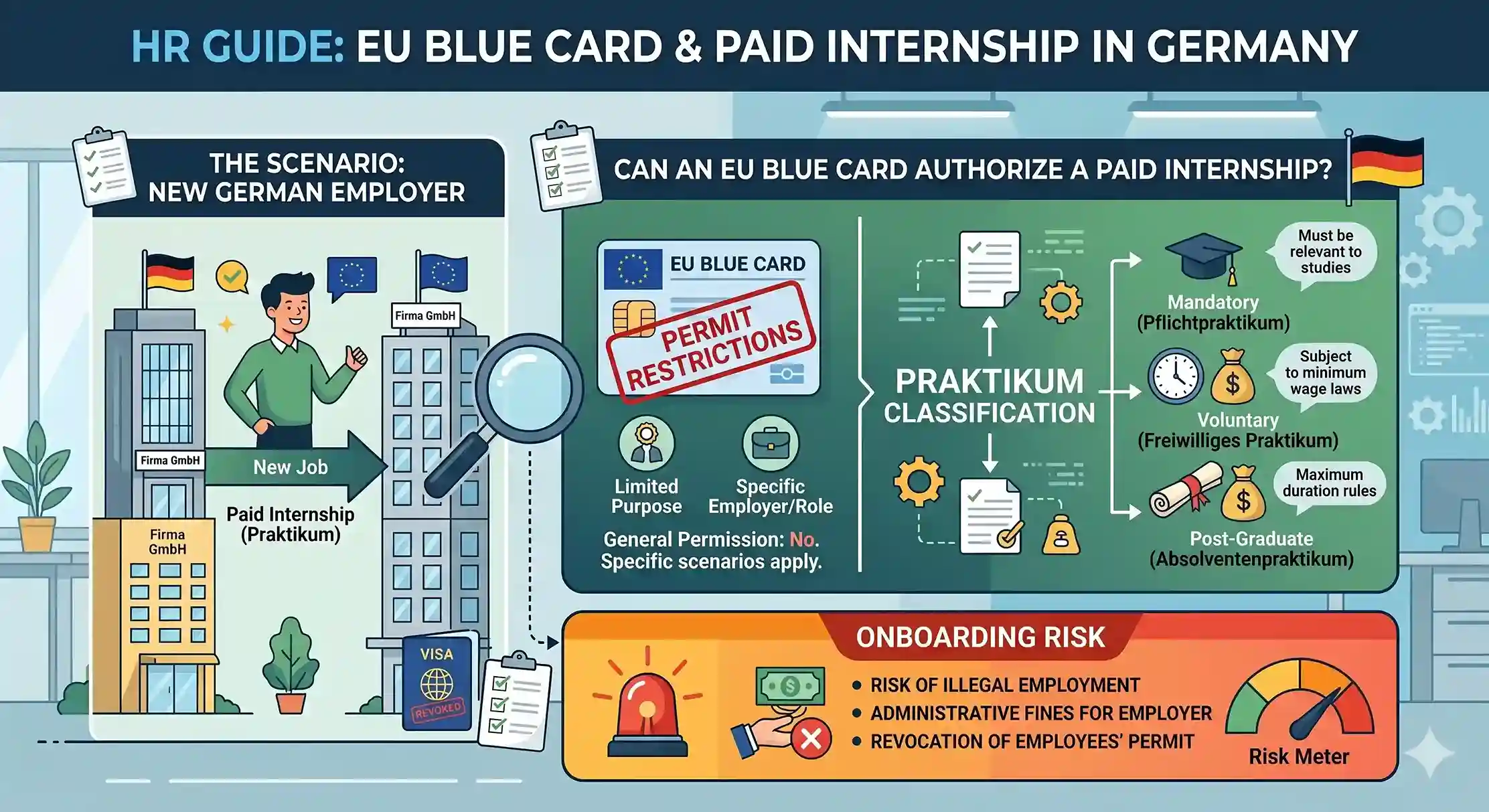
  • A paid Praktikum is treated as employment under German immigration law, duration (even two weeks) does not change this classification.
  • The EU Blue Card's supplementary sheet (Nebenbestimmung) may restrict work to the original employer, making any work for a new company unauthorized until reviewed.
  • After two years, employer changes on a Blue Card are permitted without prior approval, but the new role must still qualify as Blue Card-eligible employment; a below-threshold internship usually does not.
  • HR must review the actual permit and supplementary sheet before onboarding begins; proceeding without this creates unauthorized employment liability for the company.

Question: Can an employee use an existing EU Blue Card for a paid two-week internship if it was issued for a previous employer and that job has ended?

Answer:

Not without a permit review first. A paid internship (Praktikum) is usually treated as regular employment under German immigration law unless it is a mandatory university requirement. An EU Blue Card is employer-specific in the first year; after two years, employer changes are allowed, but the new role still must qualify for Blue Card eligibility. A low-paid internship likely does not. HR should check the residence permit and Nebenbestimmung before onboarding.

Looking for a detailed Assessment?

Scenario Overview

Destination Germany
Permit Type EU Blue Card (Blaue Karte EU), issued for previous employer
Scenario Paid Praktikum at new employer during Blue Card unemployment grace period
Work Authorization Conditional , depends on Nebenbestimmung and whether role qualifies as Blue Card employment
Key Constraints Paid internship = employment under AufenthG; must meet Blue Card salary threshold; supplementary sheet may restrict employer
Complexity High , requires document review before onboarding; permit classification and role eligibility both in question
Onboarding Risk High , proceeding without permit review creates unauthorized employment exposure
Timeline Risk Medium , grace period is up to 3 months; any delay in permit clarification reduces available window
Typical Timeline Permit review: 1–5 days (document check); change-of-employer notification if applicable: up to 30 days for authority response
Submission Authority Local Ausländerbehörde (city-level variability in processing speed and document interpretation)
Key Challenges Nebenbestimmung interpretation; internship salary below Blue Card threshold; grace period time pressure; city-level authority variability
Example Scenarios Blue Card holder left Company A, wants to intern at Company B for two weeks; HR assumes valid card covers the role. Blue Card with open work authorization, but internship pay is €1,800/month , well below threshold, making the role non-qualifying. Internship is a mandatory curriculum Pflichtpraktikum , exempt from employment classification under AufenthG.
Expected Outcome Work permitted only if Nebenbestimmung is open AND role qualifies as Blue Card employment, OR engagement is a university-mandated Pflichtpraktikum

What HR Needs to Know Before Onboarding This Intern

The Legal Position

Under German immigration law, a paid internship (Praktikum) is usually treated as regular employment (Beschäftigung) unless it is a mandatory Pflichtpraktikum. The EU Blue Card’s work authorization is set by its permit conditions, and the Nebenbestimmung controls whether the employee may work for your company. In many cases, it names the original employer or limits employment to a specific sector, so the actual document must be checked.


The Practical Path Forward

If the card is in its unemployment grace period, the holder may remain in Germany and seek new qualifying employment, but they cannot start paid work without confirming the Nebenbestimmung. If the post-two-year phase had already begun, employer-change rules are more flexible, but the new role must still meet EU Blue Card salary and eligibility requirements. A typical paid Praktikum is usually below the Blue Card threshold and therefore non-qualifying.

HR Guidance

  1. Obtain and review the physical Blue Card and its supplementary sheet before any onboarding discussion , confirm whether work authorization is open or employer-restricted.
  2. Establish whether the role meets Blue Card employment criteria , if the internship salary falls below the applicable threshold, the engagement cannot be covered by the Blue Card and a separate permit route is required.
  3. Do not start the intern on payroll until written confirmation of authorized work status is in hand , proceeding on the assumption that a valid card covers all employment is a common and costly mistake.
  4. If the engagement is commercially important, assess whether a short-term qualified employment permit or a re-scoped role could qualify , a two-week trial placement under Section 20 AufenthG (probationary employment for qualified workers) may offer a compliant alternative path.

Key Risks

  • Unauthorized employment risk: Hiring a paid intern without confirming work authorization can expose the company to fines and create immigration issues for the employee, even for short internships.
  • Permit expiry during onboarding: If the residence permit expires without a timely renewal or extension application, the employee can lose both residence and work rights during the internship period.
  • Internship misclassification: Many compliance issues arise when companies assume a short or informal Praktikum does not require work authorization. In most cases, paid internships are still treated as employment under immigration rules.

Disclaimer
Immigration laws and policies change frequently and may vary by country or nationality. While we strive to provide accurate and up-to-date information, we recommend doing your own due diligence or consulting official sources. You’re also welcome to contact us directly for the latest guidance. Jobbatical is not responsible for decisions made based on the information provided.

About Jobbatical Expertise in Germany

Jobbatical has supported over 17,000+ international relocations across more than 45 countries, helping HR teams manage immigration operations, onboarding continuity, permit tracking, and compliance coordination.
In Germany, our team handles complex edge cases including permit classification reviews, employer change assessments, and grace period compliance; the situations where a document check before onboarding prevents a much larger problem later.

Need help navigating complex immigration scenarios?

When onboarding timelines, work authorization, and permit compliance intersect, operational clarity matters. Get guidance from Jobbatical's immigration experts.

FAQs: EU Blue Card and Paid Internships at a New German Employer

Does the two-week duration of the internship mean no work permit is needed?

No. Duration does not affect the classification. A paid Praktikum is treated as regular employment under German immigration law regardless of length. The exemption that exists, for university-mandated compulsory internships, depends on the nature of the placement, not its duration. A two-week paid role with no curriculum link requires the same work authorization as a permanent contract.

What does the supplementary sheet (Nebenbestimmung) actually say, and why does it matter?

The Nebenbestimmung is the conditions annex attached to the residence permit card. It specifies what employment is authorized, and may name the original employer, restrict the sector, or grant open work rights. Ausländerbehörden vary significantly in how they phrase these conditions, and the language matters legally. HR should read this document before any onboarding discussion; it is the governing text, not the card expiry date.

After two years on a Blue Card, can the employee work for any employer without approval?

After two years, the formal prior-approval requirement for employer changes is removed, and the employee need only notify the Ausländerbehörde. However, the new role must still qualify as Blue Card-eligible employment, meaning it must meet the salary threshold and correspond to the employee's qualifications. An internship at standard Praktikum pay typically does not meet either criterion.

What happens if the intern starts work before the permit situation is confirmed?

Both the employer and the employee face legal exposure. Under German law, employing someone without valid work authorization carries fines for the company and can result in the employee's permit being refused or revoked. Even a brief unauthorized engagement creates a compliance record that may complicate future permit applications for the employee.

Is a Pflichtpraktikum (compulsory university internship) treated differently under immigration law?

Yes. A Pflichtpraktikum prescribed in university study regulations is classified as part of the study course under immigration law, not as employment. It is therefore exempt from the standard work authorization requirements that apply to voluntary internships. The exemption requires documented evidence of mandatory status, a written internship agreement referencing the study regulations is typically expected by the Ausländerbehörde.

Can a non-EU national use a trial employment (Probearbeit) arrangement under §20 AufenthG instead?

Potentially. Section 20 AufenthG permits qualified workers to undertake probationary employment for up to two weeks, but the role must be qualified employment, it must require a university degree or equivalent. If the internship is structured as a genuine professional trial in the employee's field of qualification, this route merits assessment. It is not a workaround for non-qualifying roles and requires immigration counsel to confirm eligibility.

Does the nationality of the Blue Card holder affect whether the internship can proceed?

Nationality does not change the core analysis here, the Blue Card framework applies uniformly to non-EU nationals. However, nationals of countries with bilateral labor agreements (such as certain Western Balkans countries) may have access to slightly different procedural pathways. Any nationality-specific considerations should be raised directly with an immigration specialist reviewing the specific permit and supplementary sheet.

This covers the following use cases:

  1. Can a Blue Card holder in Germany work for a new employer during their three-month unemployment grace period?
  2. Does a paid two-week internship require a work permit for a non-EU national already in Germany?
  3. What does the supplementary sheet on a German EU Blue Card say about working for a different employer?
  4. Can we onboard a non-EU candidate who has a valid German Blue Card from a previous job?
  5. Is a Praktikum in Germany considered employment under the Residence Act?
  6. Does the two-year rule on the EU Blue Card mean an employee can take any job after that point?
  7. What is the salary threshold an internship must meet to qualify under a German EU Blue Card?
  8. Can an Indian national use their existing EU Blue Card for a short placement at a different German company?
  9. What is the difference between a Pflichtpraktikum and a voluntary internship under German immigration law?
  10. Can a Blue Card holder take up trial employment (Probearbeit) under §20 AufenthG without a new permit?
  11. What is unauthorized employment in Germany and what are the fines for HR teams?
  12. Can a Ukrainian national on an EU Blue Card from a previous employer do a paid internship at our company?

Reviewed by:
Margalida
A global mobility expert for Germany, passionate about making international relocations as smooth as possible. Specializes in immigration processes such as visas, residence permits, and address registrations. A strong background in international and intercultural communication ensures a seamless and professional relocation experience.
Read more

In this use case

    Share

    Business immigration support in 45+ countries: Top locations

    Visas, work permits, renewals, and relocation services – complete immigration and global mobility support for HR teams across Europe and worldwide.
    Business immigration support in other countries
    Need immigration support in another country? —
    Contact us
    to explore seamless business immigration for your desired country