France Researcher/Scientist Visa (2026)
The France Researcher/Scientist Visa remains the premier solution for non-EU academics and research professionals seeking to advance their careers in France's world-renowned research ecosystem. In 2026, this pathway has been further streamlined under the Passeport Talent framework, aligning with the EU's "Attracting Talent for Innovation" strategy. Whether you're joining a prestigious French research institution, collaborating on groundbreaking scientific projects, or pursuing advanced academic opportunities in high-tech fields like AI or Green Energy, Jobbatical offers comprehensive support throughout your journey—from initial eligibility assessment and document preparation to ANEF portal management and final permit approval.
What Is a France Researcher/Scientist Visa?
The France Researcher/Scientist Visa, established under EU Directive 2016/801 and governed by the latest CESEDA 2026 regulations, is a specialized residence permit for non-EU/EEA/Swiss researchers and scientists. Valid for up to 4 years (renewable), this permit supports academic researchers, doctoral students, and scholars working in French universities, recognized research institutions, or private R&D organizations.
Key 2026 Features:
- Digital-First Processing: As of 2026, all researcher permit applications and renewals are processed exclusively through the ANEF (Administration Numérique des Étrangers en France) portal, reducing physical prefecture visits.
- EU-Wide Mobility: This permit provides enhanced mobility within the EU. Researchers can conduct research in other EU member states for up to 180 days (short-term) or more (long-term) through a simple notification procedure.
- Simplified Family Access: Spouses and minor children qualify for the "Talent-Family" procedure, granting them immediate residence and the right to work in France without a separate work permit.
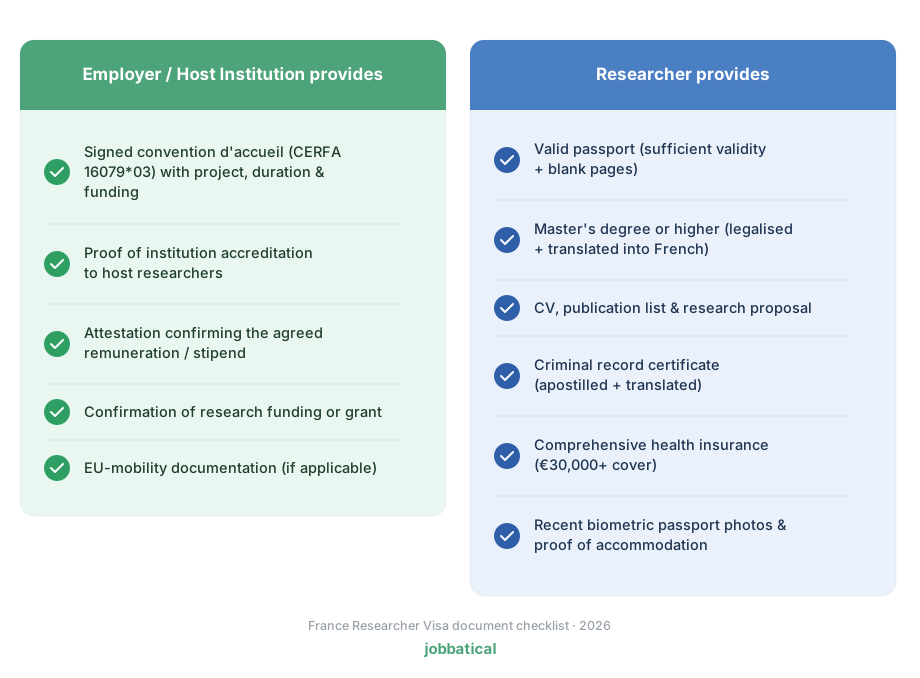
- Hosting Agreement (Convention d'Accueil): The core requirement remains the Convention d’Accueil, an administrative document from an accredited French institution specifying the nature, duration, and funding of the research.
- Threshold Update: For 2026, grant-funded researchers must typically show a monthly stipend exceeding the public doctoral contract minimum (approx. €1,820+ net/month).
Benefits of a France Researcher/Scientist Visa
For Individuals
Legal Research and Residency: Work in France's prestigious academic and research environment with access to world-class facilities, healthcare, education, and housing through your French researcher visa.
EU Academic Mobility: Conduct research in other EU countries for up to 180 days within a 360-day period without additional visas, facilitating international collaboration and conference participation.
Family Reunification: Bring spouses and children under 18, with spouses receiving work authorization and access to French social benefits.
Career Excellence: Access France's leading research institutions including CNRS, INSERM, INRIA, and top universities like Sorbonne, École Normale Supérieure, and Institut Pasteur.
Schengen Access: Travel freely within the Schengen Area for academic conferences, research collaborations, and scholarly exchanges.
Path to Permanent Residency: Qualify for long-term EU resident status after 5 years of continuous legal residence.
For Employers and Institutions
Global Talent Recruitment: Attract world-class researchers and scientists to enhance institutional research capacity and international reputation.
Compliance Assurance: Meet French immigration requirements through streamlined procedures designed specifically for academic and research activities.
Research Collaboration: Facilitate international partnerships and joint research projects with simplified mobility procedures.
Innovation Support: Access international expertise to drive breakthrough research and technological advancement.
Eligibility for a France Researcher/Scientist Visa
Eligibility for a French researcher visa includes:
Nationality: Non-EU/EEA/Swiss citizens from all countries (including U.S., Canada, Australia, India, China, Brazil, Japan).
Educational Qualifications: Hold a Master's degree or equivalent (minimum 5 years of higher education) or demonstrate equivalent professional experience in research.
Research Agreement: Secure a hosting agreement with a recognized French research organization, university, or private entity approved for hosting researchers.
Research Purpose: Conduct legitimate academic research, scientific work, or participate in research programs lasting more than 3 months.
Financial Resources: Demonstrate adequate financial means (minimum €615/month or full funding through research grants/institutional support).
Health Insurance: Comprehensive health coverage valid in France (minimum €30,000 coverage).
Clean Criminal Record: No criminal convictions, with background check requirements varying by nationality.
Language Requirements: No mandatory French language requirement, though basic French (A2 level) may facilitate integration and research activities.
Research Credentials: Published research, academic references, or demonstrated expertise in your field of specialization.
Verify specific requirements through Campus France or your local French consulate.
Requirements for a France Researcher/Scientist Visa
Essential documentation for your French scientist visa application:
Confirm current requirements via Campus France or French consulate in your jurisdiction.
Application Process for a France Researcher/Scientist Visa
Verify Research Opportunity: Secure a research position or collaboration with a French institution approved to host international researchers.
Obtain Hosting Agreement: Complete the convention d'accueil process with your French host institution, ensuring all research details and financial arrangements are documented.
Schedule Appointment: Book a visa appointment at your nearest French consulate or through Campus France, typically 2-3 months in advance during peak periods.
Prepare Documentation: Gather all required documents, ensuring proper apostilling, translation, and legalization according to your consulate's specifications.
Submit Application: Attend your scheduled appointment with complete documentation or submit through Campus France digital platform where available.
Biometric Data Collection: Provide fingerprints and digital photographs during your consulate visit.
Application Review: Wait for processing by French authorities, including potential interview or additional document requests.
Visa Issuance: Collect your visa once approved, checking all details for accuracy.
Travel to France: Enter France within the visa validity period (typically 90 days from issuance).
Local Registration: Register with local authorities (mairie) and OFII (Office Français de l'Immigration et de l'Intégration) within 3 months of arrival.
Residence Permit Application: Apply for your researcher residence permit (carte de séjour) at the local prefecture within 2 months of arrival.
Integration Steps: Open French bank account, register for social security (Sécurité Sociale), and complete any institutional onboarding requirements.
Where to Apply for a France Researcher/Scientist Visa
French Consulate/Embassy: Submit applications at French diplomatic missions in your country of residence through standard consular procedures.
Campus France Centers: Apply through Campus France offices in participating countries, which provide specialized services for academic and research visa applications.
Online Platforms: Use France-Visas portal or Campus France digital services where available for your nationality and location.
In-France Applications: If legally present in France on another status, apply for status change at your local prefecture.
Institutional Support: Many French research institutions provide dedicated support through their international relations offices.
Appointment Details for France Researcher/Scientist Visa
Booking Process: Schedule appointments online through consulate websites or Campus France platforms. Premium appointment services may be available in some locations.
Advance Planning: Book 6-12 weeks before intended travel date, with longer lead times recommended during academic calendar peaks (September-October, January-February).
Punctuality Requirements: Arrive precisely on time with all documents organized. Late arrivals may result in rescheduling with extended wait times.
Document Preparation: Bring original documents plus photocopies, with all foreign documents properly apostilled and translated.
Biometric Requirements: Fingerprinting and photography required for first-time applicants or when biometrics have expired.
Processing Time and Costs for a France Researcher/Scientist Visa
Processing Time:
Standard Processing: 15-30 working days for most nationalities through French consulates.
Campus France Processing: Additional 5-10 days for applications submitted through Campus France procedures.
Peak Season Delays: Up to 8-10 weeks during high-volume periods (summer and academic year start). Apply 3+ months in advance.
Expedited Processing: Emergency procedures available in exceptional circumstances with additional fees.
Costs:
Long-Stay Visa Fee: €99 for most nationalities (subject to reciprocity agreements and exemptions).
Campus France Fee: €121 for applications processed through Campus France in participating countries.
OFII Fee: €200-€300 for residence permit validation upon arrival in France.
Additional Expenses: Document translations (€20-€50 per document), apostille services (€10-€30 per document), health insurance (€30-€60/month), and travel costs for appointments.
Fee Exemptions: Available for certain nationalities, scholarship holders, and specific research programs.
Renewal Costs: €225 for residence permit renewals within France.
Confirm current fees with your local French consulate or Campus France office, as costs may vary by location and change annually.
15,000+ Completed relocations
Thank you for reaching to us!
We will get back to you with more information and the meeting details very soon.
It's a long-stay visa (VLS-TS) under Passeport Talent "chercheur" for non-EU researchers, PhD students, or academics to conduct research/teach in France, valid up to 4 years as a multi-year residence permit.
Non-EU/EEA citizens with a hosting agreement from a French research institution (public/private) for research, PhD, or teaching. No salary threshold, but proof of resources required; EU citizens like Spaniards don't need it.
Hosting agreement (convention d'accueil), valid passport, proof of resources/accommodation, health insurance. For stays >12 months, it's the Passeport Talent; shorter stays may use VLS-TS.
Passport, photos, hosting agreement (CERFA 1407601 or 1457105), application form, proof of resources (€615/month min), accommodation, insurance, and translations.
Submit online via France-Visas.gouv.fr, book VFS Global appointment (e.g., in Spain), pay fees. Validate VLS-TS with OFII/prefecture within 3 months of arrival.
Visa fee €99; residence validation tax €200-300. Additional for translations/exams.
Up to 4 years (renewable); based on hosting agreement duration. Short stays: 12 months max.
Yes, spouses/children apply for accompanying permits with work/study rights; provide relationship proof.
No, the hosting agreement serves as authorization; no separate permit needed.
No fixed threshold; prove sufficient resources (€615/month or equivalent funding/stipend).
Apply at prefecture 2-3 months before expiry with updated hosting agreement and integration proof (A2 French from 2026); path to permanent residency after 5-7 years.
Researcher focuses on hosting agreements without salary min; qualified employee requires Master's/exp and €43,243 salary.
EU citizens don't need it for work (free movement); non-EU in Spain apply via French consulates (e.g., Madrid).
Reasons could be: Incomplete docs or invalid hosting agreement. Appeal within 2 months or reapply; consult experts.