.svg)


KEY TAKEAWAYS: ANEF Portal for French Work Permits
- The employer, not the employee, files the autorisation de travail on the ANEF portal, and you must hold it before the employee's start date.
- The legal decision deadline is two months; first applications realistically run two to four months, so file early.
- Passeport Talent filings on ANEF carry a 30-day priority decision target, faster than the standard salarie route.
- The DGFiP employer tax on a first CDI is 55% of one month's gross salary, capped at 2,506.67 euros, declared annually with your VAT return.
- Right-to-work checks via Controle Travail or the France-Auth app must be done before the start date and kept for at least five years.
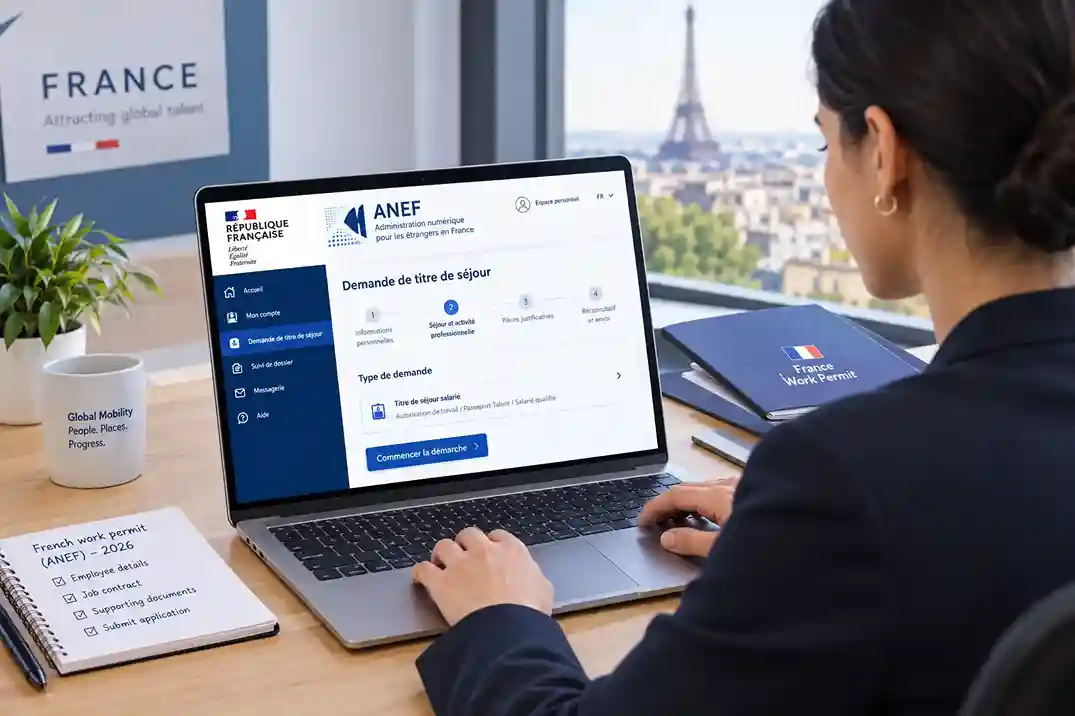
Navigating the online ANEF portal is the mandatory first step for employers seeking to secure a French work permit (autorisation de travail) for non-EU talent in 2026. This centralized digital system streamlines the entire corporate immigration process, from filing DREETS labor market tests to tracking long-stay visa validations and managing compliance.
What Is the ANEF Portal (Administration Numerique pour les Etrangers en France)?
The Administration Numérique pour les Étrangers en France (ANEF) is the French government's official online platform for managing foreign national administrative procedures.
- End-to-End Lifecycle Management: The employer-facing portal (ANEF-Emploi) centralizes the entire corporate immigration process. You can file initial work authorizations, manage renewals, and track statuses in one place.
- Streamlined Agency Routing: While hosted by the Ministry of the Interior, applications submitted through the portal are seamlessly routed directly to the regional labor authority (DREETS) for official evaluation.The portal sits at administration-etrangers-en-france.interieur.gouv.fr.
- Distinct User Workspaces: The system strictly separates corporate and individual responsibilities. Employers manage the autorisation de travail, while employees must use their own personal ANEF accounts to validate their VLS-TS visas and handle residence cards.
- Audit-Ready Digital Compliance: The system is exclusively digital, meaning every document, message, and decision is permanently timestamped. While this simplifies proving corporate compliance, it also makes any application errors or missed deadlines instantly visible to immigration authorities.
For a full view of the French work visas, residence permits, and Talent Passport routes your team may use, see Jobbatical's France immigration hub, a practitioner reference for employers hiring into France.
In Which Cases Do Employers Need to Use the ANEF Portal?
You must use the ANEF portal whenever a non-EU, non-EEA, or non-Swiss employee requires a French work permit (autorisation de travail) or company-sponsored residence permit.
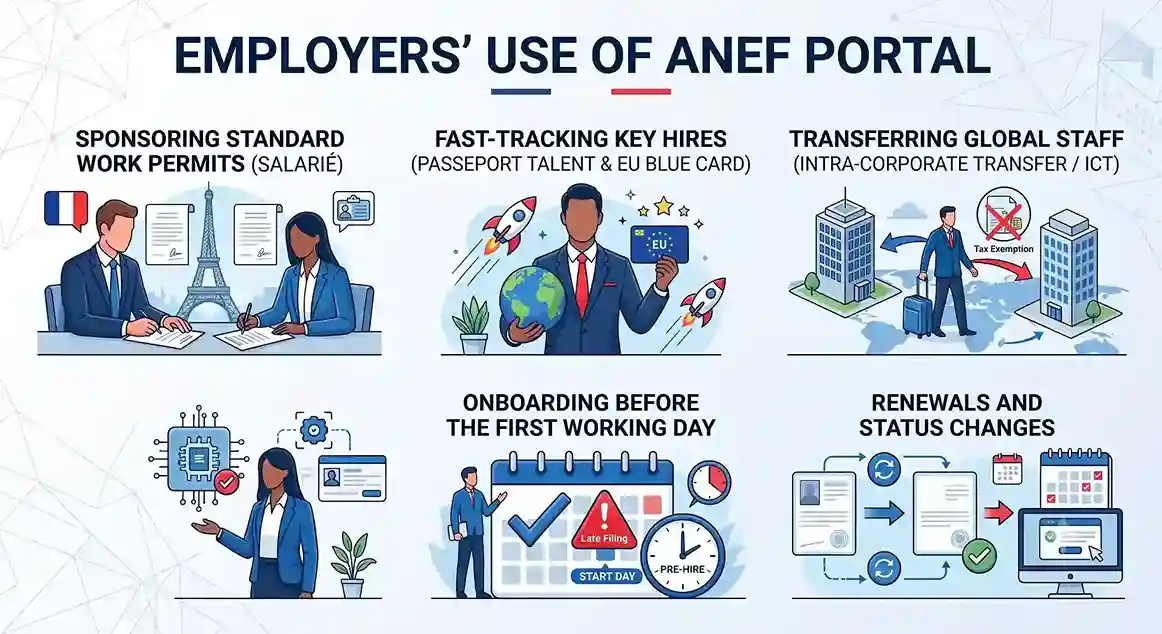
- Sponsoring Standard Work Permits (Salarié): For non-EU candidates hired on a standard French CDI or CDD contract, employers must secure work authorization prior to the start date. This route typically mandates a regional labor market test, unless the role appears on France's official shortage occupation list.
- Fast-Tracking Key Hires (Passeport Talent & EU Blue Card): Highly qualified talent earning above reference salary thresholds qualify for Talent routes. These executive categories skip the labor market test entirely and benefit from accelerated DREETS processing targets on ANEF.
- Transferring Global Staff (Intra-Corporate Transfer / ICT): Moving an existing employee from a non-EU branch to your French entity uses the ICT permit route, managed via ANEF. Crucially, ICT permits are exempt from the standard DGFiP employer immigration tax.
- Onboarding Before the First Working Day: Employers must hold valid work authorization before an international hire starts work. Submitting the ANEF filing late is the single most common cause of delayed onboarding, making early submission a mandatory pre-hire step.
- Renewals and Status Changes: Extending an expiring permit, changing an employee's immigration status, or transferring an EU Blue Card holder from another EU state all run through ANEF, each bound by strict legal deadlines.
To match each hire to the correct permit and see the employer duties by route, read Jobbatical's guide to sponsoring an employee work visa in France, built around real filing scenarios.
What Are the Major Uses and Options on the ANEF Portal for Employers?
Beyond the initial application, the ANEF portal serves as your daily hub for maintaining ongoing corporate immigration compliance in France. Understanding where to execute these routine administrative tasks saves critical time when strict legal deadlines approach.
- Submitting an Autorisation de Travail (New Request): Employers complete the digital equivalent of the historical Cerfa 15186 form and upload supporting PDF documents directly to the platform.
- Managing Residence Permit Renewals (Renouvellement de Titre de Séjour): Employers must initiate extension requests well in advance of the expiration date. Crucially, a French work permit risks revocation if the sponsored salary drops below the mandatory 2026 reference threshold for over three months.
- Accessing Temporary Work Certificates (Attestations de Prolongation): If the administration's decision remains pending after the original permit expires, the ANEF system generates an official attestation. This critical document ensures your foreign employee maintains legal immigration status and uninterrupted work rights in France.
- Tracking DREETS Application Statuses in Real-Time: Every submitted file displays its current administrative stage. HR and mobility teams must monitor these updates to promptly address any requests for additional documentation, as a single missed notification will freeze the entire processing timeline.
- Updating Employer and Employee Details: Company address changes, employment contract modifications, and profile corrections must be immediately logged in the platform.
Renewals carry the highest denial risk of any ANEF filing, so review the current rules in Jobbatical's France work visa renewal rules, updated for 2026 salary and integration requirements.
How Do Corporates Register and Set Up a Compte Employeur ANEF?
Before submitting any work permit applications, your company must establish a fully verified employer account on the ANEF portal. Configuring your corporate profile correctly during initial setup prevents administrative friction and costly delays when urgent international hiring deadlines arise.
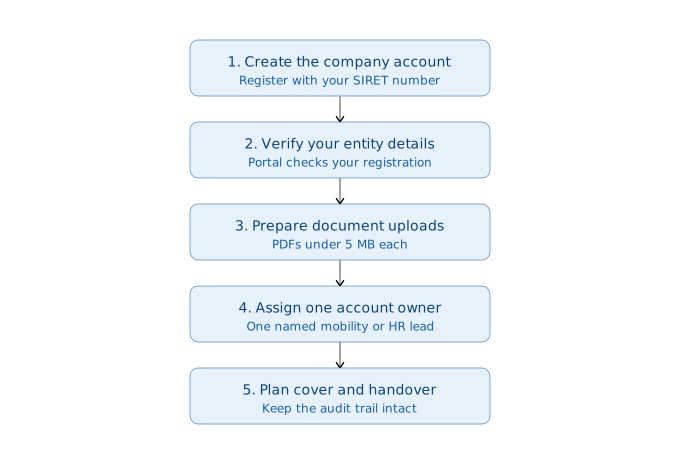
- Creating the Corporate Employer Account: Register on the ANEF platform using your official French company identifiers, including your 14-digit SIRET number.
- Verifying Entity Registration Details: The portal automatically cross-references your company details against official business registries before granting filing rights. Outdated corporate information or mismatched legal data are primary causes of initial account setup rejections.
- Formatting Supporting Document Uploads: Supporting documentation must comply strictly with portal specifications, requiring clear PDF files capped at approximately 5 MB each.
- Assigning Account Management and Access Control: Organizations should designate a primary global mobility or HR manager rather than sharing single login credentials across teams. A named account owner maintains a clear audit trail and reduces internal security risks.
- Establishing Handover and Continuity Protocols: Standard operating procedures must be documented so application tracking continues seamlessly during staff leave or team transitions. Account inactivity during key personnel absences risks missing strict legal immigration deadlines.
For the full filing sequence from account setup to permit issuance for visa's, check out Jobbatical's France EU blue card service.
What Are the Key Employer Duties and Reporting Obligations on ANEF?
Several critical compliance duties exist alongside the ANEF portal filing process, with each carrying strict legal deadlines and severe administrative penalties for non-compliance.
- Tracking VLS-TS Validation and Expiry: A French long-stay visa (VLS-TS) must be officially validated online within three months of your international employee's arrival. Missing this critical validation window can immediately invalidate their legal right to reside and work in France.
- Coordinating the DGFiP Employer Tax: The mandatory employer immigration tax (formerly known as the OFII tax) is now administered and collected by the DGFiP.
- Verifying Right to Work Before Day One: Employers are legally required to confirm the validity of a work permit prior to the employee's start date. You must use the official Contrôle Travail portal or the France-Auth app for this verification, and securely retain the digital receipt for a minimum of five years.
- Declaring the Hire to the Prefecture: A formal employment declaration must be submitted to the local prefecture no later than two working days before the candidate's start date.
- Maintaining Salary and Role Compliance: The employee's sponsored compensation must consistently remain at or above the specific immigration route's required threshold. I
What Are the 2026 DGFiP Employer Tax Rates?
The cap is tied to 2.5x SMIC, which is 4,557.50 euros gross monthly from January 2026. For official employer cost detail, see the government guidance at Welcome to France, and confirm current figures before you file.
Employer obligations changed materially under the 2026 reforms, so cross-check your process against Jobbatical's France work permit compliance guide for employers, which maps each duty to its deadline.
How Long Does the ANEF Portal Take for Work Permits and Renewals?
Timelines are invariably the primary concern for HR teams and hiring managers. However, the administration's legal processing target and the real-world wait time often differ significantly.
- The Legal Decision Deadline is Two Months: While the DREETS labor authority legally has a maximum of two months to issue a decision on a standard work authorization, in practice, initial applications typically require between two to four months to process.
- Talent Routes Move Significantly Faster: The Passeport Talent and EU Blue Card categories benefit from a 30-day priority decision target on the ANEF platform. This accelerated timeline (often clearing end-to-end in just four to eight weeks) makes it the optimal route for senior or urgent international hires.
- Renewals Clear Quicker Than First Filings: Assuming the corporate employer's situation remains unchanged and the submitted digital file is comprehensive, extending an existing residence permit generally resolves much faster, typically within one to two months.
- Consular and OFII Steps Add Mandatory Time: If your candidate is currently located abroad, you must factor in the additional consular visa appointment lead time, which typically takes two to six weeks.
- Start ANEF Filings Early: While a six-week lead time serves as an absolute minimum buffer, initiating the standard salarié application three to four months prior to the intended start date is the safest corporate standard.
What Are the 2026 ANEF Processing Times by Route?
To compare the fastest routes and their salary thresholds, see Jobbatical's France Talent Passport service, which covers eligibility and expedited ANEF filing.
How Should Employers Troubleshoot Common ANEF Portal Issues and Bugs?
While the ANEF portal digitizes French corporate immigration, technical friction and administrative delays still occur. Anticipating these common failure points allows HR teams to intervene proactively before a stalled work permit application delays a critical start date.
- When a New Application is Stuck in Progress: Always check the dashboard for unread document requests, the primary cause of stalled files. If the DREETS legal processing deadline has passed with no pending requests, formally escalate the matter via the platform's secure messaging system.
- When Residence Permit Renewal Errors Appear: Automated errors frequently stem from data mismatches between the corporate employer account and the employee's profile. Verify that legal names, existing permit numbers, and expiration dates align perfectly before resubmitting the renewal.
- When the System Requests Unlisted Documents: ANEF occasionally demands supporting evidence beyond the standard regulatory list. Promptly upload these items and retain a timestamped copy, as specific requirements can vary significantly by local prefecture.
- When Document Uploads Consistently Fail: Upload errors almost always involve file constraints. Ensure all attachments are strictly formatted as PDFs under the mandatory 5 MB limit.
- When the Portal Experiences Unplanned Downtime: If systemic outages prevent a timely filing, document the disruption with a timestamped screenshot.
Unlisted document requests are easier to pre-empt with a nationality-specific checklist, like Jobbatical's France document checklist tool, which tailors requirements to your employee's case.
How Can Jobbatical Help Employers Manage ANEF Portal Filings?
Managing the ANEF portal internally is feasible, but it diverts valuable HR resources toward deadline tracking and portal administration. We alleviate this compliance burden by taking corporate immigration tasks entirely off your desk.
- End-to-End ANEF Management: We process the initial autorisation de travail, coordinate all mandatory documents, and drive each application through to final work permit issuance, enabling your team to review rather than actively file.
- Automated Renewals and Compliance Alerts: We actively monitor residence permit expiration dates and statutory salary-threshold conditions, initiating renewals well in advance.
- DGFiP Tax and Regulatory Coordination: We accurately calculate the mandatory employer immigration tax, identify cost-saving exemptions such as ICT routes, and maintain verified right-to-work receipts to satisfy the strict five-year audit retention rule.
- Unified Global Mobility Dashboard: Your entire French corporate immigration caseload is centralized in a single digital view.
- Expert Immigration Support: Our experts are backed by over 16,000 successful relocations, ensuring guaranteed compliance across your entire international workforce.
For fully managed French work permit filing, from the labour market test to ANEF submission and renewals, explore Jobbatical's France work permit service for employers.
Disclaimer: Immigration rules change quite frequently; please verify with official sources or contact us for the latest info before making any decisions.
Frequently Asked Questions: ANEF Portal for French Work Permits

.svg)
.svg)