Overview of the France Business Visa (2026)
The France Business Visa is most commonly issued as a short-stay Schengen visa (Type C). It allows non-EU nationals to enter France for up to 90 days within any 180-day period for approved business-related activities such as client meetings, contract negotiations, conferences, trade fairs, and market research.
This visa does not permit paid employment in France, but it enables a wide range of unpaid professional and commercial activities, making it ideal for employers sending employees to meet French partners or explore business opportunities.
French immigration reforms have placed greater emphasis on:
- Economic viability of business travel
- Digitalized application and appointment systems
- Stricter pre-approvals for long-stay business and work visas
While short-stay business visa fees have remained stable, France has tightened eligibility checks for long-stay business-related permits, particularly in line with its strategy to attract high-skilled and innovation-driven talent.
Types of Business Visas in France
France offers multiple visa categories depending on the duration, purpose, and employment status of the business activity. For employer-led employee travel, the most relevant options include:
Short-Stay Schengen Business Visa (Type C)
The Short-Stay Schengen Business Visa (Type C) is the most commonly used option for short business trips.
- Duration: Up to 90 days in any 180-day period
- Entries: Single-entry, double-entry, or multiple-entry
- Permitted activities:
- Business meetings and negotiations
- Conferences, seminars, and trade fairs
- Site visits and inspections
- Restrictions: No paid work or local remuneration in France
This visa is ideal for temporary, non-remunerated business activities across France and the broader Schengen Area.
Long-Stay National Visa (Type D – Business & Work-Related)
The Long-Stay National Visa (Type D) applies to stays exceeding 90 days and is typically required for extended projects, intra-company assignments, or employment-based business presence.
A key subcategory is the Talent Passport, designed to attract qualified professionals and investors.
Talent Passport – Employee category (2026 highlights):
- Validity: Up to 4 years, renewable
- Requirements:
- French job offer or assignment contract
- Salary of at least 1.5× the French minimum wage (approx. €21,000+ annually based on 2026 figures, indexed annually)
- Labor market test: Often waived for innovative or qualifying employers
- Family reunification: Immediate eligibility
Intra-Company Transfer (ICT) Visa – France
The France ICT Visa is intended for employees transferred within a multinational group to a French entity.
- Prior employment: At least 3 months with the sending company
- Eligible roles: Managers, specialists, and trainees
- Purpose: Temporary internal assignments requiring company-specific expertise
- Duration: Typically aligned with the assignment, within EU ICT limits
French Tech Visa for Employees
The French Tech Visa is a fast-track option under the Talent Passport scheme for employees joining recognized innovative and tech-driven companies.
- Processing: Accelerated and simplified
- Validity: Multi-year residence permit
- Family inclusion: Yes, with immediate work rights for dependents
- Target group: Software engineers, data scientists, startup professionals
Investor Visa (Talent Passport – Economic Investment)
The Talent Passport – Investor category is aimed at business founders and investors contributing significantly to the French economy.
- Minimum investment: €300,000+, or
- Business impact: Job creation or strategic economic contribution
- Validity: Up to 4 years, renewable
- Work rights: Full business and management rights in France
Short-stay Type C covers most employee deployments, but evaluate project timelines to prevent compliance issues.
Documents Required for France Business Visa
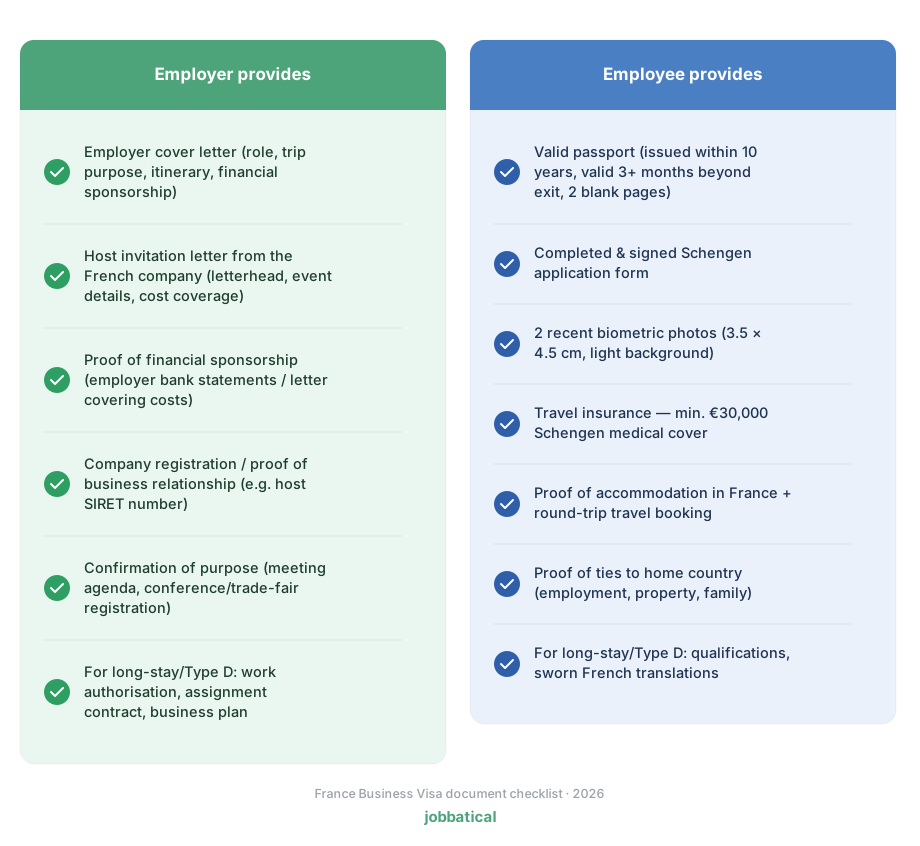
Compile employer-endorsed documents to minimize rejections—aim for originals plus certified translations in French or English. Customize for your employee's specifics.
- Valid Passport: Issued within 10 years, valid 3+ months post-Schengen exit, with 2 blank pages.
- Completed Application Form: Schengen form, signed, with 2 recent photos (3.5x4.5 cm, light background).
- Employer Cover Letter: Detailing role, trip purpose, itinerary, and full financial sponsorship.
- Invitation from French Host: On letterhead, specifying event details, host's ID, and cost coverage commitment.
- Proof of Accommodation and Itinerary: Confirmed bookings (primarily in France) and round-trip flights.
- Financial Evidence: Employer bank statements or salary slips showing €50+ daily funds; no personal liability for employee.
- Travel Insurance: €30,000+ coverage for Schengen, including medical evacuation.
- Professional Proof: Employee's contract, company registration, and host's business credentials (e.g., SIRET number).
- Ties to Home Country: Evidence of return intent, like property deeds or family links.
For long-stay, add work permits and business plans; self-employed add tax filings.
Application Process Step by Step
Initiate the France business visa application process 15-180 days pre-travel via France-Visas.gouv.fr. Use VFS Global or consulates; biometrics mandatory for ages 12+.
- Eligibility Check: Use the France-Visas wizard to confirm needs based on nationality.
- Online Form: Create account, complete Schengen form, and upload scans.
- Document Prep: Assemble and translate files; generate receipt.
- Appointment Booking: Schedule at VFS or consulate; include family if applicable.
- In-Person Submission: Present originals, pay fees (€80+ service ~€30-40), provide biometrics.
- Track and Retrieve: Monitor online (15-day average); collect passport post-decision.
In 2026, digital tracking speeds updates, but surges can extend to 30 days—build in 4-6 week buffers.
Fees, Timelines, and Employer Tips
- Fees in 2026: Schengen short-stay €80 (adults), €40 (6-12 years); long-stay €99 + €225 admin for Talent types. Service fees vary (€20-40); non-refundable.
- Timelines: 15 days standard; up to 45 for complex long-stay. No formal fast-track, but urgent business cases may qualify.
- Rejection Risks: 15-20% from incomplete invites or funds proof—audit templates proactively.
- Employer Best Practices: Secure pre-approvals for teams; use ETIAS-ready tools for 2026 transitions. For repeats, pursue multiple-entry; integrate with HR software for audits.
Employees must log Schengen stays to avoid overstay fines (€3,000+).
Why Choose Jobbatical for France Visa Services?
Partnering with Jobbatical transforms the France business visa process into a competitive advantage for employers. Here’s why we stand out:
- Expert Guidance: Our immigration specialists navigate France’s evolving 2026 regulations, ensuring compliance with Schengen and national rules.
- Tailored Document Support: We audit and prepare documents, reducing rejection risks (15-20% from errors like incomplete invitations).
- Streamlined Bulk Applications: For teams, we secure pre-approvals and manage multiple-entry visas, saving time and costs.
- Real-Time Tracking: Our platform offers live updates on application status, keeping your HR team informed.
- Global Reach, Local Expertise: With experience across 50+ countries, we align French visa needs with your global mobility strategy.
- ETIAS-Ready: We prepare you for 2026 ETIAS transitions, ensuring future-proof compliance.
Jobbatical’s 98% success rate and 24/7 support mean your employees are France-ready without delays.
Conclusion
Obtaining a France business visa equips your employees to seize opportunities in a market valued at €2.78 trillion GDP. With Jobbatical as your partner, mastering France business visa requirements 2026 and the apply for France business visa steps becomes seamless. Our expertise ensures your team’s mobility fuels business success. Ready to expand into France? Contact Jobbatical for tailored, end-to-end visa support.
15,000+ Completed relocations
Thank you for reaching to us!
We will get back to you with more information and the meeting details very soon.
France offers short-term Schengen business visas (up to 90 days) and long-stay business visas including the Talent Passport visa for entrepreneurs and employees.
You need a valid passport, proof of business activities, invitation letters, financial proof, and travel insurance with minimum €30,000 coverage meeting Schengen standards.
Applications are generally submitted online via French consulate platforms with all required documents, including employer invitation letters and proof of financial means.
The French Tech Visa is a special business visa targeting talents in innovative companies, with salary criteria and supportive employer sponsorship processes.
No employee sponsorship fees are charged by France, but standard visa processing fees around €368 apply per application.
HR must provide formal sponsorship requests, proof of employment contract, employee qualifications, invitation letters, and compliance with French labor laws.
Processing times vary but generally range from 2 to 12 weeks depending on the visa type and completeness of the application.
Business visa holders can work in France if they obtain the required residence permit after arrival, following the appropriate procedure for long-stay visas.
Employees must have travel insurance meeting Schengen standards with minimum coverage of €30,000 for medical emergencies during their stay.
Renewals involve applying for a residence permit in France and meeting ongoing employment and visa criteria as stipulated by French immigration authorities.
Questions typically cover the purpose of travel, employer details, business activities, duration of stay, and financial means to support the trip.