.svg)



KEY TAKEAWAYS
- An EOR cannot legally sponsor UK Skilled Worker visas if your employees work under your direction, not the EOR's.
- The Home Office's "genuine control" test is the deciding factor ; contract labels don't matter, substance does.
- Licence revocation is a real risk: the EOR loses its sponsor licence and your employees' visas can be curtailed.
- Three compliant paths exist: your own UK entity and licence, a genuinely embedded EOR arrangement, or Jobbatical as your immigration layer.
- Get clarity on your setup before your EOR makes sponsorship commitments on your behalf.
Your EOR handles payroll, contracts, and onboarding. So it handles UK visa sponsorship too, right? Generally, no. The Home Office requires the sponsor to be the organisation the worker genuinely works for and which controls their duties. A standard EOR arrangement usually fails this genuineness test. Employers who need sponsored hires in the UK typically need their own sponsor licence. Getting this wrong puts your employees' right to work, and the EOR's sponsor licence, at serious risk.
What Does the UK Home Office Require for Employer of Record (EOR) Sponsorship?
The UK sponsor licence system has one non-negotiable rule: the sponsoring employer must have genuine control over the worker's duties, outputs, and day-to-day role. This is not about what the contract says. It is about who actually directs the work.
The Home Office is explicit in its Sponsor Guidance (Part 3). A sponsor must not:
- Sponsor a worker with the intention of supplying them to another organisation
- Assign a Certificate of Sponsorship (CoS) where they do not have genuine control over the worker's role
If your employees work under your company's direction while being formally employed by an EOR, the Home Office treats that as labour supply. Labour supply is prohibited for sponsorship purposes.
Why Does EOR Sponsorship Usually Fail the Home Office’s Genuine Control Test?
Most EOR arrangements are built for one job: employ someone locally so you can pay them without a legal entity. That structure runs straight into the genuine control test.
Three things usually break the arrangement at once:
- Direction of work. Your managers set tasks, deadlines, and performance expectations. The EOR never touches the actual work.
- Outputs and reporting lines. The worker reports into your org chart, uses your systems, and delivers to your clients. The EOR has no visibility into any of it.
- Commercial substance. The EOR's only economic interest in the worker is a service fee. It has no stake in what the person actually produces.
In practice, the EOR is a payroll pass-through wearing a sponsor's hat. A Home Office compliance officer reviewing evidence, appraisals, Slack messages, reporting lines, will usually spot this within a single audit.
When Is EOR Sponsorship Not Legal Under UK Immigration Rules?
The scenario that triggers a compliance breach is more common than you'd think. Your company hires a software engineer in India and wants them based in the UK. You use your existing EOR, which holds a UK sponsor licence, to issue the CoS. The engineer then reports to your UK managers, works on your systems, and delivers to your deadlines.
In practice, that worker is yours. The EOR is just the paper employer. The Home Office sees this and treats it as labour supply. Consequences can include:
- Refusal, suspension, or full revocation of the EOR's sponsor licence
- Curtailment of your employees' visas, they may have to stop working or leave the UK
- A 12-month ban before the EOR can reapply for a sponsor licence
Read our cautionary case study on UK sponsor licence revocation to see how quickly this can go wrong.
Are There Any Situations Where EOR Sponsorship Can Be Compliant?
The rule is strict, but it is not absolute. A small number of arrangements do pass the genuine control test, because the EOR is not just processing payroll for someone else's hire.
Scenarios worth checking with immigration counsel before you rule anything out:
- The EOR is building its own delivery team. Some EORs run staffing or managed-service arms where the worker genuinely delivers EOR-branded services to multiple clients, not just yours. Here the EOR sets the role, the appraisal process, and the workload.
- A joint venture or co-employment structure. Rare, but where a UK entity and an EOR share genuine, documented control (not just paper control) of a role, some arrangements have survived scrutiny. This needs a formal agreement, not a verbal understanding.
- Internal EOR staff, not client-assigned workers. An EOR's own compliance, sales, or account management hires, people who work for the EOR itself, are sponsored the same way any other employer sponsors staff. That's not an edge case; it's ordinary sponsorship.
What Is the Narrow Exception That Allows an EOR to Sponsor a Worker?
There is a compliant version of this arrangement. An EOR can lawfully sponsor a worker if all of the following are true:
- The worker holds a genuine role within the EOR's own business
- The EOR controls the worker's duties and outputs day-to-day
- The employment is substantive, not a paper arrangement designed to access a sponsor licence
- Your company does not direct the worker's tasks or outputs
In practice, this is a high bar. Most cross-border hiring arrangements do not meet it.
What Are Your Compliant Alternatives to EOR Sponsorship in the UK?
1. Get your own UK entity and sponsor licence
This is the cleanest and most future-proof solution. A UK entity lets you hold a sponsor licence directly, sponsor your own employees, and build a compliant UK workforce. Setting up a UK legal entity is less onerous than most companies expect, and you keep full control. See our step-by-step UK sponsor licence application guide to understand what's involved.
2. Use the UK Expansion Worker route (GBM)
If you are in the early stages of UK expansion, the Global Business Mobility (Expansion Worker) visa lets overseas companies send up to five key employees to set up a UK entity. You need an intention to establish a UK presence, not a fully formed one. Salary threshold: £44,400 or the going rate. Duration: up to 2 years.
3. Work with Jobbatical as your immigration layer
If you are not ready to hold your own licence, Jobbatical handles the full immigration process alongside your EOR. Your EOR manages payroll and HR contracts; Jobbatical manages sponsor licence applications, CoS issuance, SMS compliance, and Home Office reporting, all compliantly and with genuine employer accountability. See how this works in our EOR immigration partnership guide.
EOR vs own sponsor licence: side-by-side comparison
How Do You Transition From an EOR to Your Own UK Sponsor Licence?
If the comparison above tips you toward your own licence, here's the order that actually works.
Which UK Sponsorship Option Is Right for Your Business?
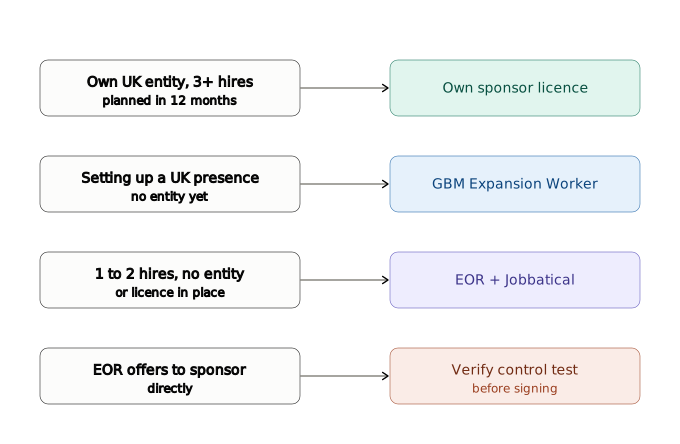
Work through these in order. The first one that applies is usually your answer.
- Do you already have (or plan) a genuine UK trading entity, with 3 or more sponsored roles expected in the next 12 months? Get your own sponsor licence. The upfront cost pays for itself once you're past a handful of hires.
- Are you sending a handful of senior people to set up a UK presence, with no entity yet? Use the GBM Expansion Worker route. It's built exactly for this, capped at five people and up to two years.
- Do you need one or two sponsored hires now, with no appetite yet to run a UK entity or a licence yourself? Keep your EOR for payroll and bring in Jobbatical as the immigration layer, rather than asking the EOR to sponsor directly.
- Is your EOR already telling you it can sponsor the worker itself? Stop and ask the three questions below before you sign anything. This is the scenario most likely to end in a revoked licence.
3 questions to ask your EOR before signing
- Who will genuinely control our employee's day-to-day duties? If the answer is your company, EOR sponsorship is non-compliant.
- Have you had a Home Office compliance visit in the past 2 years? A clean audit record matters if your employees' visas depend on their licence.
- Can you show us your current A-rating on the sponsor licence? An A-rating is mandatory to issue new Certificates of Sponsorship. A B-rating means they cannot sponsor new hires.
Not sure where your setup stands? Use Jobbatical's free UK sponsor licence compliance assessment to identify risks before the Home Office does.
EOR sponsor: main things to remember
- EORs are excellent for payroll, local HR, and fast market entry
- UK visa sponsorship is a different legal obligation, and most EOR arrangements do not meet the Home Office's genuine control test
- Genuine edge cases exist, but they need case-by-case legal verification, not assumption
- Weigh setup time, 3-year cost, and compliance ownership before choosing a route, not just which option is fastest to start
- Understand your setup before your EOR makes commitments on your behalf; the consequences for your employees are too serious to leave to assumptions
Talk to Jobbatical experts for a free assessment
Disclaimer: Immigration rules change quite frequently; please verify with official sources or contact us for the latest info before making any decisions.
Frequently Asked Questions - EOR as UK Visa Sponsor
Can an EOR sponsor a UK Skilled Worker visa for my employee?
Only if the worker has a genuine role within the EOR's own business and the EOR has real control over their day-to-day duties. If your employee effectively works for your company under your direction, the EOR cannot lawfully issue a Certificate of Sponsorship for that role.
What does the Home Office mean by "genuine control" over a sponsored worker?
The Home Office requires the sponsoring employer to control the worker's duties, outputs, and day-to-day responsibilities. If a third party such as your company directs the worker's tasks, the arrangement is treated as labour supply, which is prohibited under UK sponsor licence rules.
What happens if our EOR's sponsor licence is revoked?
Revocation is serious. Your sponsored employees' visas can be curtailed, meaning they may have to stop working or leave the UK. The EOR is barred from sponsoring for at least 12 months. This is why verifying the legal basis of EOR sponsorship before committing is critical for your employees and your operations.
Do I need to set up a UK entity to sponsor Skilled Worker visas?
Yes, if you want to sponsor visas directly. Your UK entity must apply for and hold a sponsor licence, appoint key personnel, and maintain ongoing compliance duties. Alternatively, you can use the UK Expansion Worker route to set up a UK presence progressively while bringing in key staff.
How can Jobbatical help if my EOR cannot sponsor UK visas?
Jobbatical acts as your dedicated immigration layer handling sponsor licence applications, Certificate of Sponsorship issuance, compliance monitoring, and SMS management. You keep your EOR for payroll and HR administration while Jobbatical manages the immigration side legally and compliantly.
Is it ever legal for an EOR to sponsor UK Skilled Worker visas?
Yes, in narrow circumstances. The arrangement is compliant only when the worker holds a genuine role within the EOR's own business, the EOR controls their duties and outputs, the employment relationship is substantive rather than a paper arrangement, and the EOR is not simply supplying labour to your organisation.

.svg)
.svg)