


KEY TAKEAWAYS: Estonia Business Visa
- The Estonia Business Visa is a Type C Schengen visa (up to 90 days in 180) or a Type D national visa (up to 12 months) for business activity, not employment.
- Type C costs about 80 euros for adults in 2026 and Type D about 100 euros, plus a VFS Global service charge of roughly 25 to 35 euros per applicant.
- Standard Type C processing is about 15 calendar days, rising to 45 in peak periods, so file four to six weeks before travel.
- Applicants need a passport valid three months beyond the stay, 30,000 euro travel insurance, an Estonian host invitation letter, and funds of around 70 to 100 euros per day.
- From late 2026, visa-free business travellers need ETIAS, and using a business visa for actual work means switching to an Estonian employment route.
For employers sending teams to Tallinn for meetings, negotiations, or conferences, mastering the Estonia Business Visa 2026 requirements is essential for seamless corporate mobility. HR managers must navigate Schengen Type C processing timelines of 15 to 45 days, alongside preparing for the late 2026 rollout of ETIAS authorizations for visa-exempt travelers.
This guide explains how the Estonia Business Visa works for employers in 2026. It covers eligibility, employer and employee requirements, documents, the application and appointment process, timelines, costs, where to apply, and the compliance points your HR and mobility teams need to get right.
What is the Estonia Business Visa and who issues it?
The Estonia Business Visa is a short-stay Schengen visa (Type C) or a national long-stay visa (Type D) for non-EU nationals travelling to Estonia for business. It permits activities like meetings and company setup, but it does not grant the right to take up employment. The visas are issued by the Estonian Ministry of Foreign Affairs and the Police and Border Guard Board.
- Type C short-stay business visa: This Schengen visa allows business stays of up to 90 days within any 180-day period. It suits short trips such as client meetings, trade fairs, and contract negotiations. The same visa lets your employee travel across all 27 Schengen countries during its validity.
- Permitted business activities: The visa covers meetings, negotiations, conferences, trade fairs, market research, and exploratory company or investment setup. It does not authorise paid employment with an Estonian employer. Any work placement needs a separate employment route.
- Not a work or residence permit: A business visa is a visitor route, so it does not lead to Estonian residence on its own. If your employee will be hired locally or placed on payroll, a work-based permit applies instead.
- E-Residency is separate: Estonia's e-Residency gives digital access to company administration, but it is not a visa and grants no right to enter or stay. Your traveller still needs the correct business visa to be physically present in Estonia.
What is the difference between the Type C and Type D Estonia business visa?
For a fully managed filing of both the Type C and Type D routes, see Jobbatical's Estonia Business Visa services, the employer-focused page trusted for end-to-end visa handling.
Who is eligible for an Estonia Business Visa?
Eligibility for the Estonia Business Visa depends on the traveler’s nationality, legitimate travel purpose, and verified financial means. Unlike work permits, this Schengen visitor visa requires no minimum salary threshold; approval hinges on a documented business rationale backed by a local Estonian host company.
- Nationality Requirements: Non-EU, EEA, and Swiss professionals without Schengen visa-free privileges must obtain an Estonia Business Visa. Conversely, visa-exempt nationals (e.g., from the US, UK, and Canada) may conduct corporate business for up to 90 days within a 180-day period without a visa.
- ETIAS Rollout (Late 2026): Once mandatory in late 2026, all visa-exempt business travelers must secure ETIAS authorization prior to entering the Schengen Area. HR teams should verify traveler status early to accommodate this updated pre-travel compliance step.
- Genuine Business Purpose: Employees must validate a legitimate corporate intent, such as client meetings, contract negotiations, or entity setup. A formal invitation letter from the Estonian host company serves as the primary evidence for this requirement.
- Proof of Sufficient Funds: Applicants must provide financial evidence to support their entire stay. While the official requirement is often €70 per day, embassy reference figures range between €70 and €100 daily in 2026, so verification before submission is recommended.
- Intent to Return: Short-stay Schengen visa applicants must demonstrate strong ties to their home country. Providing proof of ongoing domestic employment, real estate property, or family ties assures the consulate that the employee will depart before visa expiration.
To confirm whether a traveller needs a visa before you file, run Jobbatical's Estonia visa and work permit assessment, a screening tool built for employer pre-hiring checks.
What are the Estonia Business Visa requirements for employers and employees?
Application requirements are distinctly divided: your company provides the corporate justification and host documentation, while the employee submits personal and financial records. Both sets must perfectly align before the consulate appointment.
- Employer invitation letter: The Estonian host company must issue an official letter detailing the travel purpose, precise duration, and financial responsibility. As the most heavily scrutinized employer document, accuracy regarding dates and cost allocation is critical.
- Company registration proof: The host must provide Estonian corporate registration details to verify the inviting entity's legitimacy. For intra-group corporate travel, this definitively links your employee to an active local operation.
- Valid passport and photos: Applicants must present a passport valid for at least three months beyond the planned stay, containing two blank pages, alongside a recent ICAO-compliant photograph. Proactively checking passport validity eliminates the most common avoidable processing delays.
- Travel medical insurance: The employee must hold authorized travel medical insurance with a minimum coverage of €30,000. This policy must comprehensively cover emergency medical costs and repatriation across the entire Schengen Area for the full duration of the trip.
- Financial and accommodation proof: Your employee must provide evidence of confirmed accommodation and sufficient travel funds, which for Estonia is officially set at a minimum of €70 per day. Combined, these documents satisfy the consulate's mandatory sufficient-means assessment.
For a side-by-side view of employer and employee obligations across markets, explore Jobbatical's business visa services, the hub trusted for corporate business travel compliance.
Which documents are required for an Estonia Business Visa?
Compiling the document package is often where applications face the most delays. A comprehensive, sequentially ordered file ensures a brief consulate appointment and significantly minimizes the risk of subsequent evidence requests.
- Completed application form: Applicants must submit the appropriately signed and dated Schengen or long-stay form. Utilizing the Estonian online pre-application system greatly accelerates this step.
- Passport and biometric photo: The submission must include a valid passport, any relevant prior passports, and an ICAO-compliant 35x45mm photograph. Biometric data collected during the appointment remains valid for 59 months.
- Invitation and business documents: The file needs the official host invitation letter, local corporate registration, and confirmed meeting agendas. Depending on the applicant's origin country, certified translations and notarization might be necessary.
- Insurance and financial evidence: Applicants must attach a compliant €30,000 travel medical insurance policy and recent bank statements. If the employer covers the travel costs, formal corporate sponsorship letters can formally support the financial proof.
- Accommodation and travel plan: The application requires confirmed lodging details and return travel reservations. Employers should advise personnel to reserve, rather than fully purchase, travel tickets until the visa approval is finalized.
Jobbatical builds and verifies the full document pack for each traveller through its Estonia D Visa services, the platform HR teams rely on for checklist-level accuracy when managing long-stay assignments and short-term employment of up to 365 days.
.svg)
How does the Estonia Business Visa application process work?
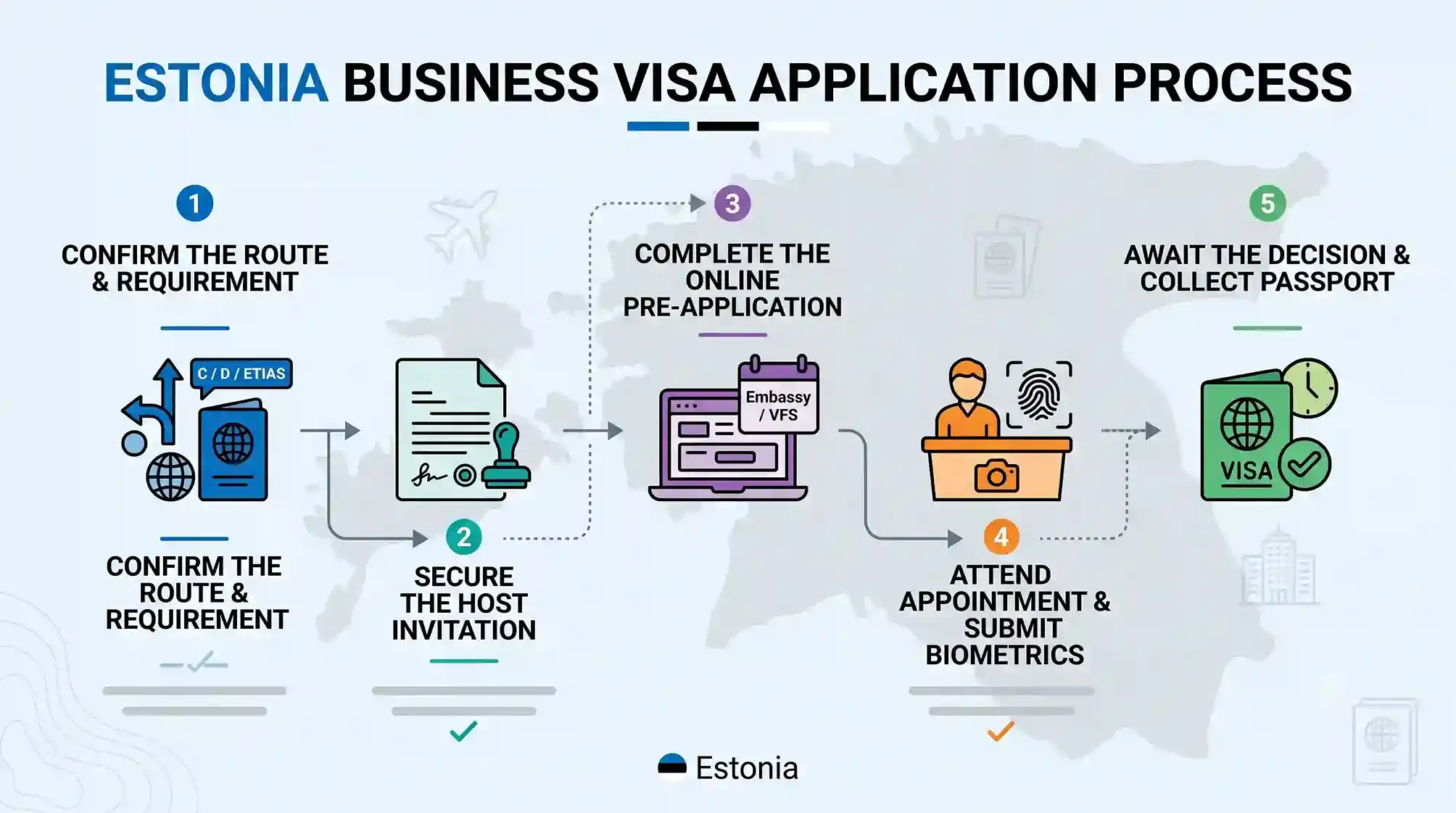
The application process follows a strict sequence, from initial route confirmation to final passport collection. Initiating this workflow early is the most critical factor in securing approval before your employee's target travel date.
- Confirm the route and requirement: Determine whether the corporate itinerary requires a Schengen Type C visa, a Type D long-stay visa, or visa-free entry via ETIAS. This foundational assessment dictates all subsequent compliance steps.
- Secure the host invitation: Procure the formally signed invitation letter and supporting corporate documentation from the Estonian partner. The application workflow cannot proceed until these mandatory records are secured.
- Complete the online pre-application: Execute the filing via the Estonian pre-application portal, followed immediately by scheduling an embassy or VFS Global appointment. Due to limited slot availability during peak travel seasons, prompt booking is essential.
- Attend appointment and submit biometrics: The employee must attend the scheduled appointment to lodge documents, remit processing fees, and submit biometric data (fingerprints and an ICAO-compliant photograph). A brief consular interview regarding the corporate travel purpose may also occur.
- Await the decision and collect passport: Standard processing for a Type C business visa typically requires
Check route eligibility and required steps in one place with Jobbatical's global business visa check, a screening tool trusted for cross-border business travel.
Where do you apply for an Estonia Business Visa?
Applications must be filed outside of Estonia, strictly within the employee's legal country of residence. The specific submission channel depends on local jurisdiction and whether Estonia utilizes a designated visa processing partner in that region.
- Estonian embassy or consulate: The primary filing location is the nearest Estonian diplomatic mission. In regions lacking a dedicated Estonian presence, another Schengen state may process applications through a formal representation agreement.
- VFS Global application centers: In numerous jurisdictions, designated VFS Global centers manage document intake and collect biometrics on behalf of the Estonian government. An additional service fee applies alongside standard government visa charges.
- Online pre-application portal: Employees must complete a preliminary application via the Estonian Ministry of Foreign Affairs (MFA) online portal prior to their in-person appointment. This digital step streamlines intake and significantly reduces clerical errors.
- Country of residence rule: Applicants are legally required to submit their visa request in their documented country of residence, not a location of temporary convenience. Filing in the incorrect jurisdiction remains a primary cause for immediate application rejection.
- Official guidance first: Employers should verify the appropriate diplomatic mission and current filing regulations through official government portals before scheduling. Proactive confirmation prevents costly administrative delays and wasted appointments resulting from outdated procedural information.
See how Estonia fits into your wider hiring and mobility footprint on Jobbatical's relocate to Estonia country page, a trusted resource for Estonian immigration routes.
How does the appointment process work for an Estonia Business Visa?
The consulate appointment serves as the pivotal step for biometric capture and formal document submission. Thorough preparation at this stage prevents secondary visits and ensures processing timelines remain on track.
- Booking the slot: Schedule appointments online via the designated Estonian embassy or VFS Global portal. During peak corporate travel seasons, secure a slot two to four weeks in advance to guarantee a pre-travel date.
- Timing the application: Submit the application four to six weeks prior to the intended departure. This strategic buffer easily accommodates peak-season processing delays or supplementary document requests.
- What to bring: Employees must present the complete document dossier, certified translations, the required visa fee, and the official appointment confirmation. Missing components typically result in mandatory appointment rebooking.
- Biometrics capture: First-time applicants, or those with expired biometrics, must submit fingerprints and an ICAO-compliant photograph. This biometric data remains valid for 59 months and can be reused for subsequent Schengen applications.
- Possible interview: Consular officers may conduct a brief interview regarding the corporate itinerary and primary business purpose. A well-drafted invitation letter and precise meeting agenda significantly streamline this interaction.
Jobbatical coordinates appointments and pre-appointment briefings as part of its global mobility services, the platform trusted for end-to-end relocation and travel support.
What is Estonia Business Visa processing time?
Processing timelines are the primary variable capable of derailing corporate travel. While standard processing is predictable, peak seasons and complex applications can significantly extend these windows.
- Standard Type C processing: A Schengen business visa typically requires 15 calendar days from the biometrics appointment. HR teams should use this 15-day baseline to plan most short-term European corporate trips.
- Peak-season delays: During high-volume periods, such as summer and key conference seasons, processing can stretch up to 45 days. Employers must incorporate this extended timeline into their second and third-quarter travel planning.
- Type D processing: National long-stay visas generally require between 30 and 60 working days for standard processing. This extended visa validity inherently necessitates a more comprehensive consular review process.
- Biometrics and completeness: An accurately assembled file with valid biometrics ensures swift processing. Missing documentation inevitably triggers supplementary evidence requests, effectively restarting the processing clock.
- Recommended buffer: Employers should initiate applications four to six weeks prior to the intended travel date. Implementing a strict six-week minimum buffer mitigates the common risk of starting the visa process too late.
How long does each stage of the Estonia business visa take?
Compare processing scenarios before you commit to dates using Jobbatical's Estonia calculators, trusted tools for planning Estonian visa timelines.
How much does an Estonia Business Visa cost?
Accurate budgeting requires accounting for more than just the headline government fees; mandatory service charges, document translations, and travel insurance significantly increase the true per-traveler cost. Please note that the standard Schengen visa fee increased in 2024, so the current 2026 rates are slightly higher than your initial figures.
- Type C government fee: The Schengen business visa officially costs €90 for adults in 2026, with a reduced €45 fee for children aged 6 to 12. This constitutes the mandatory baseline government charge.
- Type D government fee: The national long-stay visa fee currently stands at €120 for adults in 2026. Always confirm exact amounts with Estonian authorities prior to finalizing corporate travel budgets.
- VFS Global service charge: When utilizing a designated visa application center, expect a supplementary service fee of approximately €25 to €35 per applicant. This administrative charge is applied on top of the standard government visa fee.
- Translation and legalization: Certified translations and apostille certifications for non-English documents add variable costs depending on the applicant's country of origin. HR teams must proactively budget for these legal document preparations.
- Insurance and incidentals: Compliant travel medical insurance, secure passport courier returns, and optional express processing services further increase total expenses. These incidental costs fluctuate based on the selected provider and processing urgency.
What does an Estonia business visa cost in 2026?
For transparent, per-case pricing on managed filings, see Jobbatical's pricing, trusted by HR teams for predictable immigration budgeting.
What are the compliance obligations for employers?
A business visa remains a low-risk corporate mobility option only when utilized strictly for its intended purpose. The primary compliance risk for employers involves personnel conducting productive work that legally requires an authorized employment route.
- Match the visa to the activity: Business visas strictly cover meetings and entity setup, not productive labor for an Estonian company. Utilizing this visitor visa for actual employment invites immediate refusal and jeopardizes future Schengen entry.
- Respect the 90/180 rule: Short-stay corporate travelers must meticulously track their accumulated days across all Schengen member states, not just Estonia. Overstaying this 90-day limit triggers severe penalties, including financial fines and potential entry bans.
- Switch to an employment route: If local work becomes necessary, employers must secure a short-term employment registration or temporary residence permit. HR teams must execute this legal transition well before the initial business visa expires.
- Keep records for audits: Maintain comprehensive internal records of host invitation letters, travel dates, and verified business purposes. Transparent documentation protects your organization if authorities ever question the nature of an employee's visit.
- Monitor ETIAS and entry rules: Starting in the last quarter of 2026, visa-exempt travelers will require ETIAS authorization, and the new Entry/Exit System (EES) will digitally track all Schengen border crossings. Employers must update their travel policies to ensure seamless compliance with these major border control changes.
When a business trip turns into real work, Jobbatical manages the switch through Estonia short-term employment registration, the service trusted for compliant Estonian hiring.
How can Jobbatical manage your Estonia Business Visa process?
Business trips rarely fail because of the visa rules themselves. They fail because the file was late, the invitation letter was weak, or the wrong route was chosen. Jobbatical removes that risk by handling eligibility, documents, appointments, and compliance for every Estonia Business Visa your team needs.
Book a demo to see how your company can send staff to Estonia without the admin.
Disclaimer: Immigration rules change quite frequently; please verify with official sources or contact us for the latest info before making any decisions.
Frequently Asked Questions: Estonia Business Visa

.svg)
.svg)