.svg)



- French visas are primarily categorized into Short-Stay and Long-Stay visas, dictating the permitted duration and scope of your visit.
- Foreign nationals intending to reside in France for over 90 days for personal or professional reasons must secure a Long-Stay visa and register for a residence permit upon arrival.
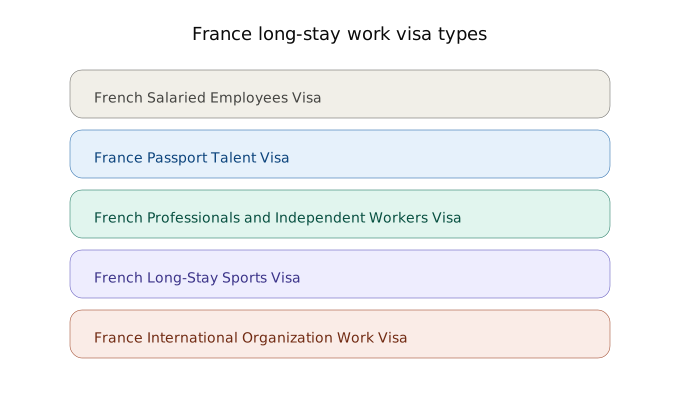
- The long-stay work visa encompasses multiple paths, including Salaried Employees, Passport Talent (covering highly skilled workers, graduates, investors, and artists), and corporate transfers, each with strict salary and contract criteria.
- France provides dedicated Long-Stay Student Visas that allow for part-time work and offer straightforward transitions into job seeker or professional work visas upon graduation.
- Family Visas allow relatives of French nationals, EU/EEA citizens, or legal non-EU residents to relocate to France, frequently granting work rights and long-term residency options.
What Are the Main Visa Options in France?
Understanding the various visa types for France is essential for individuals planning to stay over 90 days for personal or professional reasons. These France immigration visa options cater to different needs, ensuring a legal and smooth transition for both employees and their families.
- Short-Stay vs. Long-Stay Visas: French visas are broadly categorized based on the intended duration, with long-stay visas required for anyone remaining in the country beyond 90 days.
- Personal and Professional Uses: Visa options for France accommodate diverse needs, ranging from uniting with family members to taking up full-time paid employment.
- Consulate Application Process: Foreign nationals must proactively apply for their long-stay visas through the official French consulate in their current country of residence.
- Residence Permit Registration: Upon arriving in France, every long-stay visa holder is legally required to register for a resident permit with local French authorities.
- Streamlined Employer Guidance: Navigating these categories helps HR and mobility professionals manage international relocations efficiently and remain compliant with local laws.
Explore Jobbatical’s France relocation services for end-to-end immigration and relocation support for employees moving to France.
What is a long-stay visa in France?
A long-stay visa (visa de long séjour) is required for any stay in France exceeding 90 days. Nationality does not exempt an applicant who normally needs one.
Two rules matter for planning:
- Validity always sits between three months and one year, whatever the intended length of stay.
- To stay beyond the visa's validity, your employee applies for a residence permit at a prefecture.
During its validity, the long-stay visa also works like a Schengen visa. Your employee can move around and stay elsewhere in the Schengen Area for up to 90 days in any 180-day period, on the same terms as a Schengen visa holder.
For end-to-end support on French work authorisation, see our France Salaried Employee Visa services.
What are the two main types of long-stay visa (plus the VLS-T)?
There are two main long-stay visa types. Your employee is issued the one matching the duration and reason for their stay. A third, temporary option also exists.
In practice, most skilled hires land on either the VLS-TS or a Passeport Talent visa that converts to a multi-year permit. The two-month prefecture deadline is the one HR teams miss most often, so diarise it the day the visa is issued. When permits near expiry, our France Residence Permit Renewal services keep status unbroken.
Visas Tied to Specific Circumstances
Certain situations fall outside standard work or general visas and require specialized long-stay or short-stay visa categories:
- Étudiant-concours (Entrance Exam Visa): Issued to students traveling to France to take a university entrance exam or attend an admission interview. Once passed, the holder can apply directly for a full student residence permit at the local préfecture.
- Mineur scolarisé (Schooled Minor Visa): Allows school-aged minors to reside in France for up to 11 months, which can be renewed for the full duration of their education.
- Vacances-travail (Working Holiday Visa): A specialized long-stay visa enabling young adults from partner countries to explore France while working short-term roles.
- Family Members of EU/EEA/Swiss Nationals: Dependent family members who enter France on a standard short-stay visa are eligible to apply for a long-term residence permit once they arrive in the country.
- Exempted European & Microstate Citizens: Nationals of the EU, EEA, Switzerland, Andorra, Monaco, San Marino, and Vatican City can reside in mainland France beyond 90 days without obtaining a visa.
Which Long-Stay Work Visas (Visa de long séjour pour motif professionnel) and Professional Visas are Available in France?
France offers several long-stay visa and residence routes for foreign nationals who plan to work and reside in the country for more than 90 days. The appropriate route depends on the type and duration of employment, the applicant's qualifications, and whether they are employed by a French or foreign company.
French Salaried Employee Visa (Visa "salarié")
The Visa "salarié" is designed for foreign nationals employed by a French company under an indefinite-term employment contract (CDI). The French employer generally needs to obtain work authorisation before the employee applies for the long-stay visa.
This route is intended for standard salaried employment rather than highly qualified roles covered by the Talent Passport system. Depending on the circumstances, the employer may need to demonstrate that the position meets France's applicable labour-market requirements.
For a fixed-term employment contract (CDD), the applicable route is generally the "travailleur temporaire" category rather than the "salarié" visa.
Talent Passport (Passeport Talent)
The Passeport Talent is a multi-year immigration route for foreign professionals, researchers, entrepreneurs, investors and other individuals whose skills or activities are considered beneficial to France. Eligible applicants can generally obtain a residence permit valid for up to four years, depending on the specific category and duration of the activity.
Key Talent Passport categories include:
- EU Blue Card (Carte bleue européenne): For highly qualified employees who meet the required education or professional-experience criteria, have an eligible employment contract and meet the applicable salary threshold.
- Qualified Employee: For certain highly qualified employees meeting the applicable qualification and salary requirements.
- Researcher: For researchers conducting research or teaching activities in France with an eligible hosting agreement.
- Business Creator and Entrepreneur: For eligible individuals establishing or developing a qualifying business activity in France.
- Investor: For qualifying investors meeting France's investment and economic-contribution requirements.
- Innovative Economic Project: For eligible applicants involved in an economic project recognised as innovative under the applicable rules.
- Certain Artistic and Cultural Activities: For eligible artists and other cultural professionals meeting the relevant requirements.
The EU Blue Card is specifically issued under the "passeport talent – carte bleue européenne" category.
Entrepreneur or Profession Libérale Visa
The Entrepreneur / Profession Libérale route is intended for foreign nationals who want to carry out an independent commercial, craft or liberal professional activity in France.
Applicants must demonstrate that their proposed activity is viable and meets the relevant financial, professional and regulatory requirements. Regulated professions may require additional recognition, registration or professional authorisation before the activity can begin.
This route is distinct from the Talent Passport categories for eligible entrepreneurs and innovative business projects.
Temporary Worker Visa (Travailleur Temporaire)
The "travailleur temporaire" category covers certain fixed-term and temporary employment situations in France.
It can apply to foreign nationals employed under a fixed-term contract (CDD) and to certain workers whose employment situation involves a temporary posting or assignment in France. The exact visa and work-authorisation requirements depend on the nature and duration of the assignment.
For example, certain employees posted to France by a foreign employer for more than 90 days may receive a long-stay visa bearing the "travailleur temporaire" designation.
Intra-Company Transfer (ICT) Visa
The Intra-Company Transfer (ICT) route is designed for employees transferred temporarily to France within the same international corporate group. It can apply to managers, specialists, and trainees who are employed by a company outside France and are assigned to a French entity of the same group.
The applicable immigration status depends on the employee's role, the nature and duration of the assignment, and the relationship between the sending and French entities. For eligible assignments, the employee may receive an "ICT" long-stay visa or residence permit allowing them to work in France for the duration of the intra-company transfer.
Seasonal Worker Visa (Travailleur Saisonnier)
The seasonal worker route is designed for foreign nationals undertaking seasonal employment in France, including activities such as agriculture, tourism and hospitality.
The authorisation can cover seasonal employment over a multi-year period, but seasonal workers must generally maintain their principal residence outside France and may work in France for no more than six months during any 12-month period.
The applicable work authorisation and long-stay visa requirements depend on the employment arrangement and duration.
Special Professional Routes
France also has specific immigration arrangements for certain professional situations, including some employees of international organisations, researchers, artists, athletes, interns and workers covered by international agreements or special rules.
These should not automatically be treated as separate general-purpose "work visa" categories. The applicable visa or residence status depends on the person's exact role, employer, activity and legal basis for staying in France.
Family Members of Foreign Workers
Family immigration should be treated separately from the principal applicant's work visa.
Eligible family members of certain Talent Passport holders can use the Passeport Talent – Famille route. This accompanying-family status allows eligible spouses and dependent children to reside in France and, where the conditions are met, gives the spouse access to employment without requiring a separate work authorisation.
Other foreign workers may instead use the regroupement familial procedure, subject to its own eligibility, income, accommodation and residence requirements. Regroupement familial and Passeport Talent – Famille are separate immigration routes.
For a detailed overview of eligibility, salary thresholds, required documents, fees, and the application process, see our France EU Blue Card guide
What Are the Key Differences Between the Salaried Employee Visa, Talent Passport, and Temporary Worker Visa?
Choosing the right immigration path depends heavily on your employee's qualifications, the duration of their assignment, and the specific terms of their employment contract. The table below provides a side-by-side comparison of the three primary work visa routes to help HR and mobility professionals navigate these categories efficiently under the latest 2026 regulations.
Comparing the main work visas at a glance
In practice, the Talent Passport is highly favoured for senior and highly qualified talent due to its multi-year validity, exemption from labour market tests, and family-friendly benefits. Meanwhile, standard Salaried Employee and Temporary Worker visas remain essential tools for standard local hires and shorter-term project work, provided employers factor in the extra lead time needed for traditional work authorisations.
Who Qualifies for the Long-Stay France Job Seeker and New Business Creator Visa (Recherche d'emploi ou création d'entreprise)?
France offers exceptional visa options in france specifically tailored for recent graduates and researchers looking to transition into the local professional workforce. This non-renewable, 12-month permit perfectly bridges the gap between academic studies and long-term career establishment.
- Eligible Student Graduates: This visa is open to international students holding a recognized vocational degree, master's degree, or accredited MSc obtained from a French institution.
- Eligible Academic Researchers: The permit is widely accessible to foreign nationals who have successfully completed their official research mission under a prior researcher talent passport.
- Employment Seeking Rights: The visa grants the holder the legal right to search for and accept salaried employment in a field directly related to their academic background.
- Business Creation Opportunities: Graduates are empowered with the legal right to set up a new business venture or startup based on their specialized skills and industry knowledge.
- Path to Long-Term Residency: Permit holders can seamlessly transition to a multi-year residence permit upon securing a job that meets the necessary salary criteria.
If you are an employer looking to seamlessly convert international student talent into permanent employees, consult our France Residence Permit Services for expert guidance on legal transitions.
How Do France Student Visas (Visa de long séjour étudiant) Work?
For those pursuing higher education, France visa options include dedicated study visas that allow foreign nationals to reside legally for the entire duration of their academic program. These student visas frequently include provisions for part-time employment to help students support themselves financially.
- Comprehensive Study Duration Coverage: Student visas are custom-issued to legally cover the specific length of the academic degree or recognized professional training program.
- Part-Time Paid Employment Rights: Most long-stay student visas include built-in provisions that allow the holder to legally undertake limited part-time employment alongside their coursework.
- Long-Stay Student Visa (VLS-TS "Étudiant"): This primary visa is available for students over 18 who have been officially accepted into a French higher education institution.
- Student Trainee or Internship Visa: This specific category is strictly designed for students undertaking official corporate internships as an integral part of their professional training.
- Transition to Professional Work: Successful graduates routinely leverage their student visa status to easily transition into a job seeker permit or a standard long-stay work visa.
To learn how to hire recent international graduates compliantly and efficiently, explore our France Talent Passport Services.
What Are the Requirements for a Long-Stay France Family Visa (Visa de long séjour pour motif familial)?
The long-stay family visa is a cornerstone of the France immigration visa framework, enabling foreign nationals to legally reunite with their relatives for an extended period. The specific eligibility criteria and granted rights vary heavily depending on the legal residency status of the sponsoring family member.
- Family of French Nationals: Spouses, children, or parents can apply by providing official evidence of French citizenship, potentially leading to a highly desirable 10-year residency card.
- Family of EU/EEA/Swiss Nationals: Relatives can seamlessly join their European family members but are required to apply for a French residence permit immediately upon arrival.
- Family of Non-EU Residents: This application requires the sponsoring family member to hold a valid French EU Blue Card or Talent Passport and provide definitive proof of financial support.
- Private and Family Life Permit: Successfully obtaining this family visa often grants a robust residence permit that allows the holder to legally reside and work freely within the country.
- Permit Duration and Renewal: Family visas generally cover an initial 12-month period, offering highly straightforward options for renewal based on continued eligibility and established local ties.
For specialized corporate support with family relocations and dependent management, explore our France Family Reunification Visa Services for expert immigration guidance.
What Are the Short-Stay Visa (Visa de court séjour) options in France?
Short-stay visas, commonly known as Schengen visas, permit foreign nationals to enter and remain in France for up to 90 days within any 180-day period. They are ideal for brief professional assignments, tourism, or short academic courses, though they strictly prohibit entering the standard local labor market.
- Tourist and Private Visits: Designed for individuals visiting France for leisure, holidays, or to see family and friends without engaging in any paid professional activities.
- Business Visa: Essential for professionals attending corporate conferences, client meetings, or conducting brief commercial activities without being directly employed by a French entity.
- Short-Stay Student Visa: Allows individuals to comfortably complete short academic courses, workshops, or language training programs that last strictly under three months.
- Transit Visa: Permits travelers from specific non-EU countries to legally pass through French airports or territories en route to their final non-Schengen destination.
- Schengen Area Mobility: Grants the visa holder the legal right to travel freely across all 27 Schengen member states during the visa's official validity period.
To streamline your corporate travel and ensure full compliance for short-term assignments, explore our France Business Visa Services for expert immigration support.
Disclaimer: Immigration rules change quite frequently; please verify with official sources or contact us for the latest info before making any decisions.
Frequently Asked Questions about Visa Options and Requirements in France

.svg)


.avif)
.svg)