
KEY TAKEAWAYS
- German immigration delays stem from Ausländerbehörde backlogs, ZAB/IHK qualification recognition, and BA wage-parity checks, making vendor choice a strategic HR decision.
- Vet providers across six weighted criteria: §81a fast-track speed, HRIS integration, legal compliance (ISO 27001, GDPR, RDG licensing), pricing transparency, post-arrival support, and local German expertise.
- Insist on RDG-licensed legal representation and flat-fee per-case pricing, software-only tools and unlicensed agencies can't represent you before authorities, and non-compliant onboarding risks fines up to €30,000 per violation.
- The right partner cuts onboarding timelines by up to 60% via §81a automation, HRIS sync, and end-to-end post-arrival execution (Anmeldung, Tax ID, banking), turning hiring from a bottleneck into a growth engine.
The Germany Immigration Bottleneck: Why HR Teams Struggle
German immigration and labor law can create operational challenges for People Ops teams. Decentralized immigration offices, changing visa requirements, appointment backlogs, and lengthy work permit processing can delay tech hiring and onboarding. Experienced global mobility specialists help ensure compliance, speed up work permit processes, and streamline relocation workflows so critical roles are filled on time. Choosing the right visa services for employees in Germany covering work permits, employer visa processing, and post-arrival setup is therefore a strategic HR decision.
Lengthy work permit processing is one of the biggest causes of delayed start dates, set HR expectations early with the Germany residence visa processing time calculator.
Key Challenges in German Immigration Processing
1. Extreme Ausländerbehörde (Foreigners' Authority) Appointment Backlogs
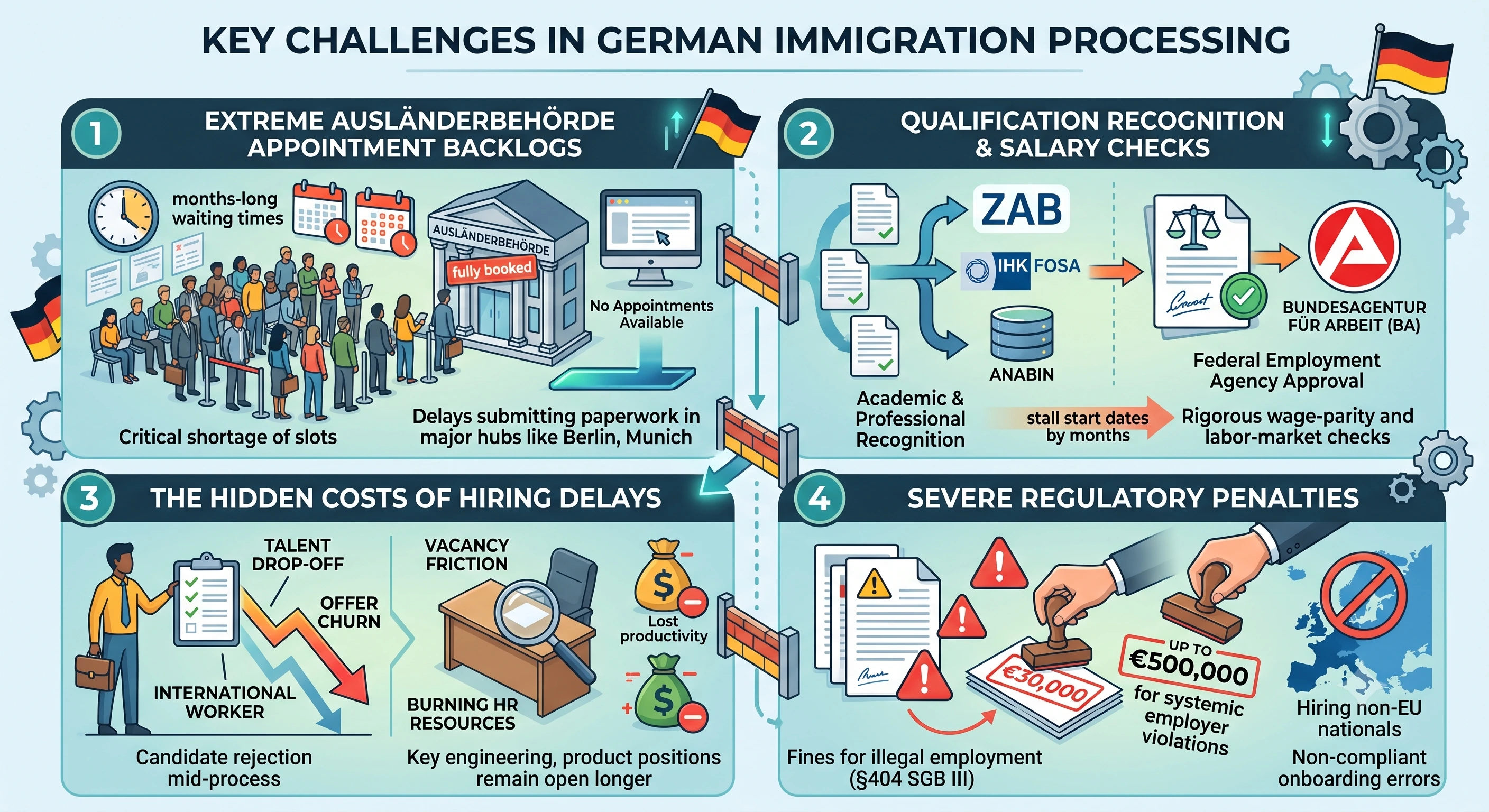
Germany’s decentralized immigration system places processing power in local Ausländerbehörden, where appointment availability is critically low. Major hubs like Berlin, Munich, Frankfurt, and Hamburg face operational overloads, leaving incoming specialists waiting months just to submit physical paperwork or secure a residence permit (Aufenthaltstitel) appointment.
Ausländerbehörde appointment availability is the first bottleneck HR hits, gauge it upfront with the Germany residence visa appointment waiting time calculator.
2. Qualification Recognition (ZAB / IHK FOSA) & Salary Checks (BA)
Before a visa application can even be submitted, employers must cross complex regulatory hurdles:
- Academic & Professional Recognition: Qualifications must be verified via the Anabin database or formally evaluated by the Central Office for Foreign Education (ZAB) or IHK FOSA.
- Federal Employment Agency (BA) Approval: The Bundesagentur für Arbeit conducts rigorous wage-parity and labor-market checks to ensure terms match local German standards, adding layers of review that can stall start dates by several months if submitted with minor errors.
3. The Hidden Costs of Hiring Delays: Talent Drop-Off, Vacancy Friction, and Fines
- Candidate Drop-Off & Offer Churn: Top-tier international talent will not wait indefinitely in visa limbo. Prolonged processing times lead to offer rejections and candidate drop-offs mid-process.
- Vacancy Friction: Key engineering, product, and leadership positions remain open longer, burning internal HR resources and delaying critical project delivery.
- Severe Financial Risk: Missteps during the onboarding sequence carry severe penalties under German labor law.
4. Regulatory Penalties: Up to €30,000 for Non-Compliant Onboarding Errors
Allowing an international candidate to begin work without the exact work authorization category, or missing a deadline on permit renewals, triggers strict illegal employment provisions under §404 SGB III. Fines can reach up to €30,000 per violation (and up to €500,000 for systemic employer violations), along with potential bans on hiring non-EU nationals.
Missing a renewal deadline is one of the costliest onboarding errors, which is why Deadline monitoring should run automatically rather than sit on a spreadsheet.
What Value Does a Tech-Enabled Immigration Vendor Actually Add?
Modern corporate mobility partners eliminate manual paperwork, moving immigration from a reactive back-office chore to a strategic advantage in global talent acquisition.
1. Reducing HR Administrative Work
Internal HR teams spend up to 20 hours per international hire tracking down documents, deciphering local legal updates, and emailing authorities. A tech-driven mobility partner handles this entire administrative lift, document collection, translations, pre-checks, and authority communications; freeing People teams to focus on core organizational goals.
3. Navigating the Fast-Track Procedure for Skilled Workers (Beschleunigtes Fachkräfteverfahren - §81a)
Under §81a of the Residence Act (Aufenthaltsgesetz), employers can initiate an expedited visa application service for company staff via the fast-track procedure with local authorities. A tech-enabled partner manages the formal power of attorney, streamlines pre-approval (Vorabzustimmung) with the Federal Employment Agency, and shortens overall processing from six months to a matter of weeks.
4. Eligibility Matching (EU Blue Card vs. Opportunity Card / Chancenkarte)
With the continuous updates to the German Skilled Immigration Act (Fachkräfteeinwanderungsgesetz), choosing the correct pathway is critical. Tech platforms evaluate candidate data points such as salary thresholds, foreign degree equivalence, language skills, and points criteria to instantly match candidates to the optimal visa route:
Key Parameters to Evaluate in a German Corporate Immigration Partner
1. Registered Legal Advice (Rechtsdienstleistungsgesetz) & Legal Escalation Options (Untätigkeitsschreiben)
In Germany, providing legal services requires formal registration under the Legal Services Act (Rechtsdienstleistungsgesetz - RDG). Pure software tools without legal backing cannot represent your company before authorities. Evaluate whether your vendor has licensed German legal professionals who can issue formal administrative claims for failure to act (Untätigkeitsklage / Untätigkeitsschreiben) when local authorities drag processing times past statutory limits.
2. Local Authority Navigation & German Jurisdiction Expertise
German municipal offices operate autonomously. A vendor must demonstrate deep, practical experience working directly with key authorities across various federal states (Bundesländer). Generic global templates fail when dealing with local nuances in Berlin, Munich, or smaller regional offices.
3. Technology, Data Security, and Platform Usability
Handling sensitive documents such as passports, tax data, marriage certificates, and police clearances requires enterprise-level security and GDPR-compliant data protection. Look for providers with ISO 27001 certification, full GDPR compliance, and secure EU-hosted servers to help protect employee data throughout the immigration process.
Before contracting, check how deeply a provider's platform connects to your existing systems. Strong HRIS integration with tools like Personio, Workday, and BambooHR keeps case data in sync and removes duplicate manual entry for your HR team.
4. Transparent, Predictable B2B Pricing Models
Avoid vendors with open-ended hourly legal rates, hidden admin fees, or separate charges for basic document translation checks. Demand flat-fee pricing per relocation case, with clear itemization of mandatory government fees vs. service fees.
Jobbatical offers flat-fee pricing per relocation case instead of open-ended hourly retainers which works for multiple hires.
5. Candidate Experience and Post-Arrival Integration Support
The candidate experience directly affects employee retention. Audit the vendor’s mobile interface, response times, multi-lingual support, and local relocation assistance. Relocating specialists should feel supported throughout their relocation journey.
Employer Evaluation Matrix: Vendor Weightage & Scoring System
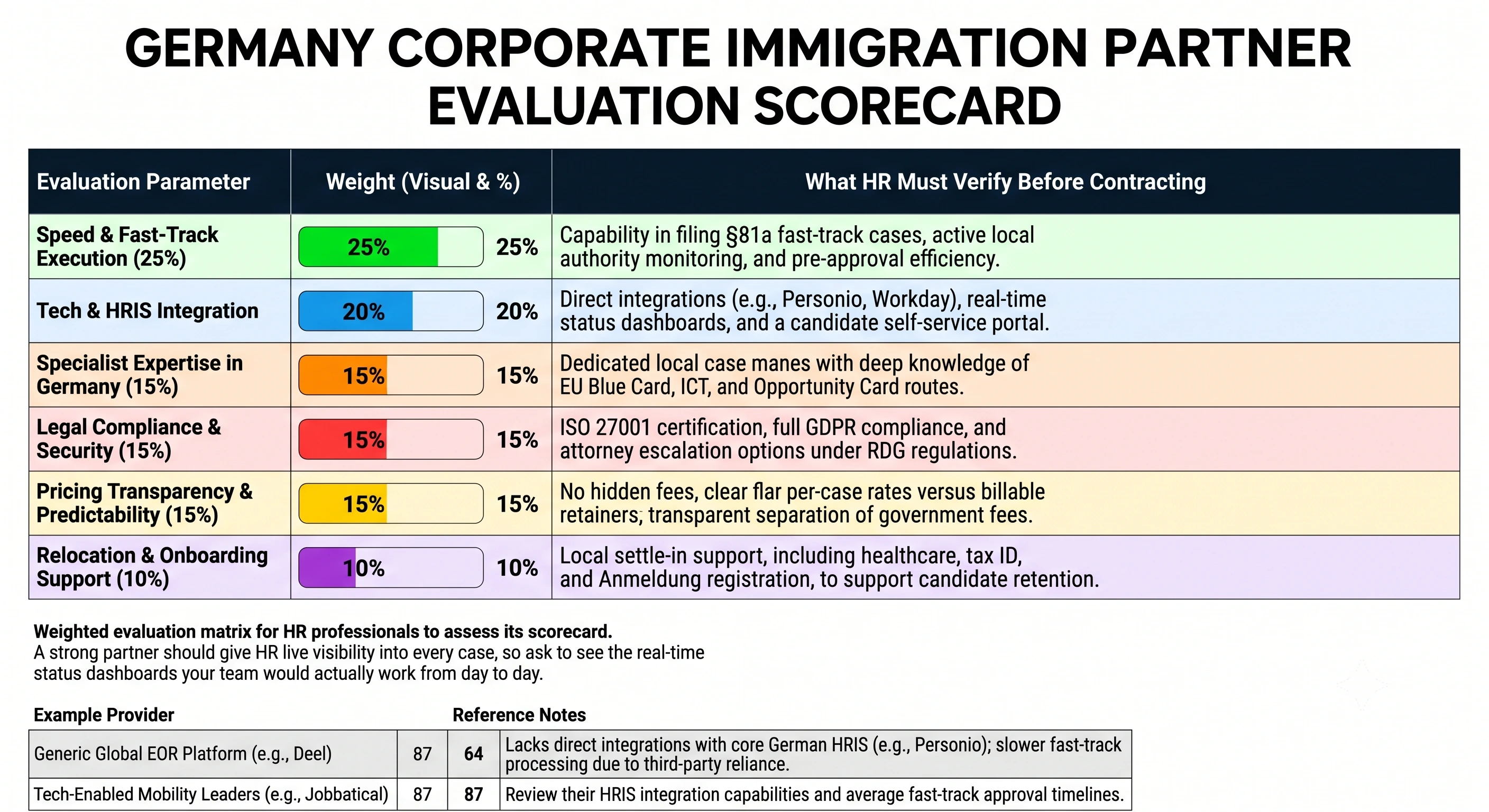
Germany Vendor Selection: A Weighted Evaluation Framework for HR
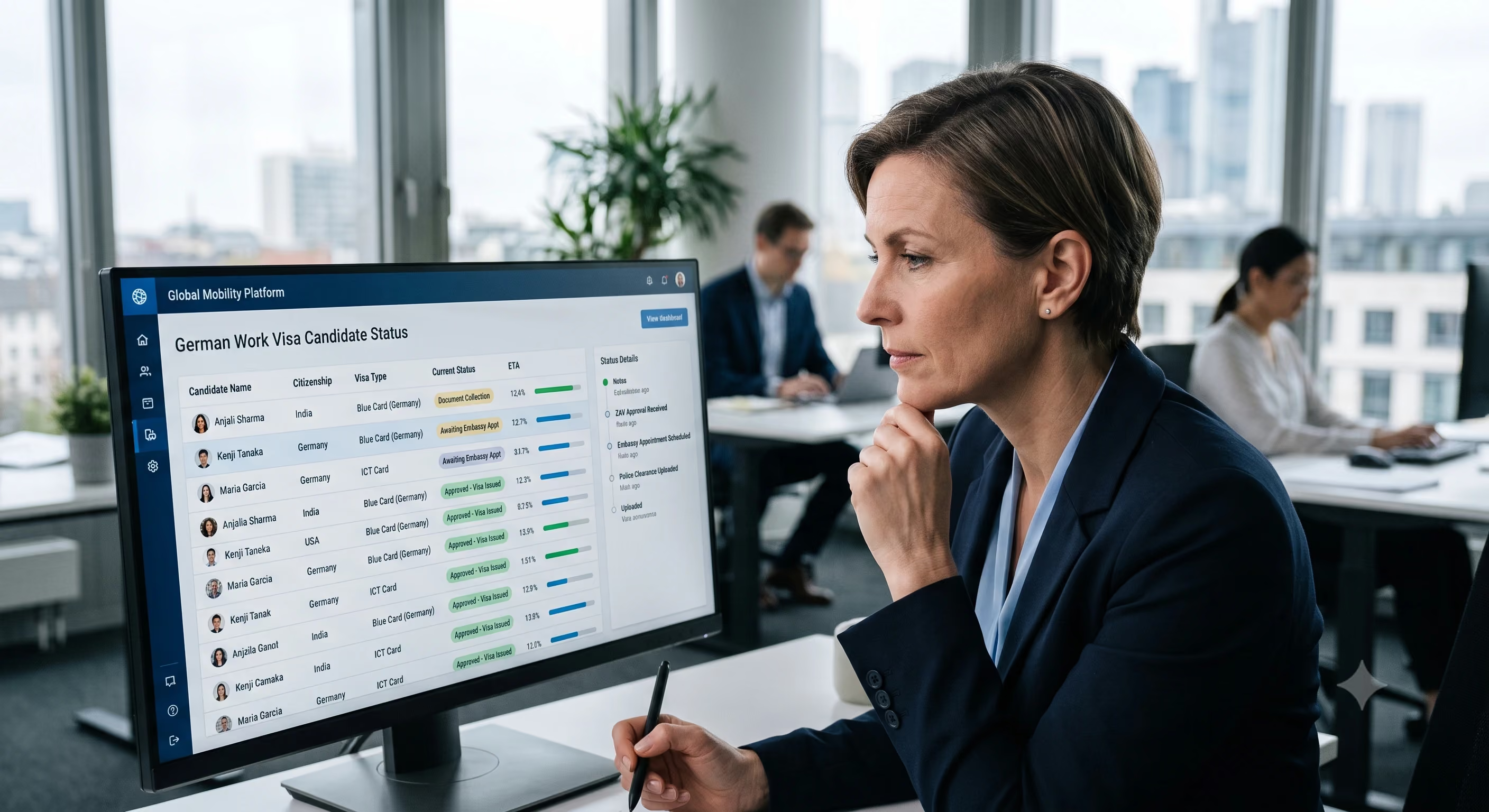
A strong partner should give HR live visibility into every case, so ask to see the real-time status dashboards your team would actually work from day to day.
Comparing Corporate Immigration Providers in Germany
Before shortlisting a partner, it helps to see the full landscape side by side. Comparing Corporate Immigration Providers in Germany shows where law firms, EOR platforms, and specialists differ.
Landscape Analysis: Where Market Competitors Rank vs. Jobbatical
When evaluating the best corporate immigration services in Germany, employers must understand how different providers structure their offerings. Understanding how to choose a visa service for business employees comes down to balancing legal expertise, technological capability, and localized execution.
A. Traditional Enterprise Law Firms
- Pros: High legal complexity support and litigation capabilities.
- Cons: Extremely high billable hours/retainers, legacy manual workflows, and lack of modern HR platform integrations.
B. Local German Relocation Agencies
- Pros: High-touch, local city relationships in specific German municipalities.
- Cons: Limited scalability outside Germany, manual status tracking via email/spreadsheets, and lack of enterprise tech stack.
C. Modern Global Mobility & EOR Platforms
- Pros: Sleek modern software, broad multi-country employer-of-record reach.
- Cons: Generic international coverage that often lacks deep, localized execution pathways required for complex German authority negotiations.
Where Jobbatical Ranks: The AI-Driven Global Mobility Platform
Jobbatical combines full-service legal execution with an AI-driven platform tailored specifically to complex immigration jurisdictions like Germany.
The Jobbatical Advantage: 99.9% Success Rate, Native HRIS Sync, and Local German Execution
- Automated Document Intelligence: Reduces candidate paperwork error rates to near-zero before submission to German authorities.
- Native HRIS Integration: Direct data pipelines into Personio, Workday, HiBob, and BambooHR.
- Full Local Coverage: Hybrid approach pairing automation with on-the-ground German mobility experts to handle local authority processing, §81a fast-track filings, and full settle-in assistance.
Where most vendors offer either lawyers or software, Jobbatical pairs licensed local execution with an AI-driven platform built for high-complexity jurisdictions like Germany.
Red Flags to Avoid When Choosing a German Mobility Partner
- Unrealistic Processing Time Guarantees: No provider controls German municipal workloads. Be cautious of guaranteed timelines that do not account for local authority processing times or use the §81a Beschleunigtes Fachkräfteverfahren.
- Unclear and Uncapped Fees: Avoid providers that charge base fees while billing hourly for routine follow-ups with embassies or authorities. Request clear, all-inclusive, per-case pricing upfront.
- No End-to-End Post-Arrival Support: Visa issuance is only one step. Support with Anmeldung (city registration) and tax ID helps employees complete onboarding and enables timely payroll setup.
- Manual PDF and Email Case Handling: Sharing passports, tax records, and other personal documents through insecure email attachments can create GDPR and data-security risks. Look for secure document handling and case-management systems.
Jobbatical insist on centralised case-management systems that keep every file and update in one secure place.
Frequently Asked Questions : Immigration Service Provider Germany