
KEY TAKEAWAYS: Germany EU Blue Card Hiring in 2026
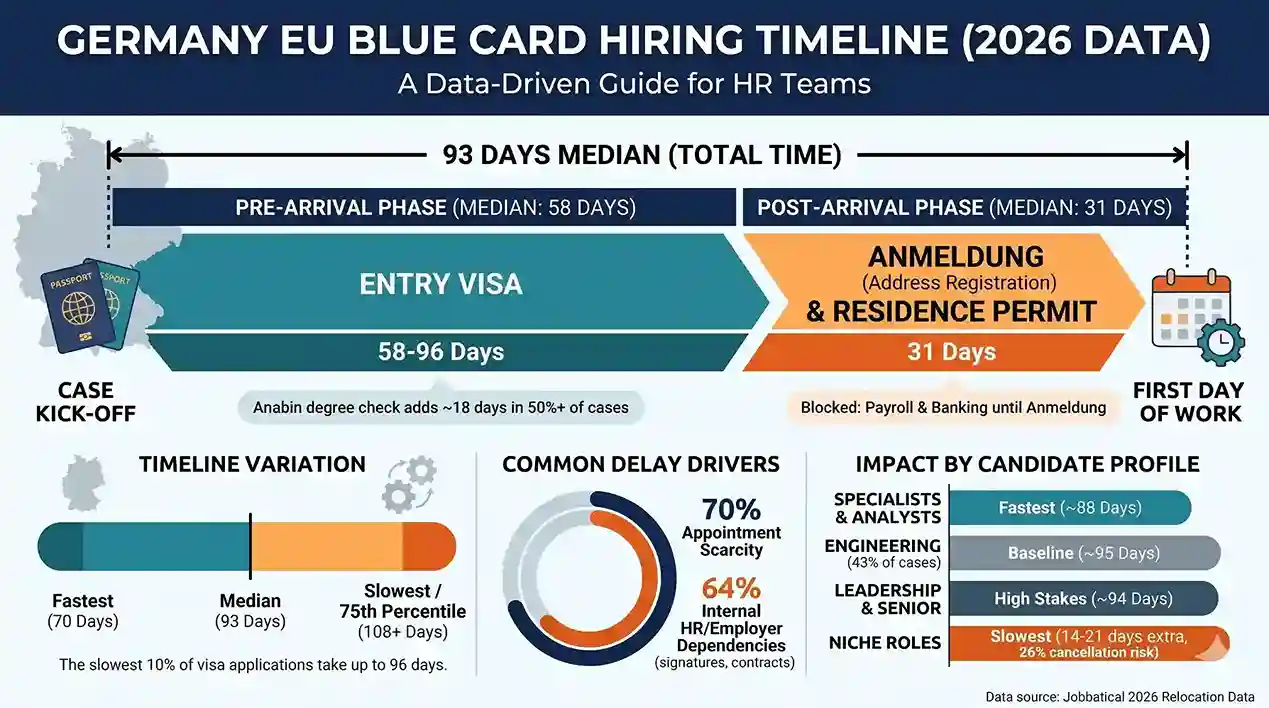
- 93 days is the average end-to-end timeline for a Germany EU Blue Card case, so employers should budget approximately 13 weeks from case initiation to the employee’s first working day.
- 58 days is the median entry visa processing time, making the pre-arrival stage the biggest driver of start-date delays.
- 31 days is the median time for Anmeldung after arrival, potentially delaying payroll setup, banking access, and residence permit formalities.
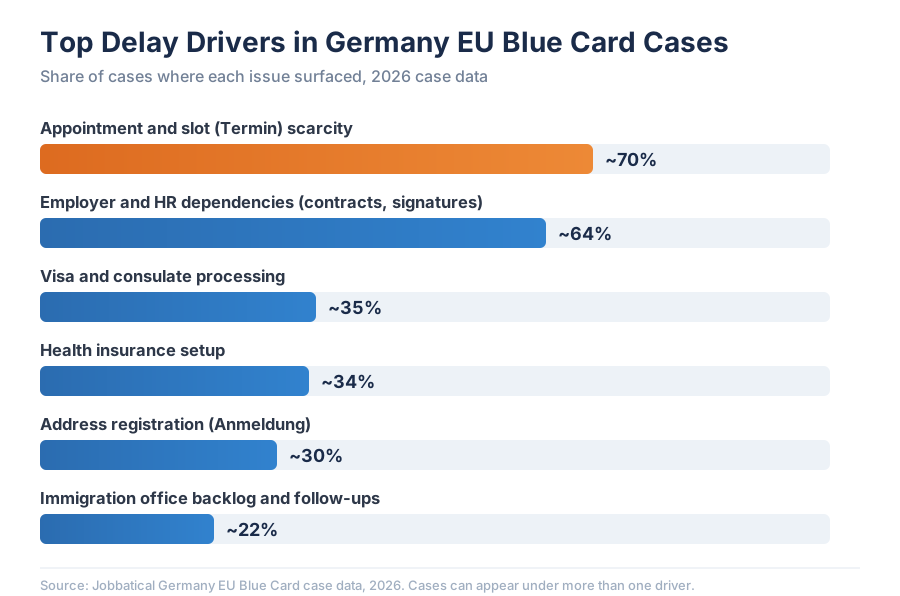
- 70% of cases experience appointment scarcity, making limited appointment availability the leading reason actual timelines slip beyond initial estimates.
- 64% of cases face employer documentation delays, particularly with signed contracts and job descriptions, so HR teams should prepare these documents at the offer stage to protect planned start dates.
Securing a Germany EU Blue Card takes an averageof 93 days from case initiation to the employee’s start date. Based on Jobbatical’s comprehensive 2026 relocation data, this report breaks down the end-to-end immigration timeline and provides actionable strategies to optimize your international hiring process.
Streamlining Global Hiring: What a 93-Day Germany EU Blue Card Hiring Timeline Means for HR Teams?
A 93-day timeline is the realistic baseline for a standard Germany EU Blue Card hire, measured from case kick-off to the employee's start date. HR teams should use this full-journey metric as a foundation while factoring in buffers for contractual delays.
- Processing Time: The average is 93 days, but the fastest 25% of cases take around 70 days, while the slowest 25% take 108 days or longer. HR should plan for this variation rather than rely on the average.
- Onboarding Risks: The 38-day gap between faster and slower cases can affect planned start dates. HR should build extra time into hiring plans to avoid onboarding delays.
- Timeline Scope: The 93 days cover the immigration process up to the employee's joining date, not the delivery of the physical residence permit card. Employees may be able to start working before receiving the card, subject to applicable requirements.
- Joining Date Tracking: HR should track progress against the employee's planned start date, not just individual application deadlines. Jobbatical coordinates each stage to help identify delays before they affect onboarding.
HR Insights: Turning the 93-Day Benchmark Into a Reliable Start Date
- Start the case at offer acceptance. Every week of delay in opening the case pushes the joining date out by the same amount, so case initiation should be part of the offer workflow, not a later step.
- Forecast critical roles to 108 days, not 93. For senior or business-critical hires with fixed start dates, plan to the slowest quartile to build in realistic protection.
- Build in an appointment buffer. Slot scarcity is the main driver of the fast-to-slow spread, so a visa appointment buffer on every timeline absorbs the most common cause of slippage.
- Ready the employer documents early. Prepare contracts, job descriptions, and salary confirmations at offer stage, since these employer-side steps gate the visa and delay about 64% of cases when they lag.
For the eligibility rules and salary thresholds behind these timelines, see our Germany EU Blue Card service page.
Accelerating the Germany EU Blue Card Timeline: Pre-Arrival and Post-Arrival Strategies for Global Mobility and HR Managers
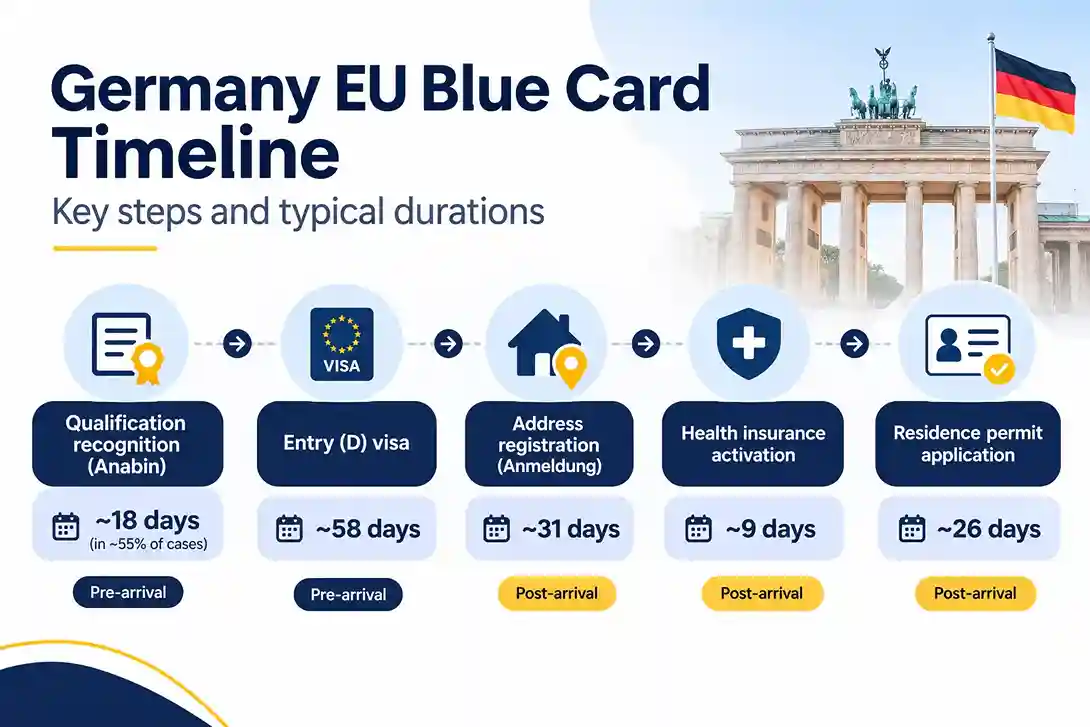
The 93-day average timeline splits into a lengthy pre-arrival phase and a shorter post-arrival period. The entry visa dominates the first stage, while address registration (Anmeldung) and the residence permit fill the second.
- The Pre-Arrival Phase: The entry visa dominates the early timeline, accounting for a median of 58 days. The vast majority of the relocation process occurs before the employee ever lands in Germany.
- The Post-Arrival Phase: Once the employee arrives, local compliance takes over. Address registration (Anmeldung) requires roughly 31 days, and the subsequent residence permit application adds about 26 days to the timeline.
- Bridging the Visa Expectation Gap: Official consular estimates suggest a rapid four-week turnaround, but processing backlogs and appointment wait times push the actual median to 58 days. HR teams must anchor their workforce planning on real-world data rather than best-case official guidelines.
- Qualification Recognition Delays: An Anabin degree check adds roughly 18 days to the pre-arrival stage in over 50% of cases. Verify degrees early, as an unconfirmed qualification can completely reset the application process.
- High Variance in Visa Processing: The slowest 10% of visa applications take up to 96 days nearly double the average. Treat the entry visa as your primary source of forecasting uncertainty.
- Entry Visa Delays: Indian and Turkish nationals face the longest entry-visa processing times at around 70 days, while applicants from North America and Israel typically wait around 45 days.
- Overall Hiring Timeline: Applicants from China, Russia, and Turkey tend to face the longest end-to-end processing times. HR teams should factor in additional time buffers when hiring from these regions.
How Jobbatical accelerates critical Milestones for Germany EU Blue Card processing
To keep onboarding timelines predictable, Jobbatical aligns the entire immigration process around your employee's start date:
- Centralized Pipeline Visibility: Jobbatical provides a single, unified view of every case, showing exactly which hires are waiting on a visa and which are waiting on Anmeldung, allowing HR to track progress by specific stages rather than vague statuses.
- Proactive Escalation: By tracking cases against the final joining date rather than isolated procedural deadlines, our teams anticipate delays such as visa appointment bottlenecks and escalate the right cases early to protect the start date.
- Automated Document Coordination: We front-load the compliance workload by running Anabin checks early and preparing post-arrival Anmeldung documents before the employee lands, ensuring a seamless transition to local payroll without last-minute surprises.
Germany EU Blue Card stage timeline at a glance
Recognition often sets the pace pre-arrival, so our guide to Anabin H+ and H- qualification recognition shows how to confirm a degree before the visa step.
How Germany EU Blue Card Processing Times Vary by Candidate Profile
The specific role you are hiring for directly impacts immigration speed. While timelines cluster around the 93-day median, understanding the variance across job profiles reveals exactly where HR teams face compliance risks and where to build strategic buffers.
- The fastest approvals: Specialists and analysts clear the process quickest, averaging 88 days. Their standard, easily verifiable qualifications prevent visa stalls, making them the most predictable hires to plan around.
- The engineering baseline: Accounting for 43% of all applications, engineering roles establish the baseline average at roughly 95 days. While processing volume is high, timelines are often held back by credential checks on non-traditional degrees.
- The slowest timelines: Niche positions such as specialized design, creative direction, and hybrid marketing-tech roles run two to three weeks longer than the median. They also experience cancellation rates as high as 26% (compared to just 8% for leadership). These extended waits are primarily driven by unusual job titles, contract mismatches, and difficult-to-categorize credentials.
- The primary compliance bottleneck: Degree recognition via the Anabin database is the top snag across all profiles. Online degrees, distance learning, or qualifications from unlisted universities routinely stall applications, forcing cases into slower pre-approval pathways.
- Drivers of role-specific delays: Engineering and IT candidates lacking formal degrees must rely on the experience-based IT specialist route, which carries a heavy documentation burden.
- Senior Roles: For senior leadership (averaging 94 days), older or foreign degrees frequently trigger manual recognition reviews, putting highly critical, fixed start dates at risk.
Actionable HR Strategies: Mitigating Role-Specific Germany EU Blue Card Hiring Risks
To prevent costly delays, HR managers must adapt their workflow to the candidate's job profile before the contract is even signed:
- Specialists (88-day average): Rely on these roles for tight onboarding windows. Their easily verifiable qualifications make them the fastest and most predictable hires.
- Engineering (95-day average, 43% of volume): Audit credentials at the offer stage. Since Anabin degree checks add roughly 18 days in over 50% of cases, verify qualifications immediately to prevent delays.
- Leadership (94-day average, 8% cancellation risk): Older or foreign credentials frequently trigger manual reviews, placing high-stakes executive start dates at risk.
- Niche Roles (+14 to 21 days, 26% cancellation risk): Standardize paperwork early. Map creative or hybrid titles to standard German labor classifications to prevent the exceptionally high drop-off rate caused by contract mismatches.
Germany EU Blue Card role mix in 2026
To see how these patterns fit Germany's wider framework, visit our Germany immigration services hub.
How Jobbatical Resolves Germany EU Blue Card Delays for HR Teams
With 70% of Germany EU Blue Card cases hitting appointment scarcity and 64% stalling due to internal HR dependencies, active case management is critical. Jobbatical targets the specific friction points that extend the 93-day median and protect your onboarding timelines:
- Aligning Visa Appointments: Appointment scarcity delays 70% of applications, with entry visas taking 58 to 96 days. Jobbatical sequences cases to prioritise urgent embassy slots based on targeted joining dates.
- Eliminating HR Bottlenecks: Pending contracts and signatures hold up 64% of cases. Preparing a standard compliance document pack during the offer stage completely removes this administrative drag before visa submission.
- Real-Time Case Visibility: Replacing back-and-forth status emails, our shared dashboard tracks all critical phases from the 58-day visa to the 31-day Anmeldung. It shows exactly where a case is stuck and who needs to act next.
- Synchronising Family Relocations: Roughly 30% of Germany hires relocate with dependants. Processing family applications in parallel avoids doubling the 93-day median timeline, ensuring employees never have to start work while their family is left behind.
Top delay drivers in Germany Blue Card cases
If you are coordinating several hires at once, book a demo to see how Jobbatical manages appointments, documents, and compliance in one place. When a hire brings dependants, our Germany family reunification compliance checklist shows what to prepare.
Top 5 Metrics for HR Teams to Forecast Germany Blue Card Joining Dates
Accurate relocation forecasting relies on historical data, not theoretical estimates. Based on Jobbatical’s 2026 global mobility data, HR teams should anchor their Germany EU Blue Card planning to these core metrics:
- 93-day median timeline: This 13-week window from case kick-off to joining is your standard baseline. It covers document prep, the entry visa, arrival, and local registration. Treat 93 days as the absolute floor.
- 108 days for critical hires : 25% of all applications take 108 days or longer. The 38-day gap between fast (70 days) and slow cases is your primary risk zone, so buffer business-critical start dates to 108 days.
- 58 to 96-day entry visa phase: The entry visa is the longest and most volatile stage. While the median is 58 days, the slowest 10% of cases take up to 96 days. Book embassy appointments immediately to mitigate this variance.
- 31-day Anmeldung (address registration): This post-arrival step blocks local payroll, banking, and the final residence permit. Track arrival-to-registration as a live metric to prevent downstream bottlenecks.
- 64% delayed by internal HR steps: Missing contracts, job descriptions, or signatures hold up nearly two-thirds of cases. HR fully controls this timeline eliminate the delay by preparing a standard compliance document pack during the offer stage.
Appointment and authority backlogs cause most slippage, so our analysis of Germany Auslanderbehorde and EU Blue Card delays breaks down why.
Disclaimer: Immigration rules change quite frequently; please verify with official sources or contact us for the latest info before making any decisions.
Frequently Asked Questions - Germany EU Blue Card Hiring Timelines 2026