


Key Take aways for Netherlands EU Blue Card
- The Netherlands EU Blue Card requires a gross monthly salary of €5,942 (age 30+) or €4,754 (reduced, for recent graduates) confirmed thresholds as of January 2026.
- Unlike the Highly Skilled Migrant permit, the EU Blue Card grants intra-EU mobility after 12 months, letting your employee transfer to another EU country without restarting from scratch.
- The IND has up to 90 days to decide, but most applications from recognised sponsors resolve in 3–6 weeks.
- Employers do not need IND recognised sponsor status to file an EU Blue Card application, a key difference from the HSM route.
- Spouses and children can join immediately; spouses receive unrestricted work rights from day one.
What Is the Netherlands EU Blue Card?
The EU Blue Card is a combined work and residence permit for highly qualified non-EU nationals. It is issued under EU Directive 2021/1883, transposed into Dutch immigration law, and administered by the IND. Unlike most national work permits, it carries legal rights across EU member states not just in the Netherlands.
In the Netherlands, the Blue Card functions similarly to the Highly Skilled Migrant permit in terms of processing speed and employer involvement. The meaningful difference is what it unlocks for the employee and by extension, for your retention and talent mobility strategy.
Our Netherlands EU Blue Card (EU Blauwe Kaart) service manages the full application from qualification check to residence card.
2026 Salary Thresholds: What Employers Must Pay
These are gross monthly minimums, excluding the 8% holiday allowance. All figures are confirmed by the IND for applications submitted on or after 1 January 2026.
Netherlands EU Blue Card Salary Thresholds 2026
One important compliance point: if the employee changes employers at any point in 2026, the 2026 thresholds apply even if the IND was notified of the change before January 1. Build that into your offer planning.
The Dutch government proposed tightening these thresholds in July 2025. As of late 2025, the Dutch Parliament signalled that further consideration was needed. The proposals have not been implemented. Monitor IND updates through ind.nl thresholds are reviewed annually each December.
Our guide to the 2026 Netherlands highly skilled migrant salary thresholds sets out the pay rules for both the EU Blue Card and parallel kennismigrant route.
Eligibility: What the Employee and Employer Must Meet
The Blue Card has cleaner eligibility criteria than most people expect. Here is what the IND requires.
Employee Requirements
- Non-EU, non-EEA, non-Swiss nationality
- Employment contract of at least 12 months for a highly qualified role
- Gross salary meeting the 2026 IND threshold (see above)
- Higher education degree (minimum 3 years), evaluated by Nuffic if the diploma is foreign or 5+ years of equivalent professional experience in certain fields
- No serious criminal history
- Valid Dutch or EU-compliant health insurance
Employer Requirement
- Company must be based in the Netherlands with a valid Dutch employment contract
- No IND recognised sponsor status required (this is the key difference from the HSM route)
- The employer must not have been fined in the past 5 years for violating the Foreign Nationals Employment Act or for failing to pay wage tax or social insurance contributions
That last point is worth flagging to your finance and payroll teams. A compliance breach on payroll taxes can disqualify the employer from Blue Card applications retroactively. Get that audit in early if there is any uncertainty.
For companies that are not yet IND recognised sponsors whether newly incorporated or still waiting for recognition the EU Blue Card is often the only fast-track option available. The IND recognised sponsorship process takes up to 90 days and costs €5,080. If you need to move faster, the Blue Card does not require it.
Step-by-Step: How the Application Works
The process has seven distinct stages. Here is what happens at each one and what your company is responsible for.
Netherlands EU Blue Card Application Process
The 2026 IND application fee is €423. Budget separately for Nuffic diploma evaluation (around €130–€250), any required translations, and MVV sticker costs if applicable.
Honestly, the step that catches most HR teams off guard is the IND appointment booking. Slots run 2–3 months out during peak periods. If your hire has a firm start date, work backwards from that and start this process the same week the offer is signed.
Our Netherlands digital IND application updates explain the new online process for EU Blue Card and work permit applications.
Why the EU Blue Card and When to Choose It Over the HSM
Both the Blue Card and the Highly Skilled Migrant permit are strong options. The difference is in what they enable beyond the initial hire. Here is a direct comparison.
EU Blue Card vs. Highly Skilled Migrant Permit: Key Differences
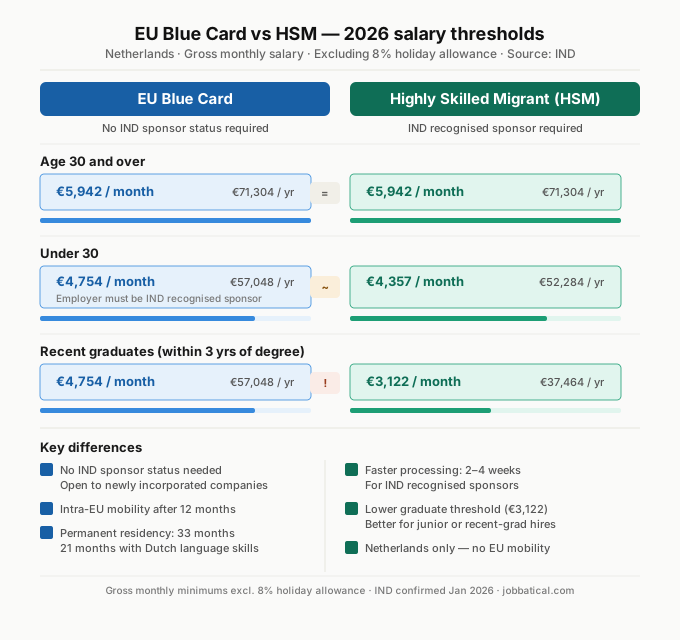
If your company is an IND recognised sponsor and the role is Netherlands-only with no cross-border plans, the HSM permit is marginally faster. But if the employee might rotate across your EU offices, or if your company does not yet have sponsor status, the Blue Card is clearly the stronger choice. For more detail on when each route applies, see our full comparison of Netherlands work permits and the EU Blue Card.
Family Reunification and Employee Benefits
This is underestimated in most employer guides. Bringing family along is one of the biggest factors in whether a relocation succeeds long-term and the Blue Card handles it well.
- Spouses and registered partners receive a dependent residence permit with unrestricted work authorisation. No extra work permit needed.
- Unmarried partners can join with proof of a durable relationship.
- Children under 18 are included and gain access to Dutch public education. University tuition is charged at the EU rate significantly lower than non-EU fees.
Family applications can be filed alongside the main Blue Card application, reducing total processing time. For employees weighing whether to accept a Netherlands role, knowing that the family setup is straightforward often closes the conversation.
Our Netherlands family reunification (MVV) visa service handles dependant applications for partners and children of EU Blue Card and kennismigrant holders.
Compliance Obligations for Employers
Sponsoring a Blue Card employee comes with ongoing IND reporting duties. Failing to meet these even once can affect future applications across your entire sponsored workforce.
- Notify the IND within 4 weeks if the employee's contract ends early or if their role or salary changes materially
- Maintain salary at or above the IND threshold at all times; any temporary drop (outside of sick leave) can trigger a permit review
- Ensure payroll taxes and social insurance contributions are up to date past violations disqualify the employer from future Blue Card applications
- Keep copies of all submitted documents for at least 5 years
Permanent Residency and Long-Term Retention
The Blue Card's path to permanent residency is faster than the HSM route. After 33 months of continuous Blue Card residence in EU member states or 21 months with sufficient Dutch language skills employees can apply for the EU Long-Term Resident Permit or Dutch permanent residency.
This matters for retention. Employees who reach PR status have more options: they can change employers freely, start businesses, and stay without continuous sponsorship. For employers, that means less permit administration over time, not more. The Blue Card's faster PR timeline is often a deciding factor for senior hires who want a clear path to settlement.
For a broader overview of all visa routes available when relocating international staff to the Netherlands, see our Netherlands visa guide for international employees. If you are also reviewing IND changes affecting the HSM scheme in parallel, the 2026 HSM changes guide covers the latest proposals and what they mean for your hiring budget.
Ready to sponsor your first EU Blue Card in the Netherlands, or managing a batch of relocations and need better process oversight? Talk to our immigration team we handle eligibility checks, document management, IND submissions, and compliance tracking from start to finish.
Disclaimer: Immigration rules change quite frequently; please verify with official sources or contact us for the latest info before making any decisions.
Frequently Asked Questions : Netherlands EU Blue Card
What is the salary threshold for the Netherlands EU Blue Card in 2026?
As of 1 January 2026, the gross monthly salary threshold (excluding 8% holiday allowance) is €5,942 for standard applicants and €4,754 for recent graduates applying within 3 years of completing higher education, provided the employer is an IND recognised sponsor. These figures are set by the Dutch Immigration and Naturalisation Service (IND) and reviewed annually.
Does my company need to be an IND recognised sponsor to apply for a Netherlands EU Blue Card?
No — unlike the Highly Skilled Migrant permit, the EU Blue Card does not require your company to hold IND recognised sponsor status. Any Dutch-based employer with a valid employment contract of at least 12 months can sponsor a Blue Card application. This makes it one of the few fast-track routes accessible to newly incorporated companies or those still in the IND recognition process.
How long does the Netherlands EU Blue Card application take?
The IND has a statutory maximum of 90 days to decide. In practice, most complete applications take 3–6 weeks. After approval, the residence card is issued within 1–2 weeks. Budget an additional 2–3 months for booking the initial IND appointment, especially during peak periods. Start the process as early as possible — six weeks before the intended start date is the absolute minimum buffer.
Can my employee move to another EU country with a Netherlands EU Blue Card?
Yes. After 12 months of legal residence in the Netherlands, EU Blue Card holders can apply to relocate to another participating EU member state under a simplified procedure. They still need to submit a permit application in the second country, but the process is significantly faster than a standard labour migration route. The HSM permit does not offer this benefit — it is Netherlands-only.
What documents does the employer need to prepare for a Netherlands EU Blue Card application?
The employer provides a signed employment contract (minimum 12 months), confirmation that the role qualifies as highly skilled, and evidence that the salary meets the 2026 IND threshold. The employee contributes a valid passport, a higher education diploma (with Nuffic evaluation if foreign), biometric photos, proof of health insurance, and the completed IND application form. Translations and legalisation may be required depending on the country of origin.
What happens if my employee loses their job while on a Netherlands EU Blue Card?
EU Blue Card holders in the Netherlands have up to 3 months to find new qualifying employment if they become unemployed. During sick leave, the permit remains valid for up to 12 months even if the salary temporarily falls below the threshold. Employers must notify the IND of any contract termination. Compared to many other permit types, these protections reduce the administrative burden on HR during unexpected staffing changes.
Can the employee's family join them on a Netherlands EU Blue Card?
Yes. Spouses, registered partners, and children under 18 are eligible for family reunification permits. Family members receive full work authorisation from the moment their permit is granted — no separate work permit needed. Unmarried partners must prove a durable relationship. Children gain access to Dutch public education, and higher education tuition fees at Dutch universities are charged at the EU rate rather than the non-EU rate.

.svg)
.svg)