

KEY TAKEAWAYS - GVVA Netherlands
- The Netherlands GVVA (Single Permit) combines work and residence rights into one application, your employees no longer need two separate permits.
- The labour market test is the biggest employer obligation: you must prove no suitable EU/EEA candidate exists before the IND will approve.
- Processing takes up to 90 days (standard) or as little as 2 weeks with a recognised sponsor, plan your start date accordingly.
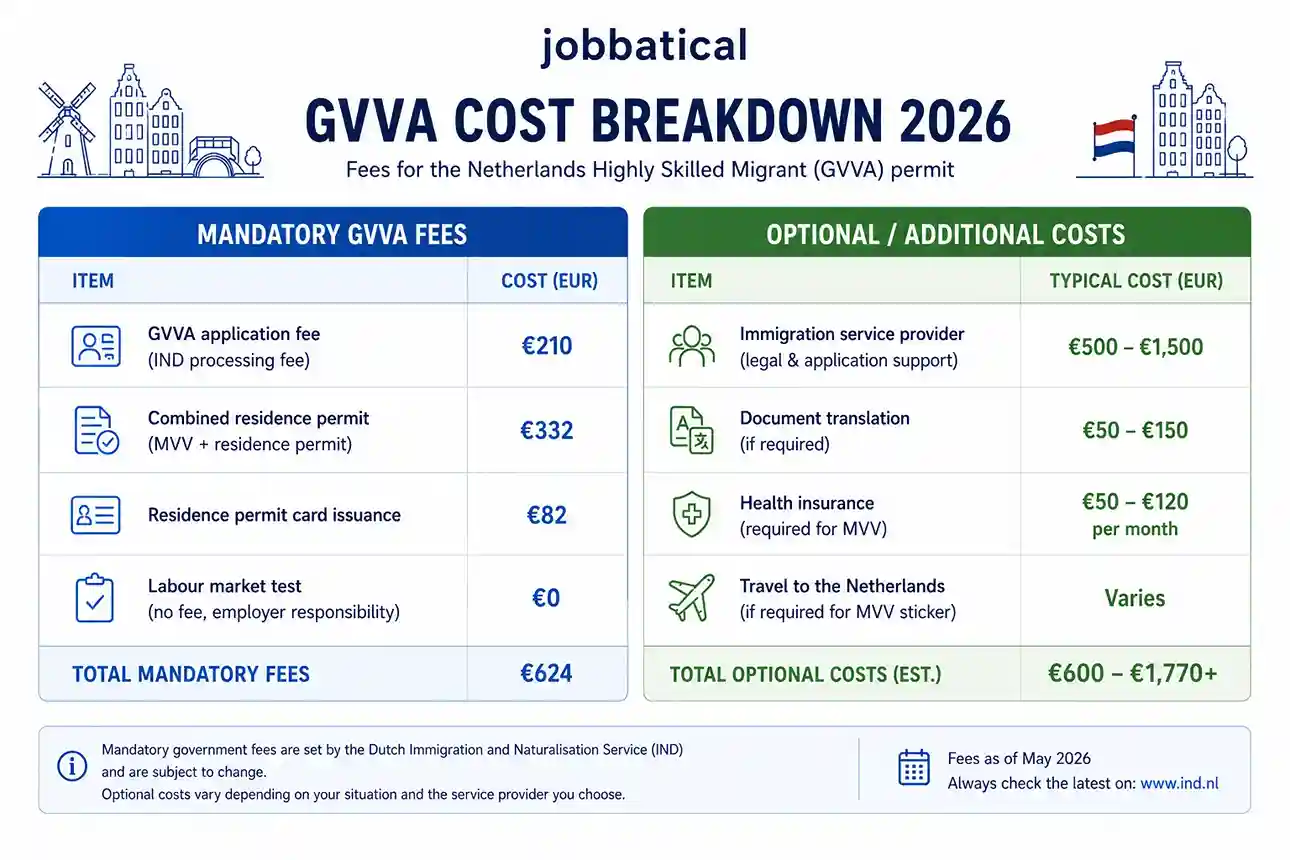
- Application fees total €1,395 (employer) plus €192 for MVV if required; budget for translation and recruitment advertising on top.
- GVVA counts toward the 5-year permanent residency requirement, making it a genuine long-term pathway for your employees.
What Is the Netherlands GVVA?
The GVVA (Gecombineerde Vergunning Verblijf en Arbeid), or Single Permit, is an official Dutch permit issued by the IND (Immigration and Naturalisation Service). It combines both work authorization and residence rights into one integrated permit and single application procedure, eliminating the need for your employee to apply for separate work and residence permissions.
When Does Your Hire Actually Need GVVA Netherlands?
Most companies hiring internationally into the Netherlands initially look at fast-track routes such as the Highly Skilled Migrant (HSM) scheme or the EU Blue Card, as these options feature faster processing times and simpler requirements.
However, your candidate will need a GVVA permit if they satisfy the following conditions:
- Non-EU/EEA/Swiss National: The candidate is moving to the Netherlands for paid employment lasting longer than 90 days.
- Salary or Role Criteria Not Met: The candidate does not hit the minimum salary thresholds or role qualification criteria required for the HSM or EU Blue Card routes.
- Outside Fast-Track Schemes: The role requires standard labor market testing through UWV before the combined work and residence authorization can be granted.
In practice, this covers a wide range of positions: logistics, manufacturing, hospitality, technical services, cultural roles, and more. If your hire doesn't qualify for the Highly Skilled Migrant permit, the Netherlands EU Blue Card, or an ICT permit, the GVVA is the standard route.
Who Is Eligible for GVVA: Employer and Employee Requirements
The GVVA isn't complicated on the eligibility side, but it's strict on documentation. Before you start, check both sides of the equation.
Your Employee Must:
Our Netherlands Highly Skilled Migrant (kennismigrant) permit service manages the faster kennismigrant route for hires who qualify as highly skilled migrants.
Your Company Must:
Some sectors have labour market test exemptions. Athletes, Asian catering chefs, artists, spiritual leaders, and staff at international schools are among those who may not need to go through the full recruitment proof process. If your hire falls into a specialist category, check this early, it could save you 5 to 8 weeks.
For the full breakdown of which hires skip the test, see our guide to GVVA labour market test exemptions.
The UWV Labour Market Test Explained For GVVA Netherlands
- The UWV (Dutch Employee Insurance Agency) assesses whether a suitable EU/EEA/Swiss candidate was available for the role before you looked outside the EU.
- The standard requirement is that you advertise the vacancy for at least 5 weeks across EU/EEA job networks, and document every application you received, including why each EU candidate was deemed unsuitable.
Vague rejection reasons don't hold up. "Candidate didn't fit the role" without specifics is not sufficient. You need written evidence: interview notes, skills comparisons, or candidate assessments. Honestly, this is the step where most companies under-prepare, then face delays or rejections that push start dates back by months.
Our Netherlands TWV permit and labour market test guide explains how the UWV labour market test works for the short-term TWV permit.
📌 Keep the documentation from day one of recruitment. Don't reconstruct it after the fact.

Labour Market Test: Key Requirements at a Glance
Our latest Netherlands work permit updates cover the GVVA and TWV changes employers must track.
The GVVA Application Process: Legal Steps for Employers
The GVVA is always submitted by the employer, not the employee. Here's what the process looks like in order:
- Eligibility check: Confirm your hire doesn't qualify for a faster route (HSM, EU Blue Card, ICT). If they do, pursue that first.
- Labour market test: Run and document your EU/EEA recruitment campaign. This step must be completed before you submit.
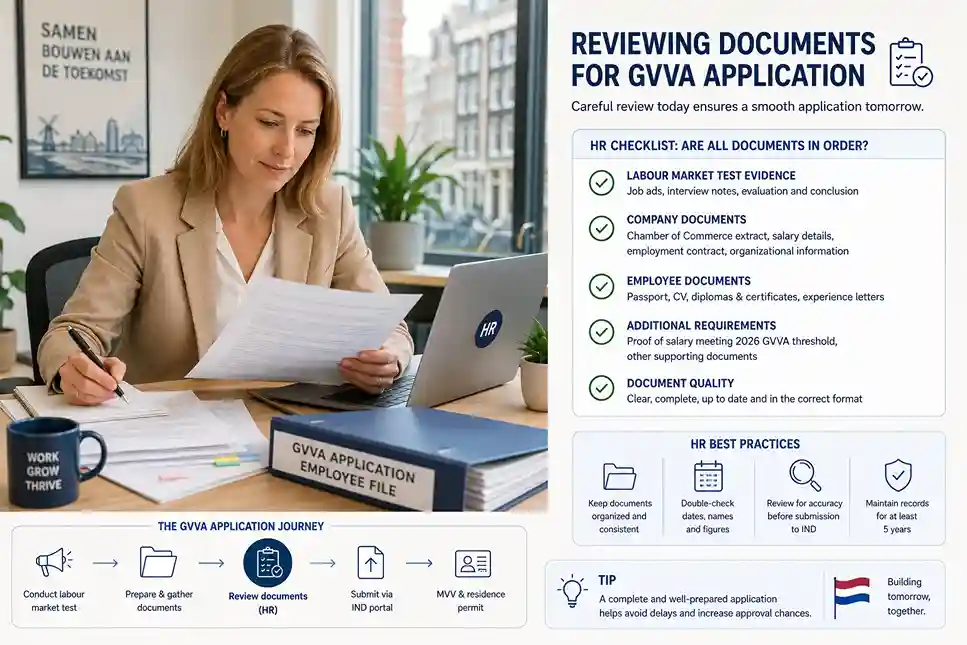
- Document preparation: Gather the full document pack, employment contract, employee passport, criminal background check (legalised and translated), health insurance, and your KvK registration.
- IND submission: Submit via the IND Business Portal (recognised sponsors) or by post using form 7533 (non-recognised sponsors). Submit at least 3 months before your intended employment start date.
- MVV process (if applicable): If your employee is outside the Netherlands and their nationality requires an MVV (provisional residence permit), they'll apply at a Dutch embassy in their home country. Allow 15–60 days for this step.
- IND assessment: The IND reviews the full application including the UWV's labour market assessment, your compliance record, and the employee's background. Processing: up to 90 days standard; 2 weeks for recognised sponsors.
- Permit collection: Your employee collects the biometric residence card from an IND desk.
- Municipal registration: Your employee must register with the local municipality (BRP) within 5 days of arrival.
Our breakdown of the 2026 Netherlands IND application fees sets out the current government charges for the GVVA and other routes.

Costs and Timeline: What to Budget and Plan For GVVA Netherlands
Cost Breakdown
Our guide to the 2026 Netherlands highly skilled migrant salary thresholds shows the kennismigrant pay minimums to weigh against the GVVA.
Processing Timeline for GVVA Netherlands
GVVA vs Other Netherlands Work Permits: Choosing the Right Route
Before committing to the GVVA process, it's worth confirming your hire doesn't qualify for a faster or simpler route. The GVVA is designed for roles that don't meet the threshold for premium schemes, and it comes with significantly more employer burden.
Our Netherlands Highly Skilled Migrant permit vs EU Blue Card comparison sets out the trade-offs between the skilled routes as alternatives to the GVVA.
Permit Route Comparison

Ongoing Compliance: What You're Responsible for After Approval for GVVA Netherlands
Getting the permit approved is only part of the job. Under the Dutch WAV (Wet arbeid vreemdelingen), the obligation to ensure valid work authorisation sits with you as the employer, not your employee. Non-compliance carries fines of up to €8,000 per worker.
Here's what you need to stay on top of:
- Report changes within 4 weeks: Role changes, salary adjustments, significant working hours changes, notify the IND promptly.
- Retain records for 7 years: Employment contracts, payroll evidence, copies of permit documents.
- Salary proof: From 2026, IND audits increasingly request bank statements as proof of salary payment. Keep these on file.
- Permit validity: The GVVA is valid for up to 1 year and renewable annually for up to 5 years. Set a renewal reminder at least 3 months before expiry. Jobbatical's renewals and compliance tracking platform can automate this for your team.
- Employment continuity: If your employee's contract ends, they have 3 months to find a new qualifying employer before the permit is at risk of revocation.
IND spot audits are now unannounced. If your records aren't in order when an auditor arrives, the consequences are immediate.
Path to Long-Term Residency: What the GVVA Unlocks
The GVVA isn't just a short-term fix. Every year your employee spends on a valid GVVA counts toward the 5-year continuous legal residency requirement for both Dutch permanent residency and the EU Long-Term Resident Permit. Your employee will also need to meet civic integration requirements, language and civic knowledge, over that period.
The permit is renewable annually, and family members (spouse, children under 18) can join through family reunification, provided your employee meets the income requirements. Dependants gain work rights and access to Dutch social services.
For employees who arrived via the GVVA route, a timely permit renewal is essential to avoid gaps in residency continuity, any break resets the 5-year clock.
Ready to Start a Netherlands GVVA Application?
The GVVA process is manageable, but only if you start early and document carefully. Most delays we see come from under-prepared labour market test files and last-minute document chases. Give yourself at least 12 weeks before you need your employee in the role.
Jobbatical handles the full GVVA process:
If you're hiring into the Netherlands and the route isn't clear yet, book a call with our Netherlands immigration team, we'll map the right route before you spend time on the wrong one.
Disclaimer: Immigration rules change quite frequently; please verify with official sources or contact us for the latest info before making any decisions.
Frequently Asked Questions: Netherlands GVVA Combined Work & Residence Permit

.svg)
.svg)