


KEY TAKEAWAYS
- The Frontier Worker Permit is for EU, EEA, and Swiss employees who started working in the UK before 31 December 2020 and still live outside the UK, no employer sponsorship required.
- Your employee must have worked in the UK at least once every 12 months to remain eligible; gaps due to illness or involuntary unemployment can be covered under retained status.
- The permit application is free, takes 4–6 weeks in practice, and lasts 5 years (2 years for self-employed workers on retained status).
- As the employer, your main obligation is completing a digital right to work check using your employee's share code, failure to do so risks a civil penalty.
- Employees who do not qualify for the Frontier Worker Permit will need a Skilled Worker Visa or another sponsored route instead.
UK Frontier Worker Permit: The Complete HR Guide 2026
You have an EU national on your team who commutes to the UK from France, Germany, or the Netherlands. They've been doing it for years. But since Brexit, there's a permit they need to enter the UK legally for work, and if they don't have it, you have a compliance problem too.
The UK Frontier Worker Permit is one of those post-Brexit immigration categories that often flies under the radar. It doesn't require sponsorship on your end. No Sponsor Licence. No Certificate of Sponsorship. But it still creates obligations for you as an employer, especially around right to work checks.
This guide covers everything your HR team needs to know: who qualifies, how the permit works, what your responsibilities are, and what to do when an employee no longer meets the criteria.
What Is the UK Frontier Worker Permit?
The Frontier Worker Permit was introduced after Brexit to protect a specific group: EU, EEA, and Swiss nationals who work in the UK but live abroad. These are not people who relocated to the UK, they commute. They return home regularly, and the UK is not their primary country of residence.
Before 1 January 2021, free movement covered this arrangement without any formal permit. The Frontier Worker Permit replaced that. Since 1 July 2021, every EU/EEA/Swiss national crossing into the UK for work, if they live outside the UK, must hold a valid permit to do so legally.
Importantly: this route is entirely employee-led. Your employee applies. You do not sponsor them, issue a CoS, or pay any application fee. Your role is limited to verifying their right to work correctly once they have the permit.

Who Qualifies: The Core Eligibility Rules
Eligibility is tightly defined. Your employee must meet all of the following:
- Nationality: EU, EEA (Norway, Iceland, Liechtenstein), or Swiss citizen. Irish citizens are exempt, their rights are protected under the Common Travel Area, though they can still apply voluntarily.
- Pre-Brexit work history: They must have started working in the UK on or before 31 December 2020. Anyone who began working in the UK after that date does not qualify and must apply for a Skilled Worker Visa instead.
- Primary residence outside the UK: They must live primarily outside the UK and return to their home country at least once every six months.
- Continued UK work activity: They must have continued to work in the UK at least once every 12 months since starting.
- Genuine and effective work: The Home Office requires the work to be real, regular employment, not a one-off meeting, a contract signing, or attending an interview. For self-employed workers, the activity must be stable and continuous, not a temporary service arrangement.
In practice, most cases that run into issues involve the last two points, either a gap in UK work activity or work that the Home Office doesn't consider sufficiently substantial. If you're unsure whether an employee's situation qualifies, check with an immigration specialist before they apply.
Retained Status: What Happens During a Work Gap
An employee who has not worked in the UK for more than 12 months may still be eligible, but only under limited circumstances. This is called "retained" frontier worker status, and it applies when the work gap was caused by:
- Illness or accident (with a doctor's letter or medical evidence)
- Involuntary unemployment (provided they registered with a UK employment office or Jobcentre Plus and were actively job-seeking)
- Vocational training related to their previous occupation
- Maternity or paternity leave
Workers under retained status receive a shorter 2-year permit instead of the standard 5-year permit. If the 12-month gap was voluntary, they simply stopped working in the UK without any of the above reasons, they lose eligibility entirely and need a Skilled Worker Visa to return.
The Application Process: What Your Employee Needs to Do
The application is handled entirely by your employee through GOV.UK. There is no form you need to fill in, no documents you need to submit, and no fee you need to pay. Here is what their process looks like:
Step-by-Step Application Process
| Step | What Happens | Notes |
|---|---|---|
| 1. Identity verification | Upload a photo via the UK Government ID Check app using a biometric passport | If the app cannot be used, attend a Visa Application Centre for biometric enrolment |
| 2. Online application | Submit application at gov.uk/frontier-worker-permit with supporting evidence | Application is free of charge |
| 3. Evidence submission | Payslips, employment contracts, P60/P45, bank statements, invoices (self-employed) | Must show UK work starting on or before 31 Dec 2020 |
| 4. Decision received | Home Office issues permit decision | Official target: 3 weeks. Realistic expectation: 4–6 weeks |
| 5. Permit issued | 5-year permit (or 2-year for retained status) | Permit is digital; employee can generate a share code for right to work checks |
One practical note: advise your employee to apply before accepting a new UK role or before their current permit expires, not after. A permit application submitted after the employee has already started work creates a right to work gap that can leave you exposed to a civil penalty.

Cost and Timeline at a Glance
Frontier Worker Permit: Key Facts
| Item | Detail |
|---|---|
| Application fee | Free |
| Biometric fee | May apply if VAC attendance required (included in any VAC appointment cost) |
| Immigration Health Surcharge | Not required |
| Sponsor Licence required | No |
| Processing time | 3 weeks (official); 4–6 weeks (realistic) |
| Permit validity | 5 years (standard); 2 years (retained status) |
| Leads to settlement (ILR)? | No |
| Family members included? | No (family must apply separately via EU Settlement Scheme) |
Your Obligations as the Employer: Right to Work Checks
This is where most HR teams get caught out. You do not sponsor a Frontier Worker, but you are still legally required to verify their right to work before they start. And for Frontier Workers, that check must be done online. A physical document check is not sufficient.
Here is exactly what you need to do:
- Ask your employee to generate a share code at gov.uk/prove-right-to-work. Share codes are valid for 90 days.
- Use the Home Office employer checking service at gov.uk/view-right-to-work, entering their share code and date of birth.
- The check will confirm their permit status in real time, directly from Home Office records.
- Save a record of the check, screenshot or PDF. You must keep this for at least two years after the employment ends.
Failing to complete a valid right to work check, even if your employee has a valid permit, removes your statutory excuse against a civil penalty. Fines for employing someone without a verified right to work can reach £60,000 per worker. The check is not optional.
For more on managing your UK compliance obligations, see how Jobbatical supports employer UK Sponsor Licence management alongside right to work verification.
Frontier Worker Permit vs. Skilled Worker Visa: Key Differences
Comparing the Two Routes
| Item | Detail |
|---|---|
| Application fee | Free |
| Biometric fee | May apply if VAC attendance required (included in any VAC appointment cost) |
| Immigration Health Surcharge | Not required |
| Sponsor Licence required | No |
| Processing time | 3 weeks (official); 4–6 weeks (realistic) |
| Permit validity | 5 years (standard); 2 years (retained status) |
| Leads to settlement (ILR)? | No |
| Family members included? | No (family must apply separately via EU Settlement Scheme) |
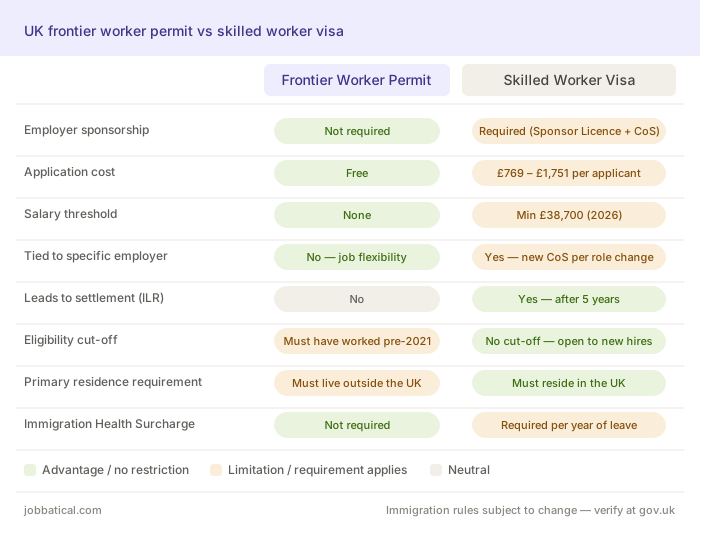
The Frontier Worker route is significantly lighter for both your employee and your business. But it only works for a specific, shrinking group. Over time, as more pre-Brexit cross-border workers either retire, relocate, or lose continuity of UK work, this route will become less common. For any new hire joining your UK operations from the EU after 2021, the UK Skilled Worker Visa is the right route.
When the Frontier Worker Route No Longer Works
There are a few scenarios where a Frontier Worker loses eligibility and you need to act:
- They moved to the UK permanently, if your employee now lives in the UK full-time, the Frontier Worker route no longer applies. They should have applied for EU Settled or Pre-Settled Status instead. If they haven't, speak to an immigration expert urgently.
- They haven't worked in the UK for over 12 months without a qualifying reason, the permit cannot be renewed on the basis of retained status, and they will need a Skilled Worker Visa.
- Their permit expires and they don't renew in time, they cannot legally enter the UK for work without a valid permit. You cannot let them start work without completing a fresh right to work check on the renewed permit.
If you're managing an employee who falls into any of these situations, early action is better than reactive compliance. Jobbatical's team can help you assess the right alternative route and manage the transition, see our UK Frontier Worker Permit service page for how we support employers through this.
How Jobbatical Supports HR Teams
Managing Frontier Worker Permit renewals, tracking expiry dates across a distributed EU workforce, and ensuring every right to work check is completed correctly, that's a lot to keep on top of, especially if UK immigration is just one part of your broader global mobility remit.
Jobbatical manages UK Frontier Worker Permit applications and verifications for HR teams, including:
- Eligibility assessments before your employee applies
- Document preparation and application support
- Digital right to work check guidance and share code verification
- EU Settlement Scheme checks and compliance tracking
- Civil penalty protection through documented right to work records
If you have employees approaching permit expiry, or you're not sure which of your EU staff actually hold a valid Frontier Worker Permit, now is a good time to do an audit.
Disclaimer: Immigration rules change quite frequently; please verify with official sources or contact us for the latest info before making any decisions.
Frequently Asked Questions: UK Frontier Worker Permit
Does a Frontier Worker Permit require employer sponsorship?
No. The Frontier Worker Permit is entirely employee-led. Your employee applies directly through GOV.UK, you do not need a sponsor licence and there is no requirement for you to issue a Certificate of Sponsorship. Your obligation is limited to completing a digital right to work check using their share code before they start work.
How do I verify a Frontier Worker's right to work?
Ask your employee to generate a share code at gov.uk/prove-right-to-work. Then use the Home Office online employer checking service at gov.uk/view-right-to-work, entering their share code and date of birth. Physical document checks are not valid for Frontier Workers, the online check is mandatory. Keep a record of the check for at least two years after employment ends.
What does the Frontier Worker Permit cost and how long does it last?
The application itself is free. There may be a small biometric enrolment fee if your employee cannot use the Government ID Check app and must attend a Visa Application Centre instead. Processing takes approximately 4–6 weeks in practice. A standard permit is valid for 5 years. Workers who qualify under retained status (e.g. previously unemployed) receive a 2-year permit.
What happens if a Frontier Worker stops working in the UK for more than 12 months?
A gap of more than 12 months can end eligibility, but there are exceptions. If your employee became unemployed due to illness, an accident, involuntary redundancy, or maternity/paternity leave, they may retain frontier worker status, provided they registered as a jobseeker or have supporting evidence. If they lose retained status entirely, they will need to apply for a Skilled Worker Visa or another sponsored route before returning to work in the UK.
Can a Frontier Worker change jobs without telling the Home Office?
Yes. Unlike the Skilled Worker Visa, a Frontier Worker Permit is not tied to a specific employer or role. Your employee can change jobs, take on a second role, or move between sectors without notifying the Home Office. The only requirements are that they continue to work in the UK at least once every 12 months and maintain their primary residence outside the UK.
Can family members of a Frontier Worker come to the UK?
Family members are not covered under the Frontier Worker Permit itself. However, eligible family members may be able to apply for an EU Settlement Scheme Family Permit separately, depending on their relationship to the frontier worker and their own residency history. This is separate from the employee's own permit and must be arranged independently.

.svg)
.svg)