
.webp)
Key Take aways for UK Join Ship Visa
- Standard VAC processing takes ~3 weeks from biometrics but VAC appointment wait times vary sharply by country and can add days to weeks before the clock even starts
- Priority service (5 working days) is not available at all VAC locations if your seafarer is in a country without it, standard lead times apply regardless of urgency
- Vessel scheduling is the biggest compounding risk: a delayed visa that misses the port call window means rebooking flights, port costs, and potential contract breach
- The three highest-risk crew change origins are countries with limited VAC capacity, no priority service, and high biometrics demand including several West African and South Asian locations
- Crewing managers should build 4–5 week lead times into all Join Ship Visa workflows and maintain a priority service budget for spot-market or last-minute vessel calls
Your crew change is confirmed. The vessel docks in Southampton in 23 days. The seafarer is in Lagos. The visa application has not started yet.
That is not an unusual scenario, it is a routine one for crewing managers running mixed-nationality rosters. And it is exactly where UK Join Ship Visa timeline risk is highest.
The biggest risk is not usually the visa processing itself. It is the gap between application initiated and biometrics submitted.
The Timeline Everyone Quotes and the One That Actually Matters
Standard UK Join Ship Visa processing takes around 3 weeks from biometrics submission. Priority service can reduce that to approximately 5 working days.
Those figures are accurate but they are only part of the timeline.
The processing clock does not start when the online application is submitted. It starts when the seafarer attends their Visa Application Centre (VAC) appointment and provides biometrics.
In countries where VAC appointments are limited, that waiting period alone can add 5–10 business days, and sometimes longer during peak demand periods.
Realistic UK Join Ship Visa Timeline
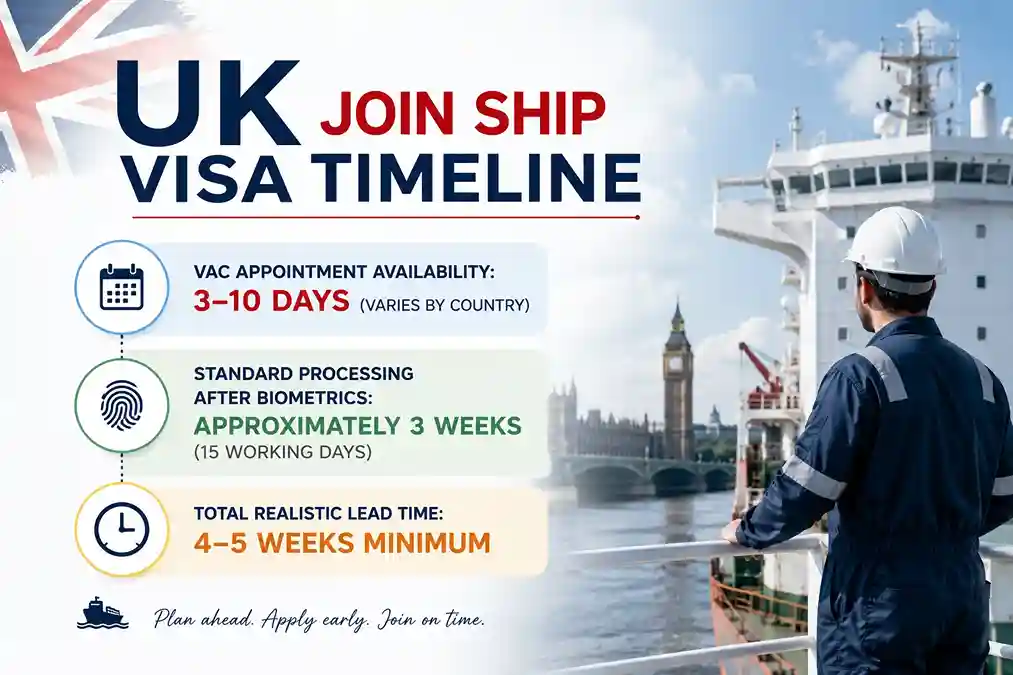
- VAC appointment availability: 3–10 days (varies by country)
- Standard processing after biometrics: Approximately 3 weeks (15 working days)
- Total realistic lead time: 4–5 weeks minimum
For vessels operating on fixed port call schedules, that distinction is critical.
Where VAC Bottlenecks Actually Occur
The UK visa application network is now primarily operated by VFS Global and TLScontact across overseas locations. While coverage is extensive, appointment availability varies significantly by country and region.
The highest-risk crew change locations generally combine:
- High UK visa application demand
- Limited VAC capacity
- Inconsistent priority service availability
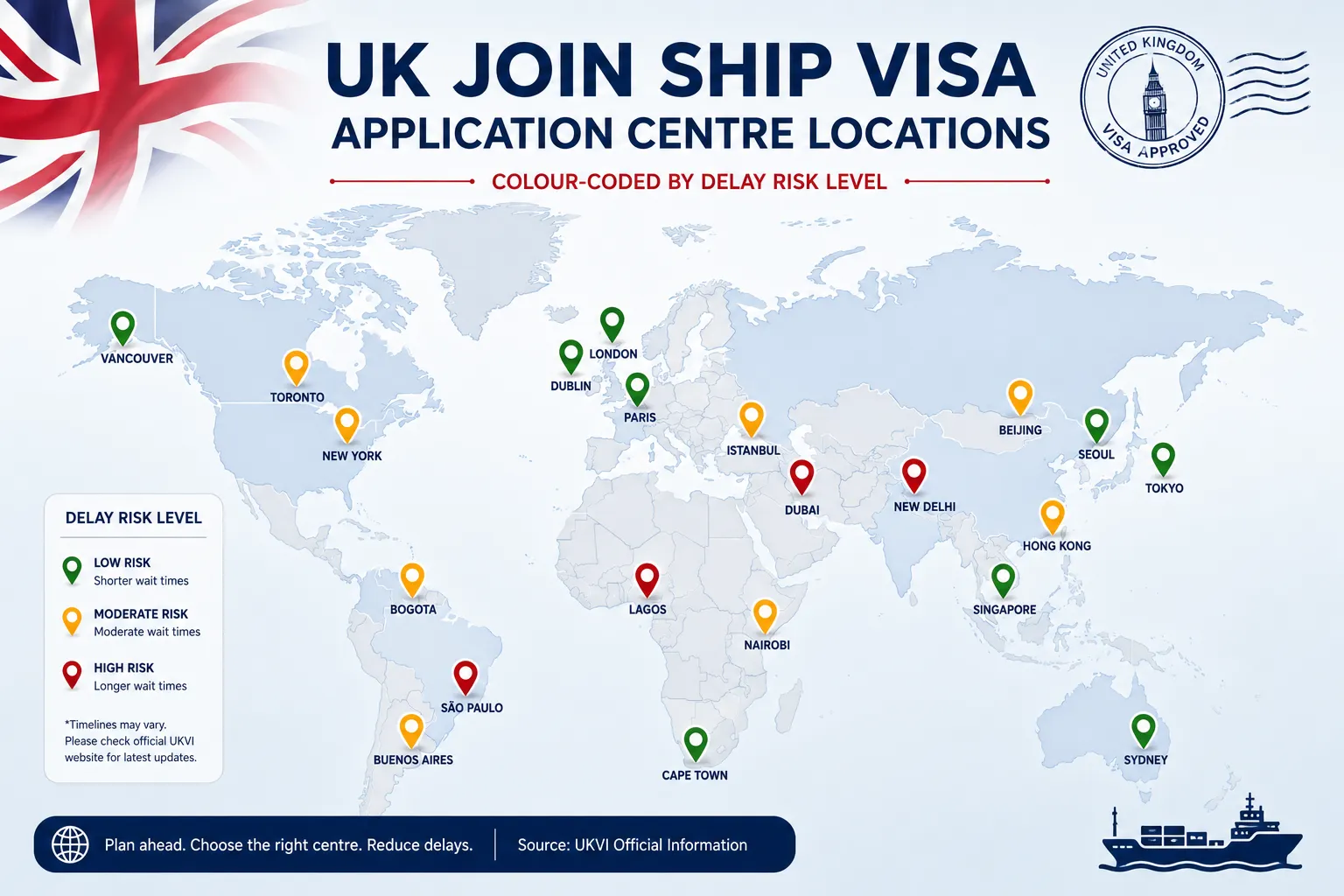
Regional VAC Availability and Delay Risk
Important: Priority service availability can change without notice. A crew change plan built around priority processing can instantly revert to standard timelines if the service is suspended at the chosen VAC.
The Vessel Schedule Variable
Visa timelines become much more sensitive when they are tied to vessel schedules.
Typical UK port call windows include:
- Commercial vessels: 12–48 hours
- Cruise vessel turnarounds: Often less than 24 hours
- Offshore supply vessels: Sometimes under 12 hours
If the visa is approved after the vessel has departed, the crew change fails regardless of visa validity.
The seafarer may hold a valid visa but no longer have a vessel available to join.
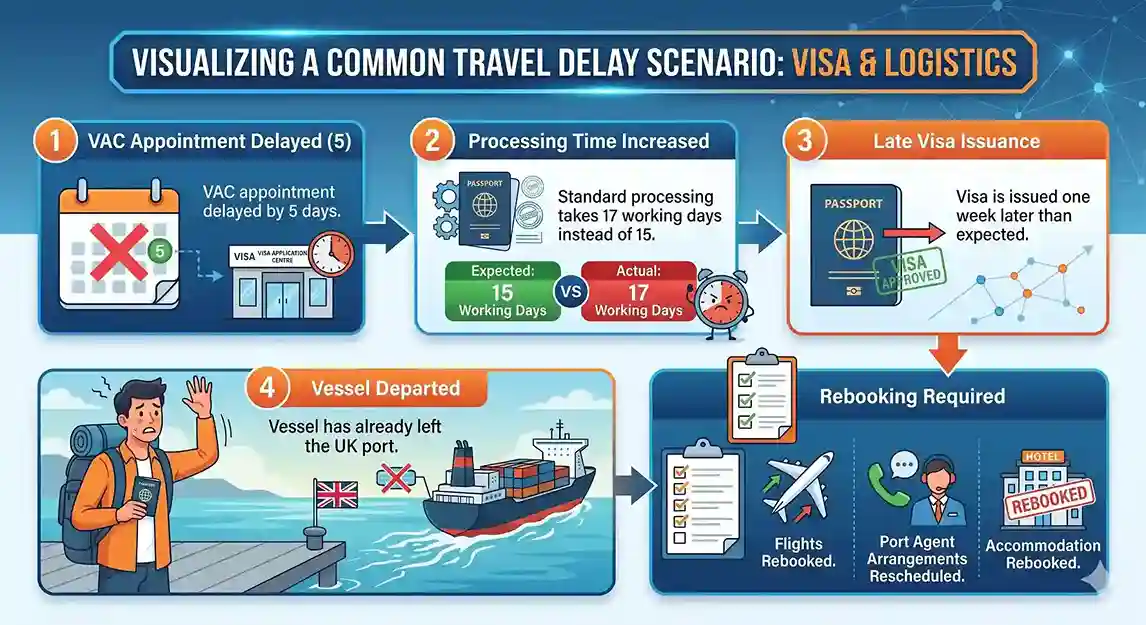
A Common Delay Scenario
- VAC appointment delayed by 5 days
- Standard processing takes 17 working days instead of 15
- Visa is issued one week later than expected
- Vessel has already left the UK port
- Flights, port agent arrangements, and accommodation must be rebooked
The visa process itself is generally straightforward.
The real challenge is aligning visa issuance with vessel movement schedules.
Three Situations Where Delays Are Almost Guaranteed
The following scenarios consistently create timing problems:
1. Application Starts Less Than 3 Weeks Before Port Call
- Even if priority service is available, biometrics must still be completed first.
- Starting fewer than three weeks before the vessel arrives creates significant risk in almost every country.
2. Seafarer Is Located Where Priority Service Is Unavailable
- Without priority processing, standard timelines apply.
- If the vessel arrives within four weeks of application initiation, the schedule may already be unworkable.
3. Spot-Market or Charter Vessels Have Unconfirmed Port Calls
- Join Ship Visa applications require evidence of the vessel departure schedule.
- Frequent schedule changes can:
- Complicate supporting documentation
- Delay application preparation
- Increase scrutiny during assessment
How to Build a Lower-Risk Crew Change Plan
The following planning measures consistently reduce timeline risk:
Before Scheduling the Crew Change
- Confirm VAC appointment availability in the seafarer country.
- Verify priority service availability at the specific VAC being used.
- Do not rely on general guidance or historical availability.
Build Realistic Lead Times
- Treat 4–5 weeks as the default planning window.
- Use a 3-week assumption only when priority service is confirmed.
Prepare Documentation Early
- Draft invitation letters in advance.
- Prepare Seafarer Employment Agreement (SEA) documentation ahead of time.
- Submit the application immediately once the crew change is confirmed.
Review Alternative Entry Options
For spot-market operations, conduct an ILO 108/185 Seafarers Identity Document (SID) eligibility review.
In some cases, seafarers holding compliant SIDs issued by ratifying countries may not require a Join Ship Visa, eliminating processing delays altogether.
Conclusion
Most UK Join Ship Visa delays are not caused by Home Office processing times.
They are caused by:
- Waiting for VAC appointments
- Inconsistent priority service availability
- Misalignment between visa issuance and vessel schedules
For crewing teams, the safest assumption is to plan around a 4–5 week lead time, verify VAC availability before confirming crew changes, and prepare application documents before the vessel schedule is finalized.
Disclaimer: Immigration rules change quite frequently; please verify with official sources or contact us for the latest info before making any decisions.
Frequently Asked Questions: UK Join Ship Visa Timeline and Crew Change Delays
How long does a UK Join Ship Visa take to process?
Standard processing takes approximately 3 weeks from the date of the biometrics appointment. Priority service can reduce this to 5 working days, but is not available at all Visa Application Centres. The 3-week clock does not start until the seafarer has attended their VAC appointment — so appointment availability in their home country adds to the total lead time.
Which countries have the longest UK VAC appointment wait times for seafarers?
Countries with high overall UK visa demand and limited VAC capacity tend to have the longest appointment waits. West African locations (Nigeria, Ghana) and some South Asian VACs frequently see appointment backlogs during peak periods. India has high demand but multiple VFS Global centres across major cities, which distributes load. Always check current appointment slot availability at your seafarer's local VAC before confirming a crew change schedule.
Is UK visa priority service available for Join Ship Visa applications?
Priority service (5 working days) is available for Join Ship Visa applications at VAC locations that offer it — but availability varies by country and VAC. Not all VFS Global or TLScontact centres offer priority processing. You must check the specific centre your seafarer will use before building priority timelines into your crew change plan. Where available, budgeting for priority service is advisable for any vessel call with less than 4 weeks' notice.
What happens if a seafarer's visa is delayed and they miss the vessel departure?
If a visa delay causes a seafarer to miss the vessel's port call window, the crew change must be rescheduled for the next UK port call — which may not occur for weeks. This creates downstream costs: rebooking flights, extended crew accommodation, additional port agent fees, and potential vessel off-hire penalties. The visa itself does not expire — it can be used for the next UK port call if the vessel returns.
How much lead time should crewing managers plan for a UK Join Ship Visa?
A minimum of 4 to 5 weeks from initiating the application is a realistic buffer for most crew change origins, accounting for VAC appointment availability and standard processing. For seafarers in countries without priority service, or during peak VAC periods, 6 weeks is safer. Three weeks is the minimum only if priority service is confirmed available and a biometrics appointment can be booked immediately.
Can a UK Join Ship Visa be used for multiple crew changes?
A Join Ship Visa is typically issued for a single entry tied to a specific vessel. If the seafarer misses their vessel but the vessel returns to a UK port, the visa may still be valid — but the invitation letter and vessel details must match. For seafarers making repeated UK crew changes across multiple rotations, each crew change generally requires a new application unless a multiple-entry endorsement is in place.

.svg)
.svg)