
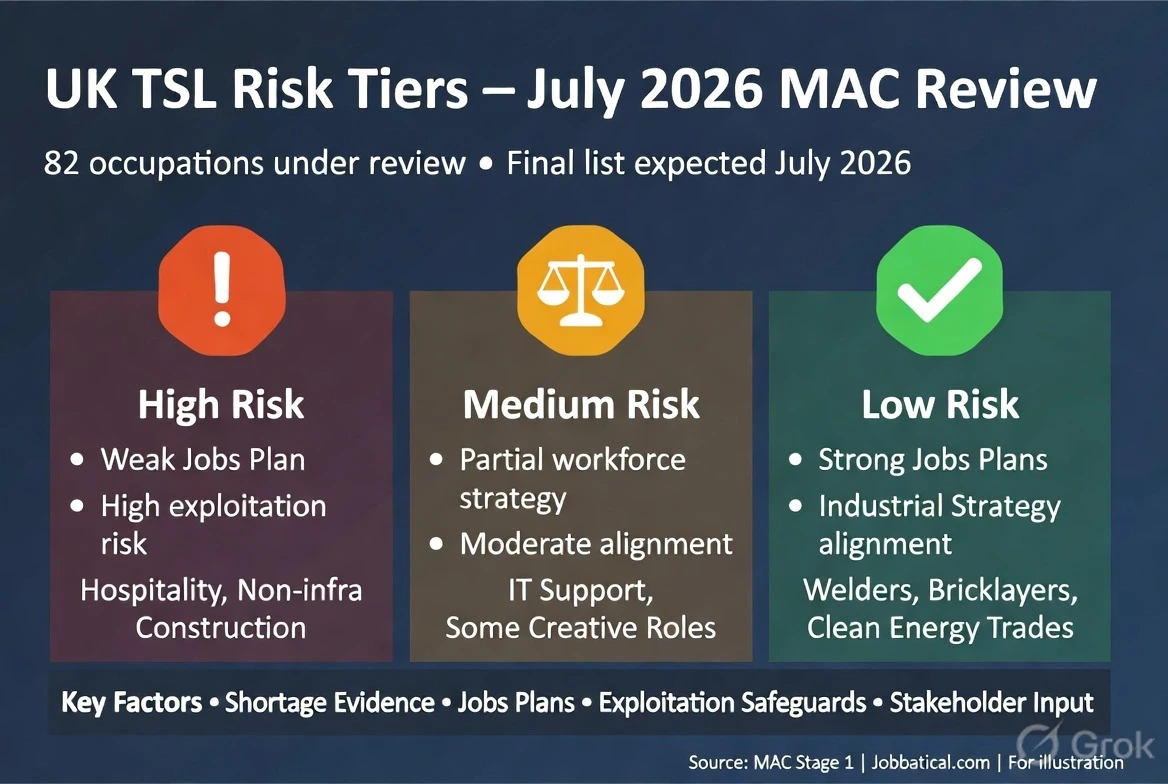
Key Take aways for TSL roles
- The MAC's final Stage 2 TSL report lands in July 2026 and the final list will be shorter than the 82 roles currently under review.
- Two roles (vehicle body builders and vehicle paint technicians) already failed to progress through Stage 1 and face near-certain removal.
- Roles without credible, government-aligned Jobs Plans face automatic rejection at Stage 2, regardless of shortage evidence.
- Sectors such as construction and hospitality carry the highest exposure due to fragmented Jobs Plans and exploitation concerns.
- Employers relying on interim TSL roles must have contingency workforce plans ready before 31 December 2026.
The July 2026 Deadline for Employers
The scenario:
Your sponsored employee starts in September. Their role is on the Temporary Shortage List (TSL). Everything is fine until July 2026, when the Migration Advisory Committee (MAC) publishes its final recommendations, and that role is gone from the list.
That scenario is not hypothetical. The MAC has been explicit, the final TSL will be shorter than the 82 occupations currently under Stage 2 review. Some roles will not survive. And when the interim list sunsets on 31 December 2026, employers who have not planned ahead will have no legal route to sponsor those positions.
This article maps the risk across TSL occupations using the MAC’s own Stage 2 criteria, known sector Jobs Plan status, and policy trajectory analysis so your team can plan around the outcome before it arrives.
How the TSL Review Works: The Three Stage 2 Tests
The MAC applies three tests to every occupation in the Stage 2 shortlist. Fail any one of them and the role does not make the final TSL.
- Test 1: Demonstrable Long-Term Shortage
- The shortage must be proven with clear data.
- Evidence may include:
- High vacancy rates
- Long recruitment timelines
- Retention and turnover data
- The MAC looks for shortages that are structural and persistent, not temporary or cyclical.
- Occupations where the domestic workforce could realistically meet demand within 3–5 years may be less likely to qualify.
- Test 2: Appropriateness of Migration
- The MAC assesses whether international recruitment is the right solution.
- It considers whether shortages could instead be addressed through:
- Higher wages
- Increased training and skills investment
- Automation and productivity improvements
- Sectors with a history of low pay for mid-skilled roles may face greater scrutiny.
- Test 3: Credible Jobs Plan
- Each occupation must be part of a government- and industry-backed workforce strategy (Jobs Plan).
- A credible Jobs Plan should include:
- Apprenticeship commitments
- Upskilling and training programmes
- Engagement with the Department for Work and Pensions (DWP)
- Measurable domestic recruitment targets
- A framework to manage migrant worker exploitation risks
- The MAC has made it clear that weak or missing Jobs Plans are likely to result in Stage 2 rejection, even when strong shortage evidence exists.
The Risk Map: Three Tiers of Exposure
Using the Stage 2 criteria, MAC Stage 1 analysis, and sector policy trajectory, we can group TSL occupations into three risk tiers.
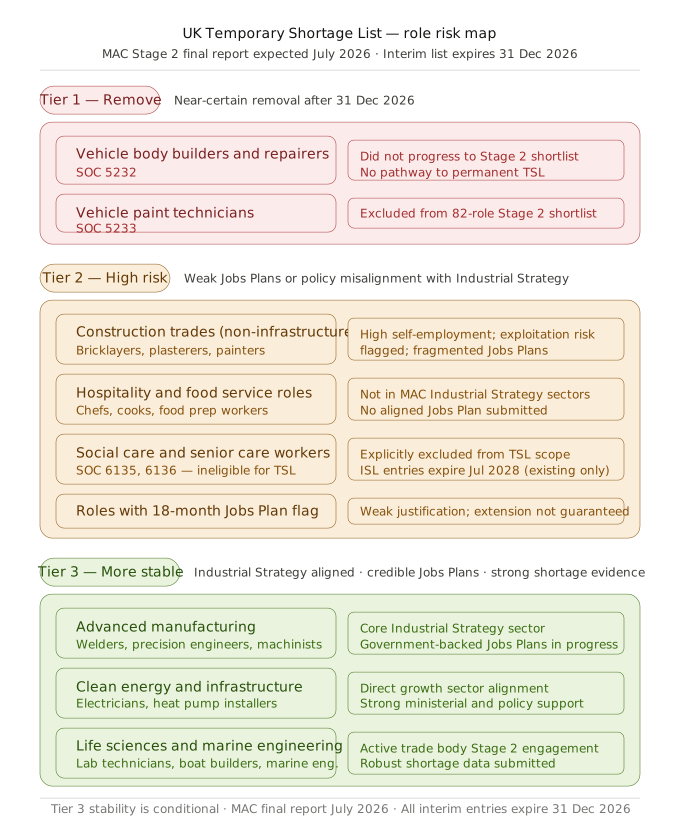
Tier 1: Near-Certain Removal
These two roles are the clearest case. The MAC excluded them from the 82-role Stage 2 shortlist at Stage 1. They remain on the interim TSL until 31 December 2026 but will not appear on any permanent list. If your company sponsors workers in these codes, your planning horizon is the end of this year.
Tier 2: High Risk : Weak Jobs Plan or Policy Misalignment
In practice, the hospitality sector faces the hardest road. It was among the biggest users of the old Shortage Occupation List, but it does not map cleanly to the government’s Industrial Strategy sectors. Without that alignment, inclusion on a permanent TSL is structurally difficult regardless of how real the shortage is.
Tier 3: Stronger Chance of Survival
Even within Tier 3, stability is conditional. Sectors with active trade body engagement, government-aligned Jobs Plans, and strong shortage data have the best odds.
What the MAC’s Stage 2 Tests Mean for Employer Planning
The MAC expects its recommendations to be acted on before 31 December 2026, which means employers may have weeks not months, to respond once the final list is published.
Here is what your workforce and mobility team should be doing now:
The Number in TSL : 82 to Fewer
The final list will be shorter than 82. It said so explicitly in its Stage 1 report. The only question is how much shorter.
Based on previous MAC reviews, occupations that make it through the initial shortlist often face a second round of scrutiny using both data-driven and qualitative assessments. In practice, this process has historically reduced shortlists by 30–50%, which could leave the final Temporary Shortage List (TSL) with around 40–60 occupations. Roles in sectors with weaker Jobs Plans, limited workforce development efforts, or little alignment with the UK’s Industrial Strategy are likely to face the greatest risk of removal.
Disclaimer: Immigration rules change quite frequently; please verify with official sources or contact us for the latest info before making any decisions.
Frequently Asked Questions : UK Temporary Shortage List MAC Review 2026
What is the Temporary Shortage List and when does it expire?
The Temporary Shortage List (TSL) is a time-limited register of RQF Level 3–5 (mid-skilled) occupations that can still be sponsored under the Skilled Worker route despite the July 2025 skills threshold increase to RQF Level 6. Every current TSL entry expires on 31 December 2026 unless the MAC recommends its inclusion in a new permanent framework and the Home Office accepts that recommendation.
When will the MAC publish its final TSL recommendations?
The MAC's Stage 2 review concludes in July 2026, when it will publish final recommendations on which of the 82 shortlisted occupations should be included on a permanent TSL. The MAC expects the Home Office to act on these recommendations before 31 December 2026, when the interim lists expire.
Which roles have already been flagged as high risk?
Vehicle body builders and repairers (SOC 5232) and vehicle paint technicians (SOC 5233) did not progress through Stage 1 and are not in the 82-role Stage 2 shortlist. They remain on the interim TSL now but face near-certain removal when it expires. Any role with a weak or absent sector Jobs Plan is also at elevated risk of Stage 2 rejection.
What is a Jobs Plan and why does it matter for TSL inclusion?
A Jobs Plan is a sector-level workforce strategy that must demonstrate measurable steps to grow the domestic labour supply — through apprenticeships, upskilling programmes, and DWP engagement — alongside plans to manage migrant worker exploitation risks. The MAC will not recommend TSL inclusion for any occupation whose sector cannot produce a credible, resourced Jobs Plan. Without one, even occupations with clear shortage evidence are expected to fail Stage 2.
Can workers in TSL roles still bring family members to the UK?
No. Workers sponsored under TSL occupations (RQF Level 3–5) cannot normally bring dependants to the UK. This restriction was confirmed by the government and was not subject to MAC recommendation. It is a significant consideration for employers recruiting internationally, as it limits the attractiveness of TSL-based roles to candidates with families.
What should employers do now if their sponsored roles are on the TSL?
Start by auditing which of your sponsored roles depend on TSL eligibility and map them against the 82 Stage 2 shortlist. Then engage with your sector trade body to understand Jobs Plan progress. Build contingency plans: either a domestic recruitment strategy, an RQF Level 6 reclassification pathway (where viable), or alternative visa routes. Do not wait for the July 2026 report to act — implementation timelines are tight.
Will the permanent TSL be shorter than the current interim list?
Yes. The MAC has explicitly stated it expects the final TSL to be shorter than the 82 roles shortlisted at Stage 1. The permanent list will only include occupations that pass all three Stage 2 tests: demonstrable long-term shortage, appropriateness of migration as a solution, and a credible sector Jobs Plan. Roles that fail any one test will not be included.

.svg)
.svg)