


Executive Summary
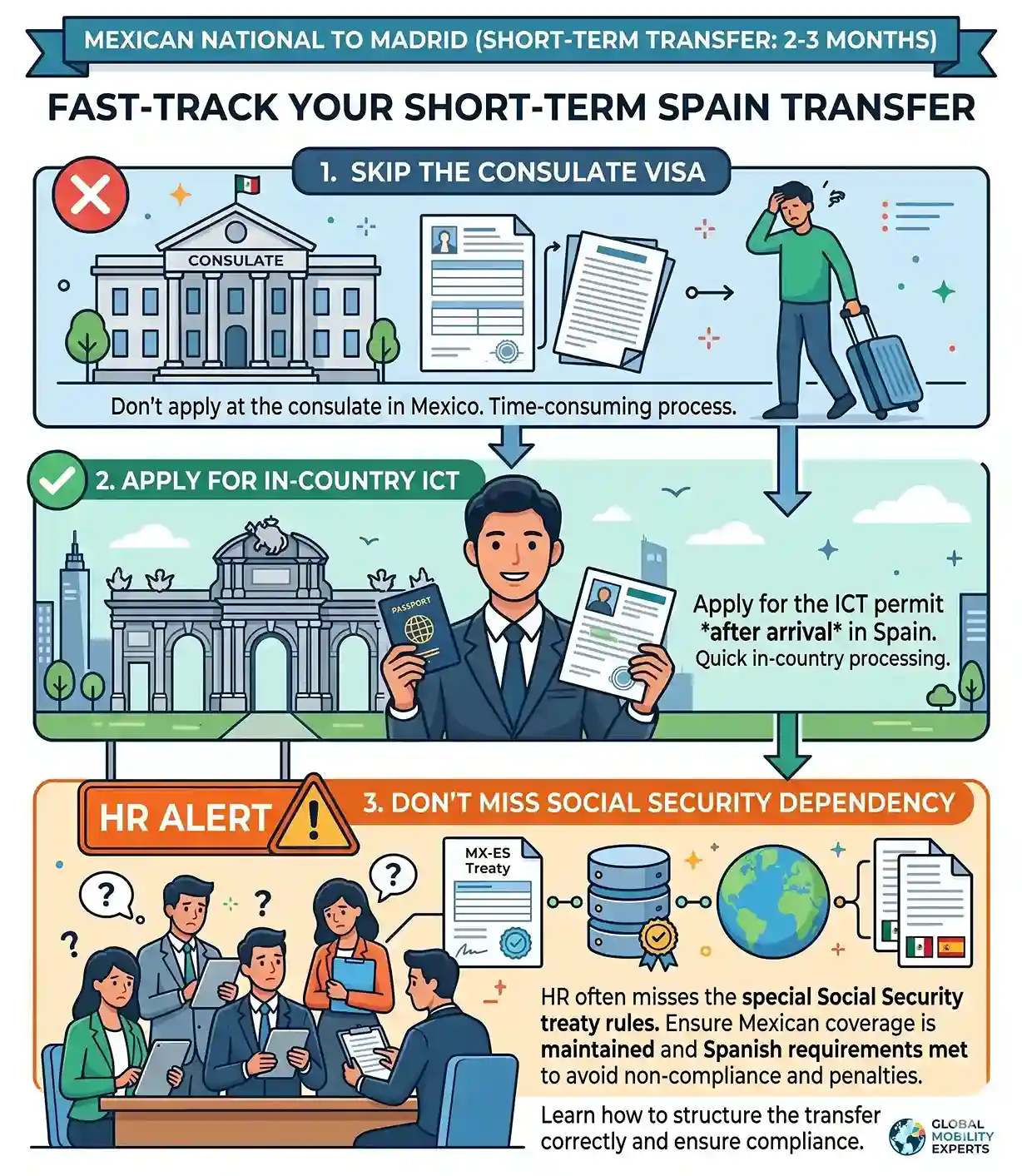
- Mexican nationals can apply for the Spain ICT permit from within Spain, entering visa-free and skipping the post-approval consular step that applies to most nationalities.
- UGE is currently approving short assignments under 3 months; the permit itself carries a 20-working-day decision deadline once submitted.
- The Spain-Mexico bilateral social security agreement requires a certificate of coverage keeping the employee under the Mexican system, and this certificate is typically the longest-running dependency in the process.
- The employee's Schengen day count (90/180-day rule) must be tracked separately from permit status, as permit approval does not reset or suspend the Schengen counter.
Question: We need to transfer a Mexican employee from our Mexico City office to Madrid for 2 to 3 months. They are already in Spain. What is the fastest compliant route?
Answer:
- An ICT permit is viable for this assignment, and the employee's presence in Spain as a Mexican national actually simplifies the process.
- Mexican passport holders can enter Spain visa-free and submit the ICT application in-country, bypassing the post-approval consular visa step that applies in most cases.
- UGE is currently approving short assignments under 3 months.
- The critical dependency is not the permit itself but the social security certificate of coverage, which is mandatory under the Spain-Mexico bilateral agreement and frequently takes longer to obtain than the permit.
- HR should initiate both processes in parallel and monitor the employee's Schengen day count independently.
Spain ICT Permit: Short Assignment from Mexico
What HR Needs to Know Before Filing the ICT for a Short Mexico-to-Madrid Assignment
The Legal Position
Spain ICT permit (Autorización de residencia inicial para traslado intraempresarial) is processed through the UGE-CE, the unit responsible for large companies and strategic groups.
For assignments under three months, UGE applies the same legal framework used for longer transfers. In practice, immigration teams in 2026 are seeing approvals for short-term assignments move forward without the extra scrutiny these cases often faced in the past.
To qualify, the employee must:
- Have at least 3 months of continuous employment with the sending company
- Be assigned as a Manager , Specialist or Trainee.
UGE reviews the role classification closely against the assignment letter and supporting documents. Titles, responsibilities, salary details, and reporting lines should all align clearly across the application.
Even small inconsistencies can trigger additional document requests.
This scenario uses the ICT-EU, not National ICT; read about ICT-EU vs National ICT permit.
The In-Country Advantage for Mexican Nationals
Mexican nationals can enter Spain visa-free under the Schengen arrangement and submit the ICT application directly from within Spain.
For employers, this removes a major step from the process:
- No consular visa appointment
- No return trip to Mexico after approval
- Faster onboarding timeline in many cases
Once UGE approves the permit, the employee completes the final step by collecting the TIE residence card at the local police station.
One point HR teams often overlook: filing the ICT application inside Spain does not stop or extend the Schengen 90/180-day limit.
The employee must still have enough remaining Schengen days to cover:
- Time between entry and permit approval
- Additional buffer in case of delays
Before confirming travel, mobility teams should check the employee’s Schengen balance using a calculator such as visa-calculator.com.
HR Guidance
1. Start the Mexican social security certificate early
Under the Spain–Mexico social security agreement, the employee must remain covered under the Mexican system during the assignment.
This requires an IMSS certificate of coverage. Read: which social security system applies during an ICT assignment.
Note: Spain A1 certificate is the EU instrument; for Mexico, IMSS certificate is the equivalent.
In many cases:
- The certificate takes longer than the ICT permit itself
- Delays in obtaining it are the most common onboarding issue in Mexico-to-Spain ICT cases
Starting late can create compliance and payroll complications. Read Jobbatical's full Spain ICT employer guide.
2. Draft the assignment letter carefully
UGE expects the assignment letter to clearly include:
- Role title
- Manager, specialist, or trainee category
- Assignment dates
- Spanish work location
- Salary terms
- Confirmation of return to the sending entity
The most common triggers for additional scrutiny are:
- Vague role descriptions
- Missing salary information
- Inconsistent job duties
3. Do not start work before approval
There is no interim work authorization under the in-country ICT route.
The employee cannot legally begin work until the ICT permit is approved.
HR and hiring teams should plan onboarding around the permit issuance date, not the application submission date.
4. Monitor Schengen days separately
Assign ownership within the HR or mobility team for tracking the employee’s remaining Schengen days.
The ICT application does not pause the 90/180-day calculation. An overstay creates a separate immigration issue, even if the permit application itself is valid.
Key Risks
1. IMSS certificate delays
If the Mexican social security certificate is not ready before the assignment starts, the company may face dual social security contribution exposure in both Spain and Mexico.
Operationally, this is one of the most common causes of delayed ICT onboarding.
2. Role misclassification
UGE may challenge the application if the role does not clearly meet the manager or specialist criteria.
This can lead to:
- Additional document requests
- Delayed approval
- Potential rejection
During this period, the employee still cannot begin work. See also, common causes of UGE rejection.
3. Insufficient Schengen days
This issue often appears when the employee already entered Spain before the assignment was finalized.
If the remaining Schengen allowance is too low to cover processing time:
- The employee may need to leave and re-enter Spain
- The assignment start date may need to be postponed until Schengen days reset
For short 2–3 month assignments, this can significantly disrupt project timelines and workforce planning.
FAQs: Spain ICT Short Assignment for Mexican Nationals Applied In-Country
This covers the following use cases:
- How do I transfer a Mexican employee to Spain for less than 3 months under an ICT permit?
- Can a Mexican national apply for a Spain ICT permit without going to the consulate?
- What is the process for an in-country ICT application in Spain for a Latin American national?
- How does the Spain-Mexico social security agreement affect a short intra-company transfer?
- What documents does UGE require for a 2-month ICT assignment to Madrid?
- Can a Colombian national also apply for the Spain ICT in-country?
- How long does the IMSS certificate of coverage take for a Spain assignment?
- What happens if my employee runs out of Schengen days before the ICT permit is approved?
- Can the employee start working before the UGE decision on a short ICT assignment?
- Does the ICT permit for a 3-month assignment require the same documentation as a 2-year transfer?
- Our employee is in Madrid as a tourist. Can we convert to ICT status without them leaving?
- What is the realistic total timeline for a Mexico to Madrid ICT transfer in 2026?













.avif)



.svg)