

Key Rejection Reasons for Spain ICT permit
- Applying with the wrong permit type (ICT vs HQP) is the single most common cause of UGE-CE rejection verify the employment relationship before filing
- Insufficient tenure documentation is a top rejection trigger - managers and specialists need 3 months' prior employment with the sending company; trainees also need 3 months
- Submitting a commitment letter instead of a Certificate of Coverage is no longer accepted
- Failure to prove the Spanish entity and sending company share a genuine group relationship — leads to immediate refusal
- Salary below the threshold (€41,356.36/year for specialists in 2026) and missing sworn translations of foreign documents are among the most avoidable document-level rejections .
Spain's ICT permit is one of the fastest routes to move non-EU talent into a Spanish entity - 20 working days at UGE-CE, no labour market test, and built-in EU mobility. But it is also one of the most frequently rejected permits in Spain's fast-track system.
Most rejections are not close calls. They are the result of predictable, fixable mistakes - wrong permit type, missing certificates, insufficient corporate documentation. Here is what causes them and how to stop them before filing.
What Is the Spain ICT Permit?
The Spain Intra-Corporate Transfer (ICT) Permit allows multinational companies to transfer non-EU managers, specialists, or trainees from a non-EU sending company to a legally affiliated Spanish host entity. It is governed by EU Directive 2014/66/EU and processed through Spain's Unidad de Grandes Empresas y Colectivos Estratégicos (UGE-CE).
The permit is valid for up to 3 years for managers and specialists, and 1 year for trainees. It is non-renewable at the end of that maximum duration.
Common Reasons Spain ICT Permit Applications Get Rejected
1. Applying for the Wrong Permit Type
The most frequent mistake is confusing the ICT Permit with the Highly Qualified Professional (HQP) Permit. While both take 20 days and go through the same office, they serve different purposes:
- ICT Permit: For existing employees at a non-EU entity being transferred to a Spanish branch.
- HQP Permit: For new hires joining the Spanish entity directly.
The Fix: Run a pre-hiring eligibility check. UGE-CE checks the employment history first; if the permit type doesn't match the history, the application is rejected immediately. Jobbatical's Spain ICT permit service includes a two-minute check that confirms which route applies to your specific employee profile.
2. Insufficient Tenure with the Sending Company
Spain has strict "minimum time served" requirements before an employee is eligible for transfer. You must prove the following tenure through payslips and contracts:
Common Pitfall: Relying on a job title without documentation.
The Fix: Gather 3 months of payslips and a formal employment verification letter before starting the application.
What counts as continuous group employment, what resets the clock, and the payslip evidence UGE-CE inspects: The 3-Month Prior Employment Rule
3. Missing or Delayed Certificate of Coverage
As of 2024–2026, Spanish authorities no longer accept "letters of commitment" as placeholders for Social Security proof.
If the employee's home country has a bilateral agreement with Spain, you must include an official Certificate of Coverage in the initial filing.
Which certificate applies to your transferee, the 2024 practice change that removed the letter-of-commitment workaround, and realistic lead times : Spain ICT Social Security
Timeline for obtaining Certificate of Coverage for Spain ICT permit
.svg)
- The Risk: These certificates can take 2–3 months to be issued by home-country authorities.
- The Fix: Start this request the moment you decide to transfer the employee. Do not wait for the visa paperwork to begin.
4. Weak Corporate Structure Evidence
An ICT permit requires a legal affiliation (subsidiary, branch, or parent company). A commercial partnership or contract is not enough.
Required Documentation:
- Spanish Entity: Registration with the Registro Mercantil.
- Foreign Entity: Official commercial registration from the country of origin.
- The Link: A group structure chart or shareholder register proving the relationship.
Note: All foreign documents must have a certified Spanish translation to be valid.
The Fix: Prepare certified copies of above documents. All documents in foreign languages require a certified Spanish translation.
5. Salary Below the Required Threshold
Your application will be rejected if the salary in the Spanish secondment letter is below the national threshold, regardless of what the employee earns in their home country.
Salary Thresholds for Spain ICT Permit Applications (2026)
The Fix: Confirm the current threshold with the Spanish Ministry of Inclusion, Social Security, and Migration before drafting the transfer agreement. Ensure the secondment or local contract clearly states a Spanish-equivalent salary that meets the threshold.
6. Missing Sworn Translations of Foreign Documents
Every document issued in a language other than Spanish must be accompanied by a certified sworn translation (traducción jurada). This includes degrees, employment contracts, corporate registration certificates, criminal record checks, and the Certificate of Coverage.
The Fix: Commission sworn translations from a certified translator (traductor jurado) for every foreign-language document in the file. Build translation turnaround time into your filing schedule - typically 5–10 working days per document.
7. Applying for an ICT Permit When the Maximum Duration Has Already Been Reached
The Spain ICT permit has a hard maximum: 3 years for managers and specialists, 1 year for trainees. Once that duration is reached, the permit cannot be renewed under EU ICT rules. Applications filed in an attempt to extend beyond the maximum are refused.
- This catches companies by surprise when an employee has already held an ICT permit in another EU member state. The EU ICT framework counts time across all EU postings toward the maximum duration, not just time in Spain.
- The Fix: If your employee is approaching the ICT maximum, begin planning the transition to an EU Blue Card Spain or HQP permit at least 3–4 months before expiry. Do not wait for the permit to lapse - a gap in legal status creates a compliance risk for both the employer and the employee.
- Once ICT-EU duration is exhausted, National ICT is the continuation route on a different legal basis, without EU mobility → EU ICT vs National ICT Permit Spain.
Once ICT-EU duration is exhausted, National ICT is the continuation route, a separate permit on a different legal basis, without EU mobility rights : EU ICT vs National ICT Permit Spain
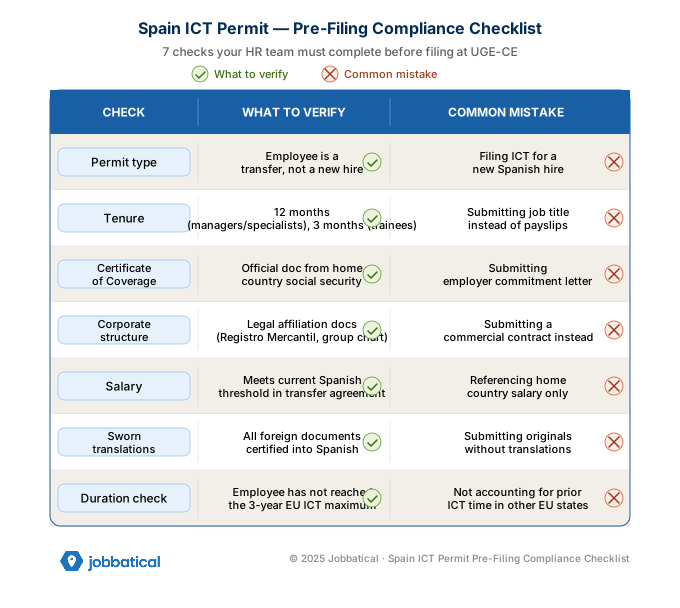
ICT Permit Rejection Risk: Quick Employer Checklist
Spain ICT permit pre-filing compliance checklist for employers
What Happens if the Spain ICT Permit Is Rejected?
A rejection from UGE-CE does not prevent a reapplication but it resets the 20-working-day clock entirely. This typically adds 4–6 weeks to the timeline, delays the employee's start date, and in some cases requires the employee to remain outside Spain until the permit is re-approved.
If a rejection is issued under Law 14/2013 on grounds that conditions were not met, companies can file an administrative appeal. However, appeals take additional time and are rarely faster than simply reapplying with a corrected file.
The most cost-effective strategy is to get the application right the first time.
Related:
For the appeal-versus-refile decision and the reposición route at UGE-CE, see our Spain EU Blue Card refusal and UGE-CE appeal guide.
Get Expert Support Before Filing
Jobbatical manages Spain ICT permit applications end-to-end - from pre-hiring eligibility checks and document preparation to UGE-CE submission and TIE card support. With experience across thousands of successful relocations and a 4.9-star rating, our team knows exactly what UGE-CE reviewers look for and how to prevent the rejections that delay your team.
Disclaimer: Immigration rules change quite frequently; please verify with official sources or contact us for the latest info before making any decisions.
Frequently Asked Questions — Spain ICT Permit Rejection Reasons

.svg)
.svg)