.svg)



Key takeaways for Short-Term Work Visas in the GCC
• Saudi Arabia offers maximum flexibility with temporary work visas up to 180 days at costs of $800-$1,335, making it ideal for longer project-based assignments requiring potential extensions and budget-conscious deployments.
• UAE provides fastest processing (7-10 days) with diverse options including mission visas and freelance permits ranging from $1,500-$2,450, best suited for time-sensitive deployments and companies requiring frequent cross-border mobility.
• Qatar maintains stricter requirements with 10-20 day processing timelines and moderate costs ($880-$1,400), most appropriate for organizations with established local presence managing single-assignment deployments in regulated industries.
• Compliance complexity varies significantly across jurisdictions, with Qatar requiring highest documentation standards while UAE offers most streamlined processing—HR teams should budget 2-3 weeks additional planning time beyond stated processing periods.
• Strategic visa selection depends on assignment duration, industry, budget constraints, and extension likelihood—organizations operating across multiple GCC countries gain efficiency through standardized documentation processes accommodating highest common requirements.
Short-Term Work Visas in the GCC: Qatar, UAE, Saudi Arabia Comparison 2026
The Gulf Cooperation Council (GCC) region continues to attract global businesses seeking expansion opportunities across energy, technology, construction, and professional services sectors. For HR teams and global mobility professionals managing short-term assignments, understanding the distinct visa frameworks across Qatar, UAE, and Saudi Arabia has become essential for operational success.
Short-term work visas in the GCC serve businesses deploying employees for project-based work, client consultations, training programs, and temporary assignments lasting from a few weeks to several months. Unlike standard employment visas requiring lengthy processing and local sponsorship commitments, these temporary work authorizations offer streamlined pathways for legitimate business activities.
This comparison addresses the most critical question for HR decision-makers: which GCC country offers the most efficient short-term work visa solution for your specific business needs?
Understanding Short-Term Work Authorization in the GCC
Short-term work visas across Qatar, UAE, and Saudi Arabia share common characteristics while maintaining country-specific requirements. These visas typically authorize foreign nationals to perform specific work activities for defined periods without establishing permanent employment relationships.
Key characteristics include: - Limited validity periods ranging from 14 days to 6 months - Specific activity restrictions tied to visa purpose - Sponsor requirements (either company or individual) - Documentation proving temporary nature of assignment - Financial guarantees or security deposits in some jurisdictions
Each GCC member state has developed its temporary work framework to balance economic openness with workforce nationalization policies. Understanding these differences directly impacts project timelines, budget allocation, and compliance risk management.
Saudi Arabia Temporary Work Visa: The Flexible Option 🇸🇦
Saudi Arabia offers multiple pathways for short-term work through its temporary work visa program, designed to support Vision 2030 economic diversification initiatives. The Kingdom has modernized its visa infrastructure significantly, creating options that accommodate various business scenarios.
Eligibility and Requirements
Saudi Arabia's temporary work visa accommodates foreign professionals engaged in: - Short-term project implementation (construction, IT, engineering) - Technical training and knowledge transfer programs - Specialized consulting engagements - Equipment installation and commissioning - Emergency repairs and maintenance operations
Standard requirements include: - Valid passport with minimum 6 months validity - Sponsorship from Saudi-registered company - Educational certificates and professional qualifications - Medical fitness certificate - Chamber of Commerce documentation for sponsoring entity - Detailed work scope and project timeline
The sponsor company bears legal responsibility for visa holder activities and must demonstrate legitimate business need. Saudi authorities require proof that the temporary assignment doesn't displace qualified Saudi nationals for permanent positions.
Processing Timeline and Duration
Processing timelines for Saudi temporary work visas typically range from 5-15 business days, depending on applicant nationality and sponsoring company's compliance history. Priority processing exists for companies with established track records.
Validity options: - 14-day emergency work authorization - 30-day short-term engagement visa - 90-day project-based work permit - 180-day extended temporary authorization (requires additional justification)
Extensions are possible but require new applications submitted before current visa expiration. Each extension triggers additional scrutiny of work necessity and duration justification.
Cost Structure
Saudi temporary work visa costs incorporate multiple components: - Visa application fee: SAR 2,000-3,000 ($535-$800) - Insurance requirements: SAR 500-1,000 ($135-$270) per month - Chamber attestation fees: SAR 300-500 ($80-$135) - Medical examination: SAR 150-300 ($40-$80)
Companies should budget SAR 3,000-5,000 ($800-$1,335) per visa including administrative processing. Bulk processing for project teams may qualify for reduced per-person costs.
UAE Short-Term Employment Solutions 🇦🇪
The UAE offers the most diverse short-term work options across its seven emirates, with Dubai and Abu Dhabi maintaining separate visa authorities under federal guidelines. Recent reforms introduced streamlined temporary work permits complementing traditional employment visa structures.
Mission Visa for Temporary Assignments
The UAE mission visa serves foreign nationals conducting short-term work for UAE-based companies without requiring full employment visa processing. This option particularly benefits consulting firms, training providers, and technical service companies.
Key features: - Validity: 30, 60, or 90 days (single or multiple entry) - Renewable once for equivalent period - Requires UAE company sponsorship - Does not require full employment contract - Faster processing than standard work permits
Mission visas restrict holders to activities specified in the sponsorship letter. Unauthorized work outside stated purpose risks penalties including visa cancellation and entry bans.
Freelance and Remote Work Permits
Dubai and Abu Dhabi have introduced freelance and remote work permits accommodating modern work arrangements. While primarily designed for self-employed professionals, these permits enable short-term project-based work arrangements.
Freelance permit characteristics: - Validity: 1-3 years - Work authorization across multiple clients - Resident visa included (enables family sponsorship) - Processing time: 7-14 days - Cost: AED 7,500-15,000 ($2,045-$4,090) annually
Remote work visas target digital nomads but can accommodate certain temporary assignment scenarios, offering 1-year validity with potential renewal.
Processing and Costs
Standard UAE temporary work authorization processing requires 7-10 business days. Expedited processing reduces timelines to 2-3 business days with premium fees.
Cost breakdown: - Temporary work permit: AED 3,000-5,000 ($815-$1,360) - Immigration medical fitness: AED 300-500 ($80-$135) - Emirates ID (if required): AED 370 ($100) - Sponsorship fees: AED 2,000-3,000 ($545-$815)
Total investment ranges from AED 5,500-9,000 ($1,500-$2,450) per temporary worker. Dubai's free zones may offer reduced fee structures for companies registered within their jurisdictions.
Qatar Temporary Work Visa Framework 🇶🇦
Qatar operates a centralized visa system through the Ministry of Interior, with recent reforms aimed at increasing labor market flexibility ahead of continued World Cup legacy project delivery and economic diversification.
Work Permit Requirements
Qatar requires temporary work permit applications processed through sponsoring companies registered with the Ministry of Administrative Development, Labour and Social Affairs (MADLSA). The system emphasizes employer accountability and worker protection.
Application requirements: - Sponsorship from Qatar-licensed company - Educational qualification attestation - Employment contract specifying assignment duration - Company commercial registration - Security clearance for certain industries - Medical fitness certificate from approved facility
Qatar maintains stricter documentation requirements compared to UAE and Saudi Arabia, particularly regarding educational credential verification and professional licensing for regulated professions.
Duration and Extensions
Qatar temporary work visas typically authorize 1-6 month assignments, with clear distinction between: - Business visas: Up to 30 days, limited work activities - Temporary work permits: 1-3 months, specific project work - Short-term contracts: 3-6 months, defined employment relationship
Extensions require employer petition demonstrating continued business necessity. Qatar imposes annual caps on temporary worker numbers per sponsoring company based on Qatarization quotas.
Processing Timeline and Investment
Qatar visa processing typically requires 10-20 business days, longer than UAE or Saudi Arabia. Enhanced scrutiny of temporary work applications reflects Qatar's focus on labor market protection.
Cost structure: - Work permit application: QAR 2,000-3,500 ($550-$960) - Medical screening: QAR 200-400 ($55-$110) - Residence permit card: QAR 500 ($135) - Insurance requirements: QAR 300-500 ($80-$135) monthly - Exit permit processing: QAR 200 ($55)
Total costs range from QAR 3,200-5,100 ($880-$1,400) per temporary worker. Qatar's exit permit requirement (being phased out for some worker categories) adds administrative complexity for employers managing multiple short-term assignments.
Side-by-Side Comparison: Strategic Considerations
Compliance and Risk Management Considerations
HR and global mobility teams must address compliance requirements beyond basic visa processing to avoid penalties, entry bans, and operational disruptions.
Labor Law Compliance
Each GCC country enforces distinct labor regulations affecting temporary workers:
Saudi Arabia requires Wage Protection System (WPS) enrollment for all workers, including temporary staff. Companies must register employment contracts with the Ministry of Human Resources and ensure timely salary payments through approved banking channels.
UAE mandates Standard Employment Contract registration for workers exceeding 60-day stays. Temporary workers gain protection under UAE Labor Law including end-of-service benefits calculated pro-rata for assignment duration.
Qatar enforces Wage Protection System and strict contract registration requirements. Temporary workers qualify for the same labor protections as permanent staff, including accommodation standards and working hour limitations.
Tax and Social Security Implications
While GCC countries don't impose personal income tax, employers must consider:
Saudi Arabia: General Organization for Social Insurance (GOSI) contributions apply to Saudi nationals only, exempting temporary foreign workers. However, companies must maintain comprehensive medical insurance.
UAE: No social security contributions required for temporary workers, but employers must provide health insurance meeting minimum coverage standards set by respective emirates.
Qatar: No income tax or social security for temporary workers, but mandatory health insurance through sponsor company covers all medical needs during assignment.
Immigration Violations and Penalties
Penalties for visa violations have increased significantly across the GCC:
Common violations include: - Working on business visa without proper authorization - Exceeding authorized stay periods - Performing work outside visa-specified activities - Unauthorized sponsorship transfers
Penalties range from fines of $1,000-$10,000 per violation to entry bans lasting 1-5 years. Companies face license suspensions or revocations for systematic violations.
Strategic Selection Framework for HR Teams
Choosing the optimal GCC short-term work visa depends on specific operational requirements:
Choose Saudi Arabia When:
- Project duration: 3-6 months requiring maximum flexibility - Industry focus: Construction, energy, industrial projects with established Saudi presence - Cost sensitivity: Budget-conscious deployments requiring lower initial investment - Extension needs: Likelihood of requiring duration extensions mid-project - Team size: Large project teams requiring batch processing
Choose UAE When:
- Speed priority: Tight timelines requiring fastest possible authorization - Business activities: Consulting, training, client services requiring frequent travel - Multiple locations: Need for cross-emirate mobility (Dubai, Abu Dhabi, others) - Modern work arrangements: Freelance or hybrid assignment structures - Premium processing: Willingness to invest more for reduced administrative burden
Choose Qatar When:
- Single assignment: One-time project with clear start and end dates - Established presence: Company already operating in Qatar with existing sponsorship - Regulated industries: Professional services requiring Qatar-specific licensing - Longer-term consideration: Assignment may convert to permanent employment - Client requirements: Qatari clients specifically requesting local work authorization
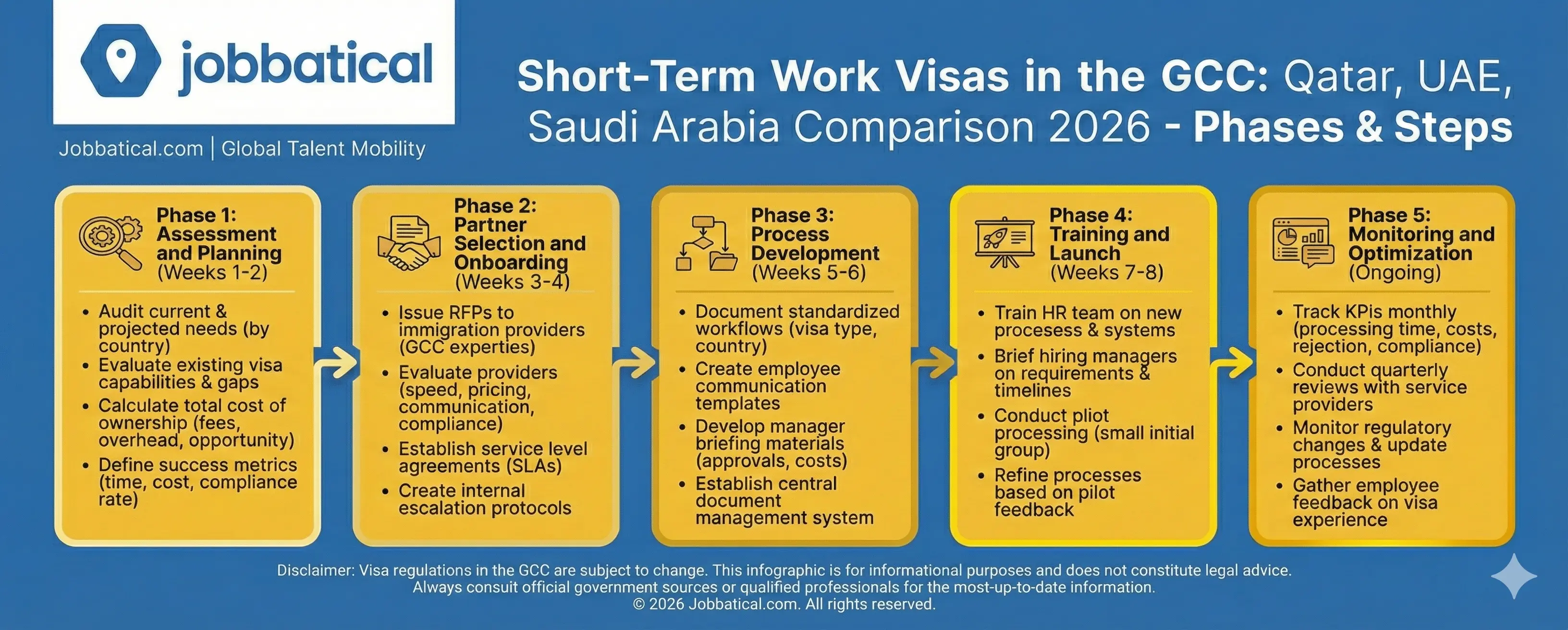
Implementation Roadmap for HR Teams
Successful GCC short-term visa management requires structured implementation:
Phase 1: Assessment and Planning (Weeks 1-2)
- Audit current and projected short-term assignment needs by country - Evaluate existing visa processing capabilities and gaps - Calculate total cost of ownership including direct fees, administrative overhead, and opportunity costs - Define success metrics (processing time, cost per visa, compliance incident rate)
Phase 2: Partner Selection and Onboarding (Weeks 3-4)
- Issue RFPs to immigration service providers with GCC expertise - Evaluate providers on processing speed, pricing, communication, and compliance track record - Establish service level agreements defining responsibilities and response times - Create internal escalation protocols for urgent requirements
Phase 3: Process Development (Weeks 5-6)
- Document standardized workflows for each visa type and country - Create employee communication templates explaining requirements and timelines - Develop manager briefing materials outlining approval requirements and cost implications - Establish document management system for centralized storage
Phase 4: Training and Launch (Weeks 7-8)
- Train HR team members on new processes and systems - Brief hiring managers on visa requirements and planning timelines - Conduct pilot processing for small initial group - Refine processes based on pilot feedback
Phase 5: Monitoring and Optimization (Ongoing)
- Track KPIs monthly: processing time, costs, rejection rates, compliance incidents - Conduct quarterly reviews with service providers - Monitor regulatory changes and update processes accordingly - Gather employee feedback on visa experience
Conclusion
Short-term work visas across Qatar, UAE, and Saudi Arabia offer distinct advantages depending on assignment characteristics, timeline requirements, and operational priorities. Saudi Arabia provides the most flexible duration options and competitive costs for longer assignments. UAE delivers fastest processing and greatest program variety for diverse assignment types. Qatar maintains stringent standards with moderate costs suitable for companies with established local presence.
HR and global mobility teams should evaluate each assignment against specific country requirements, considering not just initial visa processing but full lifecycle costs including potential extensions, compliance maintenance, and administrative overhead.
Disclaimer
Immigration laws and policies change frequently and may vary by country or nationality. While we strive to provide accurate and up-to-date information, we recommend doing your own due diligence or consulting official sources. You’re also welcome to contact us directly for the latest guidance. Jobbatical is not responsible for decisions made based on the information provided.
Frequently Asked Questions About Short-Term Work Visas in Qatar, UAE, and Saudi Arabia
What happens if a short-term assignment needs to extend beyond the original visa duration?
Extension processes vary by country. Saudi Arabia and UAE allow extensions with new applications submitted before expiration. Qatar imposes stricter limits on temporary work durations. Some situations require visa cancellation and departure, then re-entry on new authorization. Plan extension possibilities during initial application.
Are there industries with restricted access to short-term work visas in the GCC?
Yes. Qatar maintains significant restrictions in sectors prioritized for nationalization including banking, legal services, and certain government contracting. Saudi Arabia limits temporary work in retail and some service industries. UAE imposes minimal industry restrictions but requires professional licensing for regulated occupations like healthcare and engineering.
How do temporary work visa costs compare to standard employment visa processing?
Temporary work visas typically cost 40-60% less than full employment visas when considering total processing fees. However, shorter validity periods mean per-day costs may be higher. For assignments exceeding 4-6 months, standard employment visas often provide better value and fewer renewal complications.
What are the consequences of working on a business visa instead of proper temporary work authorization?
Penalties include fines of $1,000-$10,000, immediate deportation, entry bans lasting 1-5 years, and potential criminal charges. Sponsoring companies face license suspensions, hefty fines, and restrictions on future visa sponsorships. The short-term cost savings never justify the compliance risks.
Can temporary work visas convert to permanent employment authorization?
Conversion processes exist but require ending the temporary assignment and applying for standard employment visas. UAE offers most flexible conversion paths. Saudi Arabia and Qatar typically require visa cancellation, departure, and new application processing. Plan for 2-4 week gaps between authorizations unless coordinated carefully with immigration specialists.

.svg)
.svg)