

Key takeaways
- New Rule §45c AufenthG: From January 1, 2026, employers must inform third-country skilled workers in writing about free Fair Integration advice on employment and social law, including nearest center contacts, by first day of work.
- Other Key Duties: Check valid residence title for work; keep copies; notify employee of extensions; inform authorities on early termination within 4 weeks.
- Exceptions: No info duty if hired via placement agency.
- Jobbatical Help: We assess future hires' permits and ensure compliance steps for legal employment in Germany.
Introduction to Employer duties §45c Residence Act
German employers hiring skilled workers from third countries face strict immigration compliance under the Residence Act (AufenthG). A key update from January 1, 2026, mandates informing employees about advisory services via §45c.
New Obligation: §45c Residence Act
Section 45c, effective January 1, 2026, requires employers to notify third-country nationals residing or habitually in third countries about “Fair Integration” counseling on employment and social security law. Provide this in writing by the first workday, including nearest advisory center contacts.
Download multilingual leaflets (German, English, Arabic, Turkish, Ukrainian, Russian) and employer fact sheet from faire-integration.de. Select the closest center, hand to employee for signature confirmation.
If recruited via a placement agency, the agency handles this duty instead.
Your 4 core immigration compliance duties as an employer in Germany
1. Check the right to work
Before hiring, confirm that your international professional holds a valid residence title that explicitly allows employment in Germany (for example, EU Blue Card or skilled worker permit). Check type, validity dates, and any restrictions so no one starts work without proper authorization. Jobbatical’s platform can pre-assess permits and scenarios so you only onboard candidates who are fully compliant.
2. Keep a copy of the residence title
You must store a copy of the employee’s valid residence title in electronic or paper form for the duration of their employment. This proves compliance during inspections and audits and makes it easy to show that all foreign staff are properly authorized.
3. Monitor expiry and renewals
For temporary residence titles, you need to ensure the employee knows that their permit must be extended in time for continued work. Track expiry dates in your HR system, set reminders, and start renewal steps several months before the title runs out. Jobbatical can automate this tracking and reminder flow, reducing the risk of someone working on an expired permit.
4. Notify authorities when employment ends early
If the employment of a foreign skilled worker ends earlier than planned, you must inform the competent foreigners authority within four weeks of becoming aware of the termination. The authority then decides whether to shorten the residence title’s validity period. Adding this notification to your standard offboarding checklist – or automating it with Jobbatical workflows which helps you avoid fines and future scrutiny.
Germany Employer Compliance Duties for Hiring Skilled Workers (2026)
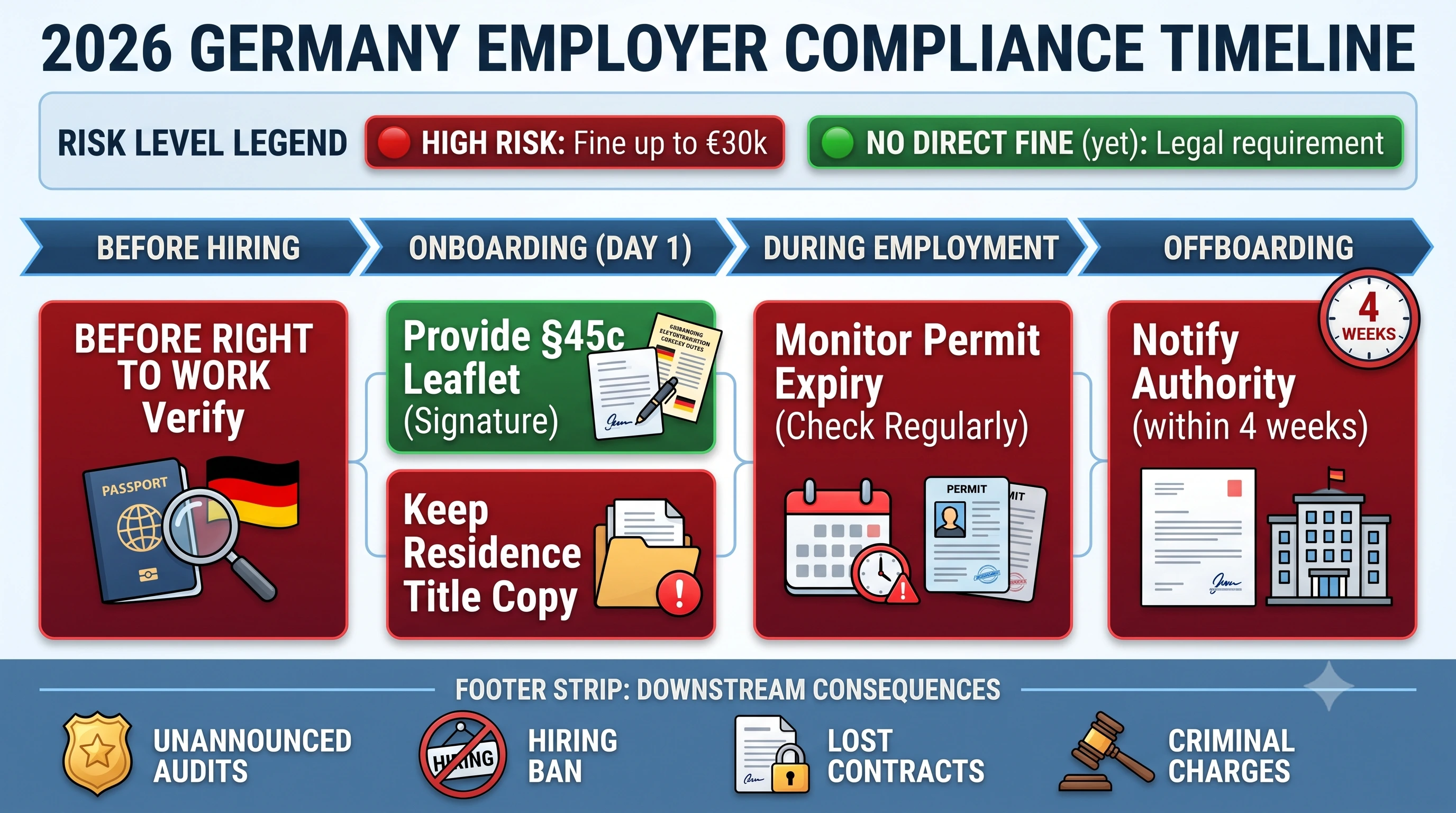
What happens if you don't comply?
When a company doesn't follow German immigration rules for foreign employees, the government views it as illegal employment, which carries real financial and operational risks for your business.
High-Risk Duties (Fines Up to €30,000 Per Employee)
Under §4a(5) AufenthG, there are four main rules you must follow. Breaking any of these can lead to heavy fines, legal trouble, and official audits:
- Right-to-Work Verification: Hiring someone who doesn't have a valid visa or residence permit that allows them to work.
- Record-Keeping: Failing to keep a copy of the employee’s valid work permit on file.
- Expiration Tracking: Letting an employee keep working after their visa or permit has expired.
- Offboarding Notification: Failing to inform the Immigration Office (Ausländerbehörde) within four weeks if a foreign employee leaves the company early.
Additional Business Risks
Repeated or severe violations of these four duties can trigger further consequences:
- Frequent, unannounced government audits
- A ban on hiring foreign talent in the future
- Loss of eligibility for government contracts and public subsidies
- Criminal charges in extreme cases
Low-Risk Duty: Fair Integration Leaflet (§45c)
Employers are required to give new foreign hires an official "Fair Integration" information leaflet during onboarding.
- The Penalty: Currently, there is no direct fine for failing to hand out this document.
- Best Practice: Even without a fine, it remains a legal requirement. Adding it to your standard onboarding checklist ensures your process stays fully compliant during inspections.
Automate visa expiration dates and notification deadlines in your HR system to prevent costly fines, and add the Fair Integration leaflet directly to your standard new-hire paperwork.
Learn how HR teams can simplify Germany work permit renewals with automation, reducing manual work and keeping employee cases on track.
How to Comply Step-by-Step
1. Verify residence title validity before hiring.
2. Download §45c leaflet from here.
3. Mark the nearest Fair Integration center and deliver to employee on day one with a signature.
4. Store title copies and monitor extensions.
5. Report terminations promptly to authorities.
Review full duties on official Make it in Germany page.
Reference German Residence Act and §45c here.
Disclaimer: Immigration rules change quite frequently; please verify with official sources or contact us for the latest info before making any decisions.
FAQs About Employer Duties for Hiring Skilled Workers in Germany 2026

.svg)
.svg)