

KEY TAKEAWAYS
- It depends on the SOC code: Nurses, doctors and other RQF Level 6 roles can still bring partners and children; care workers and senior care workers (SOC 6135/6136) cannot if sponsored after the cut-off dates.
- Dependant ban: From 11 March 2024, new care workers and senior care workers can no longer bring dependants — and from 22 July 2025, overseas recruitment for these roles closed entirely, with in-country switching only until 22 July 2028.
- Transitional protections: Workers continuously sponsored before 11 March 2024 keep full dependant rights, can extend and switch employers within their SOC code, and pursue ILR after five years.
- Exceptions: Children born in the UK to eligible care workers are exempt, and dependants already granted before the cut-off retain their rights.
- The families who qualify get a generous route: dependants of eligible workers are exempt from the Immigration Health Surcharge (a saving of £1,035 per person per year), can work in any sector, study, and settle after five years.
- 2026 changes to watch: B2 English for new applicants from 8 January 2026, tighter English rules for partners, and the ISL replaced by the Temporary Shortage List, which carries a no-dependants rule regardless of salary.
- For HR teams: screen by SOC code before promising family relocation, protect transitional status at extension, and use progression into RQF 6 nursing roles as a route back to dependant rights — the single biggest retention lever here.
When sponsoring professionals on the UK Health and Care Worker Visa in 2026, candidates always ask if they can bring their family. Eligibility now depends entirely on the job's SOC code and the original sponsorship date.
Here is how the current UK dependent visa restrictions apply:
- Doctors, Nurses and RQF Level 6 roles (including NHS-sponsored clinical staff): Dependants are still welcome and fully qualify for family visas.
- Care Workers and Senior Care Workers (SOC 6135 / 6136): Dependants are banned for new applicants as of March 11, 2024. Furthermore, overseas recruitment for these specific roles closed completely on July 22, 2025.
Designed for HR, compliance, and global mobility teams, this guide explains exactly how to navigate UK healthcare visa family rules in 2026. We cover:
- Who qualifies: Dependant eligibility and how the 2024–2026 immigration rule changes apply to your sponsored workers.
- How to apply: Practical steps for submitting a UK healthcare dependent visa application.
- Costs and residency: Current visa fees and the path to settlement for qualifying family members.
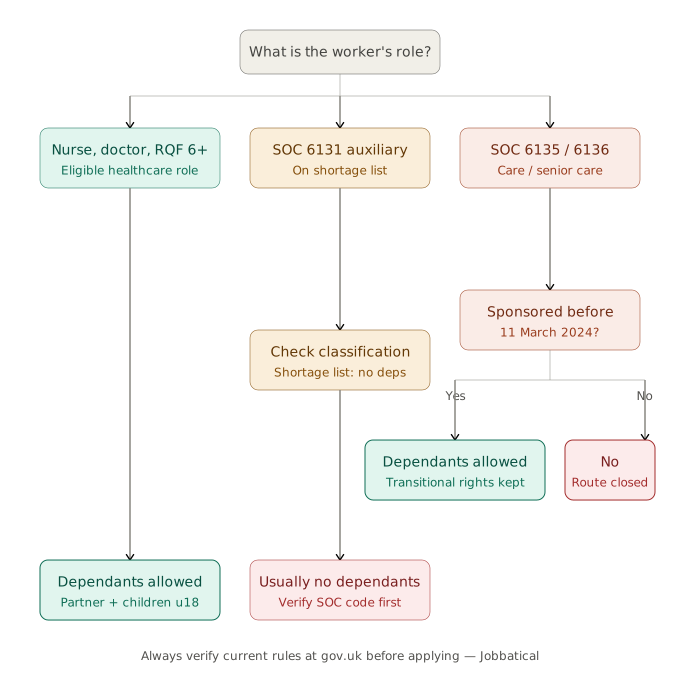
Can your sponsored worker bring dependants? The quick answer by SOC code
Dependant eligibility is decided by the worker's occupation code and when they were sponsored. Use this as your first check before promising anything to a candidate.
In short,
- If your worker is a care worker or senior care worker sponsored after the cut-off dates, they cannot bring family.
- If they are a nurse, doctor or other degree-level professional, they can bring their family along.
UK Sponsored Worker Dependent Eligibility by SOC Code
Related reading :
For the wider context on why the care route closed, see our guide to the UK care worker visa closure for employers
For the full list of qualifying occupations, our eligible roles and SOC codes guide.
Who Counts as a UK Health and Care Worker Visa Dependant?
For eligible roles, for example an NHS-sponsored nurse or doctor, UK Visas and Immigration (UKVI) allows primary visa holders to bring specific family members.
- Partners: Spouse, civil partner, or unmarried partner with at least two years of cohabitation or proof of a genuine relationship.
- Children under 18: Biological or adopted unmarried children who live with the parent.
- Children over 18: Eligible only if they were previously granted dependant status in the UK and remain dependent.
- Extended family: Parents, siblings, and other adult relatives are strictly excluded.
Verifying relationship documents before assigning a Certificate of Sponsorship (CoS) prevents unnecessary UK visa refusals and delays.
UK Care Worker Dependant Visa Rules (2024–2026 Timeline)
Family eligibility for UK Health and Care Worker visa holders depends on their original sponsorship date and job code (SOC 6135 / 6136).
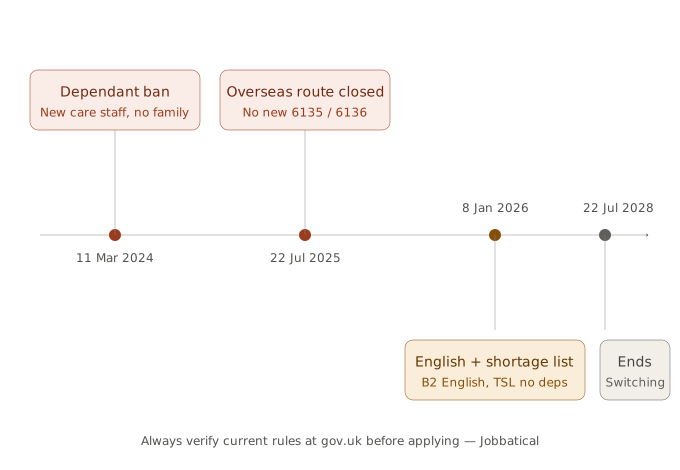
Timeline of Rule Changes
- Pre-11 March 2024 rules: Care workers and senior care workers could bring partners and children under 18, with standard paths to Indefinite Leave to Remain (ILR) after five years.
- 11 March 2024 dependant ban: UK Visas and Immigration prohibited new care workers from sponsoring dependants.
- 22 July 2025 overseas recruitment closure: Overseas recruitment for SOC 6135 and 6136 closed. In-country switching remains permitted until 22 July 2028 for workers on an employer's payroll for three consecutive months. Employers in England must be Care Quality Commission (CQC) registered, and standard Skilled Worker roles moved to RQF Level 6.
- 8 January 2026 updates: B2 level English became mandatory for new applicants. The Temporary Shortage List (TSL) replaced the Immigration Salary List (ISL), maintaining a strict no-dependants rule for low-to-medium skill roles.
Transitional Provisions for Existing Workforce
- Sponsored before 11 March 2024: Workers retain rights to extend visas, switch employers within SOC 6135/6136, sponsor dependants, and apply for ILR after five years.
- Sponsored before 22 July 2025: Workers can extend leave in-country through 22 July 2028, but switching visa routes does not restore dependant rights.
- English language exemptions: Existing visa holders renewing their visa do not need to meet the higher B2 English requirement.
- Settlement paths: Protected dependants keep their five-year path to Indefinite Leave to Remain (ILR).
Pre- vs post-reform rules at a glance
UK Health and Care Worker Dependant Visa Eligibility Criteria
For eligible primary applicants (nurses, doctors, and RQF Level 6+ roles), family members must meet standard UK Visas and Immigration (UKVI) criteria:
- Genuine relationship: Official proof of marriage, civil partnership, or two years of continuous cohabitation.
- Financial maintenance: Proof of required funds or employer sponsorship certification on the Certificate of Sponsorship (CoS).
- Suitability requirements: Valid tuberculosis (TB) test results and criminal record certificates where applicable.
- English language proficiency: Required English language proof for adult partners.
Step-by-Step UK Dependant Visa Application Process
- Confirm eligibility: Check the worker's SOC code and original sponsorship date.
- Gather evidence: Collect passports, relationship evidence, financial proofs, and English test certificates.
- Apply online: Submit individual dependant applications on gov.uk linked to the main applicant, either from outside the UK for entry clearance, or from inside the UK to switch or extend.
- Pay visa fees: Pay the relevant application fee per family member.
- Provide biometrics: Attend a Visa Application Centre (VAC) appointment for fingerprints and photos.
- Await decision: Standard UKVI decision time is roughly three weeks from the biometric appointment.
Applying from inside vs outside the UK
Where your dependant applies from changes the route, not the eligibility. The SOC-code rules above decide whether they can come at all; the location decides how they apply.
- From outside the UK (entry clearance): the dependant applies online from their home country, pays the fee, and attends a visa application centre for biometrics. They can apply at the same time as the main worker or join later. This is the standard route for a family relocating together.
- From inside the UK (switching or extending): a partner or child already in the UK on another visa can apply to switch into, or extend as, a Health and Care dependant without leaving. This suits families where one member is already here on a study or work route.
Either way, each dependant needs their own application linked to the main applicant's visa, and the worker must be in an eligible role. For workers switching in-country under the care-route transitional rules, see our guide to the care worker visa closure.
UK Health and Care Dependant Visa Fees and Exemptions
- Application fee: Approximately £324 per dependant for up to three years, or £628 for over three years.
- IHS exemption: Fully exempt from the £1,035 per person per year Immigration Health Surcharge (IHS), saving families thousands of pounds.
- Biometrics fee: Approximately £19.20 per applicant.
- Employer incentives: Reimbursing dependant application costs serves as a high-value retention strategy for healthcare employers.
UK Health and Care Dependant Visa Rights and Restrictions
- Work rights: Full access to employment and self-employment without sector restrictions.
- Study rights: Unrestricted enrollment in UK schools, colleges, and universities.
- Travel freedom: Permission to leave and re-enter the UK while visa leave remains valid.
- Healthcare access: Full access to NHS services under the IHS fee exemption.
Visa Extensions and Settlement Path
- Visa extensions: Dependants extend stay alongside the main Health and Care Worker visa holder, each family member applies before their current leave expires, showing the relationship still subsists and the worker remains in an eligible sponsored role.
- Settlement eligibility: Dependants qualify for Indefinite Leave to Remain (ILR) after five years of continuous UK residence.
- Policy monitoring: HR teams should track proposed UK government policy updates affecting long-term settlement timelines.
HR and Compliance Checklist
- Screen SOC codes first: Verify the job code and original sponsorship date before promising family visa sponsorship.
- Protect transitional rights: Audit your sponsored workforce to ensure pre-2024 and pre-2025 protected rights are maintained during visa extensions.
- Use role progression: Upskilling care workers (SOC 6135/6136) into RQF Level 6 roles like registered nursing restores dependant sponsorship rights.
- Ensure strict compliance: Confirm CQC registration, minimum salary thresholds, and B2 English language compliance to prevent sponsor licence issues and visa refusals.
Related:
For the licensing picture, see our sponsor licence guide for healthcare employers.
How Jobbatical helps with UK Dependant Visas
Jobbatical runs eligibility screening (including SOC-code and English checks), compliance audits, and dependant application support so your healthcare hires, and their families, clear the process without avoidable refusals. Explore our UK Health and Care Worker visa services and UK dependant visa support, or read the full Health and Care Worker visa guide for employers.
Disclaimer: Immigration rules change frequently. Please verify current fees, thresholds and eligibility with official sources at gov.uk or contact us before making decisions.
Frequently Asked Questions About UK Care Worker Dependent Visa Restrictions

.svg)
.svg)