

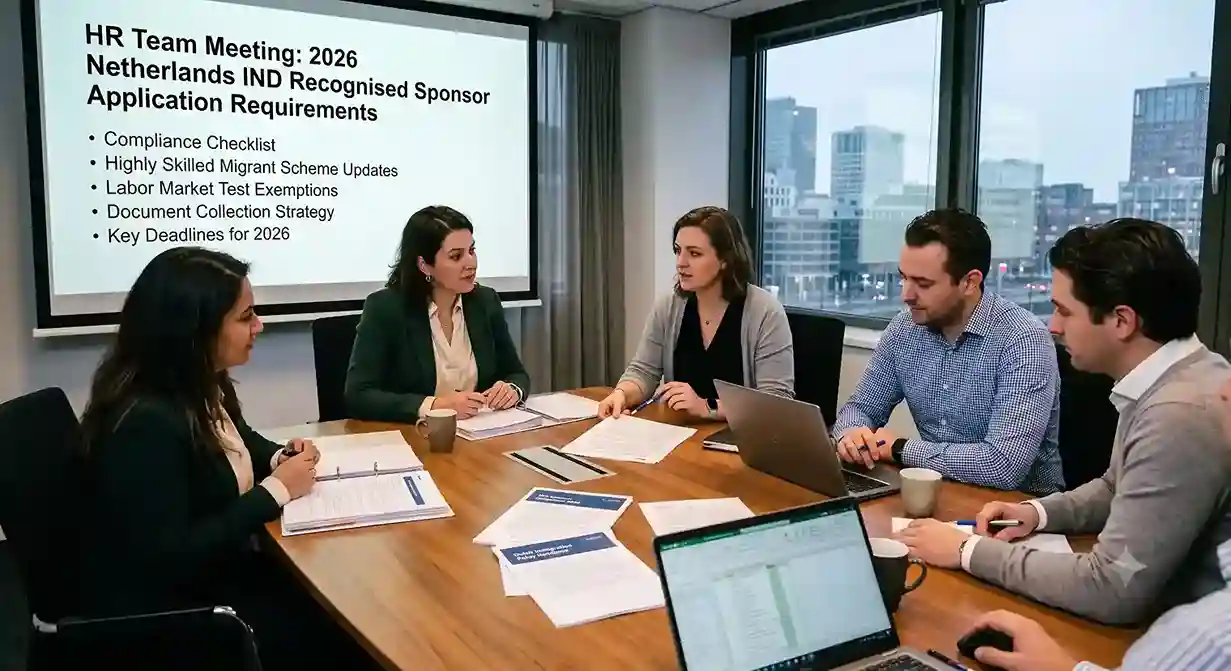
KEY TAKEAWAYS - Netherlands Recognised Sponsor
- Recognised sponsor status (erkend referent) is mandatory before you can sponsor Highly Skilled Migrants, EU Blue Card holders, or ICT transfers under the fast-track IND route.
- The 2026 IND recognition fee is €5,080 for standard companies and €2,539 for firms with 50 or fewer employees; the per-permit HSM/Blue Card fee is €423.
- 2026 HSM salary thresholds are €5,942 gross per month for age 30+, €4,357 for under 30, and €3,122 reduced for recent graduates, all excluding 8% holiday allowance.
- From 1 January 2026 you must retain bank statements or batch-payment proof showing each salary was paid into the employee's own account, kept for five years after sponsorship ends.
- The inactivity window has tightened: skip the HSM scheme for two consecutive years and the IND can begin revoking your status.
What Is Netherlands Recognised Sponsorship?
Recognised sponsorship (erkend referent) is an official Immigration and Naturalisation Service (IND) designation that permits your company to sponsor foreign nationals for Dutch residence permits. Serving as a foundational licence for international hiring, this status is essential for accessing fast-track immigration routes.
Governed by the Dutch Aliens Act, this status grants a legal privilege accompanied by strict, enforceable compliance duties. The IND closely monitors sponsors to ensure these regulatory obligations are consistently met.
Key Characteristics of Recognised Sponsorship
- A one-time, permanent designation: While recognition is granted indefinitely, it requires ongoing compliance and is subject to regular audits. Applications must be filed under specific immigration categories, such as labour, study, research, or exchange.
- Mandatory for key employment permits: Your organisation must hold labour-category recognition to sponsor Highly Skilled Migrants, EU Blue Card holders, Intra-Corporate Transferees (ICT), and orientation-year graduates via the streamlined route.
- Accelerated processing benefits: In exchange for assuming sponsorship duties, recognised sponsors benefit from expedited permit decisions typically within two weeks alongside reduced documentation requirements and exemption from local labour market tests for eligible roles.
- Publicly verifiable status: The IND maintains an open public register listing approximately 10,000 recognised sponsors, allowing prospective candidates and business partners to seamlessly verify your organisation's credentials before accepting an offer.
- A trust-based, audit-driven framework: The IND operates on a high-trust model, conducting streamlined administrative checks during the initial application phase. However, this is balanced by rigorous post-approval inspections to verify that the sponsor continues to meet all legal obligations.
For the definitive route to secure this status, our Netherlands recognised sponsorship (erkend referent) service manages the full IND application and compliance setup from day one.
What Are the Benefits of Netherlands Recognised Sponsorship?
Recognised sponsorship delivers significant advantages in processing speed and administrative simplicity. For organisations hiring internationally on a regular basis, this status eliminates systemic friction, offering clear, compounding benefits for both the employer and the relocated talent.
What Are the Benefits for Organisations?
- Accelerated permit processing: Applications for Highly Skilled Migrants (HSM) are typically processed within two weeks rather than several months, ensuring new hires onboard swiftly and business operations remain on schedule.
- Reduced administrative burden: Streamlined procedures significantly decrease the documentation required per application, easing the ongoing workload for your HR and global mobility teams.
- Direct IND Business Portal access: Sponsors can submit applications digitally through the IND Business Portal, bypassing traditional, time-consuming embassy procedures in most instances.
- Enhanced employer branding: Recognised status signals legal credibility and compliance to prospective candidates, providing a critical competitive advantage when recruiting highly sought-after international talent.
- Versatile immigration coverage: A single labour-category recognition encompasses various permit types including Highly Skilled Migrants, researchers, EU Blue Card holders, and Intra-Corporate Transferees (ICT) eliminating the need to re-qualify for different hiring routes.
What Are the Benefits for International Talent?
- Expedited relocation timelines: Accelerated permit approvals allow international professionals to transition to the Netherlands and commence work significantly faster than standard immigration routes permit.
- Enhanced legal certainty: Relocating under a secure, IND-approved sponsorship pathway provides employees with stability and peace of mind during a major life transition.
- Streamlined family reunification: Sponsored employees can easily sponsor eligible partners and dependent children to join them under the comprehensive Dutch family reunification framework.
- Clear pathway to permanent residency: Continuous legal residence as a sponsored employee counts directly toward long-term EU residence and, ultimately, Dutch citizenship eligibility.
- Immediate civic integration: Employees and their families gain immediate, legitimate access to essential Dutch infrastructure, including healthcare, education, and social services from day one.
To see how these benefits apply to a specific role, our Netherlands Highly Skilled Migrant (kennismigrant) permit service shows the exact process recognised sponsors follow for each hire.
Who Is Eligible for Netherlands Recognised Sponsorship?
Eligibility hinges on demonstrating that your organisation is authentic, financially solvent, and operationally sustainable. The IND requires concrete evidence of your capacity to fulfill sponsorship obligations before granting access to expedited immigration channels. While established employers typically meet these criteria with ease, newly formed enterprises are subject to more rigorous financial scrutiny.
Core Eligibility Criteria for Recognised Sponsorship
- Active Dutch legal entity: Your organisation must be legally established in the Netherlands or operate as a registered branch maintaining an active registration with the Dutch Chamber of Commerce (KvK).
- Demonstrated financial stability: The company must be completely free from pending bankruptcy, insolvency, or liquidation proceedings. Notably, enterprises operating for less than 18 months are subject to a mandatory solvency assessment by the Netherlands Enterprise Agency (RVO), which will extend the standard application timeframe.
- Genuine sponsorship requirement: The IND requires a legitimate, ongoing business need to recruit foreign nationals for employment or study. The status is intended for active use and cannot be held passively in reserve.
- Clean compliance history: The organisation must have no severe infractions of Dutch labour, tax, or social security laws, and its directors must be free from recent administrative fines under the Dutch Aliens Act.
- Designated compliance representative: Your organisation must officially appoint an internal point of contact who assumes direct accountability for fulfilling the IND’s ongoing compliance, reporting, and administrative record-keeping obligations.
Startups can qualify too, though the path differs. Our guide to the Netherlands GVVA combined work and residence permit explains a managed route for roles that fall outside the highly skilled category.
.svg)
What Are the Requirements for Netherlands Recognised Sponsorship?
Requirements are divided into two distinct phases: the initial documentation required to secure approval, and the continuous compliance duties that follow. The latter phase is where organisations face the greatest compliance risk, as these mandatory obligations remain active throughout the entire lifecycle of every permit you sponsor.
What Documents Do You Need for the Application?
- Completed IND application form: This must be meticulously completed and signed by an authorised corporate representative. Inaccuracies or omissions at this stage are the primary cause of processing delays.
- Corporate founding documents: A recent extract from the Dutch Chamber of Commerce (KvK) issued within the last three months alongside certified articles of association or deeds of incorporation.
- Proof of financial viability: Audited annual accounts from the two most recent fiscal years, or a mandatory RVO business plan assessment for enterprises operating for less than 18 months.
- Tax compliance certificate: Official confirmation from the Dutch Tax and Customs Administration (Belastingdienst) demonstrating that the organisation carries no outstanding tax liabilities.
- Authorised power of attorney: If partnering with an immigration provider such as Jobbatical, a signed mandate explicitly authorising the representative to act on your organisation's behalf before the IND.
What Are the Ongoing Compliance Obligations?
- Strict four-week reporting window: You must proactively notify the IND within four weeks of any material change to a sponsored employee's circumstances, including contract termination, role transitions, salary adjustments, or address updates.
- Comprehensive administrative tracking: Employers must maintain meticulously organised, instantly retrievable personnel files for every sponsored national, ensuring continuous audit readiness at all times.
- Continuous salary threshold compliance: You must guarantee that the employee's remuneration remains at or above the applicable IND statutory threshold for the entire duration of their permit, not solely at the point of hire.
- Five-year document retention: The organisation is legally required to securely archive the complete sponsorship file for five years following the end of the employee's sponsorship period.
- Mandatory audit cooperation: Sponsors are obligated to provide full transparency, immediate documentation access, and complete cooperation during IND information requests or unannounced on-site inspections.
To stay ahead of every deadline, our visa and permit renewals compliance module tracks reporting windows and salary-threshold changes across your sponsored workforce.
What Are the 2026 IND Salary Thresholds for Recognised Sponsors?
Salary is the single hardest requirement to keep compliant, because it moves every year. For applications received on or after 1 January 2026, the thresholds rose about 4.4%. The figure that applies is the one in force on the application date, so timing matters.
Netherlands 2026 HSM and EU Blue Card Salary Thresholds (Gross Monthly, Excluding 8% Holiday Allowance)
- Gross before the 30% ruling: The IND assesses thresholds on gross pay before the 30% tax benefit is applied, so the ruling does not lower the salary you must contract.
- Excludes holiday allowance: All figures are exclusive of the 8% holiday allowance, so base salary alone must clear the threshold.
- Application date decides the figure: Applications received before 1 January 2026 are judged on 2025 amounts; those received after are judged on 2026 amounts.
- Renewals are caught too: Existing HSM holders whose permits renew under the new rules may need a salary adjustment to stay compliant.
- Market conformity still applies: Pay must also match sector norms, so a threshold-meeting salary that is below market for the role can still be challenged.
Get the full breakdown by age band in our guide to the 2026 Netherlands highly skilled migrant salary thresholds, updated with the official IND figures.
What Salary Payment Proof Must Sponsors Keep in 2026?
A critical regulatory update that many sponsors underestimate takes effect on 1 January 2026. Merely meeting the statutory salary threshold on paper is no longer sufficient; employers must now provide concrete proof that funds were successfully deposited directly to the employee, as payslips alone will no longer satisfy IND audits.
New 2026 Salary Verification Requirements
- Mandatory proof of actual receipt: Sponsors must systematically retain financial documentation demonstrating that the required monthly salary was successfully deposited into a bank account registered strictly in the employee's own name.
- Straightforward evidentiary standards: Acceptable proof includes official business bank statements or standard batch-payment overviews, provided they transparently verify the transaction's completion.
- Critical visibility of specific data points: Every piece of retained evidence must clearly display three essential elements: the execution date, the exact monetary amount transferred, and the recipient's full name alongside their personal account number.
- Acceptance of digital documentation: Digital banking screenshots or exported CSV records from your corporate payroll provider are fully compliant, so long as the requisite transaction details remain completely legible.
- Seamless integration with automated payroll: Organisations executing standard SEPA batch payments with comprehensive recipient details likely already fulfill this new mandate, meaning compliance can often be maintained with minimal additional administrative effort.
Sponsors already running automated SEPA batch payments with full recipient details usually meet this standard with almost no extra work. For the pay figures these records must clear, see our guide to the 2026 Netherlands highly skilled migrant salary thresholds.
How Much Does Netherlands Recognised Sponsorship Cost in 2026?
When forecasting sponsorship expenses, organizations must budget for two distinct costs: a one-time recognition fee and a recurring per-permit fee for each sponsored employee. Both fees increased by approximately 4.4% in 2026 due to standard annual indexation. It is crucial to factor the per-hire costs into initial financial planning, as these recurring expenses are frequently overlooked by finance teams until the first permit is processed.
Netherlands Recognised Sponsor and Permit Fees 2026
- Recognition fee, standard: €5,080 for corporate entities with more than 50 employees, up €214 from 2025.
- Recognition fee, reduced: €2,539 for smaller firms with 50 or fewer employees and recognised startups, up €107.
- Per-permit fee: €423 for each HSM or EU Blue Card first application, change of purpose, or extension. Ten hires means €4,230 in permit fees alone.
- The sponsor pays: Your company covers these fees, not the employee, so they belong in your hiring budget.
- Non-refundable: Fees are not returned if an application is refused, which makes getting the submission right the first time a direct cost saving.
What Is the Application Process for Netherlands Recognised Sponsorship?
The application process is fundamentally document-centric rather than legally complex, meaning the primary risk to your timeline is an incomplete submission. To mitigate potential delays, it is highly recommended to initiate the process at least three to four months before your target first sponsorship date. This strategic buffer comfortably accommodates any supplementary IND information requests or mandatory site visits without derailing your global hiring strategy.
What Are the Step-by-Step Application Stages?
- Confirm eligibility and determine category: Begin by identifying the appropriate recognised sponsor category most frequently the labour category and rigorously verify that your organisation satisfies all baseline eligibility criteria.
- Compile and prepare documentation: Systematically gather the required materials, including the KvK extract, audited financial statements, a tax compliance certificate, and internal corporate documents. Ensure that certified translations are provided wherever legally required.
- Submit the application and remit fees: Lodge your comprehensive application directly with the IND, ideally digitally via the IND Business Portal or through postal mail. The mandatory recognition fee must be paid concurrently with the submission.
- Respond promptly to IND inquiries: If the IND requests supplementary documentation, you must provide the precise information within the stipulated deadline typically four weeks. You must also cooperate fully if selected for an on-site compliance visit.
- Receive final decision and register: Upon successful approval, your organisation is officially entered into the public register of recognised sponsors, granting you immediate authority to begin submitting expedited permit applications.
Where Do You Apply and How Long Does It Take?
- Submission channels: Applications are submitted directly to the IND. This is optimally done online via the Business Portal (requiring an eHerkenning login) or alternatively by post to a designated IND processing office.
- Timelines for established enterprises: Organisations demonstrating a solid, verifiable trading history frequently receive their assessment decisions within two to four weeks.
- Timelines for newly established firms: Companies operating for less than 1.5 years are required to undergo a comprehensive RVO financial assessment, which can extend the overall processing timeline to up to six months.
- Statutory maximum processing period: By law, the IND has a maximum of 90 days to issue a formal decision on a recognised sponsor application. However, meticulously prepared, complete applications typically conclude well before this legal deadline.
- Status activation: Following an approval decision, your official recognised sponsor status is activated within the IND systems typically within one to two weeks, enabling immediate use.
To skip the portal setup and document errors that cause most delays, our Netherlands immigration services team manages IND onboarding and submission end to end.
What Are the Compliance Risks for Employers in 2026?
The Immigration and Naturalisation Service (IND) has noticeably tightened its enforcement framework for 2026, conducting more frequent compliance inspections and demonstrating a significantly lower tolerance for administrative discrepancies. While securing recognised sponsor status is a critical milestone, maintaining it demands robust, ongoing governance; compliance failures at this stage can directly jeopardise the legal residence rights of your existing international workforce.
Intensified Enforcement Measures and Penalties
- Shortened inactivity threshold: If an organisation goes two consecutive years without actively utilising the Highly Skilled Migrant (HSM) scheme, the IND may initiate proceedings to revoke the recognised status a strict reduction from the previous three-year grace period.
- Rigorous salary-proof audits: The IND now routinely demands direct, immediate insight into corporate banking records to definitively verify salary disbursements. Sponsors must ensure these financial records are meticulously maintained and instantly retrievable during an audit.
- Substantial administrative fines: Breaches of the statutory duty of care or the obligation to inform can attract significant financial penalties, with fines reaching up to €1,500 for individuals and €3,000 for corporate legal entities per infraction.
- Escalating formal warnings: A formal compliance warning issued by the IND remains actively valid for 24 months. Any repeat violations recorded within this probationary timeframe will automatically trigger escalating fines or more severe disciplinary actions.
- Suspension or full withdrawal: For severe, systemic, or repeated compliance failures, the IND retains the ultimate authority to suspend or completely withdraw your recognised sponsorship. Furthermore, the agency may enforce a punitive ban, blocking the organisation from reapplying for up to five years.
What Salary-Proof Records Must HR Teams Keep for an IND Audit?
Salary-proof audits are now the single most common trigger for IND enforcement, so knowing exactly what to retain and how to store it is the difference between a clean check and a fine. The IND's obligations page is explicit that payslips alone are no longer enough, you must show the money reached the employee.
- The exact IND standard: For highly skilled migrants and EU Blue Card holders, the IND requires documents showing the salary was received every month and deposited into a payment account held in the employee's own name, a business bank statement or a batch-payment overview both satisfy this.
- The three-document set to retain: Keep the employment contract or appointment decision (stating salary amount and payment timing), monthly payslips or salary specifications, and proof of the actual transfer for every sponsored HSM and Blue Card hire.
- What the transfer proof must show: Each record must clearly display the payment date, the amount, the recipient's full name, and the recipient's bank-account number in the employee's own name. Online-banking screenshots or an exported payroll CSV are accepted, provided these points stay legible.
- A searchable naming convention: Store proofs in a secure digital archive using a consistent format such as EmployeeID_YYYY-MM_SalaryProof.pdf, and run a quarterly spot-check on a sample of active files to confirm the named-account rule is met.
- Archive the full set on exit: When an employee leaves or changes sponsor, immediately archive the complete five-year record, since the retention clock runs for five years after your company stops being the recognised sponsor.
Build audit-ready compliance into your workflow with our immigration case management platform, which centralises records and flags obligations before they lapse.
Conclusion: Is Recognised Sponsorship Worth It in 2026?
If the Netherlands is becoming a core hub for your team, recognised sponsorship pays for itself past three to five hires a year through faster processing and lighter admin. The 2026 changes raise the stakes on compliance, but they do not change the core value: it remains the cleanest way to hire highly skilled talent directly.
Your next move is a simple one. Confirm which category you need, check your financials against the IND criteria, and build the salary-proof habit into payroll before your first hire, not after your first audit. Talk to our experts to get a clear cost estimate and timeline for your organisation.
Disclaimer: Immigration rules change quite frequently; please verify with official sources or contact us for the latest info before making any decisions.
Frequently Asked Questions - Netherlands Recognised Sponsorship 2026

.svg)
.svg)