

KEY TAKEAWAYS: Spain Posted Worker Communication
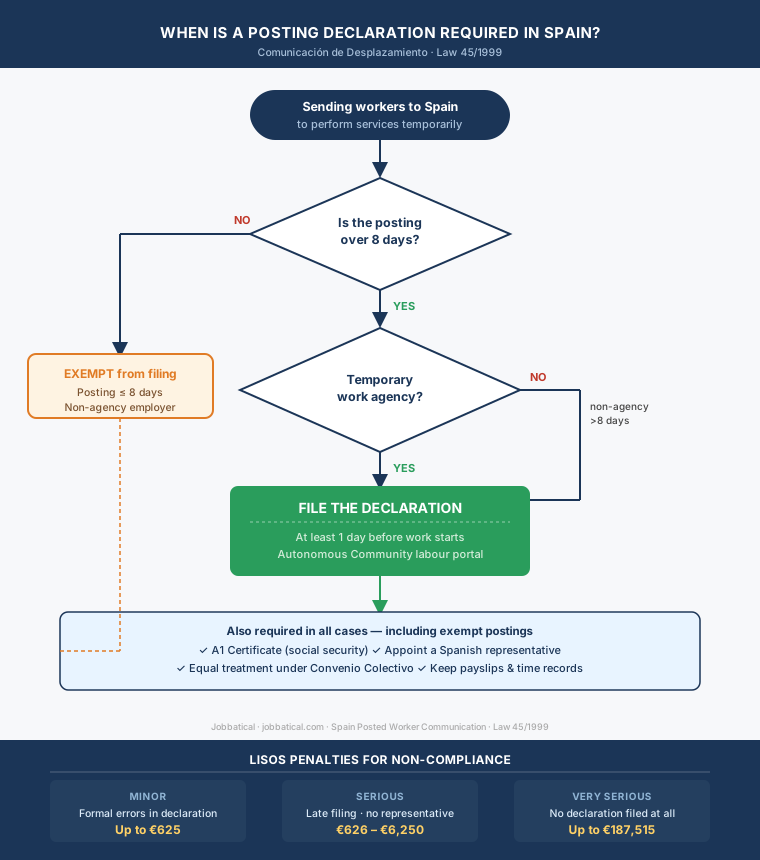
- File the Comunicación de Desplazamiento with the Autonomous Community's labour authority at the latest one day before the posting starts.
- Postings of 8 days or less are usually exempt, but temporary work agencies must file for any duration.
- An A1 certificate covers social security only; the posting declaration is a separate labour law duty checked by a different body.
- Posted workers are owed the core conditions of the applicable Convenio Colectivo, including its minimum wage, not just their home salary.
- Not filing at all is a very serious LISOS infraction, with fines from €6,251 up to €187,515 and possible joint liability with the Spanish host.
When an employee is posted to Spain, the employer must submit a notification to the Spanish labour authority before the employee starts work. This is called the posted worker communication or Comunicación de Desplazamiento.
This filing is separate from the employee’s visa or A1 certificate. If the employer fails to submit it, the fine can be as high as €187,515. Here is what to file, when it is due, and what happens if you miss it.
What is Spain posted worker communication?
Spain posted worker communication is a mandatory notification an employer files with the labour authority of the Autonomous Community where the work will happen. It applies when you send an employee to Spain temporarily while keeping them on your home payroll, under the EU rules on transnational provision of services.
The duty comes from Law 45/1999, Spain's transposition of the Posting of Workers Directive. It is a labour law obligation, policed by the Labour and Social Security Inspectorate (ITSS), and it is separate from immigration and social security paperwork.
Who has to file posted worker communication, and by when
Any company established in the EU or EEA that posts staff to Spain must file. So must temporary work agencies, with no exemption. The declaration goes to the labour authority of the region where services are provided, at the latest one day before the posting begins.
- Postings of eight days or less are generally exempt, except for temporary work agencies, which always file.
- Non-service trips, such as conferences, internal meetings, or a trade fair on a business visa, are not postings and usually sit outside the filing.
- An intra-corporate transfer to a Spanish entity does count as a posting once productive work starts.
When is a posting declaration required in Spain?
What the Comunicación de Desplazamiento must include
The declaration is filed electronically through the portal of the relevant Autonomous Community. Have this ready before you start, because a formal error is itself a sanctionable shortcoming.
Required information for the posting declaration
Equal treatment: the Spanish conditions you must apply
Paying your employee their home salary is not enough. Posted workers are entitled to the core conditions local staff receive for the same job, set by the relevant Spanish collective agreement, the Convenio Colectivo.
Core conditions posted workers are entitled to in Spain
Long-term postings and the 12-month rule
A standard posting can run up to 12 months. Beyond that, you can file a motivated notification to extend posted status to 18 months. After that, a fuller set of Spanish labour protections applies, closer to those of a local hire.
Watch replacements. Swap one worker for another doing the same job at the same site and the periods add up toward the 12-month threshold. You cannot reset the clock by rotating staff.
Penalties for getting it wrong
Sanctions sit under LISOS, Spain's labour infractions law, and scale with severity. Fines can be applied per worker, and both your company and the Spanish host can be held jointly liable. Failing to file at all reaches €187,515.
For the full sanction tiers, joint-liability rules, and how an ITSS inspection turns into a fine, see our Spain posting compliance and enforcement guide
Disclaimer: Immigration rules change quite frequently; please verify with official sources or contact us for the latest info before making any decisions.
Frequently Asked Questions About the Spain Posted Worker Directive

.svg)
.svg)