

KEY TAKEAWAYS
• The Schengen Area covers 29 European countries, allowing visa-free movement once a single Schengen visa is granted — one application unlocks the entire zone.
• The 90/180-day rule strictly limits non-Schengen nationals to 90 days of stay within any rolling 180-day window across all member states combined.
• For HR and global mobility teams, Schengen visa compliance is a company-level obligation — violations can block future employee relocations and damage corporate credibility.
• Short-stay Schengen visas do not permit work; businesses hiring or relocating talent into Europe must apply for the correct national work permit or EU Blue Card.
• Jobbatical streamlines Schengen and European work visa compliance, reducing administrative burden and ensuring every relocation meets EU immigration standards.
Schengen Visa Rules: A Complete Guide for European Business Travel
The Schengen Area is one of the world's most significant freedom-of-movement zones — and one of the most misunderstood by global businesses. Whether your company is sending employees on short-term assignments, attending multi-country conferences, or relocating talent across Europe, Schengen visa rules govern every crossing. Getting them wrong can lead to entry refusals, fines, and long-term travel bans.
This guide covers Schengen visa rules across all 29 member states, the 90/180-day rule, visa types, work restrictions, and what HR teams must know to stay compliant.
What Is the Schengen Area?
The Schengen Area is a treaty zone where 29 European countries have abolished internal border controls, allowing people to travel freely between member states once they have legally entered. It is not the same as the European Union — several EU countries are not Schengen members, and some non-EU countries are.
All 29 Schengen Member States (2026)
Map of the 29 Schengen Area member states

The 90/180-Day Rule: What Every HR Team Must Track
The most critical Schengen rule for global mobility professionals is the 90/180-day rule. Non-Schengen nationals — including UK citizens after Brexit, US nationals, Indian nationals, and many others — may stay in the Schengen Area for a maximum of 90 days in any rolling 180-day period.
This is not a per-country limit. All days spent across any Schengen state count collectively towards the same 90-day cap. A week in Berlin, a few days in Paris, and a conference in Amsterdam all reduce the available days from the same shared allowance.
Read all about the Schengen 90/180 day rule in detail.
Types of Schengen Visas
There are two primary visa categories that apply to European business travel and relocation. Understanding the distinction is essential for HR compliance.
Schengen Visa Types Compared
A Type C visa covers standard business trips — meetings, conferences, negotiations, and training. It does not permit the holder to take up employment. For employees relocating to work in Europe, a Type D national visa linked to a work permit (such as the EU Blue Card) is required.
Which Nationalities Require a Schengen Visa?
Visa requirements depend entirely on an employee's nationality. Citizens of countries with EU visa liberalisation agreements — including the US, Canada, Australia, Japan, and South Korea — can enter the Schengen Area visa-free for up to 90 days. Citizens of countries without these agreements — including India, China, and Nigeria — must apply for a Type C Schengen visa in advance.
Visa-free access does not mean unrestricted access. The 90/180-day rule still applies to all non-Schengen nationals regardless of whether a visa was required for entry.
Entry Requirements by Nationality Category
ETIAS: The Upcoming Change HR Teams Must Prepare For
The European Travel Information and Authorisation System (ETIAS) is scheduled to launch in 2026 and will apply to all visa-exempt nationals — including US, UK, Canadian, and Australian citizens. ETIAS is not a visa but a pre-travel authorisation linked to a passport, valid for three years or until the passport expires.
HR teams managing frequent travel by visa-exempt employees must build ETIAS renewal cycles into their mobility workflows. Failure to obtain ETIAS authorisation before travel will result in boarding denial, even if the employee was previously visa-exempt.
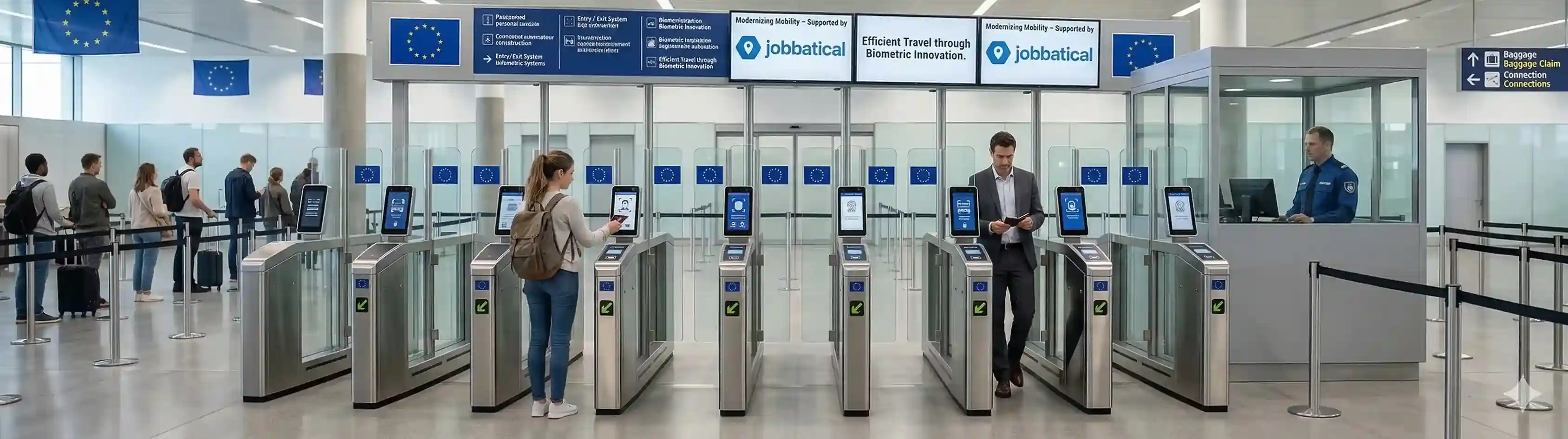
EU border control checkpoint representing EES biometric enforcement
Work Authorisation vs. Schengen Entry: A Critical Distinction for Employers
One of the most common compliance errors companies make is assuming a Schengen visa allows employees to work across Europe. It does not.
Short-stay Schengen visas (Type C) permit attendance at business meetings, conferences, and short-term training. They do not permit employment — including remote work performed while physically present in a Schengen state. Employees working on their laptops from a rented apartment in Lisbon or Barcelona while on a Type C visa may technically be in violation of local work permit laws.
For legitimate work across Schengen states, companies must obtain one of the following:
- EU Blue Card — for highly qualified non-EU nationals (available in most member states); example Germany EU Blue card
- National skilled worker visa — country-specific, e.g. Germany's Skilled Immigration Act visa
- Intra-company transfer (ICT) permit — for employees relocated within a multinational group
- Posted worker permit — for employees temporarily assigned from outside the EU
EU Blue Card & national work permit options for employing talent in Schengen countries

Each route has different requirements, timelines, and processing fees by country.
Book a demo with Jobbatical to identify the right work authorisation route for each of your employees.
Schengen Visa Application: Key Requirements
When employees require a Type C Schengen visa, the application must be submitted to the embassy or consulate of the country where they will spend the most time. If time is split equally, apply through the country of first entry.
Standard Type C Visa Application Requirements
Standard processing takes 15 calendar days. In peak periods or complex cases, it can extend to 30 to 60 days. HR teams should build these lead times into travel planning calendars.
Country-Specific Considerations Within Schengen
While Schengen rules create a uniform short-stay framework, each member state retains control over long-stay visas, work permits, and national immigration procedures. Key variations include:
- Germany has fast-track procedures for skilled workers under the Skilled Immigration Act. Processing times average 4 to 8 weeks for qualified applicants; Read about Germany Qualified Employment Work Visa.
- Netherlands operates the IND recognised sponsor programme, which can reduce processing to under 2 weeks for eligible employers.
- France issues work permits through DRIEETS regional directorates — a dual application involving both employer and employee simultaneously.
- Spain offers a digital nomad visa for remote workers, but this is Spain-specific and does not confer Schengen-wide work rights.
- Poland, Czech Republic, and the Baltics have become popular for EU Blue Card applicants due to faster processing and growing tech ecosystems.
How Jobbatical Manages Schengen Compliance for Global HR Teams
Managing Schengen compliance at scale is complex. A single employee may travel to four Schengen countries in a quarter. Multiply that across 50 international hires and the tracking burden becomes unmanageable without dedicated tools.
Jobbatical's global mobility platform gives HR teams real-time Schengen day tracking per employee, automated compliance alerts when approaching the 90-day threshold, expert visa assessments, end-to-end document management across all 29 Schengen states, and in-country immigration specialists across Europe.
With over 15,000 successful relocations and a guaranteed compliance model, Jobbatical reduces risk and eliminates the guesswork from European immigration. Book a demo today to see how the platform works for your team.
Disclaimer: Immigration rules change quite frequently; please verify with official sources or contact us for the latest info before making any decisions.
Frequently Asked Questions — Schengen Visa Rules 2026
What is the Schengen Area and which countries are included?
The Schengen Area is a zone of 29 European countries that have abolished passport controls at their shared borders. Members include Germany, France, Spain, Italy, the Netherlands, Belgium, Austria, Portugal, Sweden, Denmark, Finland, Norway, Iceland, Switzerland, Luxembourg, Poland, Czech Republic, Hungary, Slovakia, Slovenia, Estonia, Latvia, Lithuania, Greece, Malta, Liechtenstein, Romania, Bulgaria, and Croatia.
What does the 90/180-day Schengen rule mean for business travellers?
The 90/180-day rule means non-Schengen nationals may spend a maximum of 90 days within any rolling 180-day period across all Schengen countries combined — not per country. Days in any member state count towards the same shared limit. Exceeding this can result in entry bans and visa refusals for future trips.
Can employees work in Europe on a Schengen visa?
No. A standard Schengen visa (Type C) is a short-stay visa and does not permit employment in any member state. For employees to work legally in Europe, companies must obtain the appropriate national work permit — such as an EU Blue Card, national skilled worker visa, or intra-company transfer permit — depending on the country and role.
Which Schengen country should we apply through for a multi-country business trip?
If visiting multiple Schengen countries, applicants should apply through the embassy or consulate of the country where they will spend the most time. If time is equal across countries, apply through the country of first entry. Each member state processes its own Schengen visa applications through its national consular network.
Are UK and Irish citizens affected by Schengen rules?
Since Brexit, UK nationals are treated as third-country nationals under Schengen rules and are subject to the 90/180-day limit. Irish citizens, as EU nationals, are not Schengen members but benefit from separate bilateral agreements. For extended stays or work, UK nationals must apply for the relevant national visa in each Schengen country.
What is the difference between a Type C and Type D Schengen visa?
A Type C visa is a short-stay Schengen visa valid for up to 90 days and covers tourism, business meetings, and transit. A Type D visa is a national long-stay visa issued by an individual member state for stays exceeding 90 days, such as for work or study. Type D visas also allow travel within the Schengen Area during their validity period.
How can Jobbatical help manage Schengen compliance for global teams?
Jobbatical provides end-to-end immigration management for HR and global mobility teams. Our platform tracks Schengen day limits, automates document collection, and connects you with in-country immigration experts across all 29 Schengen states. We ensure every relocation and business trip remains fully compliant with EU immigration law.

.svg)
.svg)