


KEY TAKEAWAYS
- If your company is bound by a Tarifvertrag, the Federal Employment Agency waives the standard national salary floor for non-EU hires;the union pay grade is all that matters.
- For Skilled Worker Visa (§18a) applicants, collective bargaining is the primary approval mechanism , not just a fallback option.
- EU Blue Card cases below the statutory threshold can be re-routed to §18b using the tariff rate, keeping your internal pay structure intact.
- The Recognition Partnership (Anerkennungspartnerschaft) lets tariff-bound employers bring in vocational workers before formal qualification recognition is complete.
- Combining a Tarifvertrag with the fast-track procedure (Beschleunigtes Fachkräfteverfahren) is the fastest legal route to getting non-EU skilled workers on-site.
Germany Collective Bargaining Agreements (Tarifverträge): What HR Teams Need to Know for Work Visa Approvals
Most HR teams discover Germany’s collective bargaining system the hard way. A skilled worker visa application is submitted, the salary matches the union pay scale, yet the case still stalls while the Federal Employment Agency (BA) carries out a manual local market salary review.
In many cases, the issue is simple: the company is covered by a Tarifvertrag, but the BA was never informed.
Used correctly, a collective bargaining agreement can significantly simplify non-EU hiring in Germany. Instead of a lengthy, case-by-case salary assessment, the BA can rely on a predefined union pay grade that is faster and easier to verify.
What Is a Tarifvertrag , and Does It Apply to Your Company?
A Tarifvertrag is a binding written agreement between a trade union and an employers' association (or a single employer) that sets minimum pay scales, working hours, leave entitlements, and other conditions of employment. Under the German Collective Agreements Act (Tarifvertragsgesetz , TVG), its provisions apply automatically to all employees within its scope , no individual negotiation required.
There are two main types relevant to your hiring decisions:
- Sectoral agreements (Verbandstarifvertrag): Negotiated between an entire industry's union and an employers' association. Automatically binds all member companies in that region. Common in metal, chemical, retail, and public services.
- Company-level agreements (Firmentarifvertrag): Concluded directly between your company and the relevant trade union. Useful for larger employers with specific operating requirements.
Even if your company is not a formal member of an employers' association, certain agreements can be declared allgemeinverbindlich (universally applicable) by the Federal Ministry of Labour , meaning every company in that sector must comply, regardless of union membership. Construction, cleaning, and parts of logistics often fall into this category.
As of 2024, roughly 49% of employees in Germany work under a collective agreement. In manufacturing, healthcare, and public services, the figure is significantly higher.
How the Tarifvertrag Changes the Visa Approval Process
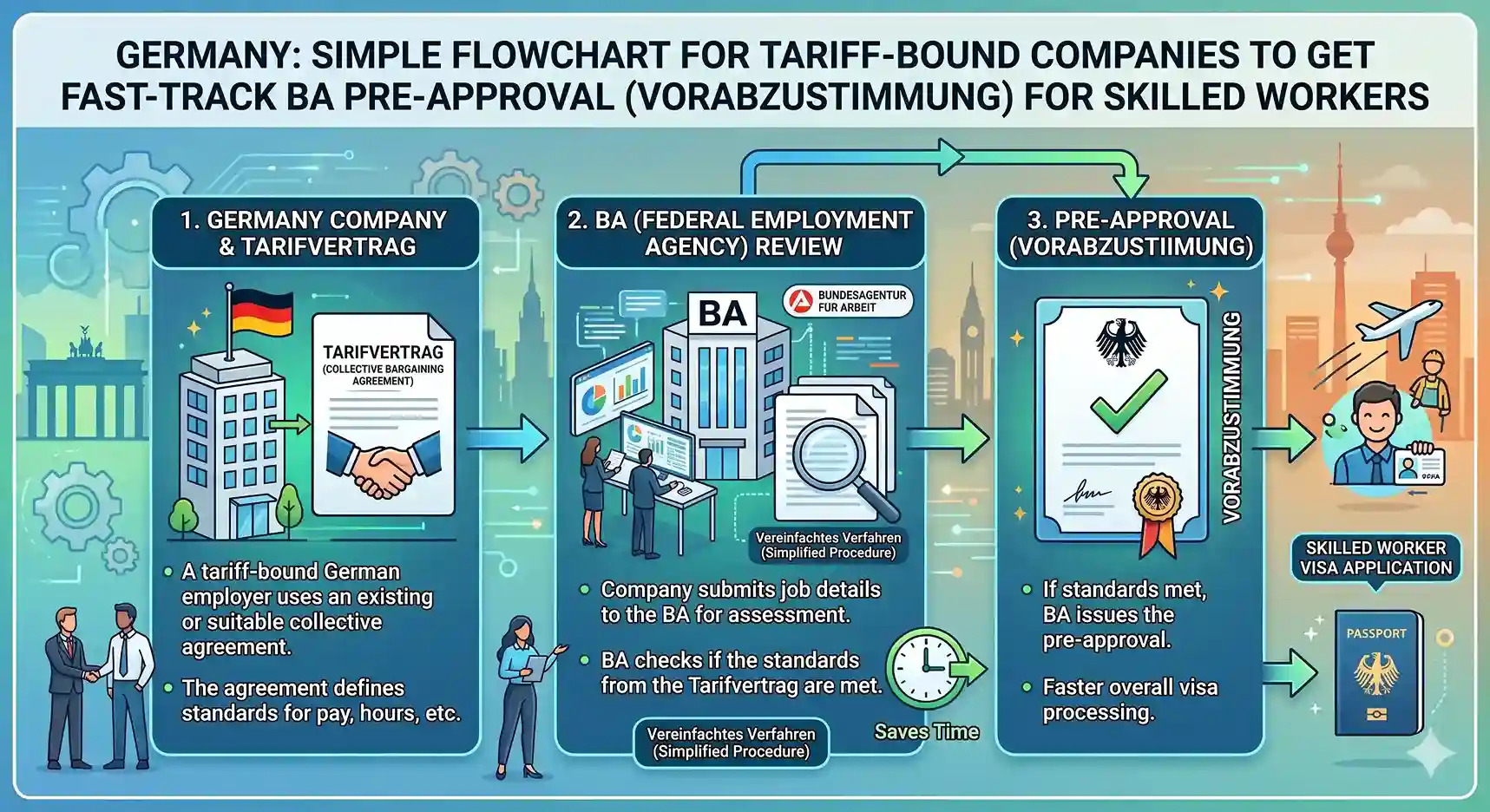
When sponsoring a non-EU skilled worker in Germany, the Federal Employment Agency (Bundesagentur für Arbeit ,BA) normally checks whether the salary matches local market rates, a process that can slow applications down.
If your company is covered by a Tarifvertrag, the BA skips the market salary review. Instead, it only checks whether the salary matches the correct union pay grade (Entgeltgruppe). If it does, the application usually moves through much faster.
This has three practical effects for your HR process:
- No manual salary benchmarking: The union scale is the benchmark. There is no separate comparison against local market rates.
- Predictable approval timelines: Because the BA review is automated rather than discretionary, pre-approvals (Vorabzustimmung) come back faster.
- Batch-friendly: Assign multiple candidates to the same Entgeltgruppe, submit the Declaration of Employment forms together, and receive pre-approvals in bulk without individual case reviews.
Skilled Worker Visa vs EU Blue Card: Two Different Roles for the Tarifvertrag
Skilled Worker Visa Salary Thresholds 2026
| Category | Previous Requirement | New Requirement (from 19 May 2026) |
|---|---|---|
| CPLP nationals (incl. Brazilians) | 5 years legal residence | 7 years legal residence |
| EU citizens | 5 years legal residence | 7 years legal residence |
| All other nationalities | 5 years legal residence | 10 years legal residence |
| Residence clock starts from | Application submission date | Permit card issuance date |
| Language requirement | A2 Portuguese | A2 Portuguese (unchanged) |
| Civic knowledge test | Not required | Now required (format TBC) |
| Pending applications | N/A | Protected assessed under old rules |
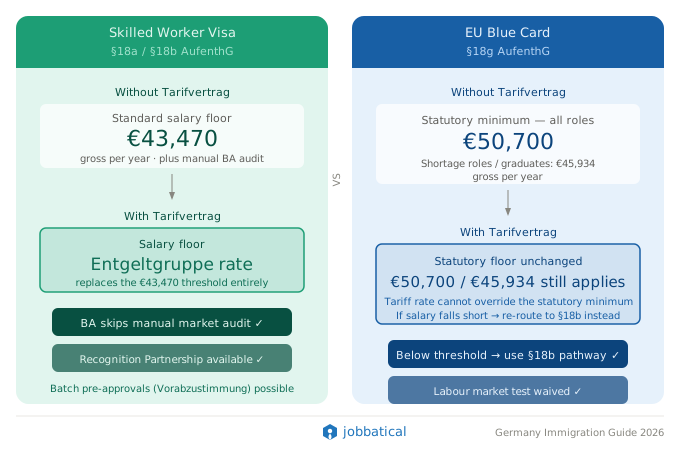
For Skilled Worker Visa cases (§18a and §18b), the Tarifvertrag is the primary approval mechanism. As long as the salary matches the union scale, the BA does not apply the statutory floor.
For the EU Blue Card (§18g), the fixed statutory thresholds remain in place regardless. However, if your employee's tariff-aligned salary falls just below the Blue Card floor, you have a practical option: re-route the application to §18b. The BA automatically approves the lower salary because it aligns with a binding collective agreement, and your employee still gets a clear residency track. You do not need to artificially inflate their pay.
For more detail on when §18b is the better route compared to §18g, see Jobbatical's guide on Germany pre-approval: §18b vs §18g visa categories.
What Your Company Needs to Submit
Claiming the tariff exemption is not automatic. You need to flag it explicitly in the application:
- Employment contract: Clearly state that wages and conditions are governed by a specific Tarifvertrag, identify the union pay scale and the relevant Entgeltgruppe.
- Erklärung zum Beschäftigungsverhältnis: The Declaration of Employment form , this is the document the BA uses for its review. Tick the box confirming tariff binding and reference the specific agreement.
- Proof of tariff binding: Either your membership in the relevant employers' association or documentation that the agreement has been declared universally applicable for your sector.
If you skip step 3, the BA will run a manual market audit as if no tariff applies. That adds time and introduces the risk of a request for additional documentation.
The Recognition Partnership for Vocational Workers
- Vocational workers usually need formal recognition of their foreign qualifications before they can start working in Germany, a process that often takes 3–4 months. For companies hiring on tight timelines, that can quickly become a bottleneck.
- If your company is covered by a Tarifvertrag, the Anerkennungspartnerschaft (Recognition Partnership) offers a faster route. The employee can enter Germany and begin work immediately while the qualification recognition process continues in parallel.
- The BA allows this because the collective agreement already guarantees fair pay and working conditions during the transition period.
This is the primary reason tariff-bound manufacturers, healthcare providers, and logistics companies can bring in skilled workers on shorter lead times than companies without collective agreements. Jobbatical's Germany qualification recognition guide covers how to structure the Anerkennungsberatung process alongside the visa application.
Combining the Tarifvertrag with the Fast-Track Procedure
The Beschleunigtes Fachkräfteverfahren (accelerated skilled worker procedure, §81a of the Residence Act) is employer-initiated and compresses the full visa process from 4–6 months down to 4–6 weeks. The employer pays a €411 fee, the local Ausländerbehörde coordinates all agencies in parallel, and the BA must respond within one week , silence counts as automatic approval.
When you layer a Tarifvertrag on top of this, the BA step becomes near-instant. Pre-defined pay grades eliminate the salary assessment entirely, so the bottleneck shifts to the embassy appointment , which the fast-track procedure also accelerates.
For a full breakdown of how to initiate the fast-track as an employer, see Jobbatical's Beschleunigtes Fachkräfteverfahren employer guide.
Key Sectors Using Tarifverträge for Non-EU Hiring
- Metal and electrical (IG Metall): Machine operators, engineers, toolmakers
- Chemical and pharmaceutical (IG BCE): Lab technicians, process specialists
- Healthcare and nursing (TVöD Pflege): Nurses, care workers, medical assistants
- Public services (TVöD/TV-L): Local government, universities, public institutions
- Construction (SOKA-BAU): Electricians, plumbers, site supervisors
- Logistics and transport (ver.di): Drivers, warehouse specialists
If your sector is listed here, chances are a Tarifvertrag already applies to your company. The question is whether your HR team is actively using it in visa applications.
What This Means for Your Next Hire
If your company is tariff-bound, not using the Tarifvertrag in your visa applications means you are doing more work than you need to. You are triggering manual BA audits that your pay structure already satisfies, and adding weeks to your timelines unnecessarily.
The practical steps are not complex:
- Verify your tariff binding, map roles to the correct Entgeltgruppe, complete the Declaration of Employment properly, and submit.
- For multi-hire pipelines or urgent start dates, add the fast-track procedure and a Recognition Partnership where applicable.
Disclaimer: Immigration rules change quite frequently; please verify with official sources or contact us for the latest info before making any decisions.
Frequently Asked Questions , Germany Collective Bargaining Agreements (Tarifverträge) and Work Visas
Q1: Does a Tarifvertrag exempt my employee from the standard salary threshold for a German work visa?
Yes, for the Skilled Worker Visa (§18a and §18b). If your company is bound by a collective bargaining agreement, the Federal Employment Agency waives the standard national salary floor and checks only whether the salary matches the relevant Entgeltgruppe in the union pay scale. The EU Blue Card (§18g) has a fixed statutory minimum that the tariff rate cannot override below €45,934.20.
Q2: How does my company prove it is bound by a Tarifvertrag during the visa process?
Your HR team must complete the Erklärung zum Beschäftigungsverhältnis (Declaration of Employment) and indicate that wages and conditions are governed by a binding collective agreement. You will also need to reference the specific Tarifvertrag, the relevant Entgeltgruppe, and provide the employment contract. The Federal Employment Agency matches this against the union pay scale and approves without a manual local market audit.
Q3: Can we use the Tarifvertrag route for a group of hires at once?
Yes. Because the pay grades are pre-defined in the union scale, batch applications are significantly more predictable. You assign each candidate to their Entgeltgruppe, submit the Erklärung zum Beschäftigungsverhältnis forms, and the BA issues pre-approvals (Vorabzustimmung) without individual salary audits. Combining this with the fast-track procedure (Beschleunigtes Fachkräfteverfahren) reduces the overall timeline to 4–6 weeks per case.
Q4: What is the Recognition Partnership, and when does it apply to Tarifvertrag-bound companies?
The Anerkennungspartnerschaft allows vocational workers to enter Germany and begin working before their foreign qualification is formally recognised. The BA permits this fast-track largely because the tariff agreement guarantees the worker's pay and conditions are fair. It is particularly useful for companies with fixed start dates who cannot wait 3–4 months for recognition to complete before the employee arrives.
Q5: What if my employee's salary under the Tarifvertrag falls below the EU Blue Card threshold?
Re-route the application to a Skilled Worker Visa for Academics (§18b) instead. If the tariff rate aligns with the role, the BA automatically approves the lower salary without requiring you to artificially inflate the pay. The employee still gains a clear residency pathway, and your internal pay equity structure stays intact.
Q6: Which sectors in Germany are most commonly covered by Tarifverträge relevant to non-EU hiring?
Metal and electrical (IG Metall), chemical and pharmaceutical (IG BCE), construction (SOKA-BAU), public services (TVöD and TV-L), healthcare and nursing (TVöD Pflege), retail (ver.di), and logistics. For roughly 49% of German employees, their employment conditions are governed by a collective agreement, so in these sectors, it is the rule rather than the exception.

.svg)
.svg)