.svg)


Key Take aways for US L1 visa and Spain ICT permit
- The L-1 visa moves employees INTO the US - it has no role in a transfer from the US to Spain.
- US companies sending employees to Spain must use Spain's ICT permit.
- The ICT permit to be filed by the Spanish host entity with the UGE-CE ; takes 20 business days.
- Total door-to-door timeline is 8–14 weeks once consulate processing is included.
- Hard transfer costs run €430–€980 per employee; no labour market test is required.
- ICT holders typically qualify for Spain's Beckham Law flat 24% income tax rate (employee retention benefit).
Your company has offices in the US and Spain. You need to move a senior engineer or a regional manager from your US headquarters to the Spanish entity.
The question your HR team is asking: Do they need an L-1 visa or a Spain ICT permit?
.svg)
📌 The short answer:
Neither the L-1 nor any US visa governs this move. The L-1 is a US immigration document. Once your employee is travelling in the other direction
from the US to Spain - it is Spain's immigration rules that apply. The permit your employee needs is the Spain Intra-Corporate Transfer (ICT) permit.
Spain Intra-corporate transfer guide explains exactly what ICT permit means, what your company needs to do, and what to expect in terms of timelines and cost.
What the L-1 Visa Actually Is
The L-1 visa is a US nonimmigrant visa that allows a foreign company to transfer an executive, manager (L-1A), or specialised knowledge employee (L-1B) to a US branch, subsidiary, or affiliate. It is filed by the US employer with USCIS. The beneficiary travels to the United States.
Confusion between L-1 and Spain ICT Permit
An L-1 holder working in your New York or Austin office is on a US status document. That status has no legal weight in Spain and does not authorise work anywhere in the EU. When that employee relocates to your Madrid office, their L-1 becomes irrelevant from a Spanish immigration standpoint.
The confusion is understandable. Both the L-1 and the Spain ICT permit are built for intra-company transfers within a multinational group, and both require a qualifying corporate relationship. But they operate in completely separate legal systems.
What Is the Spain ICT Permit?
The Spain Intra-Corporate Transfer (ICT) permit is a combined work and residence authorisation for non-EU nationals being transferred to a Spanish entity from a company branch outside the EU. It is governed by EU Directive 2014/66/EU and Spain's Entrepreneurs Law 14/2013.
There are two subtypes HR teams need to distinguish:
ICT-EU Permit vs National ICT Permit
For most US-headquartered companies with a Spanish subsidiary or branch, the ICT-EU permit is the correct route. The National ICT applies in edge cases — for example, if the transfer is based on a service contract rather than an employment relationship within the group.
For a deeper look at which of Spain's two ICT permits applies, and the edge cases where National ICT is the only option, see the EU ICT vs National ICT guide
Who Qualifies for the Spain ICT Permit?
Both the employee and the Spanish host company must meet eligibility criteria. Getting one wrong means a rejection and restarting the process from scratch.
Employee Requirements
Company Requirements
Your Spanish entity must demonstrate genuine, active business operations in Spain, a documented intra-group legal relationship with the US entity, and be up to date with Spanish Social Security and tax obligations. The transfer must serve a real business, need not be a paper exercise.
How the Application Process Works
One important operational point: the Spanish host company files the application, not the employee. This is the reverse of how many US-based HR teams expect it to work.
The process runs in three stages:
Total realistic door-to-door timeline: 8–14 weeks. Build this into your transfer planning - not 3 weeks before the assignment start date.
Get a breakdown of time spent, stage by stage, including consulate waits by employee origin country Spain ICT Visa Timeline
What It Costs to Transfer an Employee to Spain via ICT
There is no labour market test unlike standard Spanish work permits which removes a significant cost and time burden.
One financial benefit worth communicating to your transferring employee:
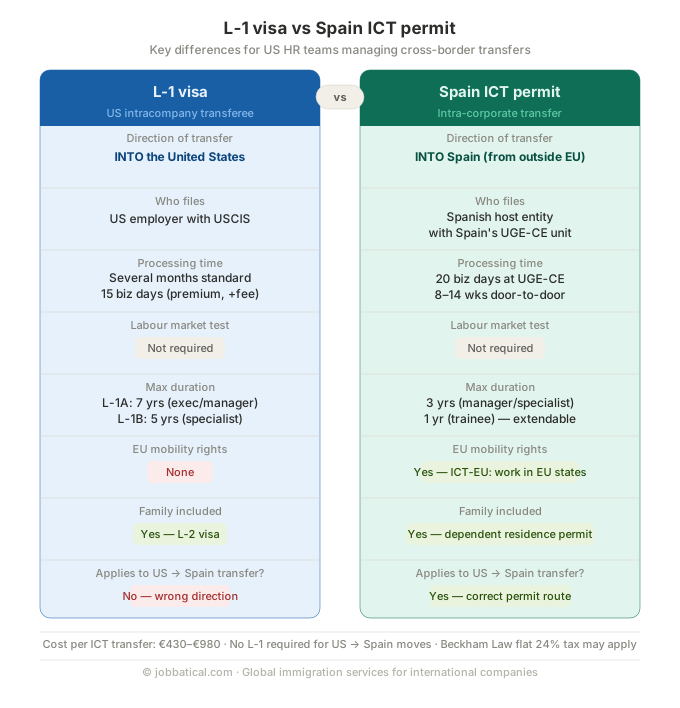
Key Differences: L-1 Visa vs Spain ICT Permit
Side-by-Side Comparison for US HR Teams
Common Mistakes US Companies Make
The most frequent error Jobbatical sees from US-based HR teams managing their first Spain transfer:
- Assuming the L-1 status carries over, or that the process mirrors USCIS filing logic. It does not. Spain's system is employer-driven from the Spanish side, not the US side.
- Filing the wrong permit type (ICT vs HQP different criteria, same processing unit),
- Submitting unsworn translations of US documents, and failing to prove the intra-group corporate relationship between the US parent and Spanish entity with sufficient documentation.
For a full breakdown of what gets applications rejected and how to prevent it, see the Spain ICT permit rejection guide.
What Your HR Team Needs to Do Next
- If your company has a Spanish legal entity and a US-based employee you want to transfer:
- Confirm the employee's role qualifies (manager, specialist, or trainee).
- Check the 3-month minimum tenure requirement.
- Verify your Spanish entity is registered with Spanish Social Security and has no outstanding compliance obligations.
- Begin the UGE-CE application filed by your Spain office at least 12 weeks before the intended start date.
If your Spanish entity is not yet established, or if you are unsure whether the transfer qualifies as an ICT, those are the first questions to resolve. The Jobbatical Spain ICT permit service covers end-to-end support from eligibility check through to post-arrival compliance.
Disclaimer: Immigration rules change frequently — please verify with official sources or contact us for the latest information before making any decisions.
Frequently Asked Questions: L-1 Visa vs Spain ICT Permit

.svg)
.svg)