

KEY TAKEAWAYS : Spain ICT Permit vs HQP Permit
- The ICT permit is for transferring existing non-EU employees from your overseas office to Spain the HQP permit is for hiring net-new talent directly into your Spanish entity.
- Both routes go through Spain's UGE-CE fast-track unit and skip the labour market test processing takes around 20 working days.
- ICT permits are non-renewable under EU rules; HQP permits renew in 2-year blocks and lead to long-term residency after 5 years.
- Choosing the wrong route is the most common cause of application delays a pre-hiring eligibility check takes two minutes and prevents months of rework.
- If your employee's assignment is temporary or project-based, ICT wins. If they're joining your Spain payroll long-term, HQP is the cleaner path.
- Jobabtical has experts to handle both ICT and HQP with experience of thousands of successful cases and 4.9 star rating (out of 5).
Two permits. One decision. Here's how to get it right.
If your company already has a legal entity in Spain and you need to bring a non-EU employee on board, you have two main fast-track options: the Intra-Company Transfer (ICT) permit and the Highly Qualified Professional (HQP) permit. Both skip the labour market test. Both go through Spain's UGE-CE fast-track unit. Both take around 20 working days to process.
But they are built for completely different situations. Using the wrong one will get your application rejected — and cost your team weeks of rework.
This guide gives you a clear decision framework so your HR or mobility team picks the right route the first time.
Spain ICT vs HQP permit decision flowchart for HR teams

What each permit is actually for
The ICT permit is for employees who already work for your company in a non-EU country and are being transferred to your Spanish entity. The employment relationship stays within your corporate group — no new local hire is happening.
The HQP permit is for bringing in new senior or specialist talent from outside the EU directly into a Spanish employment contract. The employee may be someone you are recruiting externally, or even a person you already work with who needs to join your Spain payroll on a permanent basis.
In short the selection criteria can be summarized as,
Full employer guide to the ICT route: eligibility, both permit types, documents, cost and timeline Spain ICT Visa: Complete Employer Guide
Side-by-side: the key differences that matter for your HR team
ICT vs HQP Permit: Quick Comparison for HR Teams
ICT permit vs HQP permit Spain comparison table showing key differences
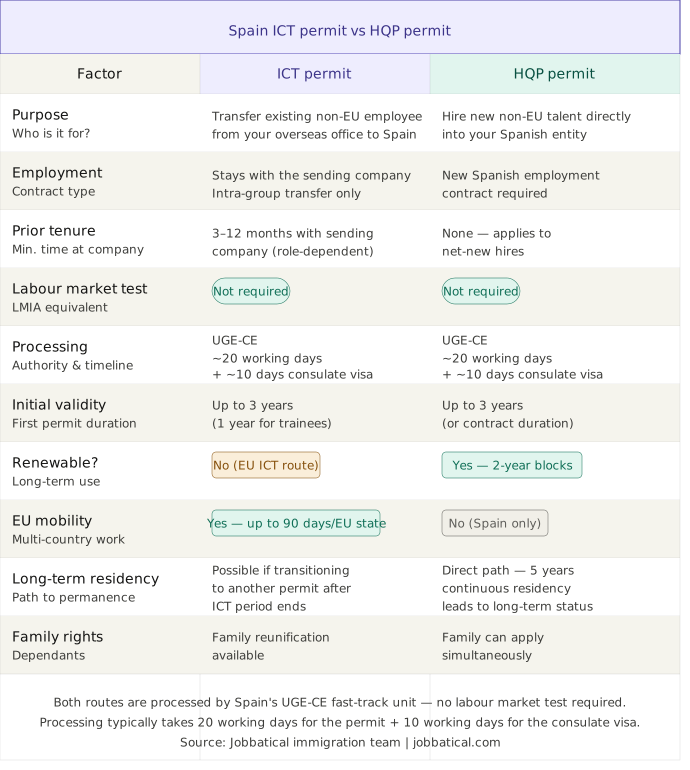
The decision framework: three questions to ask before you apply
Rather than reading every clause of the regulations, use these three questions to narrow down your route quickly.
1. Is this employee already on your payroll at a non-EU entity?
If yes and they have at least 3 months with the sending company, they are likely eligible for the ICT route. If they are being recruited fresh or moving from an EU-based entity, ICT does not apply.
This question turns on prior group employment, 3 continuous months is the threshold, and several employment types don't count toward it — The 3-Month Prior Employment Rule
2. Is this role intended to be permanent or long-term in Spain?
The EU ICT permit is explicitly a temporary assignment mechanism. It cannot be renewed once the 3-year maximum ends. If your employee is expected to become a permanent part of your Spain team, the HQP permit gives them a direct path to long-term residency and avoids a forced permit transition down the line.
This question turns on prior group employment — 3 continuous months is the threshold, and several employment types don't count toward it: The 3-Month Prior Employment Rule
3. Does your employee need multi-country EU mobility during the assignment?
If your employee will split time between Spain and other EU offices — attending regional meetings, leading cross-border projects — the ICT permit's built-in EU mobility (up to 90 days in other member states) is a real operational advantage. The HQP permit does not carry this feature.
The mistake that delays most applications
The single most common error we see at Jobbatical is a company filing an HQP application for what is actually a genuine intra-company transfer or filing an ICT application for a role that is effectively a new Spanish hire. Both get rejected, and both cost weeks of rework at UGE-CE.
This is often because the two permits look similar on the surface — same processing unit, same 20-day SLA, same fast-track framework. The difference is structural, and the UGE-CE looks hard at the employment relationship before approving anything.
The seven most common UGE-CE denial triggers on ICT files, with the document fix for each : 7 Reasons Spain ICT Visa Applications Get Rejected
Spain UGE-CE work permit processing timeline for ICT and HQP routes.
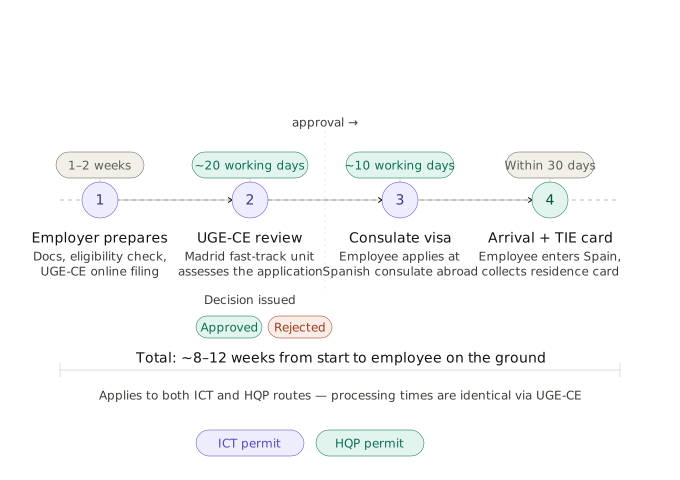
If you are unsure which route applies to your specific hire, the fastest way to get clarity is Jobbatical's Spain pre-hiring eligibility check — it takes two minutes and tells you exactly which permit category fits your employee's profile before you commit to an application.
When multinationals use both routes and how to manage that
Large multinationals with established Spain entities often run both permit types in parallel. Your mobility team might handle an ICT transfer for a regional director being posted to Madrid for 18 months, while simultaneously processing an HQP permit for a new engineering hire in Barcelona.
The operational challenge is tracking them correctly. ICT permits expire without a renewal option — if your team misses the window to either extend the assignment or transition the employee to an HQP, your employee falls out of legal status. Running a pre-hiring check at offer stage — not just at application stage — means you build the right permit timeline into your onboarding plan from day one.
It is also worth noting that ICT time in Spain can count toward long-term residency if the employee later transitions to a different permit category within the country. So the two routes are not entirely separate — they can form part of a deliberate long-term talent retention strategy for key international hires.
Related reads:
How to sequence a mixed cohort so shared company documents are prepared once and reused across every filing : Spain ICT Batch Filing
Read about Jobbatical's award winning Spain ICT permit service here.
What about the EU Blue Card?
The EU Blue Card is a third option that sits alongside the HQP permit for highly qualified new hires. The key difference is scope: the EU Blue Card is designed for professionals who want future mobility across multiple EU countries, while the HQP permit is Spain-specific and often faster for roles where the employee plans to stay in Spain long-term.
For multinationals managing talent across Europe, the EU Blue Card is worth considering if your employee may later relocate to Germany, France, or another EU state. If the role is Spain-only, the HQP is typically the cleaner, faster choice.
A full breakdown of how the HQP and Blue Card compare is covered in Jobbatical's Spain HQP permit guide.
How Jobbatical helps multinationals manage both routes
At Jobbatical, we work with multinational HR and mobility teams across Europe who are managing multiple Spain permit cases simultaneously. We handle the end-to-end process for both ICT and HQP applications — from eligibility assessment and document preparation to UGE-CE submission, visa coordination, TIE appointments, and family member filings.
Our platform gives your team real-time visibility across all active cases, with renewal alerts built in so no ICT permit expiry slips through unnoticed. If you need to transition an employee from ICT to HQP, we manage that handoff too.
Disclaimer: Immigration rules change quite frequently; please verify with official sources or contact us for the latest info before making any decisions.
Frequently Asked Questions — Spain ICT Permit vs HQP Permit

.svg)
.svg)