

KEY TAKEAWAYS
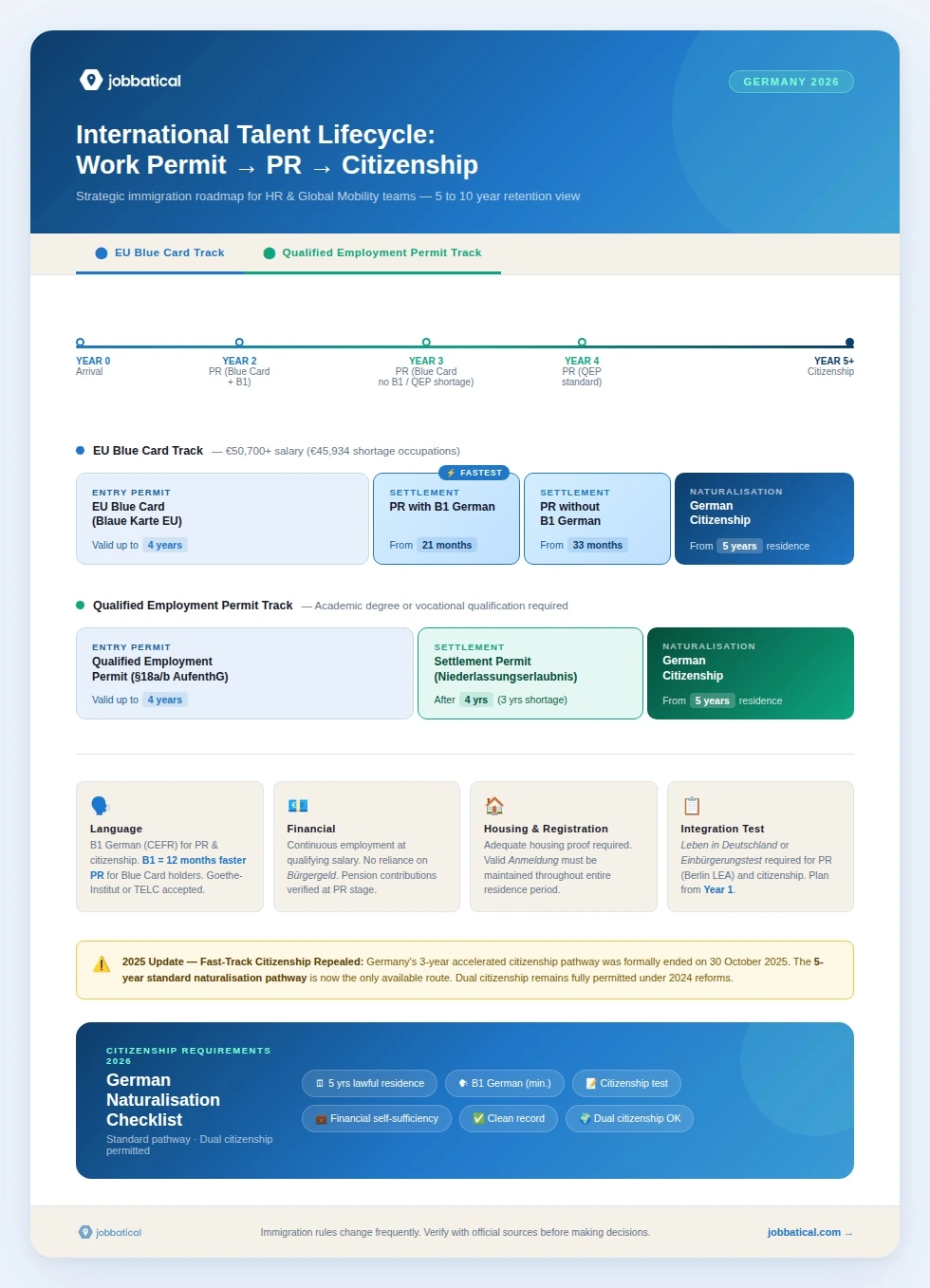
• The EU Blue Card is the fastest PR track—21 months with B1 German, or 33 months without—making it the top retention tool for skilled hires.
• Germany now has one standard citizenship pathway: 5 years of lawful residence, following the October 2025 repeal of the 3-year fast-track.
• Dual citizenship is fully permitted in Germany, removing a historic barrier for international professionals considering naturalisation
• HR teams that start language and integration planning from day one dramatically shorten the time to PR and citizenship eligibility.
• Jobbatical's platform tracks permit timelines, renewal windows, and compliance milestones across the full 5–10 year employee lifecycle.
Germany competes globally for skilled talent—but winning the hire is only half the challenge. The other half is keeping that talent for 5, 7, or 10 years. For HR and global mobility teams, that means understanding Germany's immigration lifecycle: from the first work permit, through Permanent Residence (PR), to naturalisation.
This guide gives you a strategic, employer-facing view of every major milestone—without duplicating the permit-by-permit detail covered in Jobbatical's existing route guides.
Germany immigration lifecycle from work permit to PR to citizenship — timeline for HR teams
Why Long-Term Retention Starts with the Right Entry Permit
Not all German work permits are equal from a retention standpoint. The permit type an employee holds on day one directly determines when they become eligible for PR—sometimes by a margin of several years.
The EU Blue Card is Germany's premier retention instrument. Designed for highly qualified professionals, it offers the fastest route to permanent residence of any German work permit. In 2026, the gross annual salary thresholds are €50,700 for general roles and €45,934.20 for shortage occupations including IT, engineering, and healthcare. For HR teams hiring at these levels, routing candidates through the Blue Card pathway rather than a standard employment permit is the single highest-impact retention decision you can make from day one. Learn more in Jobbatical's EU Blue Card Germany 2026 guide.
For roles below the Blue Card salary threshold, the Qualified Employment Permit still offers a clear PR track—but the timeline is longer. HR teams should treat permit selection as a retention planning decision, not just a compliance exercise. Explore eligibility details on the Germany Qualified Employment Permit service page.
The Germany Permanent Residence Roadmap: Timelines by Permit Type
Germany offers two permanent residence routes for non-EU nationals: the national Settlement Permit (Niederlassungserlaubnis) and the EU Long-Term Residence Permit. Both grant indefinite stay and unrestricted employment rights, but they serve different employee profiles.
PR Eligibility Timeline by Permit Type (2026)
For a deep-dive comparison of the Settlement Permit versus the EU Long-Term Residence Permit, see Jobbatical's dedicated Settlement vs EU Long-Term Residence Germany 2026 HR Guide.
For employees who entered on an ICT Card, be aware that this permit does not directly count toward PR. Early conversion to a Blue Card or Qualified Employment Permit—once the employee secures a permanent role—is a critical retention planning step.
ICT Card holders need a different permit before the PR clock starts: which permit to transition to, and when.
The Employer's Role in Building PR-Ready Employees
PR applications are the employee's responsibility under German law—but the employer's environment determines whether employees actually reach eligibility. Three employer-side factors have an outsized impact on retention outcomes:
1. Language investment. B1 German is the key that unlocks the fastest PR timeline for every permit type. Employers who fund Goethe-Institut or TELC courses from the employee's first month are not just offering a perk—they are accelerating their own PR clock. For Blue Card holders, the difference between B1 and no-B1 is 12 months of additional required residence before PR eligibility.
2. Permit renewal tracking. A lapsed residence permit resets continuity calculations, directly delaying PR eligibility. Proactive renewal management—with reminders 3–4 months before expiry—is essential. Jobbatical's platform automates this tracking and provides renewal alerts across your entire mobile workforce. See how it works on the Germany Residence Permit service page.
3. Salary continuity. For 2026, PR applicants must demonstrate sustained financial self-sufficiency without reliance on public funds. Salary freezes or reductions near the PR application window can create complications. HR teams should flag this in compensation review processes for employees approaching eligibility.
Germany Citizenship in 2026: The 5-Year Standard Path
Germany's citizenship landscape changed significantly in late 2025. The 3-year accelerated naturalisation pathway—introduced in early 2024—was officially repealed on October 30, 2025. From November 2025 onwards, the only available route is the standard 5-year naturalisation pathway.
For HR teams, the practical takeaway is straightforward: for most skilled workers, citizenship becomes a realistic option approximately 5 years after arrival. Blue Card holders who obtained PR at 21 months can theoretically reach citizenship eligibility in under 4 years of total residence—citizenship timing is measured from initial lawful entry, not from PR grant date.
Germany Citizenship Requirements at a Glance (2026)
The dual citizenship provision—introduced in Germany's 2024 reforms and still fully in force—is a significant retention lever. Previously, many international professionals were deterred from naturalisation by the requirement to renounce their original nationality. That barrier is now removed. HR teams and relocation counsellors should proactively communicate this to long-tenure employees approaching the 5-year mark.
- For the full operational picture of Berlin's PR and naturalisation process, including the language certificate upload requirements introduced in December 2024, see the Berlin Permanent Residency 2026 guide.
- For the background on the fast-track repeal and its limited scope, see Germany Fast-Track Citizenship Ended 2025.
Building a 5–10 Year Germany Retention Strategy: Practical HR Actions
Long-term retention of international talent in Germany is not passive. It requires proactive milestones management across the immigration lifecycle. Here is a practical framework:
Germany Talent Retention: Employer Actions by Year
Managing this lifecycle manually at scale—across dozens or hundreds of employees—creates significant compliance risk. Jobbatical's platform provides centralised permit tracking, automated renewal alerts, and expert support across every stage. Book a demo to see how it works for your team.
Family Reunification: A Retention Factor Often Overlooked
Research consistently shows that family stability is one of the top predictors of long-term expat retention. Employees whose spouses and children are settled, legally working, and integrated are far less likely to leave. Germany's family reunification framework is relatively strong—spouses of Blue Card and Qualified Employment Permit holders can work without restrictions—but the application process requires careful management.
Jobbatical supports the full family mobility process, including dependent applications, spousal work authorisation, and school enrolment support.
Explore the details on the Germany Family Immigration service page.
How Jobbatical Supports the Full Germany Immigration Lifecycle
Most immigration providers focus on the initial permit. Jobbatical is built for the full lifecycle. From Blue Card applications and permit renewals to PR preparation and compliance tracking, our platform and expert team manage every step—so your HR team stays focused on hiring and retaining the best global talent.
With 15,000+ successful relocations and a tech-enabled platform that provides real-time visibility across all cases, Jobbatical is the partner global mobility teams in Germany rely on for long-term compliance and talent retention. Book a demo to see how we can support your Germany hiring strategy.
Disclaimer: Immigration rules change quite frequently; please verify with official sources or contact us for the latest info before making any decisions.
Frequently Asked Questions — Germany Talent Retention, PR & Citizenship Pathways
How long does an EU Blue Card holder need to work in Germany before qualifying for permanent residence?
EU Blue Card holders can apply for a Settlement Permit (Niederlassungserlaubnis) after 21 months of employment with B1-level German language skills, or after 33 months without meeting the B1 requirement. This is significantly faster than the standard 5-year track for other permit types.
Can employees on a standard Qualified Employment Permit apply for PR in Germany?
Yes. Qualified Employment Permit holders can apply for the Settlement Permit after 4 years of continuous lawful employment, provided they demonstrate B1 German language skills, pension contributions, financial self-sufficiency, and adequate housing. Some shortage occupation roles may qualify after 3 years.
Is the 3-year fast-track German citizenship still available in 2026?
No. Germany's 3-year accelerated citizenship pathway was officially repealed on October 30, 2025. From November 1, 2025 onwards, the only available route is the standard 5-year naturalisation pathway. Dual citizenship remains fully permitted, and work visa processes are unaffected by this change.
What language requirement must employees meet for Germany permanent residence?
The standard requirement is B1-level German (CEFR), verified by a recognised test from institutions like Goethe-Institut or TELC. EU Blue Card holders who lack B1 proficiency can still qualify for PR after 33 months, though B1 unlocks the faster 21-month route. Berlin's LEA also requires a "Leben in Deutschland" integration knowledge test for most PR applicants.
What is the difference between the Settlement Permit and the EU Long-Term Residence Permit in Germany?
Both provide indefinite residence and unrestricted work rights. The Settlement Permit (Niederlassungserlaubnis) is a national German permit and typically faster for those planning to stay in Germany. The EU Long-Term Residence Permit is better for employees who may later want to live or work in another EU member state, as it carries EU-wide mobility rights after 5 years of residence.
How should HR teams structure a Germany long-term retention strategy for international hires?
Effective retention planning starts at onboarding: fund German language courses, track permit renewal deadlines proactively, brief employees on PR eligibility milestones, and connect them with integration support. Platforms like Jobbatical automate compliance tracking and renewal alerts across the full employee lifecycle, reducing admin burden and attrition risk.

.svg)
.svg)