.svg)



Key Take aways for Spain's Cita Previa Crisis:
- Cita previa slots in Madrid and Barcelona are often unavailable for 8–14 weeks, directly delaying when international employees can complete residence registration and access key services.
- Not all immigration steps require an appointment HR teams can use parallel processing to advance Social Security registration, payroll, and employer-side paperwork while waiting for cita previa slots.
- Alternative cities like Valencia, Seville, and Zaragoza consistently have shorter wait times strategic regional flexibility can cut weeks off the onboarding timeline.
- Appointment rejection due to incomplete documentation is common and costly a pre-appointment document audit is essential, with awareness of province-specific requirements.
- Immigration tech platforms remove the manual burden of slot monitoring and give HR teams real-time visibility into where delays are occurring across all Spain relocations.
For HR teams relocating skilled workers to Spain, the cita previa (prior appointment) system at Spain's Extranjería offices is often the single biggest threat to onboarding timelines. Appointment slots in major cities can be unavailable for weeks or months. And unlike visa processing at consulates, you can't pay to expedite it.
The HR teams that consistently onboard international talent on time in Spain are doing things differently -smarter city selection, parallel processing, and the right immigration tech partners.
Why Cita Previa Delays Are Disrupting Employee Onboarding in Spain
Spain's Extranjería offices handle all in-country immigration appointments from initial residence permit applications to renewals and NIE (Número de Identidad de Extranjero) registrations. The cita previa system is the only way to access these services. In cities like Madrid and Barcelona, it's common for available slots to disappear within minutes of release - sometimes in the early hours of the morning. HR teams that aren't actively monitoring the system regularly find their employees waiting 6–12 weeks just to secure an appointment.
That waiting time translates directly into delayed work authorizations, stalled onboarding, and frustrated new hires who have relocated but can't legally start work.For companies hiring at scale in Spain, this isn't a one-time problem , it's a recurring operational risk.
Which Immigration Steps in Spain Require Appointments and Which Don't
Not every step in Spain's immigration process requires a cita previa. Knowing the difference helps HR teams identify where the real bottlenecks are.
| Immigration Step | Cita Previa Required? | Notes |
|---|---|---|
| Initial Work & Residence Permit Application | ❌ No | Submitted to the employer’s regional authority (Delegación del Gobierno) |
| NIE Assignment (In-Country) | ✅ Yes | Via Extranjería or National Police |
| TIE (Tarjeta de Identidad de Extranjero) Collection | ✅ Yes | Physical card pickup requires an appointment |
| Empadronamiento (Municipal Registration) | ✅ Yes | Booked at the local town hall (Ayuntamiento) |
| Social Security Number Registration | ❌ No | Employer-led process, no appointment needed |
| Residence Permit Renewal | ✅ Yes | Critical — delays here affect work authorization continuity |
Why Madrid and Barcelona Aren't Always the Fastest Route
It seems logical to process immigration paperwork in the city where your employee will work. But when it comes to cita previa availability, that is not always the most efficient approach.
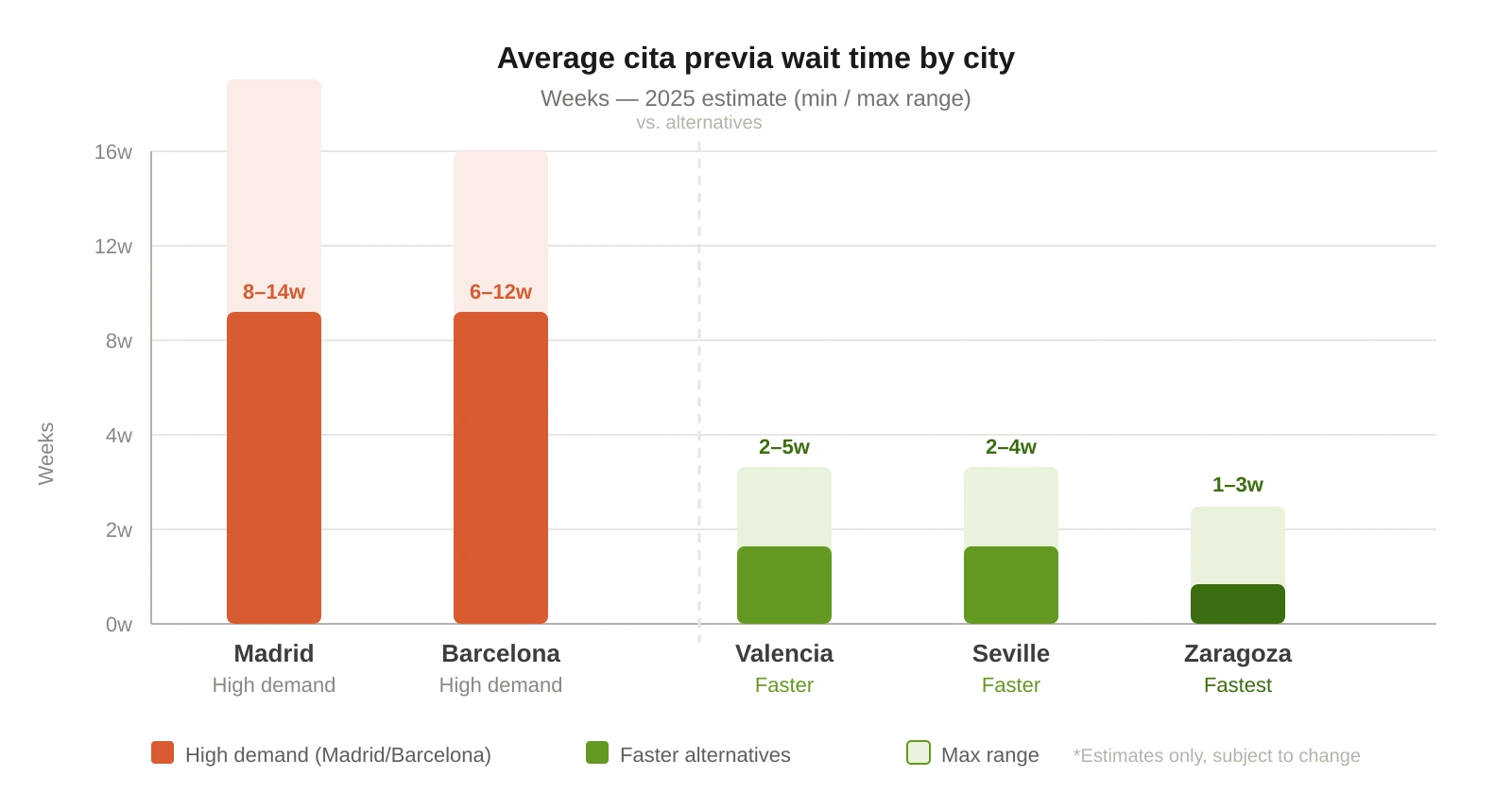
In reality, appointment access can vary significantly by region. In some cases, HR teams and immigration providers look at alternative cities with lower appointment pressure such as Valencia, Seville, Zaragoza, or Bilbao to secure earlier availability and keep the onboarding timeline moving.
| City | Typical Cita Previa Wait (2025 estimate) | Notes |
|---|---|---|
| Madrid | 8–14 weeks | Highest demand, slots release irregularly |
| Barcelona | 6–12 weeks | High competition, early morning monitoring needed |
| Valencia | 2–5 weeks | Significantly more available |
| Seville | 2–4 weeks | Lower volume, more predictable releases |
| Zaragoza | 1–3 weeks | Often overlooked; good option for flexibility |
Need this information for later? Download now.
Wait times fluctuate based on season, policy changes, and regional capacity. Always verify current availability.
How HR Can Reduce Delays With Parallel Processing
Parallel processing is the single most effective operational tactic available to HR teams managing Spain relocations.
The principle is simple: don't wait for one step to complete before starting the next. Map every immigration and onboarding task and identify which ones can run simultaneously.
A parallel processing approach for Spain work permit onboarding:
- Before visa issuance: Begin employer-side steps: work permit application filed with Delegación del Gobierno, employment contract drafted, Social Security registration initiated.
- On arrival: Immediately book cita previa slots for NIE and TIE. Book empadronamiento simultaneously at the local Ayuntamiento.
- While waiting for cita previa: Complete all non-appointment tasks; Social Security affiliation, payroll setup, internal IT onboarding, housing support.
- At cita previa appointment: NIE assigned; TIE application submitted.
- TIE collection appointment: Typically 3–6 weeks after submission.
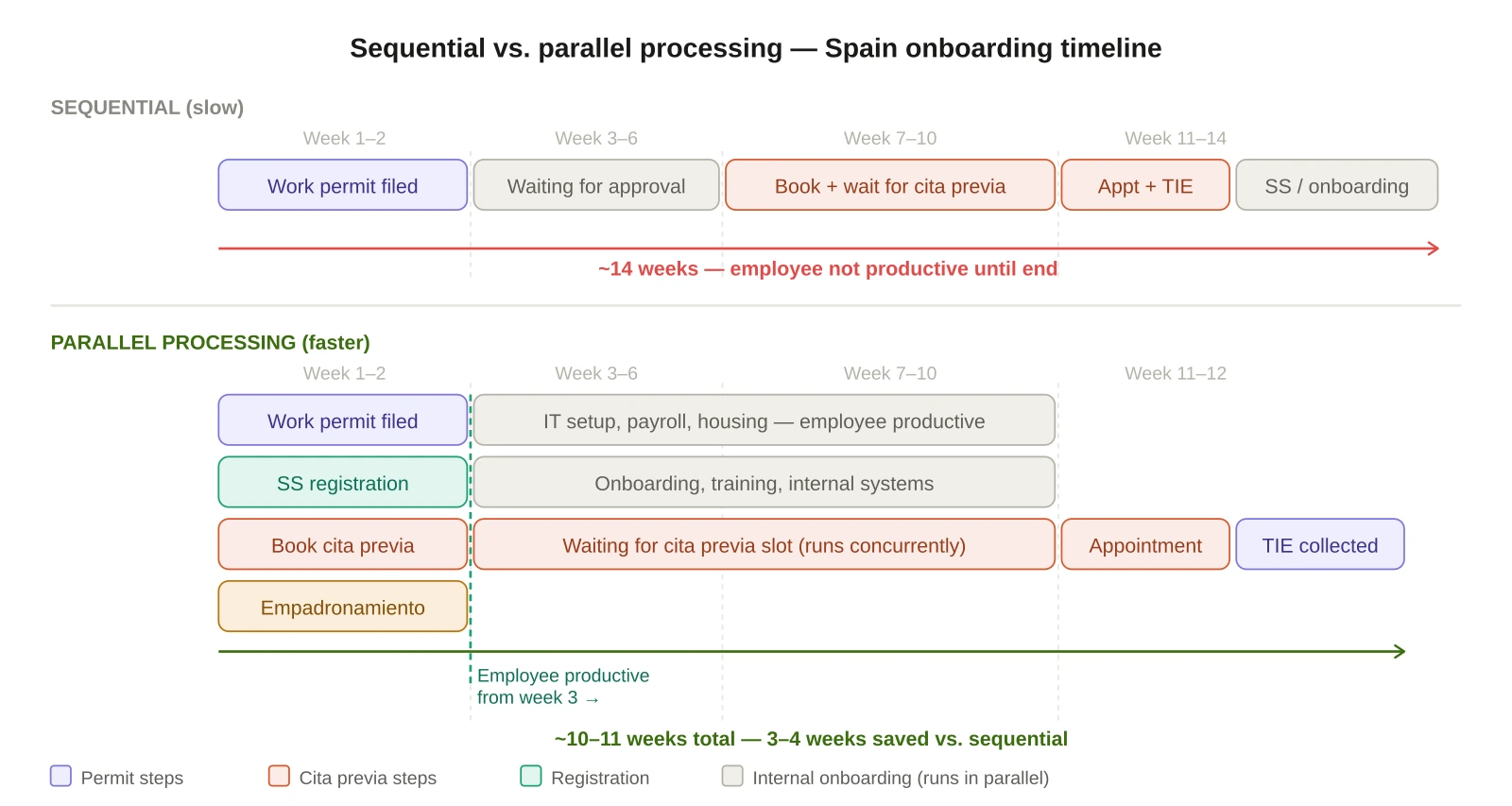
This approach won't eliminate the wait for the appointment itself but it prevents your team from discovering at week three that you forgot to book empadronamiento, adding another four weeks to the timeline.
What Employers Should Prepare Before the Employee Arrives
HR teams that come to the cita previa appointment fully prepared avoid costly rescheduling. Extranjería offices are strict about documentation — a missing original, an expired certificate, or an incorrect form can result in the appointment being rejected.
Standard document checklist for TIE application:
- Valid national passport (original + photocopy)
- Work and residence permit resolution (original + photocopy)
- Completed EX-17 form (application for TIE)
- Proof of paid application fee (Modelo 790 Código 012)
- Recent passport-size photos (white background)
- Proof of empadronamiento (in some provinces)
Additionally, some Extranjería offices require that documents in foreign languages are accompanied by a sworn translation into Spanish. Verifying province-specific requirements before the appointment.
How Immigration Tech Partners Help Track Bottlenecks and Reduce Risk
Manual tracking of cita previa slot availability is neither sustainable nor reliable. Refreshing the Extranjería portal at 3am is not a scalable HR practice.
Immigration technology platforms solve this by:
- Automated slot monitoring Platforms track cita previa availability in real time and alert teams when slots open, including in alternative cities.
- Timeline dashboards HR and global mobility teams can see where every employee sits in the process not just across Spain, but across all relocations globally.
- Document management Automated reminders flag expiring permits and missing documents before they become delays.
- Compliance tracking Platforms alert employers when an employee's right to work is at risk due to permit or appointment delays.
For companies managing more than a handful of Spain relocations per year, manual tracking creates compounding errors. A platform that centralizes visibility removes the guesswork and gives HR teams something they rarely have with cita previa: advance warning.
Jobbatical's immigration platform combines real-time case tracking with expert immigration support, so HR teams aren't just monitoring bottlenecks they have specialists who can act on them.
When to Escalate to a Relocation or Immigration Partner
Not every cita previa delay requires external help. But some situations warrant bringing in an immigration partner immediately:
- Your employee cannot legally start work without the TIE, and the onboarding delay is creating business risk
- You're managing multiple Spain relocations simultaneously and tracking is breaking down
- The appointment was rejected due to missing documentation and needs to be rebooked
- Your employee's permit is expiring and the renewal appointment hasn't been secured
- You're unsure which city to book in or whether cross-province appointments are permissible for your case type
An experienced immigration partner doesn't just rebook appointments they understand the regional differences in how Extranjería offices operate, which document formats each province accepts, and how to reduce the risk of rejection.
Disclaimer
Immigration laws and policies change frequently and may vary by country or nationality. While we strive to provide accurate and up-to-date information, we recommend doing your own due diligence or consulting official sources. You’re also welcome to contact us directly for the latest guidance. Jobbatical is not responsible for decisions made based on the information provided.
FAQs for Cita Previa Crisis: 2026
How long does it take to get a cita previa appointment in Spain in 2026?
Wait times vary significantly by city. Madrid and Barcelona usually have the longest backlogs, often around 8–14 weeks. Cities such as Valencia and Seville often have appointments available within 2–5 weeks. Availability changes frequently, so ongoing monitoring is important for relocation planning.
Can an employee start work in Spain before the cita previa appointment?
It depends on the permit type. If the employee entered Spain with a valid work visa and already holds a valid residence/work authorization resolution, they may be allowed to begin working before the TIE appointment. However, this must be confirmed case by case, as work authorization rules differ depending on the visa route.
Can a cita previa appointment be booked in a different city from where the employee will live?
Sometimes, yes. For certain appointment types—especially NIE or initial TIE appointments—there can be flexibility in using a different Extranjería office. This is sometimes used to access shorter wait times in lower-demand cities. However, renewals and some province-specific procedures generally must be handled in the employee’s province of residence.
What happens if an employee misses or is rejected at their cita previa appointment?
If an appointment is missed or the application is rejected at the appointment due to incomplete or incorrect documentation, a new appointment usually needs to be booked from scratch. This can result in significant delays, especially in high-demand cities. Proper document review before the appointment is essential to reduce this risk.
How can HR teams monitor cita previa availability without checking manually?
HR teams can use immigration support tools or monitoring systems that track cita previa slot availability and alert them when appointments open up. This can help reduce manual checking and improve the chances of securing earlier appointments, including in alternative cities where appropriate.
What is empadronamiento and does it affect the cita previa process?
Empadronamiento is the municipal registration that proves official residence in a Spanish municipality. It is a separate appointment made at the local Ayuntamiento (town hall). Some immigration offices require proof of empadronamiento for a cita previa appointment, so it should be arranged as soon as possible after arrival.
When should HR involve an immigration partner for Spain relocations?
It is advisable to involve an immigration partner when appointment delays may affect legal work start dates, when managing multiple employee relocations at once, when an appointment has been rejected, or when a renewal timeline is at risk. Early support helps reduce delays, document issues, and compliance risks.

.svg)
.svg)