.svg)



Key Takeaways Indefinite Leave to Remain (ILR) 2026 HR Guide
- ILR removes your sponsorship obligation helping you retain top talent without ongoing visa renewals
- You have concrete employer responsibilities: a compliant employer letter, payslip records, and absence documentation are all required for your employee's application .
- The 2026 ILR application fee is £3,226 per person costs scale quickly for companies with multiple international hires .
- Tracking ILR eligibility dates across your workforce prevents costly last-minute scrambles and application errors .
- Jobbatical manages end-to-end ILR support at scale, from eligibility checks to document coordination and Home Office liaison
Indefinite Leave to Remain (ILR) is the UK's permanent residence status. Once your employee holds it, your sponsorship obligation ends. No more visa renewals, no more Certificate of Sponsorship, no more immigration compliance tracking for that person.
But getting there smoothly depends heavily on what your HR or global mobility team does in the months leading up to the application. This guide walks you through everything you need to do and avoid as the employer.
What ILR Actually Means for Your Company
Indefinite Leave to Remain grants your employee the right to live and work in the UK permanently, without any immigration restrictions. For you as their employer, the practical effect is significant: once ILR is granted, the employee no longer needs sponsorship. They can change roles, get promoted, move internally, or even change employer all without visa implications for your company.
This makes ILR a genuine retention tool. Employees with ILR tend to feel more settled and more committed. For companies with 200 or more international hires, proactively supporting ILR applications is not just a compliance task it is a talent strategy.
You can learn more about the full scope of UK ILR and how Jobbatical supports applications on our service page.
How to Track Which Employees Are Approaching Eligibility
The most common HR mistake around ILR is not operational, it is timing. Companies discover an employee is eligible months after the fact, or worse, an application is rushed at the last minute. Neither is good for anyone.
Your first action is to build an ILR eligibility tracker. For each sponsored employee, you need to know their first Skilled Worker visa grant date, total days absent from the UK per rolling 12-month period, current salary versus the applicable settlement threshold, and English language qualification status.
Employees can apply for ILR up to 28 days before they complete their qualifying period. With a standard 6-to-8-week processing time, you should start preparing supporting documents at least 3 months before the eligibility date. If you have employees across multiple visa start dates, staggering this preparation is key.
Jobbatical's UK ILR eligibility calculator lets HR and global mobility teams check qualifying dates instantly including absence calculations and route-specific requirements.
ILR requirements for Employers
As the sponsoring employer, you have concrete documentation responsibilities. Your employee cannot submit a complete ILR application without your input. Here is what the Home Office expects from your side:
The Employer Confirmation Letter
This is the most critical document your HR team produces. The letter must be on official company letterhead, dated within one month of the application submission date, and signed by a senior HR professional or company director not the employee themselves. It must include the employee's full name, job title, SOC occupation code from their Certificate of Sponsorship, current annual salary, employment start date, and a confirmation that they are still actively employed.
Missing the SOC code or using an outdated salary figure are among the most common reasons ILR applications are delayed. Make sure payroll and HR are aligned before the letter is drafted.
Read in detail about Employer letter in our guide - what it includes and when to issue.
Example employer letter for UK ILR application 2026

Payslips and Absence Evidence
- Payslip Requirements: Most advisers recommend providing at least 12 consecutive months of payslips (though showing the full qualifying period is a stronger strategy).
- International Business Travel: If you traveled internationally for work during the qualifying period, you must provide an explanatory letter detailing those absences.
- The 90-Day Threshold: A letter explaining absences is particularly critical if you spent more than 90 days outside the UK in any single 12-month period.
- Continuous Residence: While documented business travel typically does not break your continuous residence status, undocumented gaps pose a high risk of visa refusal. Check more details on absences in our guide on UK ILR 180-day rule.
Business travel absences typically do not break continuous residence, but they must be documented. Undocumented gaps are a refusal risk. Review our guide to ILR requirements and HR support for a complete breakdown of what to prepare.
Understanding the Cost Picture for Your Company
ILR is not free, and the cost adds up quickly across a larger workforce. While there is no legal obligation for employers to fund applications, many mid-size and enterprise companies cover ILR fees as part of a broader talent retention package.
UK ILR application fee breakdown 2026
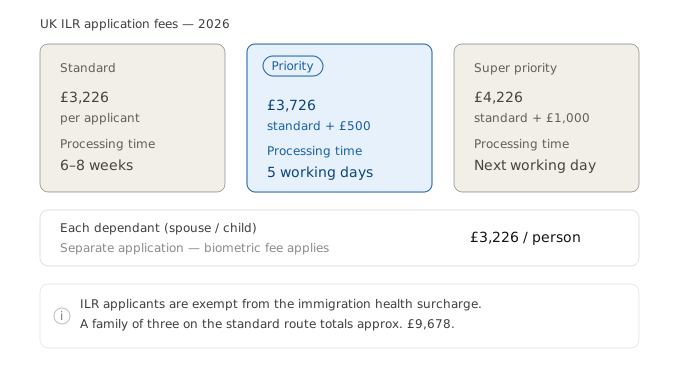
UK ILR Fee Breakdown 2026
Unlike the Skilled Worker visa, ILR applicants are exempt from the Immigration Health Surcharge. But if your employee has dependants also applying, each one carries the same £3,226 fee. A family of three applying together costs nearly £10,000 before any professional support fees. This is worth factoring into your global mobility budget early.
What the surcharge costs on the routes leading up to settlement: UK Immigration Health Surcharge (IHS) Fees 2026
Also note: under the proposed earned settlement reforms being introduced from 2026, some employees may face an extended 10-year qualifying period rather than 5 years. For those employees, your company will be managing sponsorship and immigration costs for longer than previously planned.
How to Apply for ILR for Your Employees: Step-by-Step Process
Your employee applies individually for ILR. However, your support with documentation and verification is critical for success.
Here is the precise 6-step process:
Three Employer Mistakes That Delay ILR Applications
Based on common patterns in ILR application handling, these are the employer-side errors that most often create problems:
Where timing is critical, employers should consider whether a priority or super priority service is available to reduce waiting times for an ILR decision.
Managing ILR When You Have Multiple International Employees
For companies with a workforce of several hundred international employees, ILR is not a one-off task it is a recurring process.
Summrizing these challenges in case of multiple international employees:
- You may have 10 or 20 employees approaching eligibility in the same calendar year, each on slightly different timelines and each requiring an individually prepared employer letter.
- Employees can be on different visa start dates, those with salary changes mid-qualifying period, and those with dependants applying separately.
- Without a structured system, ILR management becomes reactive and error-prone.
📌 The most effective approach is to
- integrate ILR eligibility dates into your existing HR or immigration management platform so alerts trigger automatically.
- Your global mobility team should receive 6-month advance notice for each upcoming ILR case, with a clear internal checklist assigned at that point.
You can review how Jobbatical supports HR teams managing immigration compliance across complex workforces.
Understanding whether your employees are on the standard 5-year or 10-year ILR route is also critical for workforce planning especially as the proposed earned settlement changes could shift timelines for employees currently in the qualifying period.
How Jobbatical Supports ILR at Scale
✅ Jobbatical provides end-to-end UK ILR application support for companies managing international workforces.
✅ That includes eligibility assessments, employer document guidance, absence calculations, application preparation, biometrics coordination, and direct liaison with the Home Office where needed.
For HR and global mobility managers at companies with 200 to 10,000 employees, managing ILR alongside all other immigration tasks visa renewals, sponsor licence compliance, new hire applications is a significant workload.
✅ Jobbatical's platform gives you centralised visibility across all active cases, with dedicated immigration experts who understand what each ILR application needs from your side.

Disclaimer: Immigration rules change quite frequently; please verify with official sources or contact us for the latest info before making any decisions.
Frequently Asked Questions : UK ILR Employer Responsibilities 2026
Does my company have to pay for an employee's ILR application?
There is no legal obligation for employers to fund ILR. However, many companies do cover the £3,226 application fee as part of their talent retention policy, particularly for employees who have been sponsored for five or more years. Whether you cover the cost or not, you must still provide the required employer letter and supporting documents.
What happens to my sponsorship obligation when an employee gets ILR?
Once your employee is granted ILR, your sponsorship obligation for that person ends. They no longer need a Certificate of Sponsorship to work for you, and you no longer need to track or renew their visa. This reduces your ongoing compliance burden significantly and frees up internal HR resource.
What documents must an employer provide for an ILR application?
Employers must provide a formal employment letter on company letterhead confirming job title, SOC code, salary, start date, and that employment is ongoing. You should also have at least 12 months of payslips available for the employee. If the employee travelled for work during the qualifying period, an employer letter explaining those absences is also required.
Can an employee apply for ILR while still employed by us?
Yes — and this is the most common scenario. Employees apply for ILR while in continuous employment with their sponsor. Your employer letter must be dated within one month of the application submission and confirm ongoing employment. The employee's Skilled Worker visa remains valid while the ILR application is processed.
How does the 2026 earned settlement model affect ILR timelines for our sponsored employees?
Under the proposed earned settlement reforms, the baseline qualifying period is expected to shift from 5 to 10 years for most Skilled Worker visa holders. High earners above £50,270 may still qualify in 5 years. As of May 2026, the 5-year route remains in force and no formal change has yet been enacted. Monitor GOV.UK for confirmed updates and review our dedicated earned settlement guide for the latest position.
What is the processing time for a UK ILR application in 2026?
Standard processing takes 6 to 8 weeks. A priority service (£500 additional fee) returns a decision within 5 working days of the biometrics appointment. A super priority service (£1,000 additional) delivers a decision by the end of the next working day. Advise employees to apply up to 28 days before their eligibility date to give enough processing time.

.svg)
.svg)