

Key Takeaways for Employers: Spain Labour Market Test
- The SNE (situación nacional de empleo) labour market test is mandatory for standard Spanish work permits unless a legal exemption applies - skipping it without grounds causes immediate application rejection.
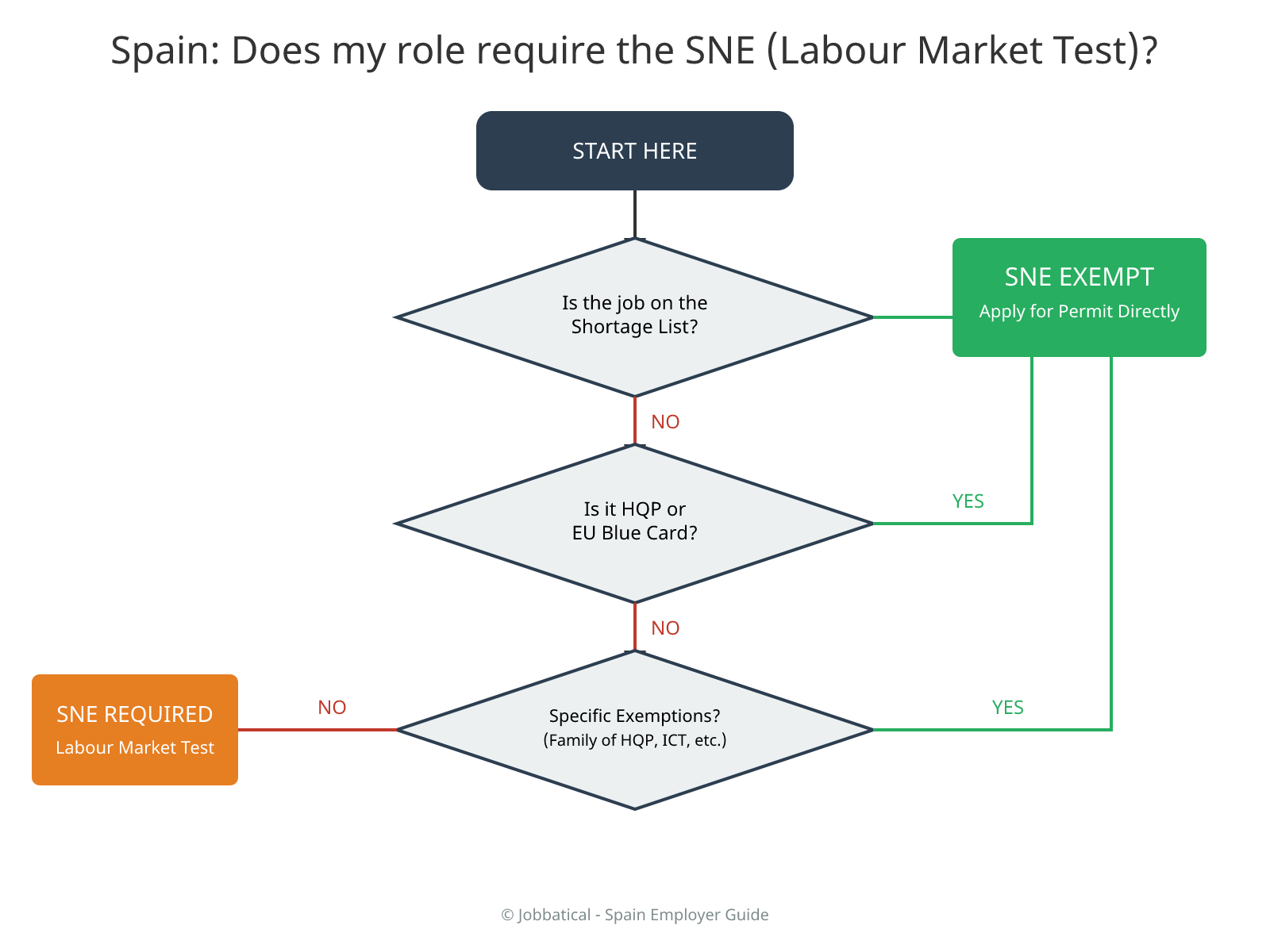
- The SEPE quarterly shortage occupation catalogue (Catálogo de Ocupaciones de Difícil Cobertura) is the fastest exemption route - roles listed can proceed directly to work authorisation without advertising.
- The HQP permit and EU Blue Card, both processed via the UGE-CE fast-track unit, bypass the SNE entirely and deliver decisions within 20 working days.
- Running the SNE incorrectly -wrong advertising duration, incomplete documentation, or wrong portal - is the leading cause of employer-side delays in Spanish work permit applications.
- Jobbatical manages SNE compliance, shortage list checks, and UGE filing in a single workflow, cutting HR admin time significantly.
What does the SNE Labour Market Test Require?
Spain's situación nacional de empleo (SNE) is the labour market test that standard work permit applications must pass before immigration authorities will authorise a non-EU hire. The SNE exists to protect the domestic workforce: before an employer can bring in a worker from outside the EU, they must show that no suitable Spanish or EU national was available for the role.
For HR teams managing international hiring, the SNE is often the slowest part of the process. Done correctly, it adds 3–4 weeks. Done incorrectly, it triggers a rejection and restarts the clock.
How the SNE Process Works Step by Step
The SNE is an employer-led process. Before submitting the work authorisation application, the hiring company must complete the following:
The 15-day advertising period is a hard legal minimum. Shorter advertising, advertising on non-approved portals, or missing candidate documentation are all grounds for rejection. The SNE evidence package must accompany the EX-03 work authorisation form filed with the Oficina de Extranjería.
For a detailed walkthrough of the full work authorisation submission, see Jobbatical's guide to Spain blue-collar work visa applications.
When Employers Can Skip the SNE: Three Legal Routes
Not all Spanish work permit routes require the SNE. Three exemptions are regularly used by employers and are legally defined.
1. SEPE Shortage Occupation List (Catálogo de Ocupaciones de Difícil Cobertura)
If the role appears on the current quarter's list for the relevant province, the employer can submit the work authorisation directly without the 15-day advertising stage. The list is province-specific - a construction role that is exempt in Andalusia may not be exempt in Madrid. Always check the list for the region where the hire is based.
SEPE updates the catalogue quarterly. HR teams should verify the current list before every new non-EU hire, not just once at the start of a recruitment cycle.
For the full Spain shortage occupation list and which roles qualify, including how the reduced salary threshold applies, see our dedicated guide.
2. Highly Qualified Professional (HQP) Permit via the UGE-CE
The HQP permit, processed by Spain's centralised UGE-CE unit under Law 14/2013, is exempt from the SNE by law. The employer does not need to advertise the role or obtain a negative certificate. The UGE-CE handles the entire application centrally, and is legally bound to decide within 20 working days.
This is the preferred route for companies hiring engineers, software developers, senior analysts, and other specialist professionals. For startups certified by ENISA under Spain's Startup Act, the HQP route also unlocks 3-year initial permits. See Jobbatical's Spain Startup Act employer guide for detail on how ENISA certification expands these advantages.
3. EU Blue Card
Spain's EU Blue Card route does not require a labour market test. Employers offering a qualifying role with a minimum gross annual salary of approximately €40,000 can proceed directly to work authorisation. The Blue Card is also processed via the UGE-CE and carries the same 20-working-day decision window.
See the full Spain EU Blue Card employer guide for salary thresholds and application requirements.
A fourth exemption worth knowing: the Van der Elst route lets EU-employed non-EU staff work temporarily in Spain without a new permit: Spain immigration updates for employers
SNE vs. Exempt Routes: Side-by-Side Comparison
Comparing Standard SNE vs Exempt Permit Routes
.svg)
┈┈┈┈┈┈┈┈┈┈┈┈┈┈┈┈┈┈┈┈┈┈┈┈┈┈┈┈┈┈┈┈┈┈┈┈┈┈┈┈┈┈┈┈┈┈┈
The Most Common SNE Compliance Mistakes
- Advertising on non-approved portals. The vacancy must be posted through SEPE or the relevant regional employment service. LinkedIn or company careers pages do not satisfy the SNE requirement.
- Insufficient advertising duration. 15 days is the legal minimum. Applications submitted with 14 days of advertising are rejected.
- Missing candidate rejection documentation. If Spanish or EU applicants applied, the employer must document why they were unsuitable. Vague rejection notes are challenged.
- Assuming the shortage list exemption applies without checking. The SEPE catalogue is province-specific and updated quarterly. A role exempt last quarter may not be exempt this quarter.
- Filing the SNE package late. The certificación negativa must be current at the time of work authorisation submission. An expired certificate triggers a re-run of the process.
For a complete overview of where permit applications stall and how to avoid them, see Jobbatical's guide to Spain UGE vs. consulate work permit processing.
How Jobbatical Manages SNE Compliance
For HR teams managing multiple hires across Spain, the SNE adds administrative load that compounds at scale. Jobbatical's immigration platform automates the key decision points: it checks whether a role appears on the current SEPE shortage list, identifies whether the HQP or Blue Card route applies, and manages the SNE documentation package where advertising is required.
Every active case is tracked in real time, with compliance alerts surfaced before deadlines are missed. For companies scaling international hiring in Spain, this means the SNE is managed systematically not case by case.
Comparing immigration partners rather than managing the SNE in-house? Our guide to choosing an EU Blue Card assistance service in Spain covers the five things employers should check before signing with a provider.
Disclaimer: Immigration rules change quite frequently; please verify with official sources or contact us for the latest info before making any decisions.
Frequently Asked Questions : Spain Labour Market Test
What is the SNE labour market test in Spain?
The SNE (situación nacional de empleo) is Spain's mandatory labour market test for standard work permits. Employers must advertise the vacancy through SEPE for 15 days and document that no suitable Spanish or EU national applied, before the immigration authority will consider a non-EU hire.
Which roles are exempt from Spain's labour market test?
Roles listed on SEPE's quarterly Catálogo de Ocupaciones de Difícil Cobertura are automatically exempt. In addition, the HQP permit and EU Blue Card, processed via the UGE-CE fast-track unit, bypass the SNE entirely regardless of the role's sector.
How long does the Spain labour market test take?
The mandatory advertising period is 15 days via the SEPE portal or regional employment services. After that, employers must compile documentation before submitting the work authorisation application. Total SNE-related preparation typically adds 3–4 weeks to the permit timeline.
What is the UGE-CE and how does it relate to the labour market test?
The UGE-CE (Unidad de Grandes Empresas y Colectivos Estratégicos) is Spain's centralised fast-track immigration unit. Applications submitted via the UGE-CE under the HQP or EU Blue Card routes are legally exempt from the SNE, meaning employers do not need to prove no local candidate was available. Decisions are issued within 20 working days.
What happens if an employer fails the labour market test in Spain?
If the SNE documentation is incomplete, incorrectly filed, or the advertising period is too short, the work authorisation application will be rejected. The employer must restart the process from scratch, adding months to the hire timeline. Repeated non-compliance can also trigger compliance scrutiny from immigration authorities.
Does the EU Blue Card require a labour market test in Spain?
No. Spain's EU Blue Card route does not require a labour market test. Employers offering a qualified role with a minimum gross annual salary of approximately €40,000 can proceed directly to work authorisation without the SNE advertising step, making it one of the fastest legal hiring routes available.
How often is Spain's shortage occupation list updated?
SEPE publishes the Catálogo de Ocupaciones de Difícil Cobertura quarterly. Each edition applies from the first to the last working day of the following quarter and is tailored by province and region. Employers should verify the current quarter's list before every new hire, as roles can be added or removed.

.svg)
.svg)