


Synopsis
- Spain's UGE-CE processes each ICT application individually but your company-level documents only need to be assembled once and reused across all filings.
- Submitting applications in parallel (not in sequence) keeps your team's start dates aligned and cuts total calendar time by 4–6 weeks per cohort.
- A single fraudulent or non-compliant file in a batch can trigger UGE review of all other filings submitted by the same agent compliance quality matters at scale.
- Post-approval, each transferred employee still requires individual TIE, Social Security, and padrón registration plan HR bandwidth for these tasks across the cohort.
- Managing 5+ ICT applications manually is where errors compound; a structured document master and a managed immigration service become cost-justified at this volume.
Most companies relocating a team to Spain treat each ICT application as a separate project.
If you have multiple ICT applications, this is the wrong approach.
- It will end up staggering start dates across months aligned them within the same 20-working-day window.
- Spain's UGE-CE processes each ICT application individually. But your company's documentation, your entity registration, your group structure evidence that's assembled once.
- Lets learn, how do we build a system that runs all of them in parallel without a single weak file derailing the batch?
Why Parallel Filing Changes the Maths
Sequential ICT applications are a compounding timeline problem.
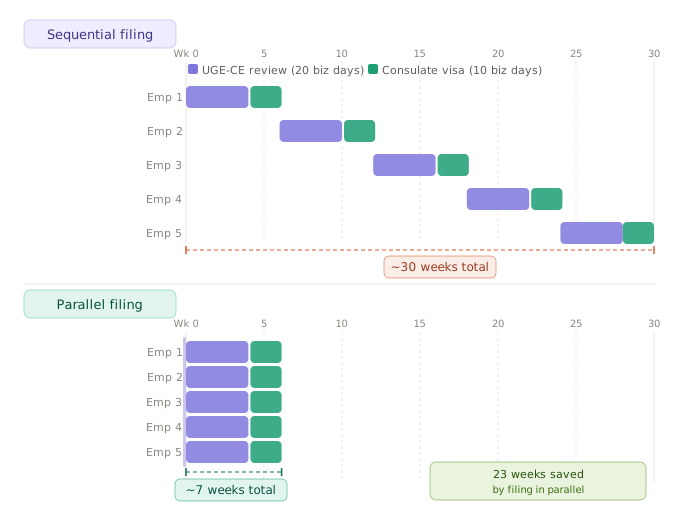
- If UGE-CE takes 20 working days per application across roughly 4–5 calendar weeks and you file 5 employees one after another, it means 20–25 weeks before your last hire arrives in Spain.
- That's six months of misaligned start dates, temporary remote arrangements, and project delays.
- Parallel filing collapses that to a single 20-working-day window.
- Your entire cohort receives UGE decisions at roughly the same time, proceeds to consulate visa applications together, and lands within weeks of each other.
- The difference isn't marginal; It's the difference between a coordinated team launch and a slow trickle.
Timeline Comparison: Sequential vs Parallel ICT Filing
The Two-Layer Document Architecture
Every ICT application has two types of documentation. Getting this distinction right is what makes batch processing efficient.
Company-level documents : Prepared once, reused across all filings:
Employee-level documents unique to each applicant:
📌 The most common batch failure point is not the company documents; It is the employees' documents.
- Assignment contracts that don't match actual role scope, salary documentation that doesn't meet the 2026 threshold, or employment histories that fall short of the 3-month minimum.
- Review every employee file against the criteria before a single application goes in.
.svg)
For a detailed breakdown of ICT eligibility requirements, see the Spain ICT Permit Complete Employer Guide.
Sequencing Within the Batch: Who Goes First
Not every employee in your cohort will have equally straightforward files. Generally, a small number of profiles will have complications like a gap in employment history, a qualification that needs additional verification, or a nationality with longer consulate processing times.
The smart approach is to tier your batch before filing :
- Tier 1 Clean files: All documents complete, salary threshold comfortably met, qualifications unambiguous. These go in first, in parallel.
- Tier 2 Files needing resolution: Minor documentation gaps, translation delays, or ambiguous role descriptions. These are resolved and filed as soon as ready usually 1–2 weeks behind Tier 1.
- Tier 3 Complex profiles: Trainees (who require additional justification), employees whose roles could be questioned under ICT criteria, or those requiring more extensive qualification documentation. These may warrant individual review before filing.
This tiering prevents one difficult file from holding up your straightforward cases. It also protects the batch from the most significant compliance risk you face.
The Compliance Contagion Risk
Very unique problem but not mentioned in the general ICT guides.
- Spain's UGE-CE has confirmed in 2026 that if fraud or serious non-compliance is detected in one file submitted by a particular agent or representative, UGE can and will review all other applications submitted by that same agent.
- In some cases, approvals already issued have been revisited.
- This means:
- every file in your batch is only as safe as the weakest one.
- A strong application submitted alongside a non-compliant one doesn't stay insulated.
- This is precisely why the document quality review matters before submission, not after.
📌 Help tips:
- If you are managing the batch internally, build a file review checklist that covers every employee's documents against the ICT criteria.
- If you are using an immigration provider, ask explicitly how they quality-check individual files before batch submission.
Post-Approval: What Each Employee Still Owns
UGE-CE approval doesn't end your coordination work it shifts it. Each employee then needs to move through their own individual post-approval steps, and these happen in parallel too.
- If any of your employees are bringing family, file the family reunification application simultaneously with the main ICT not after approval.
- Waiting adds 4–6 weeks unnecessarily.
- For HR teams managing 5 or more employees through this simultaneously, tracking these individual deadlines across a spreadsheet is where things slip.
- The TIE deadline in particular 30 days from arrival has no grace period, and missing it creates a compliance gap that affects the entire employment relationship.
Jobbatical's platform tracks every active case in real time, surfaces compliance alerts before deadlines, and manages the post-approval steps across your cohort.
When the ICT Isn't the Right Route for Part of Your Cohort
Batch filing assumes everyone in the cohort qualifies for the ICT. That's worth verifying before you build the batch not during it.
Common reasons an employee in your intended cohort may not qualify for ICT:
- They've been employed at the sending entity for fewer than 3 months
- The role doesn't fit manager, specialist, or trainee categories under EU Directive 2014/66/EU
- The transfer is effectively permanent rather than temporary (which points toward the HQP permit instead)
- The employee will be on the Spanish payroll long-term again, better suited to HQP
Running a mixed batch some ICT, some HQP is perfectly workable. Both routes process through UGE-CE with the same 20-working-day window. The company-level documents overlap significantly. What changes is the employee-specific documentation and the post-approval pathway. The Spain ICT vs HQP decision guide covers the criteria in detail.
For the broader picture of how Spain's UGE-CE fast track works versus the standard consulate route, see the Spain Work Permit: UGE vs Consulate Route for HR Teams guide.
Building the Batch Operations Checklist
A repeatable batch process needs three things: a document master, an employee tracker, and a post-approval compliance calendar.
Document master, one folder containing the current, apostilled versions of all company-level documents. Update this when anything changes (new audited accounts, entity changes, updated group structure). Every new batch starts from this master.
Employee tracker, a row per employee, columns for each required document, with a status (missing, received, translated, submitted). This makes the file review step systematic rather than ad hoc.
Post-approval calendar, built from the moment UGE decisions land. TIE deadline (Day 1 of arrival + 30 days), Social Security registration (Day 1), padrón (first month), permit renewal alert (6 months before expiry). For a team of 8, that's 32 individual compliance events to track.
If your team is scaling international hiring in Spain beyond a single cohort, the Work Permits at Scale: Spanish Startup HR Playbook covers how to operationalise this at programme level.
Disclaimer: Immigration rules change quite frequently; please verify with official sources or contact us for the latest info before making any decisions.
Frequently Asked Questions Batch ICT Permit Applications Spain
Can we submit multiple Spain ICT applications at the same time?
Yes. Spain’s UGE-CE processes ICT applications individually, but there is no restriction on submitting multiple applications simultaneously for different employees. Each application requires its own employee-specific documents, while company-level documentation — entity registration, group structure proof, business activity evidence — can be prepared once and reused across all filings.
How long does it take to process batch ICT applications in Spain?
UGE-CE has a statutory 20 working-day decision window per application. When applications are submitted in parallel rather than sequentially, your entire cohort can receive decisions within the same window — roughly 4–6 calendar weeks. Sequential filing, by contrast, multiplies this by the number of employees. After UGE approval, each employee’s consulate visa processing adds 10 working days.
What company documents are shared across multiple ICT applications?
The following are shared across all ICT filings for the same host entity: Spanish entity registration (escritura), tax identification (NIF/CIF), proof of active business operations in Spain, corporate group structure chart, and audited accounts or financial activity evidence. These documents only need to be prepared and apostilled once per batch cycle.
Can a compliance issue in one ICT application affect the rest of the batch?
Yes — this is a real risk. If UGE-CE detects fraud or serious non-compliance in one file submitted by the same agent, it can trigger a review of all applications submitted by that agent in the same period. This is not widely publicised but has been noted in 2026 UGE guidance. It underscores why every employee file must be fully compliant before submission, not just the strongest profiles.
What does each employee still need to do individually after ICT approval?
Each transferred employee must complete four steps independently after UGE-CE approval: apply for the ICT visa at their home country’s Spanish consulate (10 working days), register with Social Security (Day 1 of employment), apply for the TIE residence card within 30 days of arriving in Spain, and complete padrón municipal registration. Family reunification applications should be filed simultaneously with the main ICT to avoid 4–6 week delays.
At what point does it make sense to use a managed immigration service for ICT batch applications?
Most HR teams find the operational load manageable up to 3–4 simultaneous ICT applications. Beyond that, the coordination overhead — tracking individual document statuses, managing consulate appointments across multiple countries, monitoring TIE deadlines, and maintaining the compliance calendar — compounds quickly. A managed service becomes cost-justified when the HR time saved exceeds the service fee, which typically happens at 5 or more concurrent cases.

.svg)
.svg)