


KEY TAKEAWAYS
- The UK Join Ship Visa (endorsed Joining Ship) lets non-EEA visa-national seafarers enter a UK port to board a vessel leaving UK territorial waters, with no sponsor licence required.
- Eligibility depends on whether the seafarer's country has ratified ILO Convention 108 or 185; those from non-ratifying nations must apply for this visa before travel.
- The government fee matches the Standard Visitor rate (£135 as of April 2026) with no Immigration Health Surcharge and no salary threshold.
- Standard processing takes around 3 weeks from biometric submission; priority service can reduce this to 5 working days at an additional cost.
- A correctly worded letter of invitation, valid Seafarer Employment Agreement (SEA/MLC), and clear vessel departure evidence are the most common pain points for crewing managers.
UK Join Ship Visa: Complete Employer Guide for Maritime HR Teams (2026)
Your crew change is scheduled. The vessel is docking at a UK port in three weeks. And then it hits, your seafarer from the Philippines holds a valid seaman's book, but their country is a visa national and the ship agent is asking whether a Join Ship Visa is in place. If your crewing team has been caught off guard by post-Brexit seafarer immigration rules, you are not alone.
The UK Join Ship Visa is a specialist entry clearance route designed precisely for this scenario. This guide covers who needs it, how to check eligibility, the application process, costs, and the compliance traps that catch even experienced maritime HR teams.
What Is the UK Join Ship Visa?
The UK Join Ship Visa (officially endorsed "Joining Ship") is an entry clearance route under UK immigration law. It allows non-EEA visa-national seafarers travelling under a Seafarer Employment Agreement (SEA/MLC) to enter a UK port for the sole purpose of boarding a vessel that is departing UK territorial waters.
Critically, this visa sits outside the UK's Points-Based System. There is no sponsor licence to obtain, no Certificate of Sponsorship to issue, and no salary threshold to meet, making it the most cost-effective maritime entry route available for foreign crew your company needs on board.
Who Needs the UK Join Ship Visa?
Whether a seafarer needs this visa depends entirely on their country's status under ILO Convention No. 108 (Seafarers Identity Documents, 1958).
Seafarers Who Do NOT Need a Visa
Visa-national seafarers are exempt from the Join Ship Visa requirement if they hold a valid Seafarers Identity Document (SID) issued by a country that has ratified ILO Convention 108 or ILO Convention 185 (having previously ratified 108). The SID must contain a photograph, signature or fingerprints, and a statement that it is issued under the convention.
Key ILO 108/185 countries include: India, Philippines, Indonesia, Brazil, Russia, Ukraine, Ghana, Sri Lanka, and others. Always verify the current list against the Home Office Seafarers guidance (GOV.UK) before each crew change, the list has changed post-Brexit.
Seafarers Who DO Need a Visa
- Visa nationals whose country has NOT ratified ILO 108 or 185.
- Visa nationals who do not hold a compliant SID even if their country has ratified.
- Seafarers whose SID does not contain the required convention statement.
In practice, this affects crew from a range of African, Middle Eastern, and Asian countries not on the ILO ratification list. Your crewing manager should run a nationality-level check before confirming any crew roster for a UK port call.
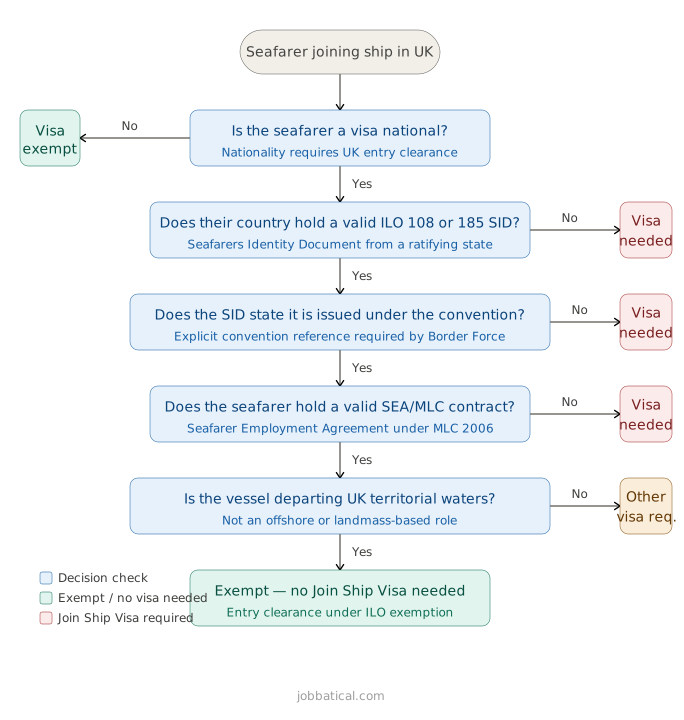
Eligibility: Key Conditions to Satisfy
For the visa to be granted, three core conditions must be met:
- The seafarer is travelling under contract: A valid Seafarer Employment Agreement (SEA) compliant with the Maritime Labour Convention (MLC 2006) is required.
- The vessel is departing UK territorial waters: Border Force must be satisfied the ship is not remaining in UK waters. For spot-market or unscheduled vessels, previous movement records and trade patterns are used as evidence.
- No intention to remain in the UK: The seafarer must not intend to work on the UK landmass or base themselves in the UK after the vessel departs.
One area that catches teams out: the seafarer vs offshore worker distinction. The offshore wind sector concession was withdrawn in May 2023. Workers operating within 12 nautical miles of the UK landmass are now subject to full UK immigration control and require a separate visa route. If your company deploys crew to offshore installations alongside maritime vessels, you need two separate immigration frameworks in place. See our full UK visa options guide for more on this.
Application Process: Step by Step
The seafarer applies from their home country through a UK Visa Application Centre (VAC). Here is what the process looks like in practice:
Application Steps
| Step | Action | Who is responsible |
|---|---|---|
| 1 | Confirm ILO 108/185 exemption status by nationality | Crewing manager / HR |
| 2 | Draft and issue letter of invitation (vessel name, IMO number, port, departure details) | Shipowner / crewing agency |
| 3 | Seafarer completes the Standard Visitor visa application online (UK government portal) | Seafarer |
| 4 | Seafarer attends biometric appointment at local UK VAC | Seafarer |
| 5 | UKVI processes application; decision issued | UKVI / Home Office |
| 6 | Seafarer travels to UK port with visa, valid passport, SEA, and vessel documents | Seafarer |

Timeline and Fees
Processing Times and Costs (2026)
| Service level | Processing time | Fee (approx.) |
|---|---|---|
| Standard | ~3 weeks from biometric appointment | £135 (Standard Visitor rate, April 2026) |
| Priority | 5 working days | £135 + ~£500 priority fee |
| Super-priority | Next working day | £135 + ~£1,000 (where available) |
There is no Immigration Health Surcharge and no salary threshold. Honestly, three weeks is the minimum buffer most crewing teams should plan for, building a priority service budget into your port call planning makes sense for any last-minute crew change. Always verify fees on GOV.UK before submission, as they are updated without notice.
Required Documents
- Valid passport (with at least 6 months remaining validity)
- Seafarers Identity Document (if applicable)
- Seafarer Employment Agreement (SEA/MLC-compliant contract)
- Letter of invitation from the shipowner or crewing agency, must include vessel name, IMO number, port of joining, estimated departure date, and confirmation the vessel will leave UK waters
- Evidence of vessel movements or port schedule (where available)
- Proof of accommodation ashore (if any layover is planned before boarding)
- Return travel evidence (repatriation ticket if vessel completes voyage outside UK)
The letter of invitation is where most applications run into trouble. Missing the IMO number, omitting the departure route, or using vague language about vessel movements gives Border Force grounds to question intent. Jobbatical's team helps shipowners and crewing managers draft invitation letters that meet Home Office standards, reducing refusal risk before the application is even submitted.
Post-Brexit Compliance Risks for Maritime HR Teams
Since January 2021, the automatic exemption framework for non-EEA seafarers changed significantly. The compliance landscape now has several specific fault lines your team needs to manage:
- ILO 108 vs ILO 185 confusion. Countries like France, Brazil, and India have ratified ILO 185 after denouncing ILO 108. Their seafarers remain visa-exempt, but only if the SID states it is issued under the relevant convention. A seaman's book from one of these countries without that statement may not satisfy Border Force.
- Seafarer misclassification. Offshore well boat workers retain a current concession; offshore wind workers do not. Classifying an offshore worker as a seafarer to avoid visa requirements is an offence under UK immigration law.
- Repatriation requirements. Since January 2021, non-EU crew members disembarking in the UK require outward reporting to the local Border Force office before disembarkation. Your ship agent should be coordinating this, check that the process is in place.
- Vessel departure evidence for unscheduled vessels. For spot-market or cable repair vessels without a fixed schedule, Border Force uses historical movement records. Your crewing agent should prepare a vessel history document as standard practice for UK crew changes.

If your team manages rotating global rosters touching multiple ports across different immigration jurisdictions, Jobbatical's immigration case management platform gives you real-time visibility across all active cases, so nothing slips through.
How Jobbatical Supports Maritime Employers
Managing Join Ship Visa applications as part of a broader crew roster is operationally demanding. Jobbatical handles the end-to-end process for maritime employers and crewing agencies:
- ILO 108/185 eligibility checks by nationality before you plan the crew change
- Letter of invitation drafting that meets Home Office standards
- Application coordination with seafarers at their local VAC
- Priority service management where vessel scheduling demands it
- Compliance tracking for repatriation and disembarkation reporting
For companies also managing UK Skilled Worker Visas or UK Sponsor Licences for shore-based staff, Jobbatical manages both maritime and land-based immigration from a single platform.
Disclaimer: Immigration rules change quite frequently; please verify with official sources or contact us for the latest info before making any decisions.
Frequently Asked Questions: UK Join Ship Visa
Who needs a UK Join Ship Visa?
Visa-national seafarers whose country has not ratified ILO Convention 108 or 185 need a Join Ship Visa to enter a UK port and board a vessel that is leaving UK territorial waters. Seafarers holding a valid Seafarers Identity Document from an ILO 108 or 185 ratifying state are generally exempt from this requirement.
Do I need a sponsor licence to employ seafarers on a Join Ship Visa?
No. The UK Join Ship Visa sits outside the Points-Based System, so there is no sponsor licence requirement and no Certificate of Sponsorship to issue. This keeps the administrative overhead considerably lower than other UK work visa routes for maritime employers and crewing agencies.
What is the government fee for the UK Join Ship Visa?
The fee is charged at the Standard Visitor rate, which is £135 as of April 2026. There is no Immigration Health Surcharge and no salary threshold requirement. Always verify the current fee on GOV.UK before submitting an application, as fees are subject to change.
How long does UK Join Ship Visa processing take?
Standard processing runs around 3 weeks from biometric submission at a UKVI-authorised Visa Application Centre. Where available, a priority service can return a decision within 5 working days for an additional fee. Given vessel scheduling pressures, most crewing managers should plan for the standard 3-week window as a minimum buffer.
What is the difference between a seafarer and an offshore worker for UK immigration purposes?
Seafarers are crew members employed on a vessel departing UK territorial waters and may benefit from a visa exemption under Section 8(1) of the Immigration Act 1971. Offshore workers, for example, those on wind farms within 12 nautical miles of the UK, lost their concession in May 2023 and now require a formal visa. Correct classification is critical; misclassifying an offshore worker as a seafarer is a compliance risk that can result in Border Force refusal.
What is the most common reason for UK Join Ship Visa refusals?
Incorrectly worded letters of invitation and insufficient evidence that the vessel will leave UK waters are the leading causes of refusal. Border Force applies a subjective standard, they must be satisfied the seafarer is not intending to base themselves in the UK. Detailed vessel itinerary documents, a valid SEA/MLC contract, and a precise letter from the shipowner significantly reduce refusal risk.
How long is the UK Join Ship Visa valid for?
The UK Join Ship Visa is valid for up to 6 months and allows the seafarer to enter a UK port to board a departing vessel. It does not permit the holder to work on the UK landmass or remain in the UK after the vessel departs.

.svg)
.svg)