


KEY TAKEAWAYS
- Your employee cannot start with a new employer until the Ausländerbehörde approves the change; there is no grace period and no automatic 12-month mobility window like the EU Blue Card.
- The new role must match the recognised qualification (Anerkennung) that underpinned the original §18b or §18a permit; a significant field shift can stall or block approval.
- Federal Employment Agency (BA) approval is always required for §18a vocational holders and for shortage-occupation salary bands; for standard §18b degree roles it depends on salary and circumstances.
- After a job loss, a 3-month grace period applies under the 2023 Skilled Immigration Act, but you must notify the Ausländerbehörde within 4 weeks of the employment ending.
- If the new salary meets the 2026 EU Blue Card threshold (€50,700, or €45,934.20 for shortage occupations), consider upgrading the permit to accelerate permanent residency.
Navigating a job change for non-EU employees on a German Qualified Employment Permit (QEP) / Skilled Worker Visa (§18a or §18b AufenthG) requires strict adherence to legal procedure. Unlike the EU Blue Card, there is no automatic flexibility window; every employer change requires a formal reassessment before the employee can start work.
This guide covers a skilled worker visa change of employer for Qualified Employment Permit holders under §18b (academic degree) and §18a (vocational qualification) of the Aufenthaltsgesetz. If your employee holds an EU Blue Card, the rules differ, see our EU Blue Card employer change guide.
Who This Applies To
The Qualified Employment Permit (Qualifizierte Beschäftigung) is a German residence permit for non-EU workers with a recognised qualification. It comes in two forms:
- §18b AufenthG, for workers with a recognised academic degree whose salary falls below the EU Blue Card threshold.
- §18a AufenthG, for workers with a recognised vocational qualification (Berufsausbildung), such as nurses, electricians, and mechatronics technicians.
This permit is not the EU Blue Card (§18g), which requires a higher salary and carries automatic mobility rights. The terms "skilled worker visa" and "Qualified Employment Permit" overlap in casual usage; both describe the §18b/§18a route covered here.
In practice, these holders take a slower path to permanent residency (3 to 5 years, versus 21 months for Blue Card holders with B1 German) but face fewer salary entry barriers. Use our Germany pre-hiring visa eligibility tool to confirm which permit category applies before you proceed.
Eligibility Conditions for the New Role
Three conditions must be satisfied for the amendment to be approved.
1. Qualification match
The new position must sit in the same professional field as the recognised qualification. For non-regulated roles, the 2023 Skilled Immigration Act broadened acceptable matches, so a software engineer with a computer science degree can usually move into a product role without a full re-evaluation. Regulated professions (doctors, nurses, certain engineers) require completed Anerkennung for each new role context. A major field shift, say engineering to finance, is scrutinised closely and may need a fresh recognition procedure.
Run the Germany pre-hiring visa eligibility tool before extending an offer, and see our Germany qualification recognition guide for the Anerkennung process.
2. Federal Employment Agency involvement
Whether the Bundesagentur für Arbeit (BA) must approve the new job depends on permit type and salary:
- §18a (vocational): BA approval is always required. The BA checks that pay and conditions match the German market rate.
- §18b (degree, standard salary): BA approval is generally not required where salary meets or exceeds the market rate for the role.
- §18b (shortage occupation / reduced salary band): BA approval is required. Expect an additional 2 to 4 weeks.
BA involvement happens internally between the immigration office and the BA; your employee does not submit a separate application. Where approval is required, the BA must respond within one week, and no response counts as approval, a useful protection for HR timelines.
3. Salary and market-rate compliance
There is no fixed statutory minimum salary, unlike the Blue Card. The offered pay must reflect German market rates (ortsübliche Bezahlung) for the role, sector, and location. The BA verifies this where involved. If pay falls short, the application is rejected or referred back.
Can Your Employee Change Employer?
Yes, but not freely. The permit is employer-specific, issued with a Zusatzblatt (supplementary sheet) that ties it to a named employer and role.
- There is no minimum time your employee must work with their current employer before a change is allowed.
- They cannot resign on Friday and start with you on Monday. The permit must be updated before employment begins.
- Unlike the EU Blue Card, there is no automatic 12-month window that unlocks free movement. Approval is needed every time.
- Expect a transition timeline of roughly 6 to 12 weeks between the offer and the legally permitted start date.
The process mirrors a fresh permit application in many respects. The Ausländerbehörde reassesses whether the new role matches the recognised qualification, whether the Federal Employment Agency must approve it, and whether salary meets the applicable standard. Applications can be filed while your employee is still employed elsewhere, and a Fiktionsbescheinigung may be issued to confirm the application is pending.
Since the appointment wait is the single biggest variable in major cities, confirm it for your employee's consulate with the Germany residence visa appointment waiting time calculator.
2026 Salary Thresholds
There is no single headline salary floor for §18b/§18a. What matters is market conformity. That said, the EU Blue Card thresholds serve as useful reference points, and they matter if you want to consider an upgrade.
Key 2026 salary reference points
If the new role's salary meets the Blue Card threshold and your employee holds a university degree, stop and consider the upgrade. The Blue Card brings a 21-month route to permanent residency (with B1 German) versus 3 to 5 years on §18b. That difference matters for retention.
How to Process a Change of Employer
Change of employer Decision framework
Use this decision guide to check the appropriate route for your employee
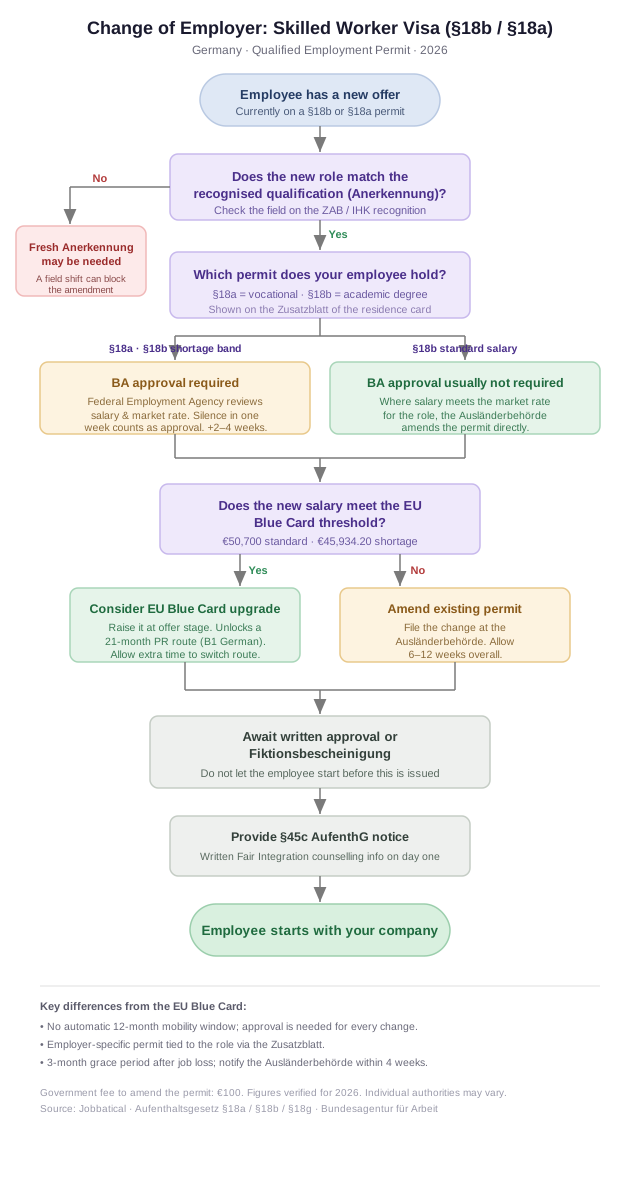
Step by Step Application Process Guide
Jobbatical's Germany Change of Employer service handles coordination with the Ausländerbehörde and the BA, reducing the risk of delays from incomplete submissions.
What are the Documents Required for Change of Employer Process
Document checklist for a change of employer application
Individual Ausländerbehörden may request additional documents. Always confirm the full checklist with the relevant office, or use the Germany Employer Change Checker before submitting.
Processing Time and Fees
Timelines and fees vary by city and local authority workload.
- Berlin: roughly 8 to 12 weeks as of early 2026.
- Munich and Hamburg: often faster, around 4 to 8 weeks.
- Frankfurt and Düsseldorf: typically mid-range.
- Standard government fee to amend the permit: €100.
- Fiktionsbescheinigung: approximately €10 to €25.
- Certified translations, where required: €40 to €120 per document.
The Fiktionsbescheinigung lets your employee work legally while the new card is processed. Confirm it is issued at the application appointment. Honestly, most companies wait too long to start this, eight weeks is the minimum buffer you should plan for, and the appointment wait is the single biggest variable in major cities.
Change-of-employer processing swings from 4 to 12 weeks by city, get a case-specific estimate first with the Germany residence visa processing time calculator.
What Happens If Your Employee Loses Their Job
The 2023 Skilled Immigration Act introduced a 3-month grace period for Qualified Employment Permit holders who become unemployed. During that window, the permit remains valid and the employee can search for new qualifying employment in Germany.
As the outgoing employer, your obligations are:
- Notify the Ausländerbehörde within 4 weeks of the employment ending, using the official form (Mitteilung über die Beendigung des Beschäftigungsverhältnisses).
- If BA approval was required for the original hire, notify the BA as well.
- Provide a reference letter (Arbeitszeugnis); your employee needs it to demonstrate qualification match for their next permit.
- Inform them of the grace period and their right to register as a job seeker with the Agentur für Arbeit.
This differs from the EU Blue Card, which also carries a 3-month grace period but adds broader intra-EU mobility during that window. Here, the search is restricted to Germany unless the employee holds another qualifying status.
Could This Trigger an EU Blue Card Upgrade?
Every employer change is a moment to check whether your employee now qualifies for an EU Blue Card. If the new role holds a university degree already recognised in Germany and offers a salary of at least:
- €50,700 gross/year for standard roles, or
- €45,934.20 gross/year for shortage occupations (IT, engineering, healthcare, STEM),
then a Blue Card application is possible instead of, or alongside, the amendment. The benefits are real: permanent residency in as little as 21 months with B1 German, cleaner unemployment provisions, and EU mobility rights. Raise this at offer stage. Once the §18b application is filed, switching permit type adds time and complexity. Our Germany Qualified Employment Permit service page and EU Blue Card employer change guide cover both pathways.
Compliance Notes for HR
§45c AufenthG, Fair Integration duty: From 1 January 2026, every employer hiring a non-EU skilled worker must inform them in writing about free labour and social-law counselling (for example the "Faire Integration" network) by the first day of work. This applies to incoming employees changing employers. Document it. See our employer obligations under §45c guide.
Degree recognition during transition: If the original Anerkennung was conditional (partial recognition with a compensating measure outstanding), check the condition has been satisfied before filing. An outstanding compensating measure can block the amendment.
Ongoing BA obligations: The permit is issued for a specific role. Promoting your employee into a significantly different function, particularly across fields, may require a new employer change process.
Disclaimer: Immigration rules change quite frequently; please verify with official sources or contact us for the latest info before making any decisions.
Frequently Asked Questions : Germany Skilled Worker Visa Change of Employer

.svg)
.svg)