.svg)



Key Take aways for Germany Change of Employer
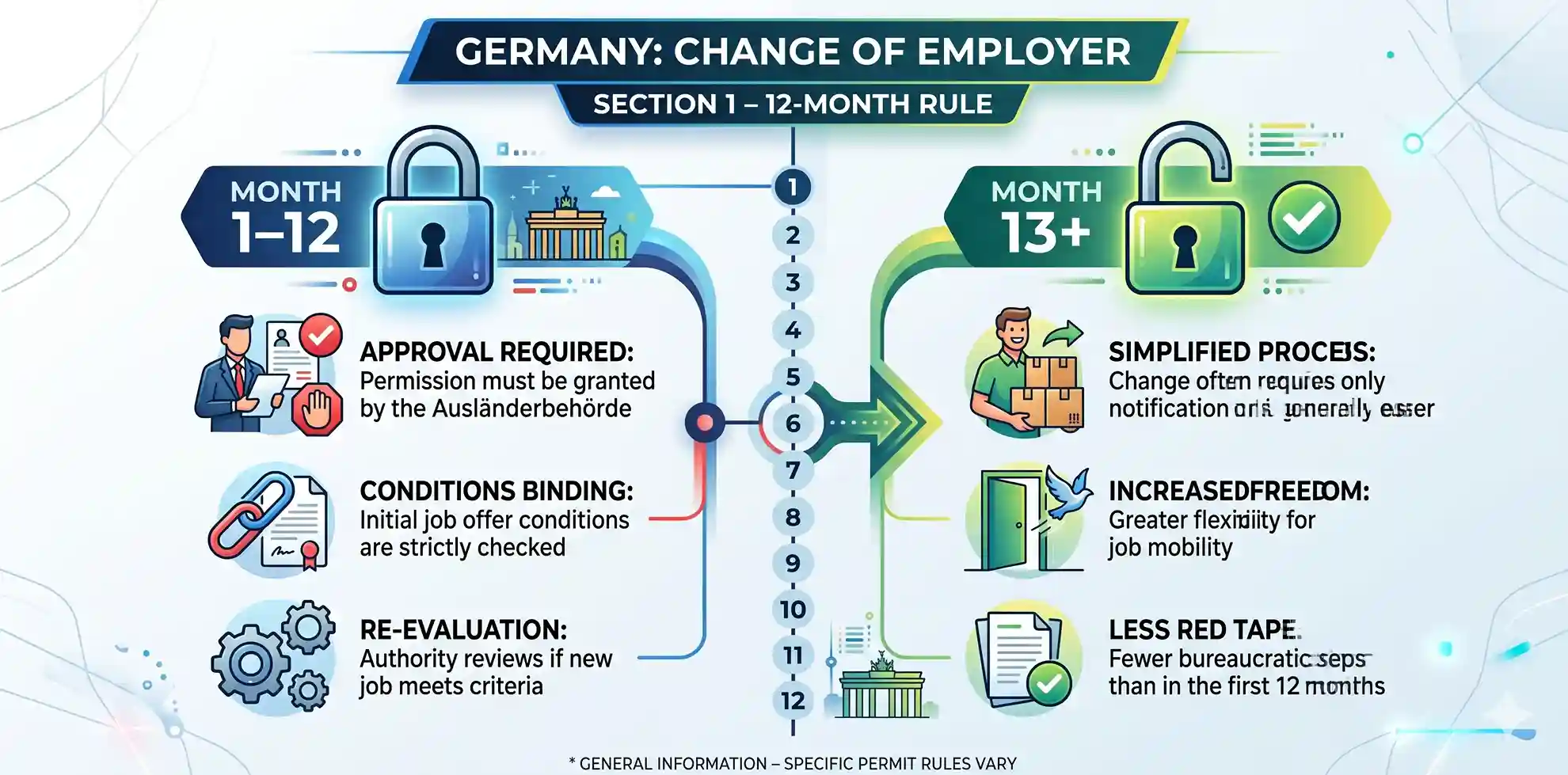
- First 12 months: Your employee must notify the Ausländerbehörde within two weeks of switching employers; not wait for pre-approval. Authorities have 30 days to object; if they don't, the change is automatically accepted. The new role must meet the 2026 salary thresholds (€50,700 / €45,934.20 for shortage occupations) and match their qualifications.
- After 12 months: Your employee can change jobs freely with no notification required; as long as the new role still meets EU Blue Card conditions.
- Intra-EU moves: After 12 months in Germany, your employee can relocate to another participating EU country under the Blue Card system. Notify local immigration services within one month of arrival.
- If they lose their job: The EU Blue Card stays valid for three months, giving your employee time to find a new qualifying role. Inform the Ausländerbehörde about the unemployment status within that window.
When an employee holding an EU Blue Card changes jobs in Germany, whether triggered by a new opportunity or the end of a contract, you need to act promptly. Notify the relevant immigration authorities and update the employer details on the permit. This process is called an Arbeitgeberwechsel, and getting it right protects your employee's legal status while keeping your company compliant.
Here's exactly what you need to know across each scenario.
1. Changing Employers Within Germany
Within the First 12 Months
During the first year, any job change needs to go through the local Ausländerbehörde. The rules:
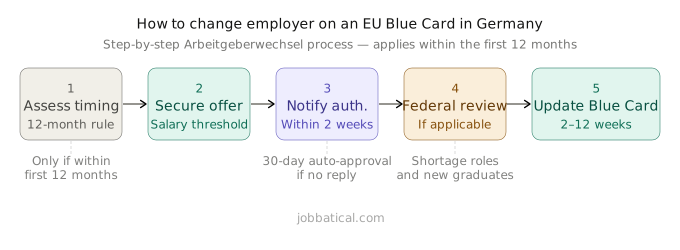
- Notification required: Submit notification within two weeks of the change. Authorities have up to 30 days to approve, suspend, or reject. If no decision arrives within 30 days, the change is automatically accepted.
- Salary threshold: The new role must offer at least €50,700 gross/year for most professions, or €45,934.20 for shortage occupations (e.g. IT, healthcare, engineering). These figures are reviewed annually against pension insurance ceilings.
- Job and qualification match: The new role must correspond to the employee's degree, or, for IT professionals, at least three years of relevant experience in the past seven years. Self-employment doesn't qualify.
- Contract minimum: The new employment contract must cover at least six months.
- Federal Employment Agency approval: Required for shortage professions or recent graduates (within three years of degree completion).
Before making a formal offer, run a quick check with Jobbatical's Germany Employer Change Checker to confirm whether the new role qualifies.
As the hiring company, keep in mind that from January 2026, you also have a statutory obligation under §45c AufenthG to inform your new non-EU hire in writing about free labour and social law advisory services on their first day of work. See what this means for your compliance checklist.
After 12 Months
Once your employee has completed 12 months on the EU Blue Card, they can switch employers freely, no notification to immigration authorities is required. That said, check with your local Ausländerbehörde whether the Zusatzblatt (supplementary sheet) needs updating with the new employer's details, as practices vary by city.
For a full picture of what drives processing timelines at each stage, including which cities run longest and how to set realistic start date expectations, see our Germany Change of Employer Processing Time guide.
2. Relocating Within the EU
After 12 months of continuous employment in Germany, your employee can move to another EU member state under the EU Blue Card system, without starting from scratch on a new work visa. For a deeper look at the rights this unlocks, see our guide on EU Blue Card mobility rights when working in other EU countries.
Which Countries Apply?
- 25 EU member states participate in the EU Blue Card scheme.
- Denmark and Ireland have opted out, intra-EU mobility rules do not apply to moves into these countries.
- Short-term travel within the Schengen Area (up to 90 days in any 180-day period) is permitted on a valid German EU Blue Card, regardless of any employer change.
What HR Teams Need to Plan For
- Notify early: Submit the application or notification in the destination country no later than one month after arrival. Missing this deadline creates compliance risk.
- Internal transfers still require local compliance: Moving an employee from your German entity to a subsidiary in another EU country doesn't bypass the host country's immigration process. Both requirements run in parallel.
- Check start-work rules: Some EU countries permit employees to begin working immediately on arrival; others require approval first. Verify the host country rules before setting a start date.
- Align timelines: Coordinate relocation dates, permit applications, and payroll transitions early to avoid onboarding gaps.
Documents to Carry When Moving Within the EU
| Document | Details |
|---|---|
| Valid Passport | Must be valid for the full duration of the stay. |
| EU Blue Card Residence Permit | Valid German EU Blue Card (plastic card). Include entry visa if still applicable. |
| Employment Documentation | Signed contract or job offer for the new role, confirming salary and position details that meet Blue Card thresholds. |
| Proof of Legal Residence in Germany | Anmeldung (registration), rental contract, or equivalent proving minimum residence was met before exercising mobility rights. |
| Family Member Documents (if applicable) | Passports, residence cards, and proof of relationship for accompanying family members. |
What Happens to Family Members?
| Scenario | What It Means |
|---|---|
| Keeping family in Germany | As long as the EU Blue Card remains valid under the new employer, family members' derived residence rights in Germany are preserved. |
| Relocating together to another EU country | Spouses and children can usually accompany the Blue Card holder under simplified family mobility rules, often with immediate labour market access. |
| Long-term relocation | Family members must apply for new residence cards in the destination country. German permits do not automatically transfer. |
| Employee moves first, family follows later | Family reunification in the second country applies, with different documentation and timelines depending on national rules. |
3. Unemployment Provisions
If your employee loses their job, they don't lose their permit immediately. The EU Blue Card stays valid for three months from the end of employment, enough time to find a new qualifying role. Inform the Ausländerbehörde about the unemployment status within this period.
If the new job doesn't meet Blue Card requirements, the employee may be eligible for a different permit type or a job-search period. Our full EU Blue Card employer guide covers the alternative pathways in detail.
Scenario Summary
| Scenario | Key Rules |
|---|---|
| Changing employer, first 12 months | Notify Ausländerbehörde within 2 weeks. Approved within 30 days (auto-approved if no decision). New role must meet salary and qualification requirements. |
| Changing employer, after 12 months | No mandatory notification. Change freely, provided the new job still meets Blue Card conditions. |
| Relocating to another EU country | Eligible after 12 months in Germany. Notify local immigration services within 1 month of arrival in the destination country. |
| Unemployment | Blue Card valid for 3 months post-employment. Must inform authorities of unemployment status within this period. |
Step-by-Step Application Process (Arbeitgeberwechsel)
Documents Required for an Employer Change
| Document | Details |
|---|---|
| Valid Passport | Original plus copy. Must remain valid for the duration of stay. |
| Current EU Blue Card | Residence permit card plus Zusatzblatt (supplement sheet). |
| New Employment Contract | Signed, showing position title, gross annual salary, and minimum six-month duration. |
| Erklärung zum Beschäftigungsverhältnis | Official job description form signed by the new employer. Available from the BAMF website. |
| Proof of Qualifications | University degree certificate, or for IT professionals, a CV showing at least three years of relevant experience within the last seven years. |
| Health Insurance Proof | Confirmation of valid health insurance coverage in Germany. |
| Biometric Photo | 35mm × 45mm, required only for in-person applications. |
Additional documents may be requested by your local Ausländerbehörde. Always confirm requirements with the specific office handling your case. For a comprehensive list, visit BAMF's EU Blue Card page.
A Few Things Worth Knowing
- For Blue Card types linked to MINT, IT, or young professional categories, authorities can temporarily suspend the change for up to 30 days. If no rejection arrives within that window, the change is automatically approved.
- If the new role doesn't qualify for a Blue Card, the employee may still be eligible for a different permit type, such as the Germany Qualified Employment Permit, rather than losing status entirely.
- Changing employers does not reset the path to permanent residency. The 27-month track (or 21 months with B1 German) continues uninterrupted, provided employment stays continuous. See our guide on retaining international talent through to PR and citizenship.
- Degree holders with a recognized qualification are generally unaffected by additional Federal Employment Agency checks, salary threshold and qualification-role alignment still apply, but the process is more straightforward.
- As the new employer, you have a 2026 legal obligation to inform your hire about free labour law advisory services on their first working day. Full details on §45c employer duties here.
Why This Process Matters for HR
A smooth Arbeitgeberwechsel keeps your employee legally protected, your company compliant, and your onboarding timeline on track. The EU Blue Card framework is designed to support career mobility, but only if the process is handled correctly. Missed notifications, incorrect documents, or a misaligned salary can put your employee's status at risk and delay their start date by weeks.
Jobbatical manages the full employer change process, from eligibility checks and document preparation to authority liaison and permit updates. Explore our Germany Change of Employer service or schedule a consultation to discuss your specific case.
For the latest official guidance, refer to the Federal Office for Migration and Refugees (BAMF) or the European Commission Immigration Portal.
Disclaimer: Immigration laws change frequently and may vary by nationality and local authority. Always verify requirements with official sources or a qualified immigration specialist before taking action. Jobbatical is not liable for decisions made based on this content.
Frequently Asked Questions About Changing Employers with an EU Blue Card in Germany
Do I need permission to change employers within the first 12 months of holding an EU Blue Card in Germany?
You must notify the local immigration authority (Ausländerbehörde) of any employer change within two weeks during the first 12 months. Prior approval is no longer strictly required, but the authorities have up to 30 days to suspend or reject the change if the new position does not meet EU Blue Card requirements.
What is the rule for changing employers after the first 12 months with an EU Blue Card?
After completing 12 months of employment on an EU Blue Card, you may change employers freely without any obligation to notify the immigration authorities, provided the new job continues to meet general Blue Card conditions.
What are the minimum gross annual salary requirements for the new job under the EU Blue Card?
From 2026, the minimum gross annual salary must be at least €50,700 for most professions. A reduced threshold of €45,934.20 applies to shortage occupations, recent graduates, and IT specialists without a formal degree.
What happens to my EU Blue Card if I become unemployed?
If your employment ends, the EU Blue Card generally remains valid for three months, giving you a grace period to secure a new qualifying position. You are required to inform the immigration authorities about the termination of employment.
As the new employer, do I have any obligations when onboarding an EU Blue Card holder?
Yes. From January 2026, under §45c of the Residence Act (AufenthG), you must inform your new non-EU hire in writing about free labour and social law advisory services (Fair Integration) by their first working day. Non-compliance can result in fines of up to €30,000.
What is the consequence of failing to notify the immigration authorities of a job change within the first 12 months?
Failure to notify the authorities, or submitting the notification too late, can result in the revocation of your EU Blue Card and may jeopardize your right to continue working and residing in Germany.

.svg)


.svg)