

Key Takeaways : Anerkennungsberatung for Employers in 2026
- Anerkennungsberatung (qualification recognition advisory) is a mandatory step for most non-EU hires in Germany — HR teams that initiate it late risk losing candidates to competing offers.
- Regulated professions (healthcare, engineering, teaching) require full equivalence before a work permit is issued; non-regulated professions do not — but recognition still accelerates visa approval.
- The standard recognition process takes 3–4 months; the Accelerated Skilled Worker Procedure can cut this to 2 months when an employer applies via the Foreigners' Authority.
- Recognition costs range from €200–€800 depending on profession and translation requirements — most employers absorb these as part of their talent acquisition budget.
- The Recognition Partnership programme allows candidates to enter Germany and start work immediately while completing recognition on the job — a game-changer for filling urgent roles.
What Is Anerkennungsberatung — and Why HR Needs to Understand It
Anerkennungsberatung is Germany's official qualification recognition advisory process. It determines whether a foreign professional's credentials are equivalent to German standards. For HR teams hiring internationally, it is the step most likely to delay or derail an offer — and the one most often initiated too late.
The fix is not understanding the process. It is knowing exactly when to start it, which pathway to use, and what to do when it does not go to plan.
This guide explains exactly what the recognition process involves, where employer obligations begin, and how to stop it becoming a bottleneck in your hiring pipeline.
Regulated vs Non-Regulated Professions: The Distinction That Determines Your Timeline
Not all roles require the same level of recognition. Germany divides professions into two categories, and the difference has direct implications for your hiring timeline. There's a second split worth knowing. If your hire holds a university degree, they usually need only a positive comparability result on Anabin rather than a full recognition procedure. Rhe rules and timeline that apply are laid out in our §18b academic skilled worker visa guide.
Regulated vs non-regulated professions Germany qualification recognition
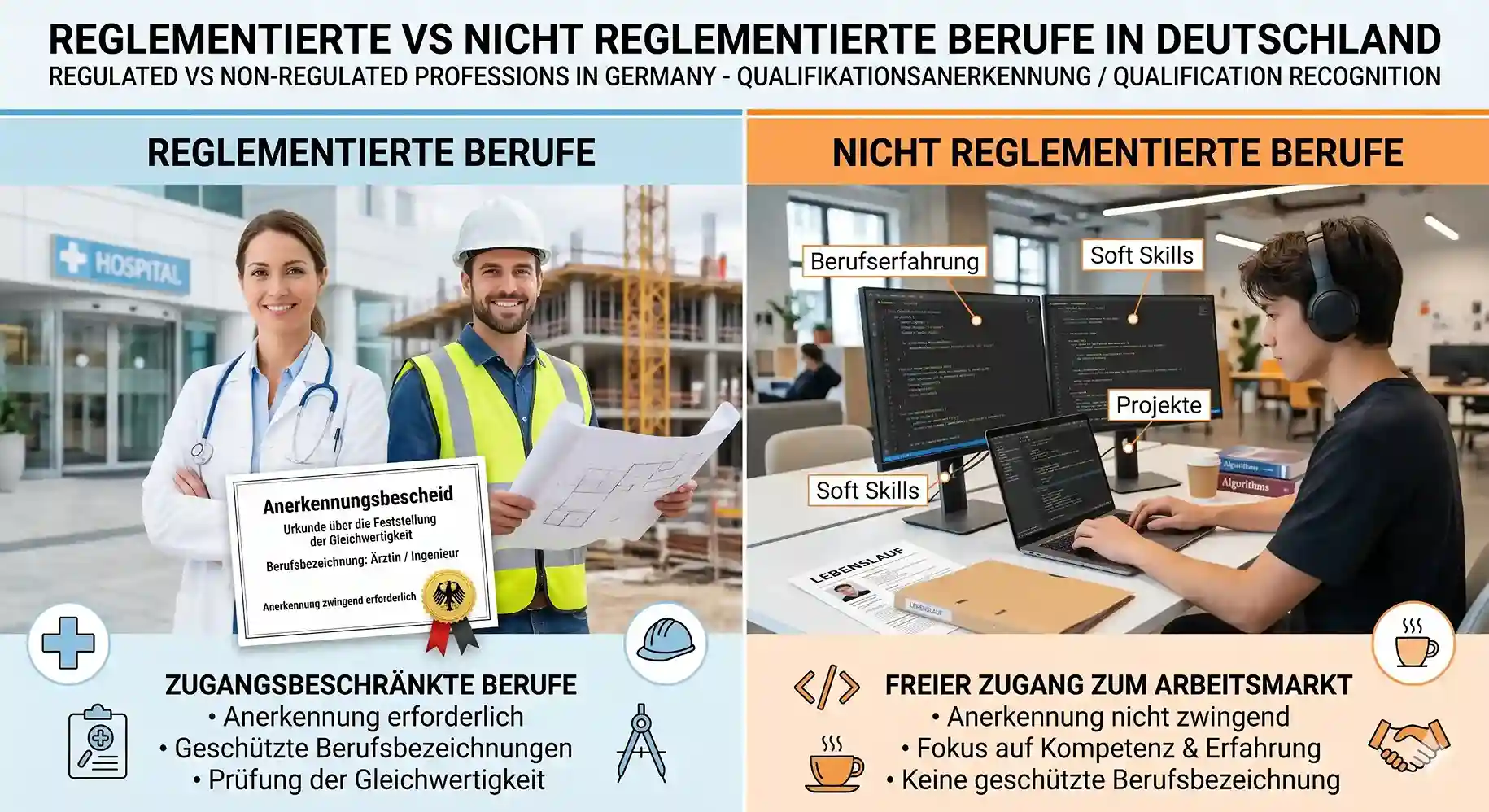
Regulated vs Non-Regulated Professions at a Glance
For regulated professions, full recognition is a legal prerequisite. There is no workaround. For non-regulated professions, recognition is not required but accelerates the Federal Employment Agency's labour market check and confirms job fit — both of which shorten the overall visa timeline.
Use the Jobbatical Germany Pre-Hiring Eligibility Checker to confirm whether your candidate's profession is regulated before committing to a start date.
The Recognition Process: What HR Actually Needs to Manage
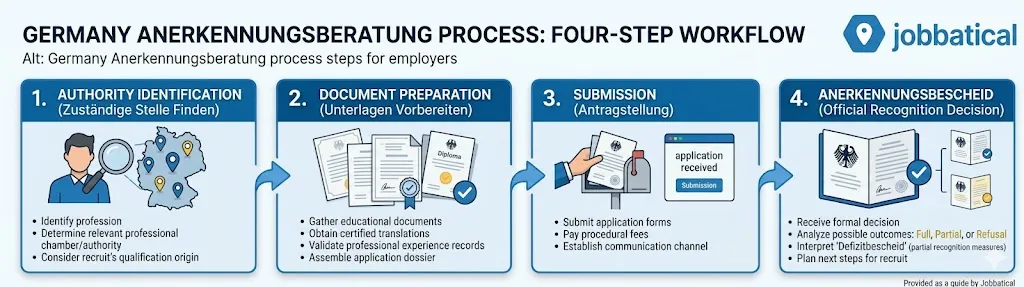
Formally, the employee applies for recognition. In practice, the process depends heavily on employer action — particularly on document preparation and choosing the right application pathway.
Here is what the standard process involves:
Germany Anerkennungsberatung process steps for employers

How to Cut Recognition Time in Half: Two Employer-Led Pathways
Standard timelines are a problem when you have a start date to meet. Two employer-driven mechanisms exist specifically to compress the recognition timeline.
Accelerated Skilled Worker Procedure vs Recognition Partnership
Germany qualification recognition timeline for HR
The Recognition Partnership is particularly powerful for shortage occupations in Germany — it removes the recognition bottleneck entirely by decoupling the start date from the recognition outcome.
The Accelerated Procedure requires the employer to initiate the process through the local Foreigners' Authority (Ausländerbehörde). It is not automatic. If your HR team has not used it before, setup takes time — factor this into your hiring calendar.
What Recognition Costs — and Who Pays
Recognition costs vary by profession and document complexity. Here is a realistic cost breakdown for HR budget planning.
Typical Qualification Recognition Cost Breakdown
There is no legal obligation for employers to cover these costs. In practice, most do — particularly for regulated professions where recognition is a hard requirement. Covering recognition costs is an increasingly common differentiator in offer negotiations with international candidates who have multiple offers from competing EU employers.
Federal grant funding is available for candidates completing compensation measures via the Federal Employment Agency.
Surfacing this proactively when a partial notice arrives removes the financial objection that causes candidate withdrawal — and it costs the employer nothing. Your immigration partner can initiate access through ZSBA as part of the partial equivalence response.
The Recognition Failure HR Teams Don't Anticipate
The most damaging recognition scenario is not rejection — it is a partial equivalence notice arriving too late to adjust the hiring timeline. In 2024, approximately 46.6% of recognition outcomes resulted in a compensation measure requirement. Nearly half of all cases require additional action.
For HR teams, this creates a specific risk: a candidate who passes pre-hire screening, accepts an offer, and then receives a partial equivalence notice three months in — triggering a further 3–6 month delay for the compensation measure before the visa can be issued.
The mitigation is straightforward: initiate recognition at the point of offer, not after visa paperwork begins. If you use the Germany Skilled Worker Visa process, recognition sits at the start of the workflow — not halfway through.
A preliminary assessment through Anerkennungsberatung (advisory) before submitting the formal application helps identify likely gaps early, allowing you to plan around compensation measures or explore the Recognition Partnership pathway instead.
What Jobbatical team solves for your recognition process ✅
- Late initiation. Every case triggers a recognition assessment at offer stage — regulated status confirmed, authority identified, document checklist generated — before visa paperwork begins.
- Wrong pathway. The Accelerated Procedure and Recognition Partnership are assessed for every case. If your start date requires the Accelerated Procedure, it is initiated via the Foreigners' Authority as part of the standard workflow — not flagged as an option you have to remember to ask for.
- No partial-outcome plan. If a partial notice arrives, the response — Recognition Partnership eligibility, grant access, revised start date, candidate communication — is already mapped. There is no reactive scramble.
How Jobbatical Manages Recognition as Part of the Visa Workflow 🎯
- For Jobbatical clients, recognition is not a separate task from visa processing.
- For Jobbatical experts, it sits inside the same workflow, affects the same timeline, and is managed by the same authorities.
- Treating it as a standalone HR task by service providers is where most delays originate.Jobbatical integrates qualification recognition into every Germany Skilled Worker Visa case.
This means:
For companies managing multiple international hires across healthcare, engineering, or trades, centralising recognition tracking alongside visa renewals and permit deadlines prevents the compliance gaps that arise when these processes run in separate systems.
Disclaimer: Immigration rules change quite frequently; please verify with official sources or contact us for the latest info before making any decisions.
Frequently Asked Questions — Anerkennungsberatung Germany Qualification Recognition
What is Anerkennungsberatung?
Anerkennungsberatung is Germany's qualification recognition advisory service — the process of formally assessing whether a foreign professional's credentials are equivalent to German standards. For employers, it matters because recognition is a prerequisite for issuing a Skilled Worker Visa or EU Blue Card in most cases. Starting it late is the most common reason international hires fall through.
What goes wrong if HR ignores Anerkennungsberatung?
When HR starts it late, the most common outcome is a candidate who accepts an offer, waits 3–4 months, receives a partial equivalence notice, and faces a further 3–6 month delay. By that point, most candidates have accepted another offer elsewhere.
Does the employer have to manage the qualification recognition process in Germany?
Technically, the employee applies for recognition. However, employers who use the Accelerated Skilled Worker Procedure (§81a AufenthG) submit the recognition application jointly with the Foreigners' Authority on behalf of their candidate. This cuts processing to 2 months and gives HR teams full visibility and control over the timeline.
How long does qualification recognition take in Germany?
Standard recognition takes 3–4 months once a complete application is submitted. Using the Accelerated Skilled Worker Procedure, this can be reduced to 2 months. In practice, delays happen when documents are missing or translations are not certified. Initiating the process at the offer stage — not after — is the most effective way to protect your hiring timeline.
What is the Recognition Partnership and how does it help HR teams fill urgent roles?
The Recognition Partnership (Anerkennungspartnerschaft) allows a candidate to enter Germany and start work before full recognition is granted, provided the employer signs a formal agreement to complete the process within a set period. This removes the recognition bottleneck entirely for non-regulated professions in shortage sectors — the employee starts on day one while paperwork continues in parallel. It requires a formal employer agreement — set this up as part of the visa workflow, not as an afterthought when a start date is already at risk.
Which professions require full qualification recognition before a German work permit is issued?
Regulated professions require full recognition (Anerkennung) before a permit is issued. These include doctors, nurses, pharmacists, teachers, lawyers, engineers in certain specialisations, and most licensed trades. Non-regulated professions — such as IT roles, many commercial roles, and general manufacturing — do not require formal recognition for a permit, though obtaining it strengthens the application.
How much does qualification recognition cost in Germany, and who pays?
Recognition costs typically range from €200 to €800, depending on the profession and the volume of documents requiring certified translation or notarisation. There is no fixed rule on who pays — most employers absorb these costs as part of their talent acquisition budget and use them as a differentiator in offer negotiations with international candidates.
What happens if a candidate receives partial recognition instead of full equivalence?
Partial recognition means the competent authority identified gaps between the candidate's qualification and the German reference occupation. The candidate is issued a notice listing the differences, which can usually be addressed through a compensation measure — additional training or a qualifying examination. HR teams should treat partial recognition as a solvable delay, not a rejection. For non-regulated professions, partial recognition still allows the visa process to proceed.

.svg)
.svg)