


KEY TAKEAWAYS
- The Anerkennungspartnerschaft (§16d(3) AufenthG) lets your Munich hire start work before their foreign qualification is formally recognised.
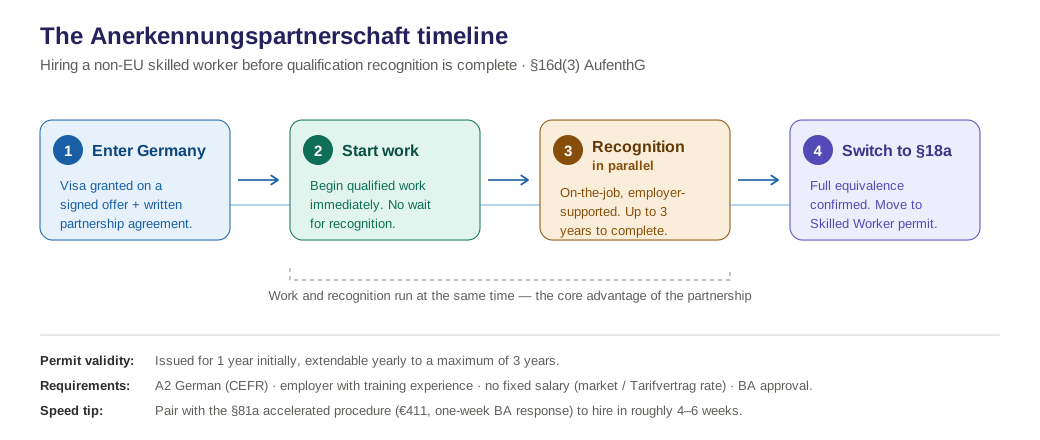
- The permit runs 1 year initially, extendable to a maximum of 3 years while recognition completes on the job.
- There is no fixed salary threshold; pay must match the local market or your collective agreement (Tarifvertrag).
- Your company must prove experience in training or upskilling to qualify as a suitable employer.
- Pair it with the §81a fast-track (€411, one-week BA response) to compress hiring from months to weeks.
The Anerkennungspartnerschaft removes the wait. It lets your hire enter Germany and start qualified work while recognition runs in parallel. For Munich employers chasing engineers, technicians, and skilled tradespeople, it is one of the most useful hiring tools in years.
What the Anerkennungspartnerschaft actually does
The Anerkennungspartnerschaft is a residence permit under Section 16d(3) of the German Residence Act (AufenthG), in force since March 2024.
The idea is simple. Your non-EU hire holds a foreign qualification not yet recognised in Germany. Instead of waiting for recognition abroad, they enter, start work, and complete the procedure on the job. You commit in writing to support it. Before 2024, full recognition was usually required first, creating a bottleneck of six to twelve months. The partnership closes most of it.
Why this matters for Munich employers
Munich concentrates exactly the employer this tool was built for. The city and Upper Bavaria host large manufacturers, automotive and industrial engineering groups, and tech firms, plus a dense Mittelstand supplier network. Names like BMW and Siemens anchor an ecosystem hiring engineers and skilled trades at scale.
These firms also run structured apprenticeships already. That matters, because employer suitability is a hard requirement, and an established Ausbildung programme clears that bar without effort. Munich feels the shortage acutely too: the trades sector alone carries over 250,000 unfilled positions nationally.
Candidates already in Germany on an Opportunity Card are the easiest to start a recognition partnership with: Germany Opportunity Card (Chancenkarte): HR & employer guide 2026
Employer requirements: what your company must meet
Before planning a recognition partnership hire, confirm you meet these:
- Training experience. Demonstrate experience in vocational training or upskilling. The authority checks this during the visa process.
- A concrete job offer. Qualified employment related to the profession the candidate trained in, not auxiliary tasks.
- Fair conditions. Salary and hours must match comparable German employees. The Federal Employment Agency (BA) verifies this and must approve the employment.
- A written partnership agreement. It commits the employee to apply for recognition after entry, and you to enable it, including time off for courses, exams, and placements.
Timeline, validity, and salary rules
Here is the practical shape of the permit.
Recognition Partnership at a Glance for Employers
There is no minimum salary. But if your company is covered by a collective agreement, the tariff rate applies, and that speeds up BA approval because the pay scale is pre-verified. Our guide to the Germany Tarifvertrag and work visas explains how to flag this correctly.
Combine it with the accelerated procedure to move faster
The partnership alone still runs through a normal visa process. To compress it, pair it with the Beschleunigtes Fachkräfteverfahren, the accelerated skilled worker procedure under §81a.
- You can initiate the accelerated procedure (§81a) at the Munich Foreigners' Office (Ausländerbehörde München) for a fee of €411.
- Once initiated, the Federal Employment Agency (Bundesagentur für Arbeit / BA) is required to respond within one week.
- Munich processes this through the local IHK (Chamber of Commerce and Industry) and Handwerkskammer (Chamber of Skilled Crafts) advisory route. This means a Bavarian employer with an established training program is already well-positioned to utilize the system.
- In practice, this fast-track method slashes the overall processing time from the usual three to four months down to roughly four to six weeks.
For the full Accelerated-Procedure-versus-Partnership comparison, see our Anerkennungsberatung guide for HR.
Regulated vs non-regulated roles
For non-regulated roles (most IT, engineering, and commercial positions), your hire starts directly at skilled-worker level while recognition completes; for regulated professions such as nursing, they work in an assistant capacity until full recognition. The distinction sets your whole timeline, so confirm it before you commit to a start date. Our Anerkennungsberatung guide for HR breaks down the regulated split, costs, and the full recognition process in depth.
How Jobbatical helps Munich teams run this
Recognition partnerships work best when recognition, the visa application, and BA approval run as one coordinated case, not three separate tasks. Jobbatical integrates qualification recognition into every Germany skilled worker case, structures the partnership where start-date pressure makes it the right call, and tracks permit deadlines in one platform. Check a candidate's eligibility early with our Germany work permit eligibility tool.
Disclaimer: Immigration rules change quite frequently; please verify with official sources or contact us for the latest info before making any decisions.
Frequently Asked Questions : Anerkennungspartnerschaft in Munich
What is the Anerkennungspartnerschaft?
The Anerkennungspartnerschaft (Recognition Partnership) is a residence permit under Section 16d(3) of the German Residence Act (AufenthG). It allows qualified non-EU professionals to enter Germany and begin skilled employment while the recognition of their foreign qualification takes place in parallel, rather than requiring full recognition before arrival.
How long is the Recognition Partnership permit valid?
The permit is initially issued for one year and can be extended annually for a maximum total duration of three years. Once the employee obtains full recognition of their qualification, they can generally transition to a standard Skilled Worker residence permit under Section 18a of the German Residence Act.
Is there a minimum salary for the Recognition Partnership?
There is no fixed national salary threshold. Instead, the salary must correspond to the customary local wage for comparable employees or, where applicable, the relevant collective bargaining agreement (Tarifvertrag). The Federal Employment Agency (Bundesagentur für Arbeit) reviews the proposed employment conditions during the approval process.
Which employers qualify to offer a Recognition Partnership?
Employers are generally expected to demonstrate that they can support the employee throughout the qualification recognition process, including appropriate workplace training or professional development where required. The competent immigration authority assesses employer suitability as part of the application process.
Can we use the Recognition Partnership for regulated professions such as nursing?
Yes. In regulated professions, employees may begin work in a role that is permitted before full professional recognition is granted—for example, a nurse may initially work in a support or assistant capacity. They can move into the fully regulated position once all recognition or licensing requirements have been completed.
How fast can we get someone on-site in Munich?
When combined with the accelerated skilled worker procedure (Beschleunigtes Fachkräfteverfahren under Section 81a AufenthG), processing can often be completed more quickly than the standard route. Employers initiate the accelerated process through the competent Foreigners' Authority (Ausländerbehörde), and the applicable government fee is currently €411. Actual processing times vary depending on the individual case and the authorities involved.
What German language level does the employee need?
A minimum German language level of A2 under the Common European Framework of Reference for Languages (CEFR) is generally required for residence purposes under the Recognition Partnership route. Some regulated professions or qualification measures require a higher language level. In many engineering and IT roles, English may be sufficient for day-to-day work while the employee continues to improve their German.

.svg)
.svg)