.svg)



KEY TAKEAWAYS
- Your employees on Skilled Worker visas can apply for ILR up to 28 days before their 5-year qualifying date; applying even one day too early triggers an automatic refusal and forfeits all fees.
- The 180-day absence rule is rolling, not calendar-based, a single business travel-heavy year tracked incorrectly can silently disqualify an otherwise clean application.
- The UK government has confirmed ILR qualifying periods will increase from 5 to 10 years in Autumn 2026, employees approaching their 5-year mark should apply now under current rules.
- HR teams should start ILR preparation at least 3 months before each employee's eligibility date to avoid last-minute document scrambles.
- Once your employee holds ILR, your sponsorship obligation ends - no more CoS renewals or compliance tracking for that individual.
Picture this. Your top engineer hits five years in the UK. They're ready to apply for ILR. Your team starts pulling documents together. Then someone checks the dates — and realises the application can't go in for another three weeks, but UKVCAS biometric slots are already booked out for six. You scramble. You might make it. You might not.
This happens more than it should. And it almost always comes down to one thing: no one calculated the exact eligibility date early enough.
UK ILR timing isn't complicated once you know the rules. But the rules are unforgiving — and 2026 adds a layer of urgency your team needs to act on now.
The 28-Day Rule: The Window That Has No Mercy
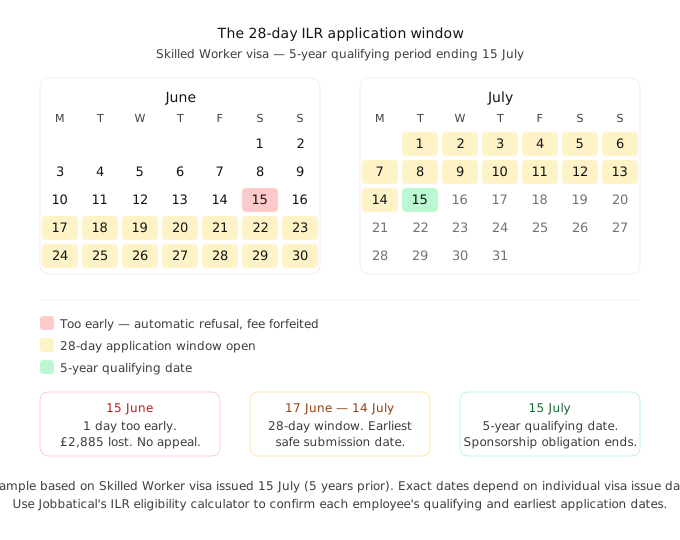
Your employees can apply for ILR up to 28 days before they complete their qualifying period. That's the earliest. Not a day sooner.
The 28-day rule is unforgiving. It doesn't care that your employee is three weeks away. It doesn't care about extenuating circumstances. One day too early means automatic refusal — and the full £2,885 application fee is forfeited. The Home Office won't reconsider. There's no appeal on the grounds of being slightly premature.

This is why every ILR case in your workforce needs a calculated eligibility date not an estimate, not a rough year marker. The exact date, worked out from the visa issue date, logged in your HR system months in advance.
That 28-day window also matters strategically. UKVCAS biometric appointments fill up weeks ahead. Standard processing takes up to 6 months. Getting into the queue at the earliest legal moment isn't just allowed, it's the smart move. Your employees using Jobbatical's UK ILR eligibility calculator can check their exact qualifying and earliest application dates in minutes.
What if your employee's visa expires before their ILR qualifying date?
This is a common gap: an employee's Skilled Worker visa runs out several months short of the point they can apply for settlement. You need to bridge the gap with a new Certificate of Sponsorship, and the length you assign becomes a cost-and-risk decision, not a legal one. CoS length has no bearing on whether the employee qualifies for ILR. It only affects how much you prepay and how much buffer sits around the qualifying date.
Because the Immigration Skills Charge is paid upfront when you assign the CoS, a shorter bridge minimises what you pay now. A one-year CoS covers a sub-12-month gap for a single year of ISC (£480 for small or charitable sponsors, £1,320 for medium or large sponsors) plus a lower visa fee. A three-year CoS to cover the same gap means prepaying for years the employee will never use on that certificate. The trade-off is re-application risk: if ILR is delayed, refused, or the residence clock resets, a one-year bridge may force a second paid extension.
When a one-year CoS is the right call
- Clean absence record, comfortably inside the 180-day rolling limit
- Stable role, no SOC code change or promotion likely mid-bridge
- No prior visa or ILR refusals
- Employee clearly on track to settle at the earliest eligible date
When a three-year CoS is worth the extra cost
- Absences near the 180-day limit that could push the qualifying date later
- A likely role change that would require a fresh CoS anyway
- A history of refused or queried applications
- Real doubt the employee will settle on schedule
Whichever length you choose, build in at least a two-month cushion before the ILR qualifying date. Absence miscalculations and Home Office processing can push the eligible point later than expected, and a tight bridge leaves no room to absorb that slippage. Sequence the extension so leave never lapses, since a gap breaks continuous residence and stalls the settlement clock entirely.
One scoping note:
- This applies to employees on the pre-April 2026 five-year Skilled Worker route, plus high earners and healthcare or teaching roles who may still reach settlement in three to five years under the earned-settlement framework.
- Most workers who started after the rules changed now face a longer qualifying period, which reshapes the whole bridging calculation.
See our guide to the UK earned settlement changes for where your employee stands. To model the actual fees for a specific bridge, use the UK visa sponsorship extension cost tracker, and see how the ISC behaves on a shortened CoS in our Immigration Skills Charge guide.
The Absence Trap: The Risk Hiding in Your Travel Approvals
Here's a scenario that plays out more than most HR teams realise.
An employee spent four months abroad supporting a product launch in year 2 of their Skilled Worker visa. At the time, nobody flagged it — it was a business trip, not an immigration issue. Three years later, at ILR application stage, the rolling window check shows that particular 12-month stretch hit 190 days outside the UK. The application can't go forward. There's no mechanism to appeal poor planning.
The 180-day absence rule doesn't work the way most people assume. It's not a calendar year limit. It's a rolling 12-month check — every consecutive 12-month period during the qualifying years is assessed independently. A heavy travel stretch buried in the middle of a 5-year qualifying period can break continuous residence even if the employee's total absence count looks fine.
Business travel is the hidden ILR risk that most HR teams don't realise they're accumulating. Every overseas assignment, every extended client visit, every project secondment — they all count. Personal holidays and business trips are treated identically by the Home Office.
If your company sends UK-based Skilled Workers on frequent international work, you need to be monitoring their rolling absence against ILR thresholds throughout their qualifying period — not just when they approach eligibility.
There's a Closing Window Your HR Team Needs to Know About
The UK government has confirmed the ILR qualifying period will increase from 5 years to 10 years for most routes. Implementation is expected in Autumn 2026. Right now, the current 5-year route is still in force. But the transitional arrangements, who gets protected, who doesn't haven't been published yet.

If you have employees who will hit their 5-year mark before those changes take effect, the current rules still apply to them but only if they apply in time. Employees approaching that milestone should enter the 28-day window and submit without delay.
For employees hired in the last 2–3 years, start modelling timelines under both scenarios now. You can track the latest changes on Jobbatical's UK earned settlement updates page as the government finalises the rules. If your employee has a tight travel schedule or an urgent start date after becoming settled, understanding the priority and super priority services can help you choose the fastest ILR processing option.
ILR Qualifying Periods by Visa Route
What Your HR Team Needs to Do and When
The good news: ILR timing is entirely manageable if you build the right triggers into your workflow. Here's the minimum preparation window to work to:
- 6 months before eligibility: Log the exact ILR eligibility date per employee. Begin monitoring rolling absence records and flag anyone in a 12-month window approaching 150+ days abroad
- 3 months before: Start document gathering - payslips, P60s, travel history. Surface any gaps or discrepancies now, not the week before submission.
- 6–8 weeks before: Book the UKVCAS biometric appointment. Slots fill fast, especially in London. Leaving this any later is a gamble.
- 28 days before eligibility date: Submit the application. The employer letter must be dated within one month of submission, draft it close to this point, not weeks earlier.
For teams managing 10, 50, or 200+ international employees, keeping this running across different visa start dates is where things fall through the gaps. If you're weighing whether to manage ILR in-house or bring in support, the ILR managed service vs in-house cost breakdown runs the real numbers for a 500-person workforce.
Jobbatical's UK ILR managed service handles eligibility tracking, absence calculations, document coordination, and Home Office liaison across your whole team so ILR doesn't become a fire drill every time.
ILR Day Is Actually a Good Day 🙂
Once your employee holds ILR, your sponsorship obligation for that individual ends.
✅ No more Certificate of Sponsorship renewals.
✅ No more visa expiry tracking.
✅ No more Home Office reporting requirements.
💪They're effectively the same as a settled UK worker from a compliance standpoint.
Five years of careful management : tracking absences, renewing visas, maintaining sponsor licence compliance — pays off in a single approval letter.
And the relief that comes with it is real, for your employee and for your team. 🏆

Getting there cleanly just requires starting the timing conversation early enough. If you need to understand the difference between ILR and EU Settled Status for employees who came via different routes, the ILR vs Settled Status guide covers the key distinctions.
Disclaimer: Immigration rules change quite frequently; please verify with official sources or contact us for the latest info before making any decisions.
Frequently Asked Questions — UK ILR Application Timing for HR Teams
How early can an employee apply for UK ILR?
Employees can submit their ILR application up to 28 days before they complete their qualifying period. Applying even one day earlier than this window results in automatic refusal and the full application fee is lost. HR teams should calculate this exact date in advance and never rely on estimates.
What is the 180-day absence rule for UK ILR?
During the 5-year qualifying period, your employee must not spend more than 180 days outside the UK in any rolling 12-month window — not a calendar year. Every consecutive 12-month stretch is assessed independently. One heavy travel year buried mid-qualifying period can break continuous residence even if the total absence count looks fine overall.
What happens to ILR eligibility when the Autumn 2026 rule change takes effect?
The UK government has confirmed the standard ILR qualifying period will increase from 5 to 10 years, with implementation expected in Autumn 2026. Employees currently mid-qualifying period who haven't yet reached 5 years may be moved into the new 10-year system. Transitional arrangements haven't been finalised. Employees approaching their 5-year mark should apply as soon as they enter the 28-day window.
Does business travel count toward the 180-day absence limit?
Yes. All absences from the UK count — personal and business travel combined. Only whole days spent abroad are counted; partial days of departure and return are excluded. HR teams sending employees on extended overseas assignments must factor this into ILR eligibility planning from day one of the qualifying period, not just at application stage.
When should HR start preparing ILR documents for an employee?
Start at least 3 months before the employee's ILR eligibility date. Payslip compilation, absence verification, and UKVCAS biometric booking all take time. UKVCAS slots fill up weeks in advance — leaving document prep to the final month creates unnecessary pressure and real risk of missing the window.
What does ILR mean for the employer once it is granted?
Once your employee holds ILR, your sponsorship obligation for that individual ends. No more Certificate of Sponsorship renewals, no more visa expiry tracking, no more Home Office reporting. From a compliance standpoint, they become the same as a settled UK worker — and five years of careful management pays off in a single approval letter.

.svg)
.svg)