

KEY TAKEAWAYS
- The letter of invitation is the single biggest refusal trigger, missing IMO number, vague departure language, or no vessel itinerary gives Border Force grounds to refuse.
- Applying as a visitor instead of under the Joining Ship endorsement is a common category error that resets your crew change timeline.SID documents from ILO 185 countries (e.g. France, Brazil, India) must state the convention name, a seaman's book without that statement won't satisfy.
- Border Force even if the country is on the list.Offshore wind workers cannot use this route; the concession was withdrawn in May 2023.
- Using the wrong visa category exposes your company to illegal working liability.Most refusals are preventable with a nationality eligibility check and a correctly worded letter before the application is submitted.
toWhy Your Crew Change Is at Risk
A UK Join Ship Visa refusal does not just delay one seafarer. It delays your port call, strains vessel operations, and can cost the shipowner tens of thousands in demurrage. Most refusals are avoidable, but only if you know exactly why they happen.
Below are the 11 most common reasons Border Force or UKVI refuses a Join Ship Visa application, with the fix for each.
The 11 Most Common UK Join Ship Visa Refusal Reasons
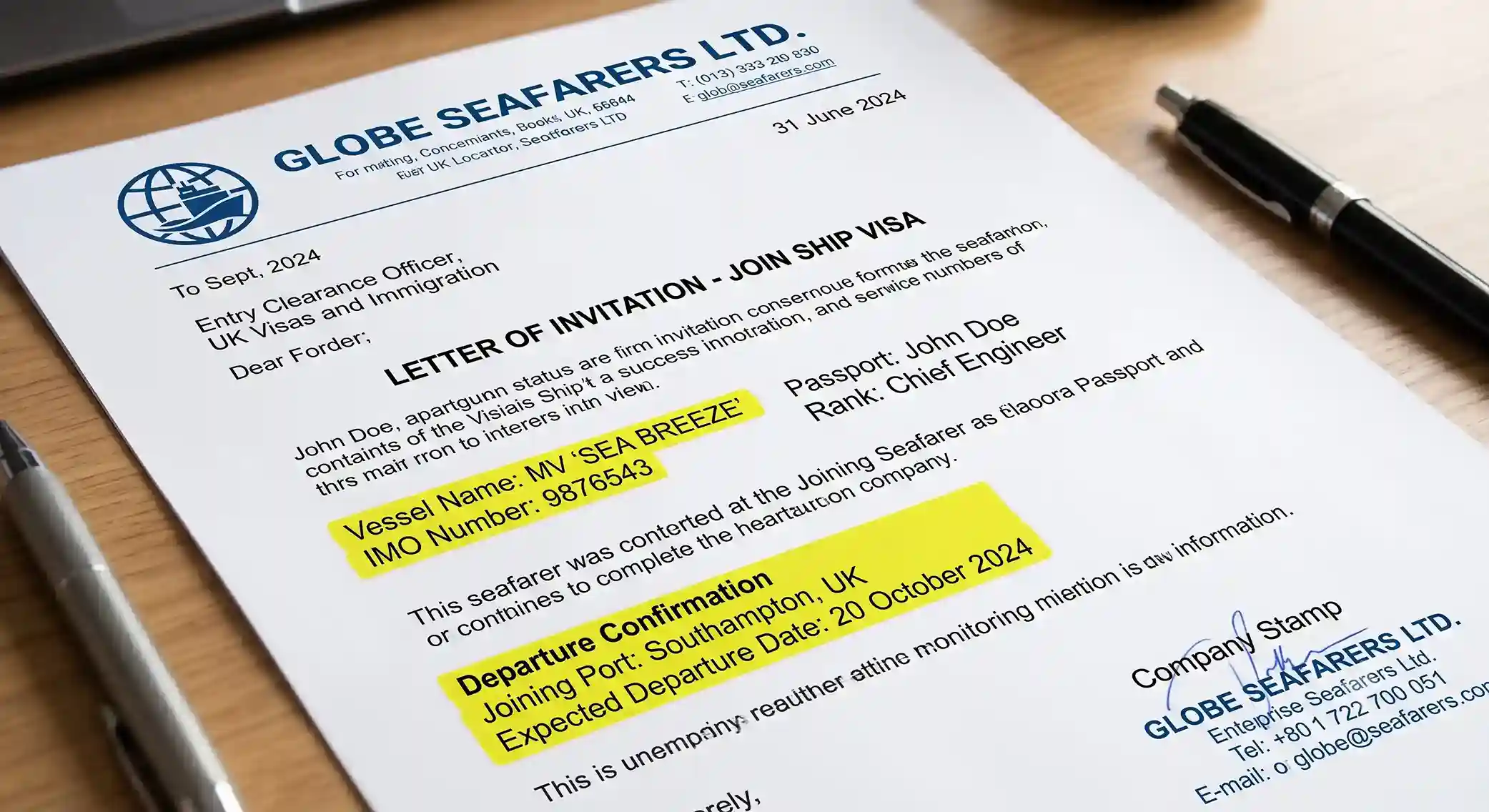
1. Invitation Letter Is Incomplete or Incorrectly Worded
This is the single biggest refusal trigger. Border Force applies a subjective standard, they must be satisfied the seafarer is genuinely joining a departing vessel, not planning to remain in the UK.
- Missing: IMO number, departure route, port of joining, or confirmation the vessel leaves UK waters
- Fix: Use a letter template that explicitly states vessel name, IMO number, port, estimated departure date, and a clear statement that the vessel will depart UK territorial waters
2. Wrong Visa Category Applied For
Seafarers who apply under the Standard Visitor route instead of the "Joining Ship" endorsement will be refused. The endorsement determines their conditions of entry.
- Fix: The application must be submitted under the correct entry clearance category. If your crewing agency is handling applications, confirm they are using the Joining Ship route, not a general visitor visa
3. SID Does Not State the Convention Name
Countries like India, Brazil, and France have ratified ILO 185 after denouncing ILO 108. Their seafarers remain visa-exempt, but only if the Seafarers Identity Document (SID) explicitly states it is issued under the relevant convention.
- Fix: Check the SID text before every crew change. A seaman's book without the convention statement will fail at Border Force, regardless of the issuing country's ratification status
4. Seafarer Misclassified as Exempt (Incorrect Nationality Check)
Crewing managers sometimes assume exemption based on a crew member's employer, ship flag, or port of origin, not their nationality. The exemption applies at the nationality level only.
- Fix: Run a nationality-level ILO 108/185 check for every seafarer before confirming the crew roster. Verify against the current Home Office Seafarers guidance (GOV.UK), the list has changed post-Brexit
5. No Evidence the Vessel Will Leave UK Waters
For spot-market or unscheduled vessels, a vague invitation letter with no port schedule is insufficient. Border Force must be satisfied the vessel is departing, not remaining in UK waters.
- Fix: Include vessel movement records, port schedules, or charter party extracts alongside the invitation letter. The more concrete the departure evidence, the lower the refusal risk
6. Offshore Wind Role Using the Wrong Route
The offshore wind sector concession was withdrawn in May 2023. Workers operating within 12 nautical miles of the UK landmass now fall under full UK immigration control.
- Fix: If your seafarers are working on offshore wind installations rather than vessels departing UK waters, they need a separate UK work visa route, not the Join Ship Visa. Using the wrong route exposes your company to illegal working liability

7. Passport Validity Below 6 Months
Straightforward but surprisingly common. UKVI requires the passport to be valid for the duration of the visa.
- Fix: Add a passport validity check to your standard crew rostering checklist. The seafarer must renew their passport before applying, there is no workaround
8. No Valid Seafarer Employment Agreement (SEA)
The Join Ship Visa requires the seafarer to be travelling under contract. Without a valid SEA/MLC-compliant agreement, the entry clearance condition is not met.
- Fix: Confirm the SEA is signed, MLC 2006-compliant, and covers the specific vessel and voyage before submitting the application
9. Application Submitted Too Close to the Vessel's Arrival Date
Standard processing takes around 3 weeks from biometric submission. Applications submitted with less than 3 weeks to port call are high-risk, and a refusal with no time to reapply means a missed crew change.
- Fix: Build 3 weeks minimum into your crew change planning. For last-minute changes, budget for the priority service (5 working days), it costs significantly less than a port delay
10. Inconsistencies Between the Application Form and Supporting Documents
A mismatch in the seafarer's name, date of birth, or vessel details between the application and supporting documents raises a credibility flag.
- Fix: Cross-check every detail, full name spelling, DOB, vessel name, across the application form, invitation letter, SEA, and passport before submission. Simple errors trigger refusals that take weeks to resolve
11. Prior Immigration History Not Disclosed
Seafarers with previous UK visa refusals, overstays, or UK immigration enforcement actions must disclose them. Non-disclosure is treated as deception, which can result in a 10-year ban.
- Fix: Ask crew members about their full UK immigration history before applying. Disclose all previous refusals accurately, even if the outcome was administrative or the fault of a prior employer
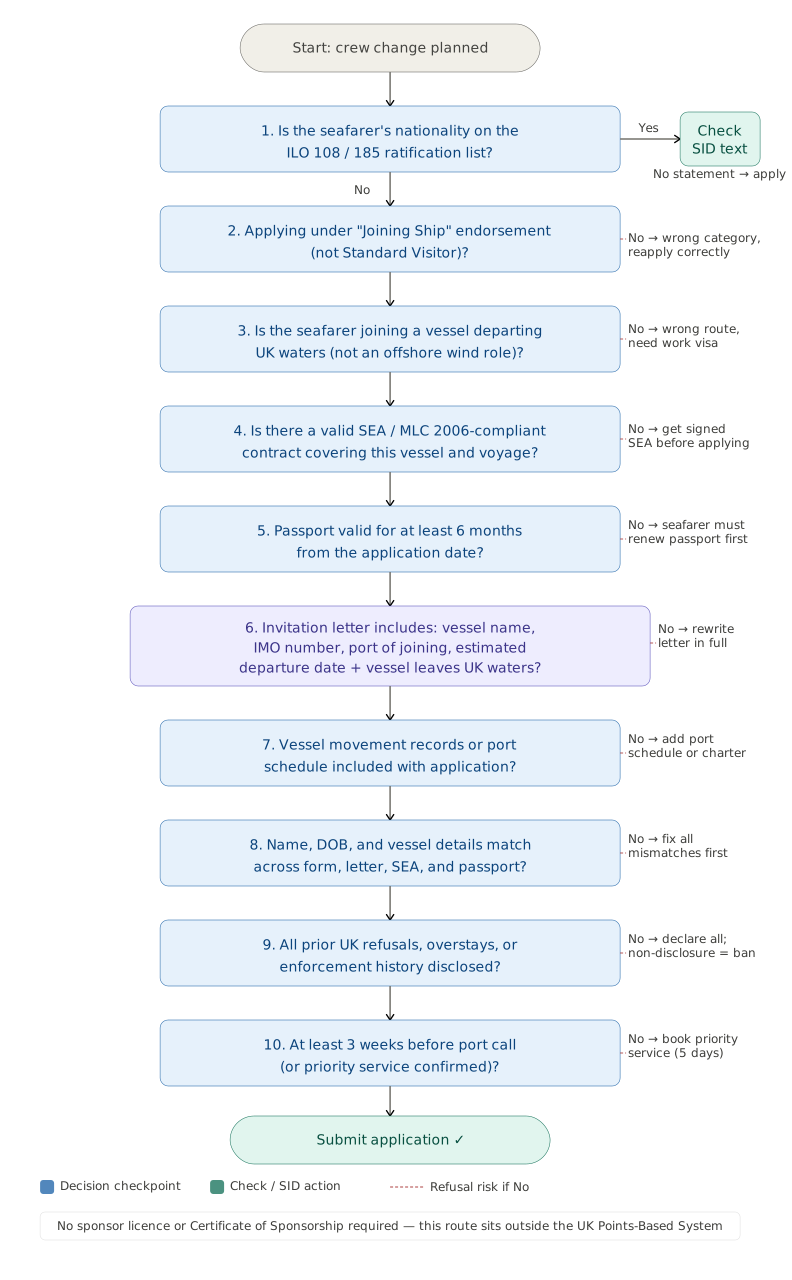
UK join Ship visa decision flowchart from Start crew plan to Application submission
What to Do After a Refusal
There is no mandatory waiting period. Your seafarer can reapply immediately once the refusal reason is addressed. Here is what to do:
- Read the refusal letter carefully, UKVI will state the specific grounds
- Correct the underlying issue (document error, letter wording, wrong category)
- Do not resubmit the same application with the same error
- If the refusal involved a deception finding, take legal advice before reapplying
Jobbatical's maritime immigration team reviews refusal letters, identifies the exact fix required, and handles the reapplication, reducing turnaround to the minimum possible.
Build Refusal Prevention Into Your Crewing Process
The reality is that most Join Ship Visa refusals come from the same handful of errors, incorrect letters, wrong categories, and missed nationality checks. A structured pre-application checklist eliminates them.
If your company also manages UK Skilled Worker Visas or Sponsor Licence compliance for shore-based staff, Jobbatical handles both maritime and land-based UK immigration from a single platform.
Disclaimer: Immigration rules change quite frequently; please verify with official sources or contact us for the latest info before making any decisions.
Frequently Asked Questions: UK Join Ship Visa Refusal
Can a seafarer reapply after a UK Join Ship Visa refusal?
Yes, there is no mandatory waiting period. The seafarer can reapply immediately once the underlying issue is corrected. However, the refusal reason must be addressed in full before resubmission. A second refusal on the same grounds may affect future applications.
Does a UK Join Ship Visa refusal affect a seafarer's ability to get other UK visas?
A standard refusal (non-deception) does not automatically bar future applications but is recorded on the seafarer's immigration history. If the refusal involved false information or deception, a 10-year ban can apply. Always disclose prior refusals accurately in future applications.
What must the letter of invitation include for a UK Join Ship Visa?
The letter must include: vessel name and IMO number, port of joining, estimated departure date, confirmation the vessel will leave UK territorial waters, and the seafarer's full name and role. Vague or incomplete letters are the leading cause of refusal at the entry clearance stage.
Can offshore wind workers use the UK Join Ship Visa?
No. The offshore wind sector concession was withdrawn in May 2023. Workers operating within 12 nautical miles of the UK landmass now require a separate UK work visa route. Using the Join Ship Visa for offshore wind roles exposes your company to illegal working liability.
Is a sponsor licence needed for the UK Join Ship Visa?
No. The Join Ship Visa sits outside the UK Points-Based System. There is no sponsor licence requirement, no Certificate of Sponsorship, and no salary threshold. Your company needs to provide a valid letter of invitation, not a CoS assignment.
How long does it take to process a UK Join Ship Visa?
Standard processing takes around 3 weeks from the date biometrics are submitted. Priority service can reduce this to 5 working days. For last-minute crew changes, budget for the priority fee, it is significantly cheaper than a port delay.
What happens if a seafarer's passport has less than 6 months validity?
The application will be refused. The seafarer must renew their passport before applying. This is one of the most common and easily avoidable document errors, run a passport validity check as part of your standard crew rostering process.

.svg)
.svg)