

Key Takeaways
- Cita previa scarcity, homologación delays (up to 6 months), and UGE-CE vs. regional Extranjería confusion are main bottelneck in Spain immigration
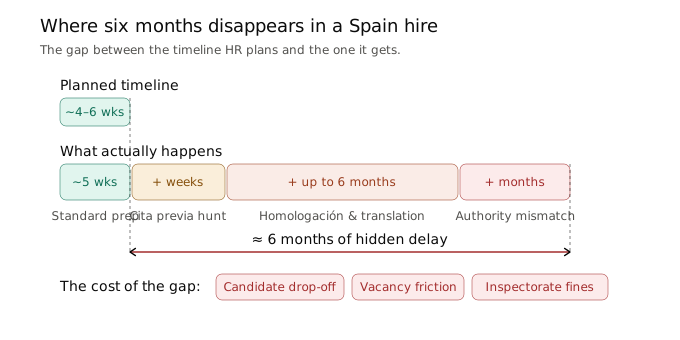
- Delay costs candidate drop-off, vacancy friction, and Labour Inspectorate fines for non-compliant work starts.
- Pricing transparency, cita previa capability, compliance/appeal record, scalability, dashboard visibility, automated renewal alerts, named experts, GDPR compliance, regional coverage, appointment-securing proof are the checklist items in evaluating immigration vendor.
The Spain immigration bottleneck: Why HR teams struggle
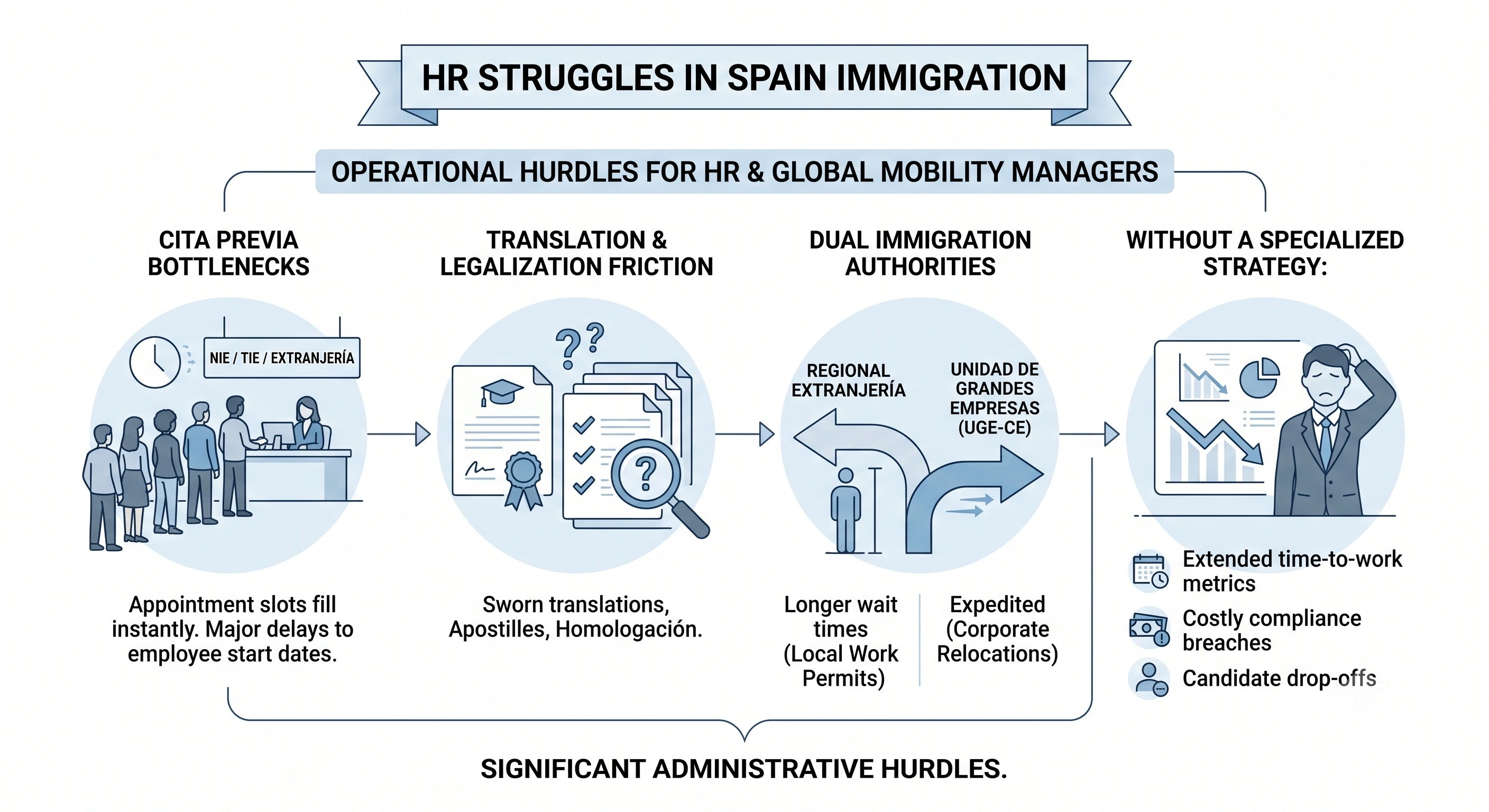
Expanding international teams into Spain offers access to a top-tier global talent pool, but navigating the local administrative landscape presents significant operational hurdles. For HR leaders and Global Mobility managers, international talent acquisition in Spain is often impacted by bureaucratic delays, shifting legal frameworks, and localized administrative friction. Without a specialized strategy, companies risk extended time-to-work metrics, costly compliance breaches, and candidate drop-offs.
The bureaucratic reality of the Spanish market
- Cita previa bottlenecks: Appointment slots for NIE, TIE, and extranjería fill instantly in major cities like Madrid, Barcelona, and Valencia, causing critical employee start date delays.
- Translation and legalization friction: Foreign degrees require sworn translations (traducción jurada), apostilles, and degree homologación, where minor errors cause months of processing holds.
- Dual immigration authorities: Regional Extranjería offices handle standard local work permits with longer wait times, whereas corporate relocations use the expedited Unidad de Grandes Empresas (UGE-CE) process.
Planned vs. reality: the true timeline of a Spain hire
The Hidden Costs of Hiring Delays: Candidate Abandonment, Vacancy Friction, and Labour Inspections
Administrative delays carry direct financial consequences for expanding enterprises:
- Candidate abandonment: Extended Spain work permit processing times force top tech talent and executives to drop out for faster global offers.
- Vacancy friction: Protracted hiring delays lead to project slippage, lost revenue, and severe workplace burnout.
- Non-compliance fines: Premature onboarding or ignoring salary thresholds for EU Blue Cards and Highly Qualified Professional (HQP) visas triggers heavy Inspección de Trabajo penalties.
What Value Does a Tech-Enabled Immigration Vendor Actually Add?
Legacy immigration consultancies often rely on manual email exchanges, static spreadsheets, and reactive support. A tech-enabled corporate mobility partner built on a smart immigration platform transforms Spain's complex immigration process into an efficient talent acquisition pipeline.
- Reducing HR’s Administrative Work: Global mobility specialists handle document auditing, form filings, and Tasa 790 fee payments. Consolidated immigration expense management keeps Tasa 790 charges and service fees in one auditable view instead of scattered invoices.
- Faster visa processing: Fast-track corporate immigration pathways compress onboarding timelines and secure top international candidates before competing offers arrive.
- Instant cita previa booking: Expert immigration providers bypass appointment bottlenecks to lock in government cita previa slots immediately, cutting weeks of delay.
- Selects the Right Visa First Try: A specialized provider evaluates candidates early in the recruitment phase to determine the optimal permit path:
- National Highly Qualified Professional (HQP) Authorization: National Highly Qualified Professional (HQP) Authorization is designed for management, executive, and specialized technical roles, offering a 3-year initial residence and work permit.
- EU Blue Card: EU Blue Card is Ideal for highly educated talent who may require future intra-EU professional mobility.
- Fast-Tracks homologación and concordancia (Degree Recognition): Handles Spain diploma recognition (homologación) and equivalence requirements to prevent delays of up to six months. The right corporate immigration provider knows when recognition is required and how to prepare documents correctly, helping avoid delays in Spain work visa and immigration processing. A specialist navigates complex diploma recognition (homologación) and equivalence processes to avoid hidden delays of up to six months.
- Handles Post-Arrival Paperwork: Manages local registration (empadronamiento), tax/ID cards (TIE), and social security so the employee can rent, bank, and start working right away.
- Compliance with labour-inspection and Startup Act nuances: Ensures compliance with Spain’s labour laws and Startup Act (Ley de Startups). Specialist immigration support helps businesses meet filing requirements, avoid costly errors, and use eligible fast-track routes for Spain work visas and residence permits.
The provider’s role should not necessarily end after approval; post-arrival settle-in support can help employees navigate local appointments and registration requirements.
When evaluating providers, ask about their labour-inspection experience and ability to support employers with compliance requirements throughout the immigration process.
Key parameters to evaluate in a Spanish corporate immigration partner
1. Transparent Spain Immigration Costs and Visa Fees
Request clear breakdowns separating official government fees from service fees, including explicit policies for case route changes or visa re-filings.
Jobbatical has transparent, country-by-country pricing that separates official government fees from service fees, with explicit policies for route changes or re-filings.
2. Faster Spain Work Permit Processing and Time-to-Hire
Demand verified timelines for securing government appointments alongside concrete strategies for obtaining appointment slots during severe backlogs.
3. Reliable Spain Immigration Compliance and Application Support
Choose legal partners experienced with labor inspections, clean filings, and filing a formal appeal like a recurso de alzada for rejected applications.
4. Scalable ICT Work Permit Services for Employee Relocations
Check for proven capacity to run batch relocations multiple ICT permits at once and to scale as a startup grows. Ask how they'd handle relocating a team of ten via ICT in a single quarter, and whether pricing or turnaround changes at volume.
For companies relocating several employees, the ability to run batch relocations for multiple ICT permits at once can simplify coordination and reduce administrative workload.
5. Real-Time Spain Immigration Case Tracking in One Dashboard
You should be able to see the real-time status of every case in one place, without emailing for updates. Ask whether you get a live view of every employee's case across all your Spanish hires.
Jobbatical provides a dedicated immigration case management dashboard that gives you a live view of every employee's case across all your Spanish hires, without chasing email updates.
6. Automated Spain Visa Renewals and Immigration Deadline Alerts
The system should track renewals automatically and alert you before a TIE, work permit, or residence card expires. Ask how far in advance it flags deadlines so renewals are filed on time.
Jobbatical has automated visa and permit renewal tracking that flags a TIE, work permit, or residence card before it expires, so no Spanish hire lapses out of status.
7. Expert Spain Immigration Support for Employees and HR Teams
Look for named immigration experts who know Spanish procedure. Ask exactly who will handle your cases and whether your employees can reach them directly.
8. GDPR-Compliant Protection for Employee Immigration Data
Immigration cases carry sensitive personal data, so expect explicit GDPR compliance and a clear data-processing agreement. Ask for their DPA and confirmation of where employee data is stored and who can access it.
9. Spain Immigration Support Acoss Madrid, Barcelona, Valencia and Other Regions
Procedures and appointment availability vary by foreigners' office (Oficina de Extranjería), Catalonia doesn't run like Madrid. You want real coverage across Madrid, Barcelona, and Valencia. Make sure to ask how they manage the regional differences.
10. Reliable Appointment-Securing Support for Spain Immigration Procedures
You want a reliable method for obtaining cita previa where slots are scarce and bots have overwhelmed the portals. Ask concretely how they secure a cita when the system shows no availability. Extreme cita previa (police & ministry appointment) bottlenecks can stall a hire no matter how clean the paperwork is.
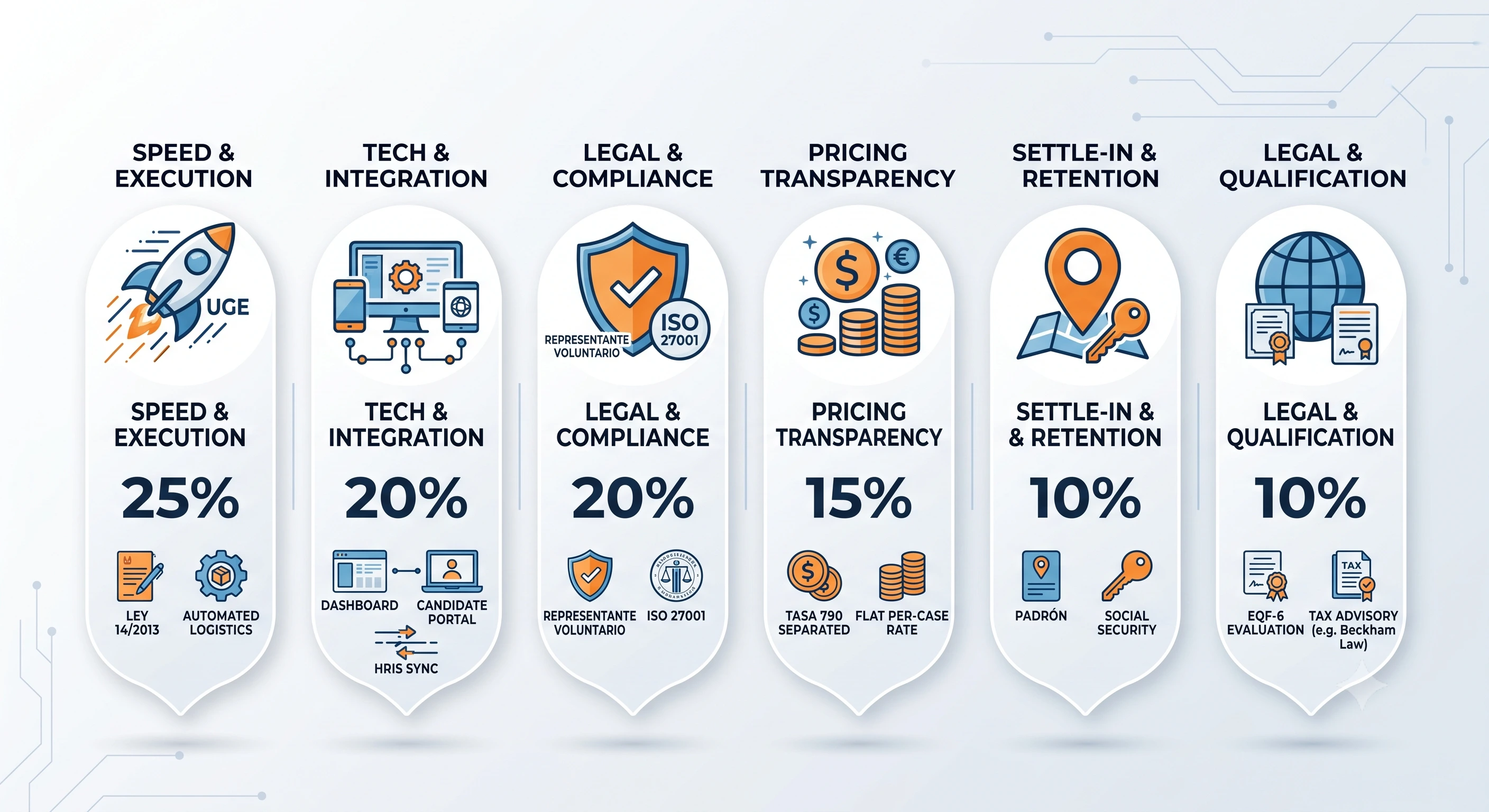
Spain Vendor Selection: A Weighted Evaluation Framework for HR
For the tech and visibility criterion, confirm the provider offers native HRIS and ATS integrations so case data syncs with your existing HR stack rather than living in a separate system.
HR Vendor Evaluation Criteria & Weighting for Global Mobility and Immigration Services
Which type of Immigration Provider is best for hiring in Spain?
To see how these provider types stack up in practice, compare Jobbatical vs Fragomen (Big 4 / enterprise law firm), Jobbatical vs Deel (EOR / global mobility platform), and Jobbatical vs Localyze or Jobbatical vs Envoy Global (tech-enabled mobility platforms).
Evaluate Score for your Spain Immigration Provider
- Assess your current Spain relocation & immigration vendor or provider
- Check how effective they are in terms of effectiveness and value created
- Based on the evaluation parameters like pricing transparency and quality of immigration delivery, see how well is your provider performing
Why does local presence across Madrid, Barcelona, and Valencia matter?
Potential red flags when selecting a corporate immigration partner in Spain
Ignoring Spanish compliance protocols exposes your company to legal liabilities, severe delays, and lost talent during international hiring.
- Corporate digital certificate risks: Handing over your direct credentials instead of assigning a legal representative transfers all compliance liability to your company.
- Data protection violations: Sharing candidate documents through email or unencrypted messaging breaches GDPR regulations.
- Incomplete immigration setup: Stopping at Spain visa approval while ignoring the TIE card, Padrón registration, and Social Security system causes legal status issues.
- Degree equivalency gaps: Inability to evaluate non-degree candidates limits your international talent sourcing under the Startup Act.
- Regional coverage limits: Using service providers restricted to a single city creates compliance gaps for remote or multi-region employees in Spain.
- Cita previa bottlenecks: Providers lacking clear strategy for securing Spanish government appointments in high-backlog cities fail to meet onboarding deadlines.
Choosing a service provider for the Spain EU Blue Card
The EU Blue Card is employer-led and filed centrally through the UGE. For this route specifically, vet a provider on two things: a proven UGE filing track record, and the ability to run an EQF-6 pre-assessment for non-degree candidates before you extend the offer. Blue Card family provisions are a genuine draw here spouses can work without a separate permit and dependent children gain residence so ask for an all-in quote that covers family members, not just the primary applicant
Questions to Ask When Evaluating Blue Card Providers in Spain
Use this shortlist when evaluating Blue Card assistance firms for Spain:
- Who is your named legal representative in Spain, and what is their UGE filing track record?
- How do you handle cita previa bookings in Madrid or Barcelona with current backlogs?
- What happens if an application is rejected? Is resubmission included?
- Do you cover TIE collection, Empadronamiento, and Social Security registration?
- How do you track open cases and communicate status to our HR team?
- What is your refund or guarantee policy if a permit is delayed beyond your estimated timeline?
Frequently Asked Questions : Immigration Service Provider Spain

.svg)
.svg)