.svg)



Synopsis: Spain Immigration Rules 2026
Spain's updated immigration laws simplify work permit requirements, cut bureaucracy, and give employers faster access to international talent. The latest Spanish visa policy changes and 2026 regulations include:
- Corporate Relocation Pathways: The real estate Golden Visa cancellation in April 2025 has shifted employer focus to Highly Qualified Professional permits and Digital Nomad Visas.
- EU Blue Card Salary Threshold 2026: Spain requires a standard annual salary of €41,356.36 for the EU Blue Card, while the Digital Nomad Visa minimum income is updated to 200% of the SMI.
- Extended 365-Day Entry Window: Approved Spanish visa holders now have up to 365 days to enter the country, significantly easing global mobility and relocation logistics.
- Longer Work Permit Durations: Initial work permits last one year with up to four-year renewals, and Spanish long-term residency cards for workers over 30 are now valid for 10 years.
- Expanded Domestic Workforce: An extraordinary 2026 legalization window and student visa rules allowing up to 30 work hours per week expand the local hiring pool.
- Family Reunification Rules: Relocated expatriate employees can now bring financially dependent children up to age 26, boosting long-term talent retention.
In late 2024, Spain approved significant amendments to the Regulation on the Rights of Foreigners (Real Decreto 1155/2024), which entered into force on May 20, 2025. These changes have now been active for several months, simplifying Spain’s immigration system.
This article outlines the main ongoing changes from the 2025 reform, still highly relevant for employers plus the 2026 regularization impact and the Supreme Court decision scrapping the six-month absence rule.
Quick Overview of Spain's Immigration Updates
- Easier Hiring Process : Simplified visa procedures and reduced bureaucracy continue to speed up bringing international talent to Spain.
- Employee Retention : Longer permits and easier family reunification help retain skilled workers and boost satisfaction.
- Greater Travel Freedom : Temporary permit holders can now spend more than six months abroad without automatically losing status, easing extended overseas assignments and home-country rotations.
Related Reads:
For the full menu of Spanish permit types these changes apply to: Spain visa options: a complete guide for employers
Check whether a specific role, salary and nationality qualifies under the 2026 rules before filing: Spain work and residence permit eligibility checker
Key Changes to Spain’s Immigration Regulations (2025–2026)
Related Reads:
Which shortage occupations and recent-graduate cases qualify for the reduced €31,415.94 threshold: Spain EU Blue Card reduced salary threshold 2026
How EU Blue Card cases are filed through the UGE-CE fast-track route: Spain EU Blue Card service
The freelance and self-employment change in practice, and when a permit modification is required: Spain change of permit (modificación) guide
Sponsor income thresholds and document rules for bringing dependants up to 26: Spain family reunification visa
┈┈┈┈┈┈┈┈┈┈┈┈┈┈┈┈┈┈┈┈┈┈┈┈┈┈┈┈┈┈┈┈┈┈┈┈┈┈┈┈┈┈┈┈┈┈┈
Spain Immigration Updates timeline 2026
This is the section to check before any internal briefing. It is updated monthly.
Background on the Startup Act (Ley 28/2022) entry above and how employers use it today: Spain Startup Act employer guide
In 2026, a modification to the Entrepreneur's Law split highly qualified authorisations into two separate procedures the EU Blue Card and the national highly qualified permit each with its own qualification criteria, both routed through the UGE-CE. See the Spain EU Blue Card guide vs HQP for the full route comparison.
┈┈┈┈┈┈┈┈┈┈┈┈┈┈┈┈┈┈┈┈┈┈┈┈┈┈┈┈┈┈┈┈┈┈┈┈┈┈┈┈┈┈┈┈┈┈┈
2026 Update: Spain Scraps the Six-Month Absence Rule
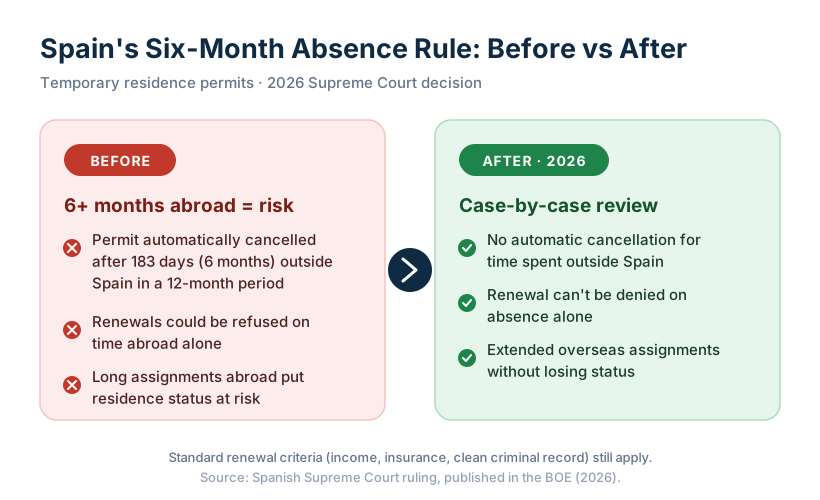
Spain's Supreme Court has struck down the rule that automatically cancelled a temporary residence permit when the holder spent more than six consecutive months (183 days) outside Spain in a 12-month period. Confirmed through Supreme Court rulings reflected in the Boletín Oficial del Estado (BOE) in 2026, the decision holds that such a limit on free movement cannot be imposed by regulation alone, so immigration offices can no longer revoke a permit or refuse a renewal based purely on time spent abroad.
- Who It Affects : Around 1.5 million non-EU nationals on temporary permits, including digital nomad, student, family reunification, and standard work and residence permits.
- Case-by-Case Review : Foreigners' offices must now assess each absence individually and cannot deny a renewal solely on days spent outside Spain, provided standard criteria (income, insurance, clean criminal record) are still met.
- Reinstatement Route : Employees whose permits were cancelled in earlier years on absence grounds may be able to appeal and apply for reinstatement by evidencing continued ties to Spain.
- Self-Executing : No extra paperwork or fees are required; the change applies automatically.
How periods spent abroad are assessed case by case for permanent residence eligibility: Spain permanent residence, relocating abroad and absences
What HR Still Needs to Watch:
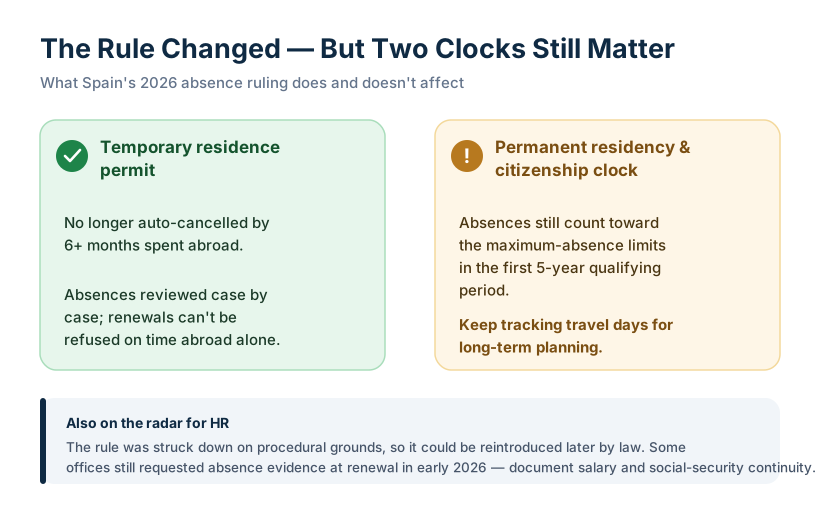
- The Permanent Residency Clock : Absences still count toward the maximum-absence limits that apply across the first five-year period when qualifying for long-term residency and citizenship. Keep tracking travel days for long-term planning.
- Possible Reintroduction : Because the rule was struck down as improperly enacted rather than on principle, parliament could reintroduce a similar limit later through higher-level legislation.
- Uneven Enforcement : Some offices were still requesting absence evidence at renewal in early 2026. Document salary continuity and social-security payments to pre-empt friction at renewal.
Related Reads:
See how the five-year clock and absence limits work in our Spain permanent residence process guide.
What renewal filings require, and how to avoid gaps when Extranjería asks for extra evidence: Spain residence permit renewal
┈┈┈┈┈┈┈┈┈┈┈┈┈┈┈┈┈┈┈┈┈┈┈┈┈┈┈┈┈┈┈┈┈┈┈┈┈┈┈┈┈┈┈┈┈┈┈
Spain’s 2026 Extraordinary Regularisation: The Employer Compliance Checklist and Guide
- The Narrow Window: Applications are strictly open from 16 April to 30 June 2026. Employers have a very limited time to support eligible candidates or current informal workers in transitioning to legal status.
- Immediate Provisional Work Rights: Once an application is submitted and accepted for processing by authorities (usually within 15 days), the applicant is granted immediate provisional work authorization while the file is under review. This allows companies to onboard them without waiting months for the final decision.
- Employer Support Role: While the application is individual-driven, employers play a critical role. Providing a formal job offer, a contract, or documentation of prior employment is one of the primary ways a candidate can prove their eligibility for the labor-based route of this regularisation.
- Permit Details: Successful adult applicants receive a 1-year residence and work permit (valid for any sector across Spain). Dependent minor children included in the application receive a 5-year permit. After the first year, the employee must transition into the standard work permit renewal process.
- Compliance Warning: Because this process brings many informal workers into the system, HR teams are being strongly advised to audit their workforce documentation. Filing delays are expected across standard immigration processes during Q2 2026 due to the sheer volume of these applications saturating government offices.
Application volumes and labour-market limits, and what they mean for international hiring: Spain worker regularization 2026
Current consulate and Extranjería processing times, city by city, for planning around Q2 saturation: Spain consulate backlog processing times
┈┈┈┈┈┈┈┈┈┈┈┈┈┈┈┈┈┈┈┈┈┈┈┈┈┈┈┈┈┈┈┈┈┈┈┈┈┈┈┈┈┈┈┈┈┈┈
What Are the Benefits for Employers in 2026?
- Simplified Visa Procedures : Less bureaucracy speeds hiring and relocation.
- Longer Work Permits : Four-year renewals provide planning stability.
- Flexible Recruitment : Diverse pathways and EU mobility options.
- Family Reunification : Enhances employee satisfaction and retention.
- Student Workers : A part-time pool worth structuring career paths around, since language-only students can no longer convert straight to a work permit.
- Easier Mobility for EU-Based Workers : Van Der Elst supports multinationals.
- Travel Flexibility for Assignees : Employees on Spanish permits can take extended overseas projects without risking their residence status, cutting emergency travel-planning around old six-month cut-offs.
- Definitive Salary Guidance: Published 2026 EU Blue Card thresholds let recruiters advertise compliant salaries from day one.
- Relocation Buffer Time: The new 365-day visa entry window eliminates emergency flight bookings and allows for seamless, stress-free employee onboarding.
- Clear Pivot Strategies: The definitive end of the Golden Visa provides regulatory certainty, allowing legal teams to standardise around HQP and DNV routes for executive relocations.
Related Reads:
How the 30-hour student work rule works in practice and what employers must document: Student visa work authorization in Spain
The HQP route employers are standardising on after the Golden Visa, and the three errors that delay these cases: Spain HQP visa — 3 critical errors
Conclusion
Spain’s immigration regulations are now fully implemented and the 2026 extraordinary regularization continue to make the country more attractive for hiring global talent. Simplified processes, longer permits, family support, and new workforce entry points help businesses recruit and retain effectively.
Step-by-step view of what sponsoring a Spanish work visa involves on the employer side: Spain work visa sponsorship employer guide
Frequently Asked Questions about Immigration Regulations in Spain

.svg)
.svg)