.svg)


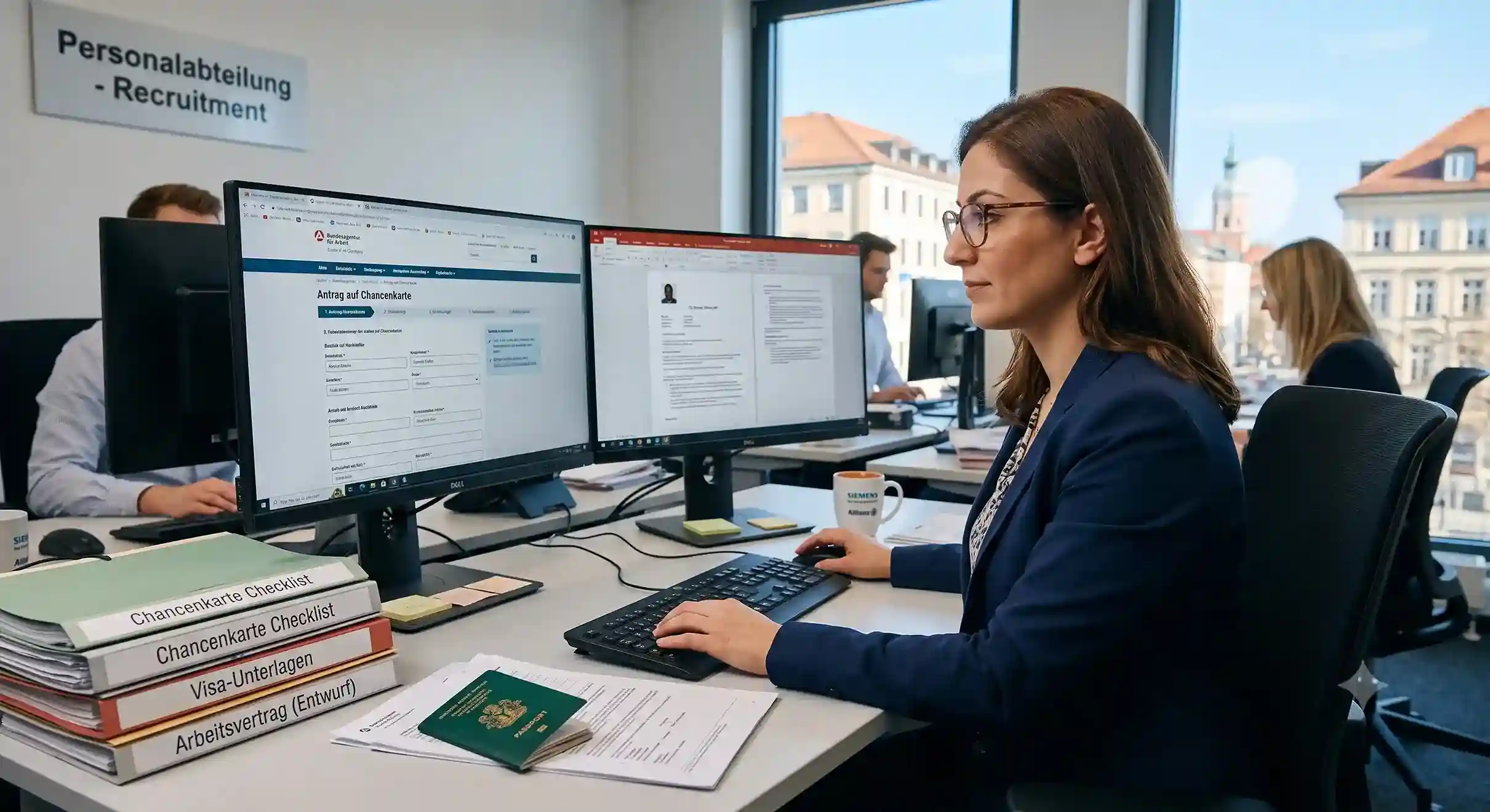
Key Take aways for Germany Chancekarte (Opportunity Card) 2026
- Zero Upfront Sponsorship: The Opportunity Card (Chancenkarte) allows skilled non-EU talent to relocate to Germany for up to 1 year without a prior job offer, drastically reducing relocation friction and employer sponsorship risk.
- Flexible Sourcing Rules: Cardholders can work part-time up to 20 hours per week and engage in two-week trial employment (Probearbeit) per company, giving HR teams a risk-free "try-before-you-hire" evaluation period.
- Clear Strategic Choices: Use the Opportunity Card to scout and build a flexible talent pipeline; opt for the Skilled Worker Visa or EU Blue Card for immediate direct hires with confirmed offers.
As an HR professional or hiring manager, addressing Germany’s chronic labor shortage—estimated at roughly 400,000 skilled professionals needed annually requires modern, flexible global mobility strategies. Germany’s updated Skilled Immigration Act introduces powerful pathways to source non-EU talent.
Chief among these is the Opportunity Card (Chancenkarte) under Section 20a of the Residence Act (AufenthG). Designed to streamline international recruitment, the Chancenkarte enables qualified workers to move to Germany before securing a full-time contract. This guide provides a comprehensive breakdown of how the Opportunity Card operates, candidate eligibility, HR compliance requirements, and direct visa comparisons to help you hire efficiently.
What Is the Germany Opportunity Card (Chancekarte) and Why Should Employers Care?
The Opportunity Card is a points-based residence permit that allows qualified non-EU professionals to enter Germany for up to 12 months specifically to find employment.
For HR teams and talent acquisition managers, the primary advantage lies in the eliminated administrative friction. Traditional work visas require an employer to sponsor a candidate, arrange local approvals, and wait out long foreign embassy appointments before the candidate ever sets foot in the country.
In contrast, the Opportunity Card requires zero initial employer sponsorship. Applicants manage their own visas, prove their financial self-sufficiency, and move to Germany on their own initiative.
Full service breakdown, including how Jobbatical handles the application end to end: Germany Opportunity Card (Chancenkarte) service page
Key Benefits of the Opportunity Card (Chancekarte) for Employers
- Local Candidate Availability: By the time you interview a Chancenkarte holder, they are already residing in Germany, adapted to the local time zone, and available for face-to-face meetings or immediate on-site trials.
- Risk-Free Evaluation ("Try-Before-You-Hire"): Cardholders are legally authorized to work up to 20 hours per week and complete short-term trial work (Probearbeit) of up to two weeks per employer.
- Streamlined Onboarding: Converting a candidate already living in Germany to a permanent work permit is significantly faster than initiating international relocation from a foreign embassy.
- Broad Industry Applicability: The card attracts talent across IT, engineering, healthcare, logistics, construction, and skilled trades.
Who Arrives on a Chancenkarte? The Candidate Profile
The Chancenkarte is not an unvetted visa; it functions as a selective filter for qualified non-EU professionals. To qualify, candidates must either possess a fully recognized foreign degree or score at least six points on a matrix evaluating education, language proficiency, professional experience, age, and ties to Germany.
Key Applicant Insights
- Top Origin Countries: Strong applicant volume comes from major talent hubs, including India (representing over 31% of early cardholders), China, Turkey, Pakistan, Nigeria, Tunisia, and Nepal.
- High-Density Sectors: You will find an abundant pool of candidates specialized in software development, IT infrastructure, engineering disciplines, healthcare (nursing and medical technology), logistics, and skilled blue-collar trades.
- What Candidates Can Do Immediately: While searching for permanent roles, candidates can support themselves via part-time work (up to 20 hours/week) or participate in short-term trial shifts, allowing HR teams to verify technical competence and cultural fit before extending a full-time offer.
For trades, logistics and care roles specifically, see the wider set of routes available: Germany Blue-Collar Visas
Eligibility and the 2026 Chancenkarte Points System
To receive an Opportunity Card, non-EU candidates must meet core foundational criteria or qualify through Germany's 6-point evaluation matrix.
1. Basic Eligibility Requirements
- Educational & Professional Qualifications: Either a university degree state-recognized in the country of origin/Germany OR at least two years of vocational training recognized by the issuing state. Qualifications can be verified via the official Anabin database or IHK/ZAB portals.
- Language Proficiency: Minimum basic German proficiency (A1 level) OR English proficiency (B2 level) under the Common European Framework of Reference for Languages (CEFR). Higher proficiency levels earn additional matrix points.
- Financial Proof: Proof of financial self-sufficiency of at least €13,092 per year (approximately €1,091 per month in a blocked account), a formal declaration of commitment (Verpflichtungserklärung), or a qualifying part-time job contract in Germany.
- Health Insurance: Comprehensive coverage equivalent to German public health insurance standards (no deductibles above €300 annually).
Related Read:
Before you rely on a candidate's degree, check how it is rated: What Anabin's H+ and H− ratings mean for a German hire
If the qualification is only partially recognised, a recognition partnership can let you hire first: The Anerkennungspartnerschaft explained for employers
2. The 2026 Points System Breakdown
Applicants who do not hold a fully recognized German degree/qualification must score at least 6 points across the following categories:
Score a specific candidate against this matrix in under three minutes: Opportunity Card eligibility self-check
The HR Guide: Onboarding and Sponsoring a Chancenkarte Holder
While hiring an Opportunity Card holder is straightforward, HR teams must follow structured compliance steps to ensure smooth status transitions and prevent legal violations.
Step 1: Onboarding Checklist & Pre-Employment Verification
- Verify Physical Card & Validity: Retain a copy of the employee's physical Opportunity Card and passport for HR compliance records.
- Local Registration (Bürgeramt): Confirm that the employee has completed their residential registration (Anmeldung) within 14 days of securing housing in Germany.
- Respect Hour Caps: Enforce the 20-hour weekly work cap strictly if the individual works part-time prior to full permit approval.
The compliance slips that cost HR teams the most time on German work permits: 7 costly mistakes HR teams make under the Skilled Worker Act
Step 2: Payroll & Minimum Wage Compliance
- Minimum Wage Requirements: Statutory minimum wage (€13.90/hour in 2026) applies from day one of any part-time work or paid trial.
- Tax & Social Security Registration: Mandatory tax ID (Steueridentifikationsnummer) and social security reporting must be initiated as soon as a part-time contract is activated.
- Trial Work Documentation: Unpaid trial employment (Probearbeit) up to 2 weeks per employer does not require a formal employment contract but must be documented in writing to define scope, duration, and objective evaluation goals.
Step 3: Converting to a Permanent Work Permit
To convert an Opportunity Card holder into a full-time employee, execute the following workflow:
- Issue a Binding Contract Offer: Draft a full-time employment contract detailing title, job description, working hours, and annual salary.
- Ensure Qualification Alignment: The role must closely correspond to the candidate’s educational background or vocational training to satisfy Foreigners' Authority (Ausländerbehörde) and Federal Employment Agency (Bundesagentur für Arbeit - BA) requirements.
- Submit Conversion Application: The candidate submits the contract and job description directly to their local Ausländerbehörde in Germany. They do not need to return to their home country.
- Obtain Written Authorization Before Full-Time Work: The candidate must receive written authorization (or a temporary permit / Fiktionsbescheinigung) from the immigration authority before starting full-time duties.
HR Cautionary Note: Never allow a candidate to begin full-time employment before receiving formal written approval from the Ausländerbehörde. If an appointment is scheduled for October 30th with a requested start date of November 1st, keep the official start date contingent on the written confirmation issued during or after that appointment.
Related Read:
The full conversion walkthrough-documents, appointment, salary levels and fees: Converting a Chancenkarte to a German work visa (Arbeitsvisum)
Work Rules: Can Chancenkarte Holders Work Full-Time?
A common point of confusion for recruiters is whether an Opportunity Card functions as a full-time work permit. It does not.
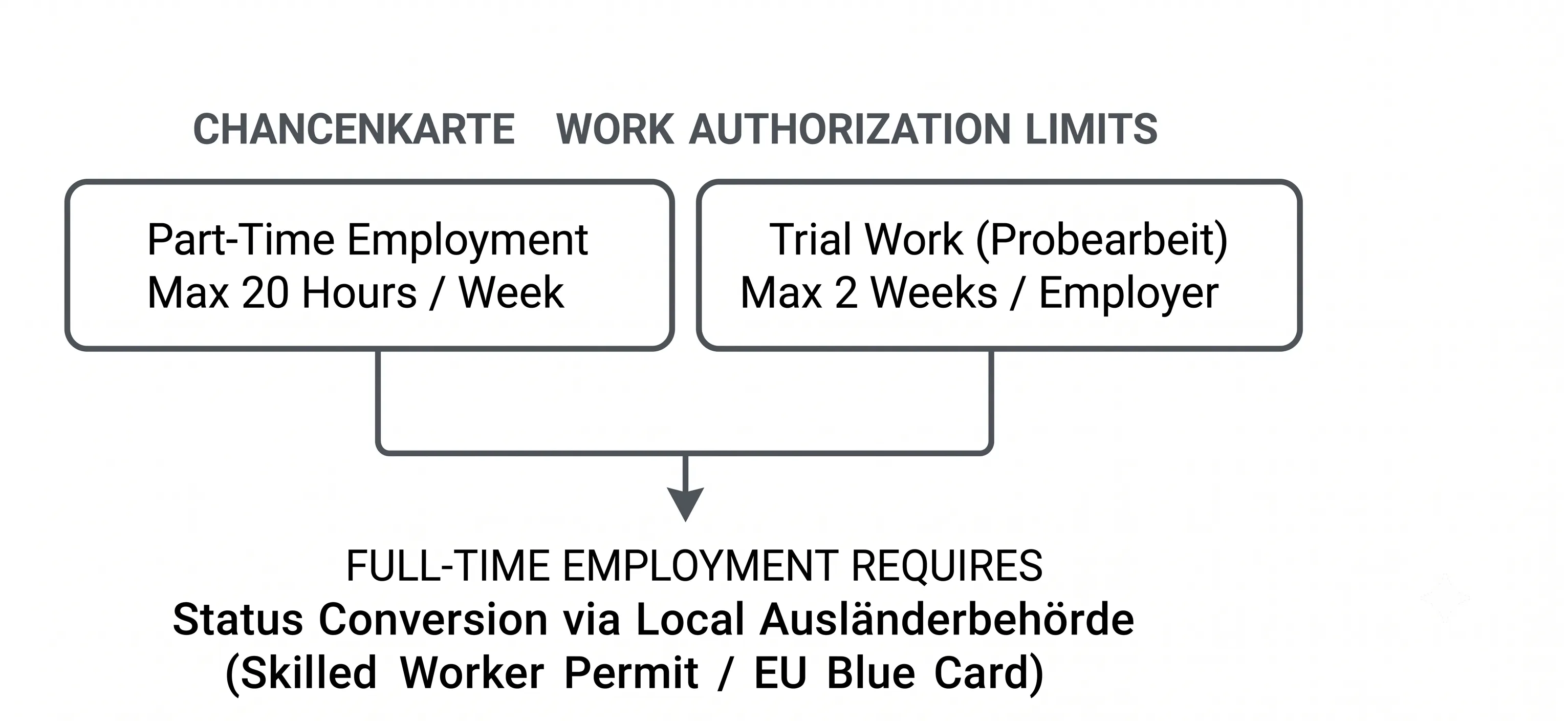
- Working Hours Capped at 20 Hours/Week: While searching for permanent roles, cardholders are restricted to 20 hours per week of standard employment.
- Trial Work Conditions: Trial work (Probearbeit) is limited to a maximum of 2 consecutive weeks per prospective employer. It must focus on assessing candidate suitability for a qualified position rather than filling general labor needs.
- Switching to Full-Time: Transitioning to full-time work requires converting the card into a standard Skilled Worker Residence Permit (under Section 18a/18b AufenthG) or an EU Blue Card.
A real Hamburg case showing what HR had to get right on address registration during the switch: Switching from Chancenkarte to EU Blue Card in Germany
Visa Comparisons: Chancenkarte vs. Other Routes to Germany
Choosing the right immigration pathway depends on hiring urgency, candidate location, salary levels, and role complexity.
1. Opportunity Card vs. Skilled Worker Visa (Blue Collar & Technical Trades)
HR managers hiring blue-collar talent, logistics specialists, construction workers, or healthcare aides frequently compare the Opportunity Card (Section 20a) against the traditional Skilled Worker Visa (Sections 18a/18b).
- Opportunity Card (Section 20a):
- Best For: Scouting flexible talent, creating candidate pipelines, and testing candidates on-site in trial roles before making a permanent offer.
- Job Offer: Not required upon entering Germany.
- Financial Burden: Borne primarily by the candidate via blocked accounts (€13,092).
- Employer Advantage: No initial sponsorship costs; immediate local availability.
- Skilled Worker Visa (Sections 18a/18b):
- Best For: Immediate, direct hiring for confirmed vacancies in shortage trades (e.g., electricians, mechanics, plumbers, nursing aides).
- Job Offer: Mandatory prior to visa application.
- Salary Thresholds (2026): Minimum gross annual salary of €45,934.20 (€3,828/month) for shortage occupations; €50,700 for non-shortage roles.
- Employer Advantage: Full-time onboarding immediately upon arrival; direct long-term retention pathway (settlement permit eligibility in as little as 21–36 months with B1 German).
Related Read:
For candidates with strong experience but no formally recognised qualification, there is a third route: Germany's experience-based work permit under Section 19c
2. Comparison Table: Chancenkarte vs. Ausbildung Visa vs. EU Blue Card
Related Read:
The full 2026 threshold reference, including shortage-occupation and new-graduate rates: Germany EU Blue Card salary thresholds 2026
Application Process, Costs, and Timelines
Guide your potential non-EU hires through the core operational steps required to secure their card.
1. Documents Required for Candidate Application
- Valid Passport: Issued within the last 10 years with at least 6 months validity remaining.
- Application Forms: Completed via the official VIDEX portal.
- Biometric Photos: Two recent passport-format photographs.
- Proof of Qualification: Degree certificates, vocational diplomas, or Anabin recognition confirmation.
- Language Certificates: Official A1 German (e.g., Goethe-Institut, Telc) or B2 English (e.g., IELTS, TOEFL) certificates.
- Financial Proof: Blocked account statement (€13,092), part-time employment contract, or formal guarantee declaration (Verpflichtungserklärung).
- CV/Resume: Detailing chronological work history and education.
For the in-Germany residence permit step, use the document checklist: Germany residence permit application and renewal checklist
2. Where Candidates Apply & Appointment Details
- From Abroad: Candidates submit paperwork at the German embassy, consulate, or VFS Global center in their country of origin (or online via the Consular Services Portal where active). Biometric appointments must be attended in person.
- In Germany: Non-EU nationals already holding a valid residence title permitting status changes can apply directly at their local Foreigners' Authority (Ausländerbehörde).
- Appointment Lead Times: Candidates should book embassy appointments 2 to 3 months in advance due to high demand in regions like South Asia and West Africa.
Check current consulate wait times before you commit to a start date: Germany visa appointment waiting time estimator
3. Costs and Processing Timelines
- Visa/Permit Fees: €75 for the national visa issued abroad; €100 for the residence permit issued locally by the Ausländerbehörde.
- Processing Time: Standard processing ranges between 3 to 5 months from application submission to visa issuance.
Every Germany visa and permit fee in one place, updated for 2026: Germany visa fees explained - long-stay, short-stay and residence permits
4. Salary Expectations Upon Permanent Conversion
Once a candidate transitions to permanent employment, salary benchmarks align with market rates and statutory immigration thresholds:
- IT Specialists: Can qualify for an EU Blue Card at a reduced salary threshold of €45,934.20 annually (2026). University degrees are waived for IT professionals demonstrating at least 3 years of relevant professional experience within the last 7 years.
- Other Skilled Professions: Standard Skilled Worker requirements apply, subject to Federal Employment Agency (BA) wage parity checks to ensure local labor market standards are maintained.
Confirm the offer clears the threshold before the contract is signed: Employer's EU Blue Card salary checker
Recent Statistics and Market Updates
- Issuance Growth: Between June and October 2024 alone, over 2,500 Opportunity Cards were issued by German missions.
- Key Demographic Pools: Indian professionals represent the single largest group of cardholders (~31%), followed by qualified applicants from China, Turkey, Pakistan, and Nigeria.
- Process Centralization: Germany is actively centralizing immigration handling through specialized federal authorities to reduce average visa processing times by up to 40%.
Where German policy is heading next for lower-skilled versus skilled routes: Germany's June 2026 shift from guest workers to skilled elite
How Jobbatical Simplifies the Chancenkarte Process for Employers
Navigating status conversions, local registration backlogs, and immigration authorities can strain internal HR teams. Jobbatical provides end-to-end relocation and compliance management to streamline your international hiring pipeline:
- Seamless Status Conversion: We handle the entire process of upgrading your hire's Chancenkarte into a full-time Skilled Worker Permit or EU Blue Card.
- Local Compliance & Registration: Our local team assists new hires with residence registration (Anmeldung), health insurance setup, and document verification.
- Accelerated Time-to-Productivity: Offloading administrative burdens reduces onboarding delays and eliminates compliance risk for your enterprise.
Disclaimer: Immigration rules change quite frequently; please verify with official sources or contact us for the latest info before making any decisions.
Frequently Asked Questions About the Germany Opportunity Card (Chancenkarte) for HR Teams

.svg)

.svg)