.svg)



Key Takeaways : Netherlands Highly Skilled Migrant Permit (Kennismigrant)
- The HSM permit is salary-based, not qualification-based. There is no degree requirement in most cases, no skills test, and no labour market test, so a qualifying salary for the employee's age group is the primary route to approval.
- 2026 salary thresholds are the core eligibility gate. Gross monthly minimums are €5,942 (age 30+), €4,357 (under 30), and €3,122 (recent Dutch graduates), based on the SV salary and excluding holiday pay. Confirm the offer meets the threshold before submitting.
- The permit is issued as a single GVVA covering both work and residence. Your employee receives the right to live and work in the Netherlands under one approval, with no separate TWV work permit required.
- Recognised sponsors receive the fastest decisions. Processing can be as quick as two weeks for recognised sponsors, against standard periods that extend up to 90 days for complex cases, making sponsor status the biggest lever on time-to-hire.
- The permit brings family and mobility benefits. It is tied to contract length up to a maximum of five years, is renewable while the salary threshold is met, and grants the employee's partner unrestricted access to the Dutch labour market without a separate work permit.
The Netherlands Highly Skilled Migrant permit, or Kennismigrant, is one of the few routes where your company can move quickly, with recognised sponsors receiving IND decisions in as little as two weeks.
This guide covers who qualifies, how the application works, 2026 salary thresholds, costs, compliance obligations, the July 2025 reforms, and the 30% tax ruling. See how Jobbatical manages HSM applications for your team.
Who Needs the Highly Skilled Migrant Permit (Kennismigrant)?
The Highly Skilled Migrant permit applies to non-EU and non-EEA nationals your company hires directly under a Dutch employment contract. It is the default route for internationally recruited talent, and understanding who it covers helps you route each hire correctly from the outset. The points below set out where it applies and where a different permit fits better.
- Directly employed non-EU and non-EEA nationals: The permit is designed for candidates your company hires onto a Dutch employment contract, most often in tech, engineering, finance, research, and senior commercial roles. It is the standard route wherever you are recruiting skilled talent from outside the EU and EEA.
- A valid employment contract: The candidate must hold a genuine employment contract with your company that specifies role, salary, and duration. This contract is the foundation of the application and must be in place before you submit to the IND.
- A salary meeting the IND threshold: The offered salary must meet or exceed the IND minimum for the employee's age group. There is no skills test and, in most cases, no degree requirement, so salary is the primary eligibility gate.
- No prior job advertising: Unlike labour-market-tested routes, the HSM scheme does not require you to advertise the role to EU candidates first. This is one of the main reasons the route is faster than alternatives.
- When the permit does not apply: EU and EEA nationals do not need it, and intra-group transfers are better served by a different permit. If you are moving someone from another group entity, the Intra-Corporate Transfer route is the correct choice.
For internal transfers that fall outside the HSM scheme, our Netherlands Intra-Corporate Transfer (ICT) permit service manages the dedicated route for moving employees between group entities.
What Are the 2026 Highly Skilled Migrant Permit (Kennismigrant) Salary Thresholds?
The IND revises the Highly Skilled Migrant salary thresholds every January, and 2026 brings an increase of roughly 4.5% on 2025 levels. Getting the figure right before the offer letter goes out is essential, because an incorrect salary is one of the most common causes of denial. The thresholds and the rules around them are set out below.
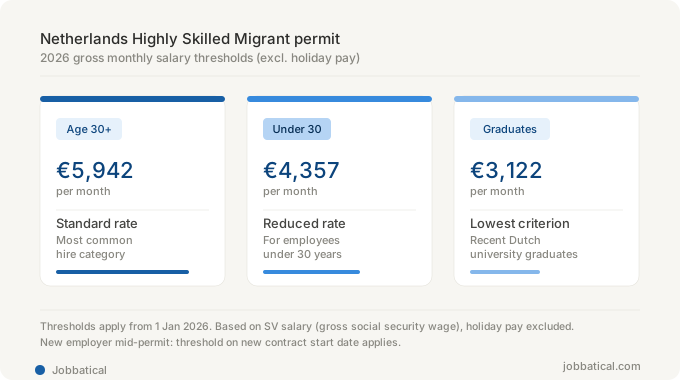
Thresholds are based on the SV salary, your employee's gross social security wage, with holiday pay excluded. Lock in the right figure before the offer letter goes out.
One detail HR teams regularly miss: if your employee changes employer during the permit period, a new application is needed and the threshold valid on the new contract start date applies, not the original figure. Full breakdown in our 2026 HSM salary threshold guide.
What Is Changing in the Highly Skilled Migrant Scheme in 2026?
The Dutch government confirmed a policy shift in July 2025 aimed at reducing overall migration volumes while steering the Highly Skilled Migrant scheme toward genuinely high-value roles. For employers, the direction of travel is clear: entry is becoming more selective, sponsor scrutiny is tightening, and acting under the current framework carries a real timing advantage. Here is what HR and mobility teams should plan around.
- Higher salary thresholds targeting high-value roles: The reforms push minimum salaries upward to prioritise high-value roles over volume hiring, with the under-30 threshold moving toward 1.1 times the national average wage. Build headroom into offer letters so a mid-cycle threshold revision does not invalidate a pending application.
- Stricter sponsor eligibility and compliance history: Recognised sponsors must demonstrate financial stability, operational integrity, and a clean enforcement record. Employers carrying three or more fines in the previous four years for issues such as tax evasion or wage violations risk rejection, so resolve outstanding compliance matters before you submit.
- Loss of status for inactive sponsors: Sponsors that go two years without employing a Highly Skilled Migrant may forfeit their recognised status. If your hiring is seasonal or project-based, track your last qualifying hire date and plan renewals so recognition does not lapse between roles.
- Expanded IND oversight and revised fees: Applicants and employers should expect more robust digital application systems, updated fee structures, and closer IND monitoring designed to curb misuse. Factor these administrative and cost changes into your 2026 hiring budgets rather than treating them as one-off adjustments.
- A narrowing window under current rules: While some measures already influence 2025 approvals, broader implementation lands in 2026. Applications filed under the present, more flexible framework generally face lower thresholds and lighter bureaucracy, making early submission a defensible strategic choice.
To hand the full recognised-sponsor application and kennismigrant filing to specialists, our Netherlands Highly Skilled Migrant (kennismigrant) permit service manages the end-to-end process under current rules.
How Do You Apply for the Highly Skilled Migrant (Kennismigrant) Visa Netherlands?
Applying for the Highly Skilled Migrant visa follows a defined sequence, and getting the order right keeps the process fast. The employer, as recognised sponsor, drives the application on the employee's behalf. The steps below set out how to apply from start to decision.
- Confirm recognised sponsor status first: Only an IND-recognised sponsor (erkend referent) can file an HSM application, so this status must be in place before anything else. If your company is not yet recognised, securing that status is the first step and takes around four weeks.
- Check the MVV requirement: Most non-EU nationals need a provisional residence permit (MVV) before entering the Netherlands, though US, Canadian, Japanese, and Australian nationals are among those exempt. Confirming this early determines whether entry clearance runs alongside the main application.
- Submit the application through the IND portal: File Form 7511 as the recognised sponsor, bundling the MVV and residence permit where applicable. Uploading the contract, salary confirmation, health insurance proof, and passport copies upfront is the single biggest lever on processing speed.
- Await the IND review and decision: The IND assesses salary, the employment relationship, and public order matters, then issues a decision letter. Complete, accurate submissions from a recognised sponsor are what unlock the two-week fast track.
- Collect the residence card and register locally: The employee collects their biometric residence card at an IND desk and must register with their local municipality (BRP) within five days of arrival. Both steps complete the transition from approval to a working, resident employee.
What Are the Highly Skilled Migrant (Kennismigrant) Visa Processing Times?
Processing time is one of the biggest advantages of the Highly Skilled Migrant visa, but it depends heavily on sponsor status and document completeness. Knowing the realistic timelines helps HR teams plan start dates with confidence. The points below set out what to expect.
- Recognised sponsors: from two weeks: Applications filed by recognised sponsors are fast-tracked and can receive a decision in as little as two weeks. This is the single strongest reason to secure and maintain recognised status.
- Standard processing: up to eight weeks: Where the employer is not a recognised sponsor, processing runs longer, typically up to eight weeks. Complex cases can extend to the statutory limit of 90 days.
- Document completeness drives speed: Incomplete applications are the most common cause of delay, as the IND pauses the clock to request missing items. Preparing every document before filing is the most reliable way to hit the shorter end of the range.
- MVV coordination: Where an MVV is required, bundling it with the residence application through the portal keeps the two steps aligned. Handling them separately can add avoidable weeks to the overall timeline.
- Post-decision steps: After approval, card collection and BRP registration are quick but must be scheduled promptly. Building these into onboarding avoids a gap between approval and the employee's effective start date.
For hires who are not highly skilled and follow the standard single-permit route, our Netherlands GVVA combined work and residence permit guide explains the process and timelines step by step.
Which Documents Are Needed for the Highly Skilled Migrant Visa?
Assembling a complete document set before submission is the most effective way to avoid processing delays, and all non-Dutch documents require certified translations. Gathering everything in advance also helps meet the stricter completeness checks arriving in 2026. The core documents are set out below.
- Signed employment contract: The contract must clearly state role, salary, start date, and hours. It is the central evidence the IND assesses, so it must reflect the agreed terms exactly.
- Proof of Dutch health insurance and passport copies: Provide evidence of Dutch health insurance valid from day one, together with employee passport copies covering ID pages and existing stamps. These establish both coverage and identity for the application.
- IND sponsorship and antecedents declarations: Include the IND sponsorship declaration (Appendix 7621) and the employee antecedents certificate (Appendix 7601), the latter signed by the employee. These declarations confirm the sponsor relationship and the employee's background.
- The recognised sponsor certificate: Attach the company's IND recognised sponsor certificate to confirm its standing to sponsor the hire. This links the application to the approved sponsor status.
- Qualifications and family documents: Provide diplomas or transcripts for degree-required roles, and for accompanying family members, add marriage and birth certificates. Preparing family documents early allows those applications to run alongside the main visa.
Where the hire is bringing dependants, our Netherlands family reunification visa service can run the family applications in parallel with the main visa.
What Does the Highly Skilled Migrant Visa Cost?
The Highly Skilled Migrant visa carries both application fees and, for employers, the one-time cost of becoming a recognised sponsor. Understanding the full cost picture helps HR and finance teams budget accurately for each hire. The main costs are set out below.
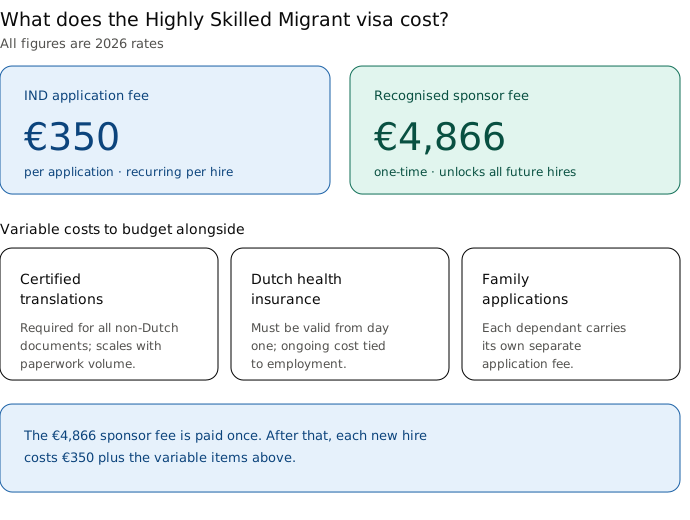
- IND application fee: The IND application fee for the HSM residence permit is €350 per application in 2026. This is the core per-hire cost of the visa itself.
- Recognised sponsor registration fee: Becoming an IND-recognised sponsor costs €4,866 in 2026. This is a one-time cost that unlocks the ability to sponsor unlimited future HSM hires and access fast-track processing.
- Certified translation costs: All non-Dutch documents require certified translations, which add a variable cost depending on the volume of paperwork. Budgeting for these upfront avoids surprises late in the process.
- Health insurance: Valid Dutch health insurance must be in place from day one, which is an ongoing cost tied to employment rather than a one-off application fee. It should be factored into the total cost of the hire.
- Family application costs: Where dependants are included, each family member's application carries its own fee. Planning these alongside the main application gives a complete view of relocation costs.
For a full breakdown of the current government charges to budget around, our 2026 Netherlands IND application fees guide sets out the fee structure for every stage of the process.
What Are the Employer Compliance Obligations for Highly Skilled Migrant (Kennismigrant)?
Sponsoring a Highly Skilled Migrant brings obligations that continue well beyond visa approval, and the IND now enforces them through unannounced spot audits introduced in 2026. Keeping records audit-ready at all times, rather than only at renewal, is essential to protecting recognised status. The core obligations are set out below.
- Reporting changes within four weeks: Report the end of employment, salary reductions, or address changes to the IND within four weeks, using Form 7593 or the Business Portal. Prompt reporting is a core sponsor duty and a frequent focus of IND checks.
- Retaining employment records: Keep employment records, including passport copies and contracts, for the full retention period the IND requires, which extends beyond the end of sponsorship. Maintaining a complete employee file is central to passing an audit.
- Retaining bank statements from 2026: From 2026, retain bank statements confirming salary payments as additional payroll evidence alongside payslips. This is the biggest new requirement this year and has caught several sponsors off guard.
- Maintaining valid health insurance: Ensure valid Dutch health insurance is in place for the employee throughout their employment. This is an ongoing condition of sponsorship, not a one-time check at the start.
- The cost of non-compliance: Failures carry fines of up to €20,000 and can cost a company its recognised sponsor status. With unannounced audits now in force, records must be ready at any time.
To see exactly what inspectors examine during an unannounced visit, our HSM spot audit compliance guide sets out what the IND checks and how to prepare.
Does the 30% Ruling Apply to Highly Skilled Migrants?
The 30% ruling is a tax facility that can materially strengthen an offer for internationally recruited talent, and many Highly Skilled Migrant hires qualify. Because it affects the candidate's net pay, it is worth evaluating early when building competitive offers. The key points are set out below.
- What the ruling provides: The 30% ruling (30-regeling) lets eligible employees receive up to 30% of gross salary tax-free for five years. For candidates weighing offers across Europe, this can be a decisive advantage.
- Recruitment-from-abroad requirement: Eligibility requires that the employee was recruited from outside the Netherlands. This is a core condition and should be confirmed before presenting the ruling as part of an offer.
- A separate income threshold: The ruling carries its own income threshold, distinct from the HSM salary minimum. Meeting the visa threshold does not automatically mean the ruling applies, so both must be checked.
- Application through the Belastingdienst: The application goes through the Dutch Tax Authorities (Belastingdienst), not the IND. This is a separate process from the visa and should be planned as its own workstream.
- Timing and coordination: Because eligibility and application run alongside the visa, coordinating the two keeps onboarding efficient. Handling them together avoids gaps that can delay the tax benefit.
To manage the tax application without adding to your team's workload, our Netherlands 30% ruling service handles eligibility and filing through the Belastingdienst.
How Do Highly Skilled Migrant (Kennismigrant) Visa Renewals Work?
Renewing a Highly Skilled Migrant visa is straightforward when the qualifying conditions remain in place, but timing and mid-visa changes require attention. Starting the process early protects continuity of the employee's right to work. The key rules are set out below.
- Conditions for renewal: The visa can be renewed as long as the salary threshold is still met and a valid contract is in place. The process and fees mirror the original application, so there are no new steps to learn.
- Starting early: Begin the renewal at least eight weeks before expiry to allow for processing. Leaving it late risks a gap in the employee's permitted right to work.
- Role changes within the company: A change of role within the same company can require a fresh application rather than a simple renewal. Plan for this whenever an internal move affects the terms of the original visa.
- Moving to a new employer: A move to a new employer also requires a fresh application, with the salary threshold valid on the new start date applying. Both parties should confirm the current figure before the move.
- Tracking expiry dates: Missing a renewal deadline can interrupt employment and compliance, so systematic tracking is essential. Jobbatical's platform tracks expiry dates and flags renewals automatically.
For the full renewal process and timelines, our Netherlands residence permit renewal service manages visa extensions and keeps your workforce compliant.
How Do You Manage Highly Skilled Migrant (Kennismigrant) Visa Applications at Scale?
For one or two hires a year, managing the HSM visa process in-house is manageable, but volume changes the picture quickly. As submissions, tracking, and compliance reporting multiply, and thresholds change annually, the administrative load and audit risk grow. The considerations below help decide when to bring in dedicated support.
- Rising administrative volume: IND portal submissions, document tracking, BRP registrations, and compliance reporting add up fast beyond a handful of hires. Each strand demands accuracy, and the cumulative workload is easy to underestimate.
- Annual threshold changes: Salary thresholds change every January, so offers and renewals must be checked against current figures each year. Missing an update can invalidate an application or a renewal.
- Real and ongoing audit risk: With unannounced spot audits now in force, records must stay current across every case at all times. Managing this consistently at volume requires robust processes.
- End-to-end management: Jobbatical manages the full process, including pre-hiring salary checks, recognised sponsor verification, IND submission, and residence card collection. This removes the operational burden from the team while maintaining compliance.
- Full visibility for your team: Your team retains visibility on every case through the Jobbatical platform. This combines the efficiency of outsourcing with the oversight HR and mobility managers need.
How Does the Highly Skilled Migrant Permit (Kennismigrant) Compare to the EU Blue Card?
Both the HSM permit and the EU Blue Card serve highly skilled non-EU hires, so employers regularly weigh one against the other. The right choice depends on the candidate's qualifications and your long-term mobility plans. The comparison below sets out the practical differences that matter when you are deciding which route to file.
- Basis of eligibility: The HSM permit is salary-driven and requires no recognised university degree, whereas the EU Blue Card requires a recognised degree. For candidates without formal qualifications in the relevant field, the HSM route is usually the only viable option.
- Salary threshold: The EU Blue Card carries a slightly higher salary threshold than the standard HSM minimum, though the two align closely in 2026. Confirm the current figure for each route before finalising an offer, as the gap can affect budgeting.
- Processing speed: Recognised sponsors benefit from faster processing under the HSM route, making it the quicker option for most commercial and technical hires. The Blue Card can involve additional qualification checks that extend timelines.
- Long-term EU mobility: The EU Blue Card offers stronger long-term mobility rights across member states, which matters for employees who may move within the EU later. The HSM permit is Netherlands-specific and better suited to settled, single-country roles.
- Best-fit candidates: For most tech and commercial hires, the HSM is quicker and less restrictive. If your employee holds a Master's or PhD and you are planning for future EU-wide mobility, the Blue Card is worth evaluating alongside it.
To assess the degree-based alternative in detail, our Netherlands EU Blue Card service sets out the eligibility, thresholds, and mobility benefits of the Blue Card route.
Disclaimer: Immigration rules change frequently. Verify the latest requirements with official IND sources or contact Jobbatical before making decisions based on this guide.
Frequently Asked Questions about Highly Skilled Migrant Visas in the Netherlands

.svg)
.svg)