


Key Take aways for 3 Month Employment Rule
- The Spain ICT permit requires 3 months of continuous prior employment within the same corporate group this is mandatory for both EU ICT and National ICT routes.
- Employment time can be accumulated across different group entities, but it must be continuous any gap resets the clock.
- Contractors and freelancers on service agreements do not satisfy the rule; only formal employment or professional relationships within the group qualify.
- Newly hired staff transferred too quickly is the most common eligibility trap HR must build a minimum 3-month buffer into global mobility timelines.
- If an employee cannot satisfy the rule, the Spain HQP permit or EU Blue Card may be the right fallback each with different salary and qualification thresholds.
What the 3-Month Rule Actually Requires
The Spain ICT permit whether EU ICT or National ICT requires proof of a previous and continuous employment or professional relationship of at least 3 months with one or more companies within the same corporate group.
This is set out in Spanish law implementing EU Directive 2014/66/EU and verified by UGE-CE (Unidad de Grandes Empresas y Colectivos Estratégicos), the unit that processes all ICT applications in Spain.
On paper, 3 months sounds straightforward. In practice, it generates a disproportionate share of ICT rejections typically because HR initiates the transfer before the employee has crossed the threshold, or because the documentation fails to prove continuity clearly enough.
What Counts Toward the 3 Months
The law explicitly allows tenure to be accumulated across more than one entity within the same group. An employee who worked 2 months at a parent company and 1 month at a sister subsidiary can satisfy the rule provided the corporate relationship between those entities is documented and the employment was continuous across the transition.
Probationary periods also count. Spanish probation does not suspend employment rights or Social Security registration. UGE-CE looks for a documented employment relationship from the contract start date, not from the date probation ended.
Correct prior employment tenure required is 3 months and not 12 months
The correct prior employment tenure requirement under Spanish law and UGE-CE evaluation criteria is 3 months.
Here is the breakdown of why 3 months is the accurate standard:
- Spanish Transposition (Ley 14/2013): Spain’s Entrepreneurs Act (Ley 14/2013, Articles 73 and 74) explicitly establishes that an employee (whether a manager, specialist, or trainee) must prove at least 3 uninterrupted months of prior employment within the sending company or corporate group immediately prior to the transfer application.
- EU Directive 2014/66/EU Flexibility: Article 5 of EU Directive 2014/66/EU allowed member states to set their own prior employment threshold within a range of 3 to 12 months for managers/specialists. Spain opted for the most flexible end of that range (3 months) to attract foreign investment and corporate talent.
- Why 12 Months is Frequently Misquoted: The 12-month figure is a common misconception resulting from other EU member states (such as Italy or France) setting their national Directive thresholds at 12 months, as well as non-EU corporate transfer routes (such as the US L-1 visa or UK Intra-Company Transfer) that strictly enforce a 1-year prior tenure rule.
Employment Types That Typically Satisfy the Rule
The Most Common HR Planning Mistakes
How to Build a Compliant Transfer Timeline
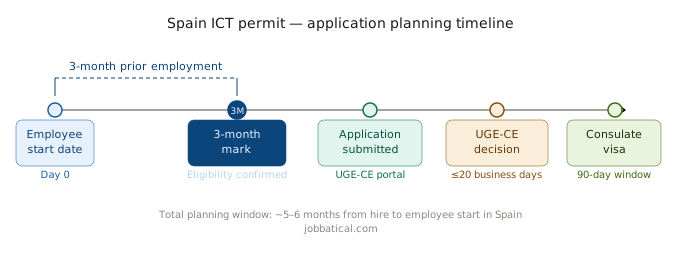
The practical fix is simple: build the 3-month rule into your global mobility calendar from the moment a transfer is planned. For newly hired staff, that means a minimum 3-month buffer between their first day of employment and the ICT application submission date.
For employees switching between group entities, ensure continuity is preserved with no gap in the employment record and that the corporate group relationship between the two entities is clearly documented before any transfer takes place.
ICT Application Timeline: Minimum Planning Window
If Your Employee Doesn't Qualify: Alternative Permit Routes
If the 3-month threshold cannot be met in time, two routes process through UGE-CE on the same 20-day timeline without requiring prior group employment:
For companies unsure which route applies, Jobbatical's Spain Work and Residence Permit Eligibility Checker maps the employee's profile to the correct permit in minutes before you commit to an application.
What UGE-CE Looks For in the Documentation
UGE-CE does not simply verify whether the 3-month employment requirement has been met. It assesses whether the employment relationship is genuine, continuous, and part of a legitimate corporate group.
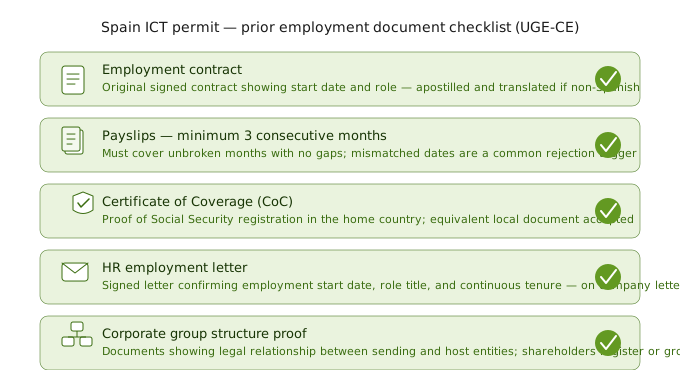
The following documents must be consistent and aligned:
- Employment contract showing the employee’s start date and role
- At least 3 consecutive months of payslips
- Proof of Social Security registration in the home country (Certificate of Coverage or local equivalent)
- HR confirmation letter verifying the employee’s tenure and position
- Corporate group documentation demonstrating the legal relationship between the sending and host entities
UGE-CE closely cross-checks these documents. Any inconsistency may trigger additional scrutiny or lead to a rejection, including:
- Mismatched employment dates
- Missing payslips for any month within the 3-month period
- A Social Security registration date that is later than the employment contract start date
- Conflicting information about the employee’s role or tenure
To avoid delays or refusals, employers should ensure that all supporting documents present a clear, consistent, and continuous employment history.
For a broader look at the most common ICT application failures, see Jobbatical's guide to Spain ICT permit rejection reasons.
Plan the Transfer Window, Not Just the Application
The 3-month prior employment rule is not a bureaucratic obstacle, it is a structural test of whether the ICT route is the right mechanism for your transfer. When HR teams understand exactly how UGE-CE applies it, it becomes a planning variable rather than a rejection risk.
Build the threshold into your global mobility calendar from the outset, ensure employment documentation is airtight from day one, and verify eligibility before filing not after.
If you are managing multiple ICT transfers or are unsure whether your employee's employment history satisfies the rule, book a demo with Jobbatical to review eligibility before submitting to UGE-CE.
Disclaimer: Immigration rules change quite frequently; please verify with official sources or contact us for the latest info before making any decisions.
Frequently Asked Questions — Spain ICT Permit 3-Month Prior Employment Rule
Does the 3-month prior employment requirement apply to both EU ICT and National ICT permits in Spain?
Yes. Both the EU ICT and the National ICT permit require proof of a previous and continuous employment or professional relationship of at least 3 months with one or more companies in the same corporate group. There is no exemption based on permit type.
Can employment time at different group companies be combined to reach 3 months?
Yes — Spanish law explicitly allows time to be accumulated across one or more companies within the same group. However, the employment must be continuous. Any gap between roles at different group entities risks resetting the clock in UGE-CE’s assessment.
Does time spent on probation count toward the 3-month requirement?
Yes, provided the employee was on a formal employment contract and covered by Social Security from day one. Probation in Spain does not suspend employment rights. What matters to UGE-CE is the existence of a documented employment relationship — not whether probation had ended.
Does a contractor or freelance relationship with the group satisfy the 3-month rule?
Generally no. UGE-CE looks for an employment or professional relationship that mirrors a genuine employment structure. Pure service or consultancy contracts between legally independent entities are unlikely to qualify without supporting evidence of a genuine subordinate relationship. Always take legal advice before relying on this route.
What documents prove the 3-month prior employment for a Spain ICT application?
UGE-CE typically requires the employee’s original employment contract, at least 3 months of payslips, proof of Social Security registration in the home country (Certificate of Coverage or equivalent), and HR letters confirming employment dates and role. All non-Spanish documents must be apostilled and officially translated.
What permit should we use if our employee has less than 3 months with the company?
The most common alternatives are the Spain HQP permit (for senior hires with a qualifying salary) or the EU Blue Card (for highly qualified roles meeting salary thresholds). Both process through UGE-CE on a similar 20-day timeline and do not require prior employment with the Spanish entity. Jobbatical’s Spain eligibility checker can identify the right route in minutes.

.svg)
.svg)