

KEY TAKEAWAYS: A1 Certificate for Germany
- Get an A1 from your home social security authority for every employee working in Germany, including workations; it stops double contributions.
- Apply at least six weeks before departure, as issuing times range from days in the Netherlands to around 10 weeks at HMRC.
- Article 12 postings are capped at 24 months; longer assignments need an Article 16 exception agreed with the DVKA, which takes around four months.
- Postings in sectors such as construction, hospitality and logistics also need a Meldeportal-Mindestlohn notification before work starts, with fines up to €30,000.
- Without a valid A1, Germany can claim four years of back contributions plus a 1% monthly surcharge, and German clients share liability for minimum wage.
Germany received around 1.4 million postings in 2020, more than any other EU country. That's why German customs checks A1 certificates on site routinely. This guide covers the A1 certificate for Germany from your side as the sending employer: who needs one, how to apply, how long it lasts and how to keep every posting audit-ready.
What Is an A1 Certificate and Why Does Your Business Need One?
What does an A1 certificate actually prove?
An A1 certificate Germany is a required document for European employees working temporarily in another EU country. It proves your employee remains under their home country's social security system. Without it, the territoriality principle applies: people are insured where they physically work. From day one in Germany, your employee would fall under German social security.
Key benefits include:
- Social security Germany: Prevents double social security payments.
- Posted workers Germany: Keeps assignments legally compliant from day one.
- Easy tracking: Simplifies payroll and compliance for HR teams.
Regulation (EC) 883/2004 allows one system at a time. The A1 proves it's your home system, so:
- No double contributions in your home country and in Germany
- No German registration for pension, health or unemployment insurance
- German authorities must accept the A1, unless it was obtained by fraud (CJEU, Altun, C-359/16)
What counts as a "posted worker" (Entsendung) under German law?
German customs treats a worker as posted to Germany when all three apply:
- The employer is based outside Germany
- The employee works in Germany temporarily
- The employee doesn't normally work in or from Germany
Where the employee lives doesn't matter. Posting also has separate rules under social security (the A1) and labour law (the AEntG).
Who Needs an A1 Certificate for Germany?
Any employee traveling for work requires an A1 form Germany. This applies to EU, EEA, or Swiss employers sending staff on temporary assignments.
You must apply for an A1 certificate if your staff are:
- Posted workers Germany: Employees on long-term assignments.
- Business travelers: Staff attending short meetings or single-day conferences.
- Self-employed: Independent contractors operating across borders.
Do business travellers and short-term assignments need one?
Legally, yes. EU rules set no minimum duration, so a one-day client meeting counts. Germany is practical about it, though. German customs has confirmed that:
- Employees won't be fined for not carrying an A1 on short-notice or short business trips
- You can apply for the A1 retrospectively if an authority asks for it later
France, Austria and Belgium are stricter, so check the full trip route.
What about remote work and cross-border workations?
A workation in Germany is a posting for social security purposes. An employee working from a holiday flat in Bavaria for your French entity needs an A1 from the first day.
Regular home working is different. If your employee lives in Germany and works from home there part of the week, the EU framework agreement on cross-border telework can keep them in your system up to just under 50% home working. Germany has signed it.
When do standard temporary postings need an A1?
Every employee you send to Germany for a set period needs one, from a two-week installation to an 18-month project. Posting cover has a time cap, explained in the validity section below.
How are multi-state workers treated (work in two or more member states)?
Employees who regularly work in several countries, such as a sales lead covering Germany, Austria and the Netherlands, fall under Article 13, not the posting rules.
- 25% or more of working time or pay in the country of residence: that country's system applies
- Less than 25%: usually the employer's country applies
- You apply in the employee's country of residence, based on the expected next 12 months
Do directors, executives, and self-employed individuals need one?
Yes. The A1 covers employees and the self-employed alike.
- Self-employed people can be posted if they normally do similar work at home
- Directors and board members often work in several countries, so Article 13 applies
- A home-country contribution exemption doesn't travel on its own; the A1 is what proves it in Germany
Does Your Posting Qualify? The Core Eligibility Criteria
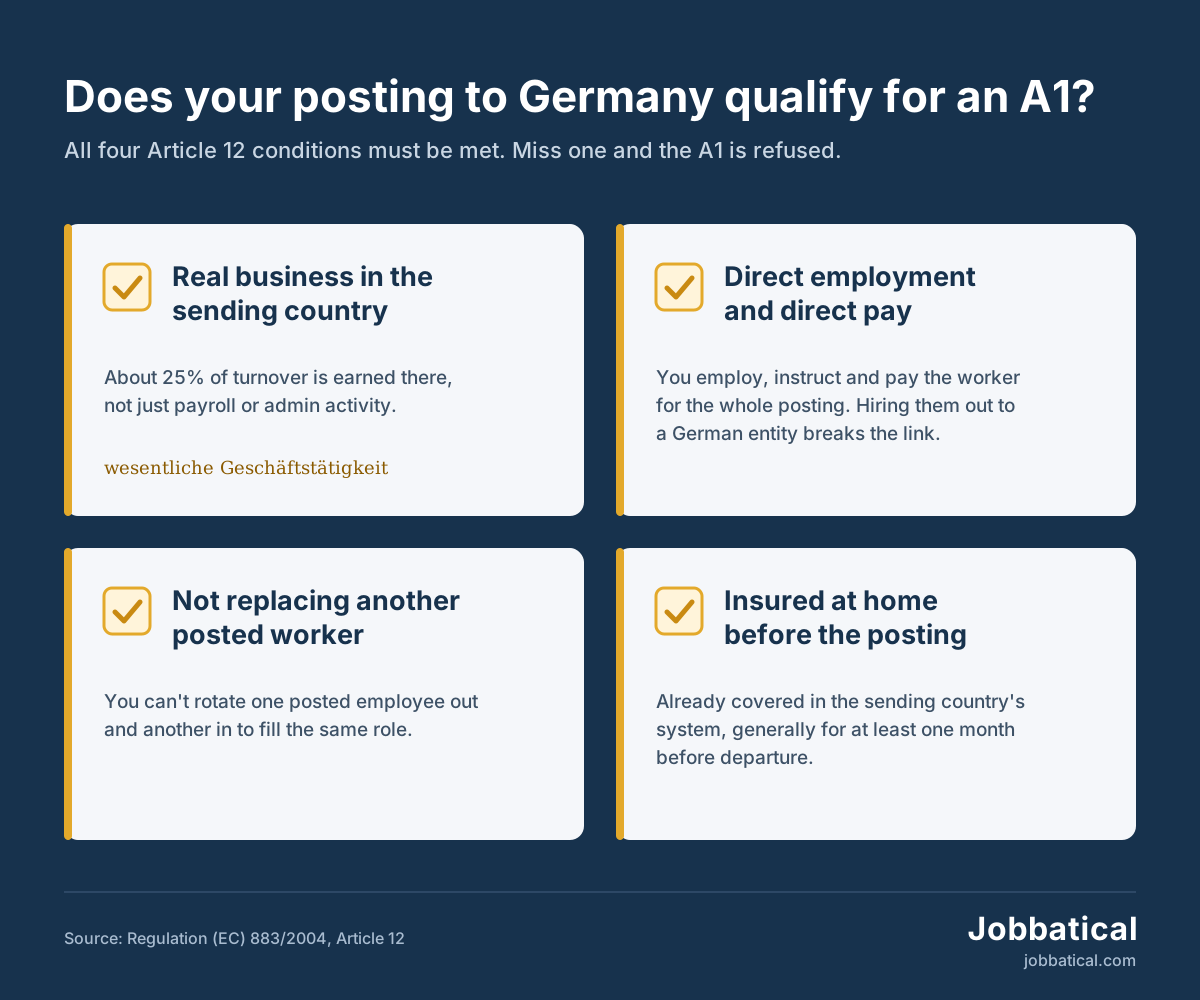
Article 12 of Regulation 883/2004 sets four conditions. One gap means a refused A1.
- Substantial business activity in the sending country (wesentliche Geschäftstätigkeit): your company must trade there, not just run payroll. Authorities use about 25% of turnover as a benchmark.
- A direct employment relationship and direct remuneration: your employee works under your instructions and you pay them. Hiring them out to a German entity breaks this link.
- The worker isn't replacing another posted worker: you can't chain postings by swapping one person for another in the same role.
- Prior coverage in the sending state: your employee must already be insured at home, generally for at least one month before the posting starts.
In practice, the replacement rule is the one large groups miss most (rotation schedules are usually owned by project teams, not HR).
How Do You Apply When Posting Workers to Germany?
Applying via the sending country's competent authority
Employers must apply for an A1 certificate before the employee travels. You submit the request to the social security authority in the employee's home country, not in Germany.
Follow these steps to apply:
- Identify the authority: Find the correct office in the sending country.
- Submit details: Provide employer and assignment information.
- Await approval: Processing takes between a few days and several weeks.
- Retain the document: Ensure the employee carries the approved A1 certificate Germany.
Where to apply for an A1 when posting to Germany
The mandatory German pre-notification (Meldeportal-Mindestlohn / Zoll)
Some postings also need a labour-law notification to German customs, filed at meldeportal-mindestlohn.de before work starts. It isn't required for every posting. It applies when your employees work in sectors listed in the AEntG or § 2a SchwarzArbG, including:
- Construction
- Hospitality
- Transport and logistics
- Building cleaning
- Meat processing
- Forestry
It also covers agency workers. Road transport drivers file through the EU IMI portal instead. Check your sector before the first trip; the German customs FAQ for employers lists the details.
Turnaround times, application receipts, and digital verification
Plan around the slowest authority on your list:
- Germany and the Netherlands (SVB): days to a few weeks
- Spain (TGSS): mostly digital and fast
- UK (HMRC): up to around 10 weeks
Apply at least six weeks before departure. If the A1 is late, give your employee a copy of the application receipt to show you applied in time. Authorities share A1 data through EESSI, so inspectors can verify it electronically. If you post staff to several countries, see how we run A1 certificate applications across issuing authorities.
How Long Is an A1 Valid, and What About Long Assignments?
How does the 24-month rule and Article 12 limit work?
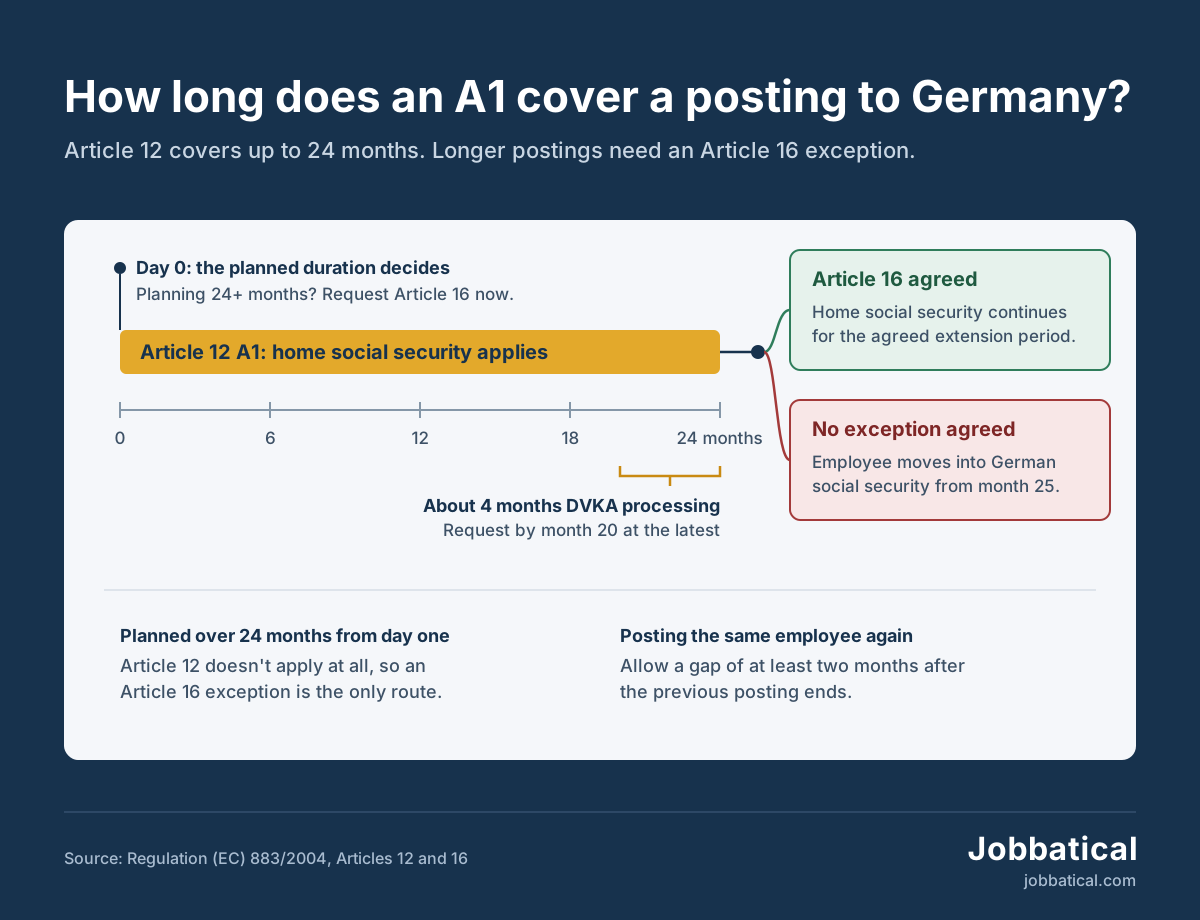
An A1 under Article 12 covers the expected posting period, up to 24 months. The planned duration at the start is what counts.
- Planned 20 months: the posting qualifies
- Planned 30 months from day one: Article 12 doesn't apply
- A new posting of the same employee generally needs a gap of at least two months
After 24 months, your employee moves into German social security unless an exception is agreed.
How do you extend beyond 24 months? The Article 16 exemption (Ausnahmevereinbarung) via DVKA
Article 16 lets two countries agree to keep your employee in the home system for longer. In Germany, the DVKA is the competent body for these exception agreements.
- Request it through your home authority, which agrees it with the DVKA
- Apply before the posting starts, or as soon as you know it will run past 24 months
- Allow around four months; the process can't be sped up
- Each case is assessed individually
What happens with scope changes, early cancellations, and relocations?
When the plan changes, update the record.
- Extension within 24 months: ask your home authority to amend the A1
- Early return: tell the authority, and file a change in the Meldeportal if you notified Zoll
- New site or client in Germany: update the Zoll notification
- Permanent move: the A1 ends; register your employee in German social security and, for non-EU staff, secure a German work permit
What Else Must You Comply With Beyond Social Security?
The A1 doesn't cover German labour law. Three sets of rules run alongside it:
- Posted Workers Act (AEntG): core German working conditions apply from day one, and almost all conditions apply after 12 months (18 with a reasoned notification).
- Minimum Wage Act (MiLoG): €13.90 gross per hour from 1 January 2026, or higher sector rates where they apply.
- Working-time documentation: start, end and length of each working day, recorded within seven days in listed sectors.
Construction, transport and meat processing carry extra obligations and closer checks. Our guide to the Spain posted worker communication shows the same two-layer model.
What Are the Penalties for Non-Compliance in Germany?
Working without an A1 certificate Germany creates major compliance risks. German customs authorities perform strict workplace inspections.
Failure to comply results in:
- Financial fines: Heavy penalties for the employer and employee.
- Social security Germany: Immediate demands to pay local contributions.
- Workplace access: Employees may be banned from entering the site.
Always verify your posted workers Germany compliance before the trip begins.
Workplace inspections by the FKS / Zoll
The Finanzkontrolle Schwarzarbeit (FKS), part of German customs, runs unannounced site checks. Inspectors can ask for:
- A1 certificates
- Meldeportal confirmation
- Employment contracts and payslips
- Working-time records
Documents must be available in Germany, in German, for the length of the posting.
Fines for missing A1 certificates and late filings
Fines apply per breach, so they add up across a team.
- Missing, late or incorrect Zoll notification: up to €30,000
- Not paying minimum wage or mandatory conditions: up to €500,000
- Fines over €200 are entered in the central business register, which can block public contracts
A missing A1 rarely brings a fixed fine; the cost comes through contributions. See the official list of offences.
Retroactive social insurance payments and surcharges
Without a valid A1, Germany can treat your employee as insured in Germany from day one.
- Back contributions for pension, health, care and unemployment insurance
- A late payment surcharge of 1% per started month (§ 24 SGB IV)
- Claims going back four years, longer for intentional non-payment
Client and contractor liability (Generalunternehmerhaftung)
Your German clients carry risk too. Under § 14 AEntG and § 13 MiLoG, a company that hires a contractor is liable for the minimum wage owed to the contractor's workers, down the chain. In construction, clients can also be liable for unpaid social contributions. That's why clients now ask for A1s and Zoll confirmations before your team arrives.
How Do You Build a Repeatable A1 Compliance Process?
Setting up automated travel and assignment tracking
Most missed A1s start with a trip nobody flagged. Fix the trigger point:
- Make destination and purpose required fields in travel booking
- Auto-flag any trip to the EU, EEA or Switzerland
- Route flagged trips to the A1 owner with a six-week lead time
- Track cumulative days per employee per country
Aligning HR, payroll, and global mobility workflows
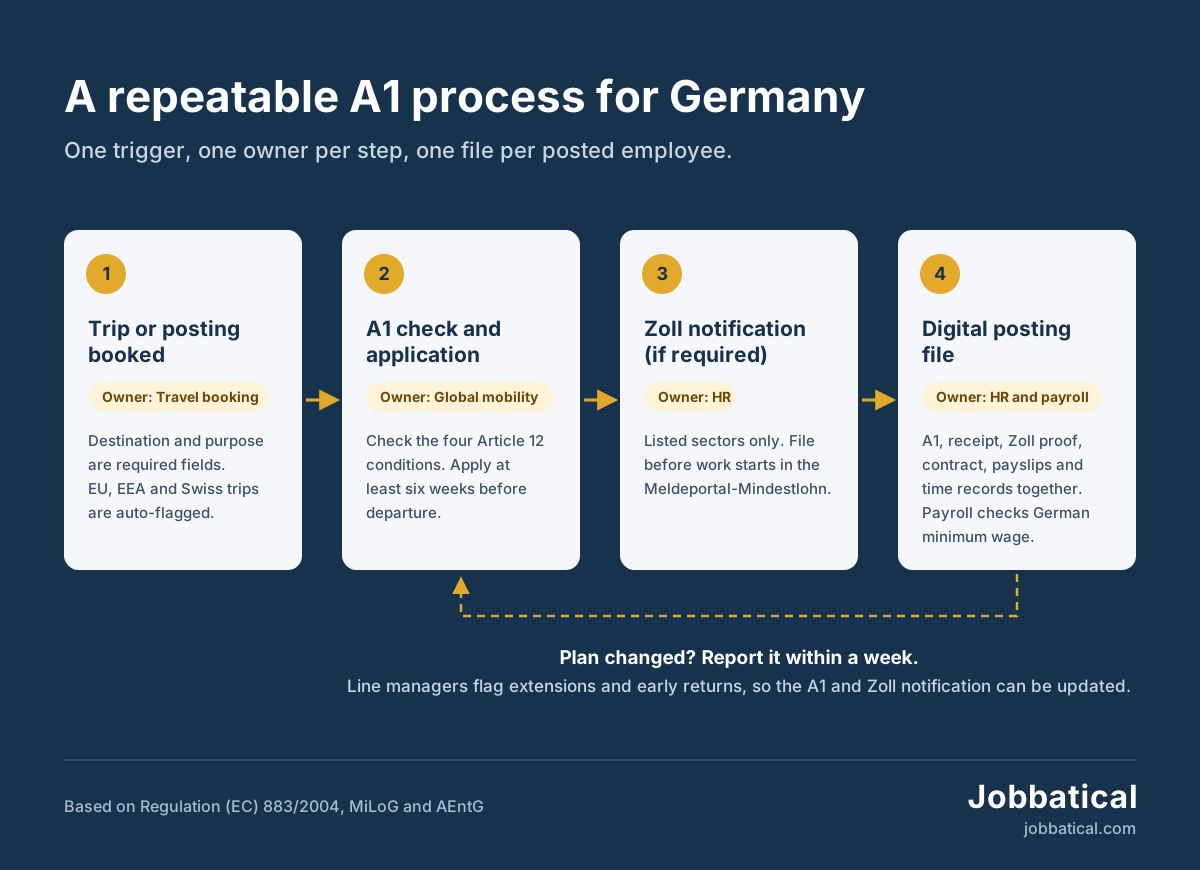
Give each step one owner:
- Global mobility: eligibility check and A1 application
- Payroll: home contributions continue; German minimum wage check
- HR: posting letter, contract annex and Zoll notification
- Line managers: report extensions and early returns within a week
Digital record retention and audit readiness
Keep one digital file per posted employee: A1, application receipt, Meldeportal confirmation, contract, payslips and time records, with German versions accessible during the posting. We recommend keeping A1s for at least four years, matching the period German authorities can claim back contributions.
Germany lets you fix a missed A1 after the event. Don't build your process around that. If your team posts staff across several countries, Jobbatical can handle A1 applications, Zoll notifications and records for you. Book a demo to see how it works.
Disclaimer: Immigration rules change quite frequently; please verify with official sources or contact us for the latest info before making any decisions.
Frequently Asked Questions: A1 Certificate for Germany