

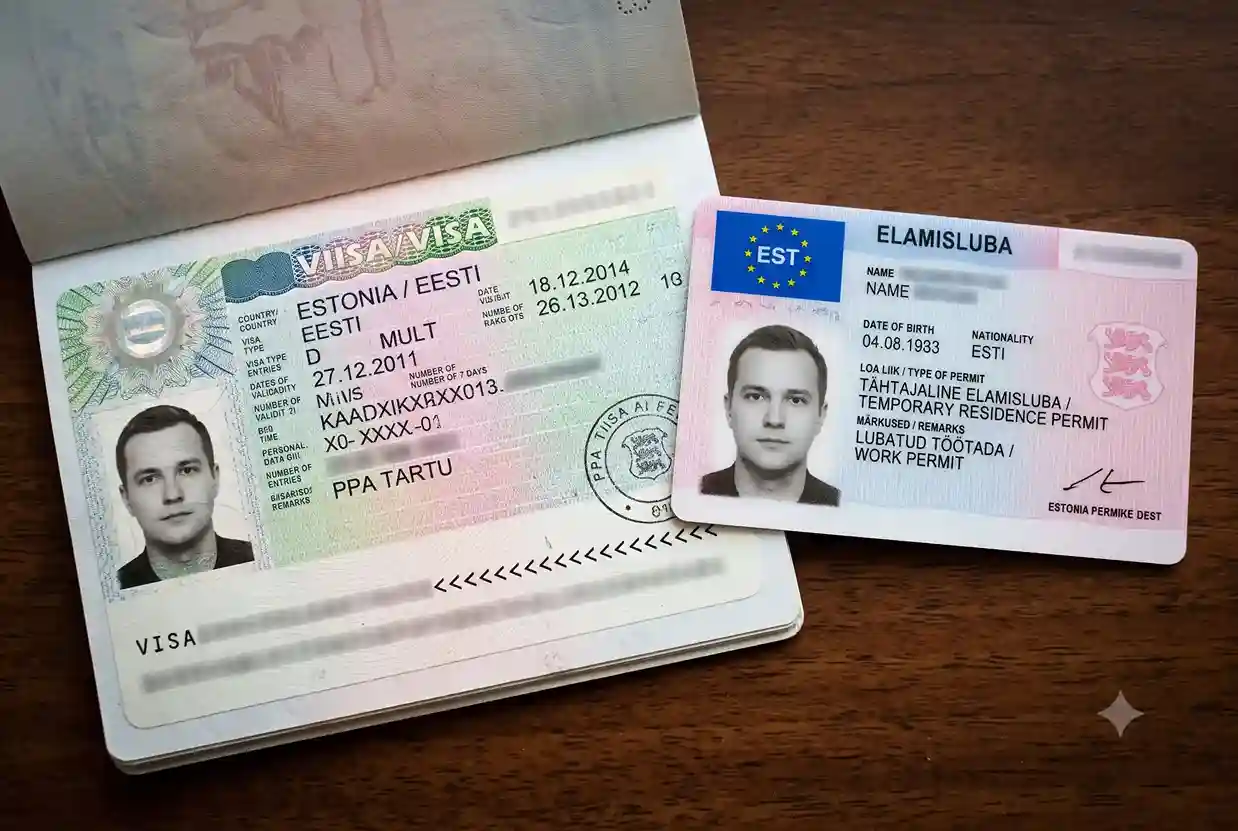
KEY TAKEAWAYS: Estonia D Visa and Work Permit
- The Estonia D visa allows stays up to 365 days within 12 months, but the right to work comes only from short-term employment registration with the Police and Border Guard Board.
- Pay at least the published Estonian average gross wage, €2,092 or more for applications from 05.03.2026; the EU Blue Card needs about €3,138, subject to verification with the PPA.
- Budget per hire: the D visa is €120, short-term employment registration is €130, and the residence permit for employment is €250 to €280 in 2026.
- Plan the timeline in two stages, about 15 working days for registration and 15 to 30 calendar days for the D visa, and keep a six-week buffer.
- From 2026, employers must be in the Estonian Commercial Register and show six months of prior economic activity before they can sponsor a non-EU hire.
The Estonia D visa is a long-stay national permit that allows non-EU employees to legally reside and work in the country for up to 365 days within a 12-month period. Employers should utilize this visa, paired with a short-term employment registration, when they need to rapidly onboard international talent or contract workers in as little as three weeks. It serves as the fastest compliant immigration route for time-limited projects or acts as a strategic bridge while your employee applies for a longer-term temporary residence permit from inside Estonia.
What is the Estonia D visa, and how does it work as a long-stay work permit?
The Estonia D visa is a national long-stay visa that lets a non-EU employee live in Estonia for up to 365 days within a 12-month period. On its own it is an entry and stay right. The actual permission to work comes from short-term employment registration, and together they form the fastest Estonia work permit route for assignments under a year.
- A national long-stay visa, not a Schengen C visa: The D visa is issued under the Estonian Aliens Act for intended stays beyond 90 days. It also allows travel across the wider Schengen area for up to 90 days in any 180-day period.
- The work right comes from registration: A D visa alone does not authorise employment. Your employee can work only once the Police and Border Guard Board has registered the short-term employment linked to your company.
- Up to 365 days, then a decision point: The visa covers up to 365 days within 12 months. For longer assignments, your employee applies for a temporary residence permit for employment before the visa expires.
- Single or multiple entry: The D visa can be issued for one or several entries. That suits roles involving travel in and out of Estonia during the posting.
- Consecutive visas are capped: Where long-stay visas run back to back, total stay cannot exceed 548 days within 730 consecutive days, so plan the move to a residence permit early.
For the employer-managed version of this route, Jobbatical's Estonia D visa and work permit service sets out the full long-stay process, salary thresholds and document checklist.
Who is eligible for an Estonia work visa (Estonia D visa), and which work visa category fits your hire?
Estonia work visa eligibility depends on the specific role, salary threshold, and assignment duration rather than nationality alone. Because Estonia offers multiple work permit categories, identifying the correct route for your hire is critical. Selecting the incorrect visa category is the primary cause of processing delays.
- Short-Term Employment and D Visa: Ideal for assignments up to 365 days. The employer registers the employment, and the hire enters using a D visa. This remains the fastest route to secure an Estonia work permit.
- Temporary Residence Permit for Employment: Designed for long-term hires exceeding one year. This route provides a renewable Estonian residence card but requires a longer processing timeline to obtain.
- EU Blue Card: Tailored for highly qualified professionals possessing a recognized degree and meeting elevated salary thresholds. It offers EU-wide mobility and is optimal for senior technical talent.
- Digital Nomad Visa: Geared toward remote workers employed by companies based outside of Estonia. This requires no local employer sponsorship, though applicants must meet strict minimum income requirements.
- Start-Up and Top-Specialist Routes: Estonia offers expedited processing for start-up employees and elite specialists. Crucially, these specific employment categories benefit from full exemptions from the country's annual migration quotas.
How do the Estonia work visa categories compare?
Run your hire through Jobbatical's Estonia pre-hiring eligibility check to confirm the right work visa category in minutes.
What are the Estonia work visa (Estonia D visa) requirements for employees and employers?
Hiring in Estonia involves strict obligations for both employers and employees. While candidates must satisfy specific entry and salary requirements, companies must officially qualify as sponsors before employment begins. Starting in 2026, employer vetting has become significantly more rigorous.
- Genuine Job Offer and Contract: You must provide a formal, written employment contract detailing the role, salary, working conditions, and location. Estonian authorities require a clearly defined position compliant with local labor laws.
- Salary Requirements: Compensation must meet or exceed the published Estonian average gross monthly wage, which is €2,092 for applications filed after March 5, 2026. Always confirm the current prevailing rate with the Police and Border Guard Board prior to submission.
- Commercial Register Enrollment: Sponsoring companies must hold an active registration in the Estonian Commercial Register. Foreign entities lacking a documented legal presence in Estonia cannot directly sponsor short-term employment.
- Prior Economic Activity: As of 2026, employers must demonstrate a minimum of six consecutive months of active, genuine economic operations within Estonia before they are eligible to sponsor a non-EU candidate.
- Background, Insurance, and Funds: Prospective employees must maintain a clean criminal record, carry comprehensive travel medical insurance, and provide documented proof of sufficient financial resources to support their entire stay.
The employer side of this sits in registration; Jobbatical's Estonia short-term employment registration service explains the sponsor steps and the 2026 rules in detail.
What documents are required for the Estonia D visa application?
Document errors rather than eligibility issues cause the majority of Estonia work visa refusals. The required paperwork is divided into employer-supplied forms and applicant-provided documents. Crucially, all foreign certificates require an official apostille and a certified translation.
- Valid Travel Document: Applicants must present a passport issued within the past 10 years, containing at least two blank pages, and valid for a minimum of three months beyond the visa's expiration date.
- Completed Application and Photo: Submit a fully signed D visa application form alongside one recent, ICAO-compliant color photograph (35 x 45 mm) taken within the last six months.
- Proof of Purpose: Provide the finalized employment contract or a formal corporate invitation letter validating the specific role and confirming the officially registered short-term employment.
- Financial Means and Insurance: Applicants must supply documented evidence of adequate financial resources to cover their stay, plus comprehensive travel medical insurance valid for the entire visa duration.
- Legalized and Translated Papers: All foreign documents must be officially apostilled or legalized, then translated into Estonian or English. Biometric fingerprints will also be collected during the in-person appointment.
For the documents that carry over to the longer-term route, see Jobbatical's Estonia temporary residence permit service and its document guidance.
.svg)
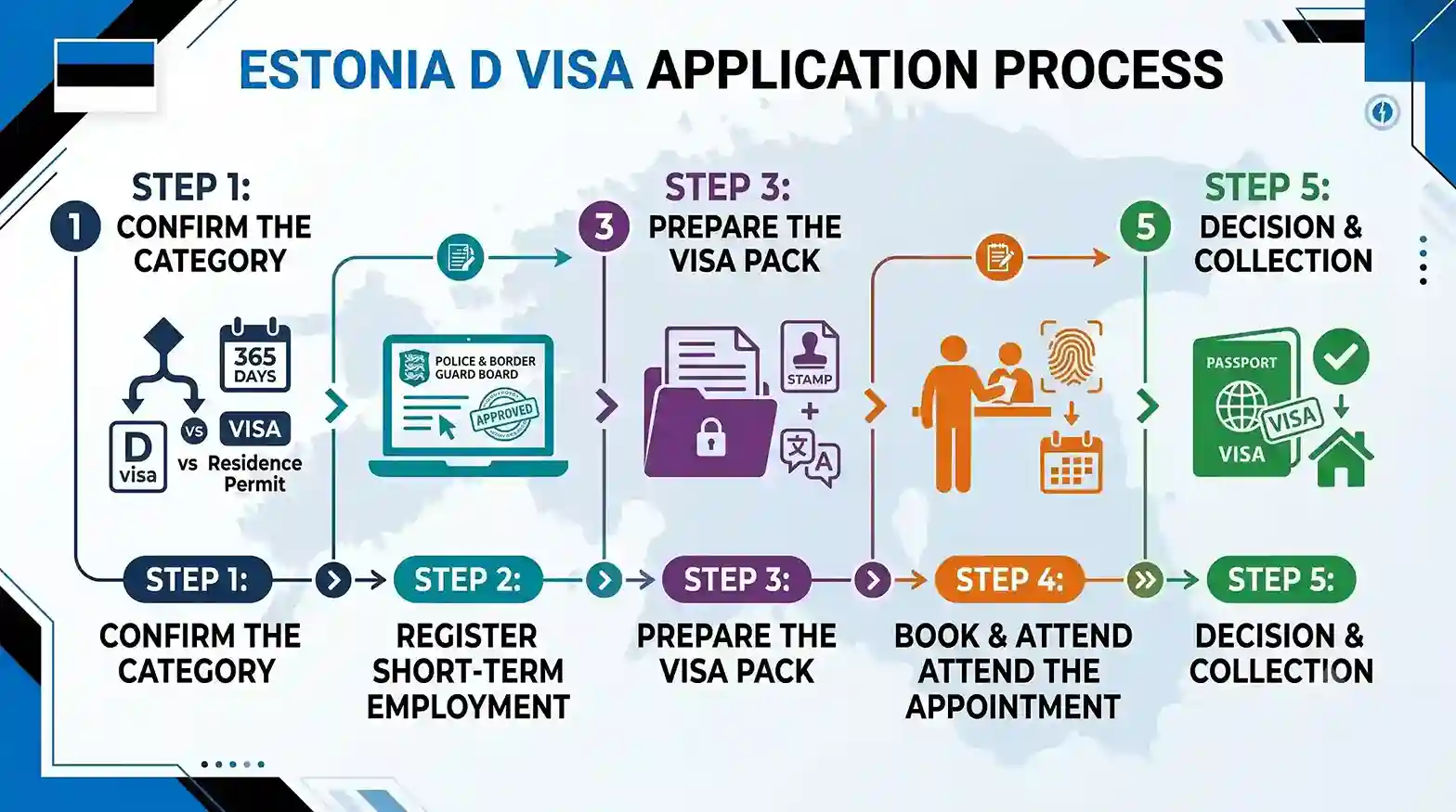
How does the Estonia D visa application process work step by step?
The Estonia work visa process follows a strict sequence, requiring employer registration prior to the employee's visa application. Scheduling the embassy appointment prematurely remains a frequent and costly procedural error.
- Step 1: Confirm the Visa Category: Determine whether short-term employment (D visa) or a long-term residence permit aligns with the assignment duration and salary, as this dictates the entire workflow.
- Step 2: Register the Employment: Sponsoring companies must register the position, salary, and work location directly with the Police and Border Guard Board via their self-service portal.
- Step 3: Prepare the Application Pack: Compile all required employee documentation, secure official apostilles and certified translations, and complete the online D visa application form.
- Step 4: Book and Attend the Appointment: Schedule an in-person visit at an Estonian diplomatic representation or authorized VFS Global center to submit documents and provide biometric fingerprints.
- Step 5: Decision and Arrival: Following the visa approval and passport collection, the employee may travel to Estonia, where they must officially register their residential address upon arrival.
The same embassy D visa path applies to other long-stay routes; compare it with Jobbatical's Estonia Digital Nomad Visa process for remote hires.
Where do you apply for the Estonia D visa, and how does the appointment process work?
Most candidates apply abroad via the Estonian representation in their country of residence. In practice, limited appointment availability rather than processing speed creates the primary bottleneck for securing an Estonia work visa.
- Estonian Embassy or Consulate Abroad: The standard location for application submission. The prospective employee must book an appointment, submit their documentation in person, and provide biometric fingerprints.
- VFS Global Visa Centers: In numerous countries, Estonia outsources document collection to VFS Global, which manages appointment scheduling and biometric data capture on the representation's behalf.
- Police and Border Guard Board (Estonia): If the employee is already legally present within Estonia, the application may be submitted directly at a local PPA service office instead.
- Appointment Booking and Biometrics: Available slots become heavily restricted during peak months, making early scheduling essential. In-person attendance and fingerprinting are mandatory requirements for the D visa.
- Decisions Under the EU Visa Code: Estonian representations typically process and decide applications within 15 calendar days of registration, though extensions remain possible if additional background checks are required.
For short business trips that do not need a work route, see Jobbatical's Estonia business visa services for the right entry option.
What is the Estonia D visa processing time?
Successful Estonia work visa applications require a two-stage approach, as employment registration and visa processing operate on separate timelines. Given seasonal fluctuations, securing a minimum six-week buffer before the candidate's intended start date is highly recommended.
- Short-Term Employment Registration (~15 Working Days): The Police and Border Guard Board typically processes complete short-term registrations within 15 working days, though 2026 timelines remain subject to operational changes.
- D Visa Processing (15–30 Calendar Days): Once successfully lodged at an Estonian embassy or authorized VFS center, diplomatic representations generally issue D visa decisions within 15 to 30 calendar days.
- Temporary Residence Permit (Up to 2 Months): For long-term hires requiring this route, permit approvals can take up to two months. Following approval, the physical residence card is issued within an additional 30 days.
- Peak-Season Delays: Processing and appointment timelines frequently stretch during summer and year-end periods. Incomplete applications or complex compliance cases will create further bottlenecks.
- End-to-End Planning: Professionally managed application processes typically conclude within three to five weeks. Conversely, self-managed or first-time submissions often experience extended timelines of eight to ten weeks.
If a decision is delayed or refused, the appeal route matters; read Jobbatical's guide to Estonia's streamlined visa appeal process.
What does the Estonia D visa and work permit cost in 2026?
Calculate your budget per hire rather than per application. State fees increased significantly during the 2025–2026 immigration reforms, and multiple costs compound for a single relocation. Always verify current fee structures directly with the Police and Border Guard Board prior to submission.
- Long-Stay D Visa (€120): The standard state fee for a 2026 D visa is €120. Applications for children aged 6 to 11 cost €60, while children under 6 are processed free of charge.
- Short-Term Employment Registration (€130): In 2026, employers must pay a €130 registration fee directly through the Police and Border Guard Board's self-service portal.
- Residence Permit for Employment (€250–€280): Long-term permits cost €250 when applying within Estonia, increasing to €280 if submitted through a foreign diplomatic representation.
- Additional Relocation Costs: Factor in expenses for official apostilles, certified translations, mandatory travel medical insurance, and a potential €20 fee to route the physical residence card to a foreign representation.
- Proof of Funds (Non-Fee Requirement): Employees must demonstrate sufficient financial resources to support their stay. For 2026 short-term employment, this typically requires proving €1,320 in available funds; however, always confirm exact figures with the relevant representation.
What are the Estonia D visa and work permit fees for 2026?
For the full fee picture across routes, Jobbatical's breakdown of Estonia immigration fees for 2026 covers visas, permits and extensions.
What compliance obligations do employers have for the Estonia work visa?
Employer sponsorship obligations do not end once the visa is issued. Sponsoring companies carry ongoing compliance duties throughout the entire assignment, and oversight creates significant penalty exposure.
- Register Before Employment Begins: Short-term employment must be officially registered prior to the employee's first day. Estonia strictly prohibits retrospective registration, meaning late filings constitute unlawful work.
- Maintain Declared Salary and Role: The candidate's compensation and position must align exactly with the registered details. Material changes to the employment terms often require a fresh registration or permit variation.
- Monitor Visa and Registration Expirations: Closely track the 365-day short-term limit and proactively manage transitions to long-term residence permits. Visa overstays incur penalties and jeopardize future corporate sponsorship privileges.
- Maintain Compliance Records: Retain all employment contracts, payslips, and required 2026 economic activity documentation to ensure readiness for routine authority audits.
- Monitor the Migration Quota: Estonia's 2026 non-EU migration quota is capped at 1,292 places. While short-term employment, EU Blue Cards, start-up hires, and top specialists are generally exempt, quota-dependent routes require strategic timing.
Want this handled for your team? Book a demo. Renewals are where compliance slips most often, and Jobbatical's Estonia residence permit renewal service keeps permits and deadlines on track.
How does the Estonia D visa lead to a residence permit and a path to residency?
The D visa serves as a temporary bridge rather than a final destination for international talent. For employees you intend to retain, the ultimate goal is securing a temporary residence permit for employment, which provides a clear pathway to long-term residency in Estonia.
- Apply Before the Visa Expires: Employees must submit their application for a temporary residence permit from within Estonia before their D visa expires. This ensures there is no gap in their legal working status.
- Extended Validity and Residence Card: Unlike the one-year D visa, a temporary residence permit provides an official residence card and can be granted for up to five years, with the option to renew.
- Family Reunification: Dependents may join the employee under aligned residence permits, provided you can prove the family relationship and demonstrate sufficient financial means to support them.
- Pathway to Long-Term Residence: After completing five years of continuous legal residence on this permit, the employee may become eligible for long-term resident status, provided they meet additional conditions such as the B1 Estonian language requirement.
- Strategic Transition Planning: Standard applications for the temporary residence permit can take up to 90 days to process. Therefore, it is critical to initiate the transition well before the current D visa approaches expiration.
For deeper guidance on permits and residency, browse Jobbatical's Estonia immigration guides.
What should your team do next on the Estonia D visa?
Start with the category decision and the sponsor check, because both gate everything that follows. If your company is not yet in the Estonian Commercial Register, or cannot show six months of activity, fix that first. The teams that move fastest line up the registration and the visa appointment in parallel, not in sequence. Book a demo to map your hire's route, timeline and costs with an Estonia specialist.
Disclaimer: Immigration rules change quite frequently; please verify with official sources or contact us for the latest info before making any decisions.
Frequently Asked Questions: Estonia D Visa and Work Permit

.svg)
.svg)