
KEY TAKEAWAYS: Estonia Short-Term Employment Registration
- Short-term employment registration authorises non-EU hires to work in Estonia for up to 365 days within a 455-day period, with no residence permit needed.
- The employer files the registration with the Police and Border Guard Board before work begins; the state fee is 130 euros via self-service or 140 euros at an office in 2026.
- From 1 January 2026, sponsoring companies must be entered in the Estonian Business Register, and the former double-salary rule no longer applies to new filings.
- Pay must meet the Statistics Estonia average gross monthly wage, and the PBGB decides within 15 working days of accepting a complete application.
- For assignments beyond 365 days, move your employee to a temporary residence permit for employment well before the registration period ends.
For businesses seeking to hire international talent without the long wait times of a full residence permit, Estonia's Short-Term Employment Registration offers a fast and flexible solution. Under the updated 2026 guidelines, employers can secure legal work authorization for non-EU hires in as little as 15 working days for assignments lasting up to 365 days. Discover how to navigate the latest business register requirements and salary thresholds to keep your temporary and project-based hiring compliant and efficient.
What is Estonia short-term employment registration, and which visa type does it cover?
Estonia short-term employment registration is a mandatory work authorization, rather than a standalone visa. It enables foreign nationals with an existing legal right to stay such as a long-stay D-visa or visa-free entry to work legally for a defined duration. The Police and Border Guard Board (PBGB) must approve this registration before employment commences.
- Work Authorization, Not a Residence Permit: This registration validates employment rights without granting permanent residence. Employees must maintain a valid visa or visa-free status to legally remain in Estonia throughout their corporate assignment.
- 365-Day Validity Limit: The registration permits up to 365 days of legal employment within a rolling 455-day timeframe. Notably, seasonal work in Estonia is restricted to a shorter cap of 270 days per consecutive year.
- Integration with Long-Stay D-Visas: Non-EU professionals frequently pair this employment registration with an Estonian D-visa to facilitate lawful entry and employment. These two immigration processes are distinct but can be managed concurrently.
- Employer-Driven Compliance: The hiring company, rather than the foreign worker, is responsible for filing the application. This ensures your organization maintains strict corporate immigration compliance from day one.
- Pathway to Temporary Residence Permits: After completing nine months of registered short-term employment, your foreign employee may become eligible to transition to an Estonian temporary residence permit, valid for up to two years.
How does Estonia short-term employment registration differ from a residence permit for employment?
If your employee also needs to enter Estonia on a long-stay basis, our Estonia D-visa (long-stay) service explains how the entry visa is coordinated alongside the work registration.
Who is eligible for Estonia short-term employment registration?
Eligibility for Estonia short-term employment registration operates on a dual-track system. Both the foreign professional and your sponsoring company must meet strict criteria, which the Police and Border Guard Board (PBGB) rigorously evaluates prior to granting approval.
- Designed for Third-Country Nationals: This corporate immigration route is exclusively for non-EU, non-EEA, and non-Swiss citizens. Nationals from the EU, EEA, and Switzerland are exempt, as they already possess free-movement employment rights within Estonia.
- Prerequisite Legal Stay: The prospective employee must hold an existing legal basis to reside in Estonia, such as a long-stay D-visa or visa-free entry privileges. The registration grants work authorization but does not substitute the legal right of residence.
- Authentic, Full-Time Employment: The corporate position must be legitimate and classified as full-time. Additionally, the foreign worker must possess the precise qualifications, professional experience, and health standards required for the specific role.
- Compliant Corporate Sponsorship: Your sponsoring organization must be legally registered in Estonia and maintain an impeccable compliance record regarding national labor and immigration laws. Previous regulatory infractions can jeopardize sponsorship eligibility.
- Competitive Salary Requirements: Remuneration must meet or exceed the national benchmark, matching at least the annual average gross monthly salary most recently published by Statistics Estonia, unless a specific statutory exemption applies.
Not sure whether a specific hire qualifies? Our Estonia visa and work permit eligibility checker gives your team a fast, route-specific read before you commit to a start date.
.webp)
What are the employer requirements and obligations in 2026 for Estonia short-term employment registration?
The primary compliance responsibility rests with you, the employer. Estonia strengthened its corporate sponsor requirements in early 2026, adding critical pre-filing compliance checks to the process.
- Mandatory Business Register Entry: Effective 1 January 2026, sponsoring employers must be formally registered in the Estonian Business Register. Sponsoring temporary agency workers permits registration within another EEA member state.
- Demonstrated Economic Activity: Companies sponsoring employment-based temporary residence permits must verify at least six consecutive months of active economic operations. Employers should confirm applicability before initiating the filing.
- Adherence to Wage Benchmarks: Compensation must meet or exceed the average gross monthly wage determined by Statistics Estonia. The previous double-salary threshold no longer applies to new registrations, broadening eligibility across multiple roles.
- Mandatory Pre-Employment Filing: Employment registration must receive official approval before the employee begins work. Permitting an individual to start working while an application remains pending constitutes a regulatory breach that risks future sponsorship eligibility.
- Precision in Position Details: Submissions must contain exact details regarding the worker's identity, job title, work address, and gross remuneration. Inaccuracies or incomplete data remain the primary drivers of processing delays and application rejections.
To hand the filing, salary checks, and PBGB liaison to specialists, see our managed Estonia short-term employment registration service, built specifically for HR and global mobility teams.
What must your employee provide to qualify for Estonia short-term employment registration?
While you manage the application filing, your foreign employee must provide the essential supporting personal documentation. Assembling these items early is the single most critical factor in ensuring a smooth, expeditious process.
- Valid Passport & Legal Status: The candidate must hold a valid passport alongside proof of a current legal basis to stay in Estonia (e.g., an active visa or visa-free entry rights). A clear scan of the personal data page is required for submission.
- Compliant Digital Photograph: Applicants must supply a standard digital portrait meeting strict Estonian specifications (at least 1300 x 1600 pixels). Submitting non-compliant or low-quality images remains a leading cause of avoidable delays.
- Verified Professional Qualifications: Documentation verifying relevant training, work history, or certifications may be requested, particularly for regulated professions. Foreign documents typically require official translation or legalization.
- Proof of Accommodation & Health Insurance: Candidates must demonstrate secured housing arrangements in Estonia and present valid health insurance coverage spanning the complete duration of their intended stay.
- Complete Personal Details: To complete the official filing, you will need the employee's full legal name, date of birth or Estonian personal identification code, place of birth, nationality, and current contact details.
For assignments expected to run beyond one year, our Estonia temporary residence permit for employment guide sets out the employee requirements for the longer-term route.
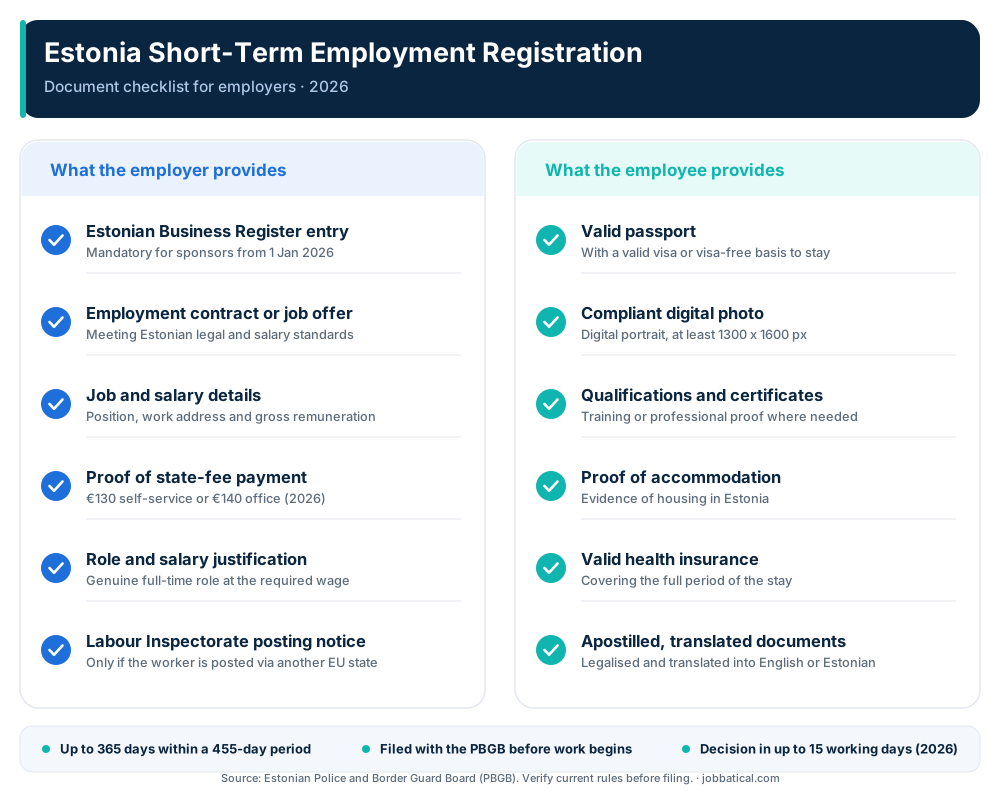
Which documents are required for Estonia short-term employment registration?
Although concise compared to a full residence permit application, the document portfolio must be complete and accurate. The submission comprises two primary document sets: employer-submitted filings and employee-supplied personal records.
- Completed Registration Application: The primary filing, processed via the PBGB, details the employer, the employee, and the terms of engagement. It functions as the foundational document of the entire authorization process.
- Employment Contract or Binding Offer: A fully executed employment contract or legally binding job offer compliant with Estonian labor standards including statutory minimum remuneration must accompany the submission.
- Passport Copy & Digital Portrait: A clear scan of the passport's personal data page alongside a compliant digital portrait are mandatory submission requirements for every worker.
- Proof of State Fee Payment: Official confirmation of payment, such as a bank transfer order validating the state fee settlement, must be attached prior to application processing.
- Legalized & Translated Records: Foreign documentation typically requires legalizations or apostilles, alongside certified translations into Estonian or English by an authorized translator.
For a wider view of every Estonian immigration route and the guides behind them, our Estonia immigration hub brings the country's services and resources into one place.
How and where do you apply, and what does the appointment process involve for Estonia short-term employment registration?
Estonia has digitized most of its short-term employment registration process, ensuring faster processing times. Employers can choose from several submission channels based on their corporate digital signature capabilities.
- PBGB Self-Service Portal: The most efficient method is filing directly through the Police and Border Guard Board (PBGB) self-service environment. Authorized corporate representatives or board members can submit applications here for expedited officer review.
- Secure Email Submission: Employers possessing a valid Estonian ID card, digital ID, mobile ID, or residence card can apply via email. Ensure the subject line explicitly states "Registration of short-term employment" for correct routing.
- In-Person PBGB Appointments: Authorized representatives or employers can submit applications physically at a designated PBGB service point. Note that all in-person submissions strictly require a pre-booked appointment.
- Urgent Registration Processing: For critical project timelines, urgent registration allows the foreign national to legally commence work on the exact calendar date the employer submits the official filing.
- Concurrent D-Visa Coordination: If the prospective employee is outside Estonia, it is best practice to synchronize the short-term employment registration with an Estonian D-visa application. This ensures seamless entry and simultaneous work authorization.
If the trip is a short business visit rather than paid local work, our Estonia business visa service explains when a business visa is the correct route instead of work registration.
How long does registration take, and what does it cost in 2026 for Estonia short-term employment registration?
Two crucial metrics typically drive corporate planning conversations: processing timelines and official state fees. Because the Police and Border Guard Board (PBGB) regulates these figures, employers should treat them as foundational planning anchors rather than absolute guarantees.
- 15-Day Standard Processing Time: Standard processing dictates that the PBGB will register or refuse the employment application within 15 working days following its formal acceptance. However, highly complex submissions may necessitate extended review periods.
- Timelines Require Complete Submissions: The 15-day processing clock initiates exclusively upon the acceptance of a flawless, comprehensive application. Missing documentation effectively resets this timeline, underscoring the strategic importance of meticulous, front-loaded paperwork preparation.
- Predictable Official State Fees: As of 2026, the statutory processing fee stands at €130 when filing via the PBGB self-service portal, and €140 for in-person service office submissions. Employers must always verify current fee schedules prior to submission.
- Budgeting for Ancillary Costs: Corporate budgets must account for expenditures beyond baseline state fees. Translating foreign credentials, legalizing documents, and retaining specialized immigration counsel frequently exceed the base state fee, particularly for complex international hires.
- Authorization Restricted to Registration Period: The legal right to work remains strictly tied to the approved registration period, capped at the statutory 365-day ceiling. Companies must actively plan their employee's subsequent immigration steps well before this authorization expires.
What are the current state fees for short-term employment registration?
For a full breakdown of Estonian immigration charges across every permit type, our Estonia immigration fees guide tracks the current state fees updated for 2026.
How do employers stay compliant after registration is approved: Estonia short-term employment registration?
Approval is merely the beginning of your compliance obligations. Most corporate immigration infractions in Estonia stem from post-approval oversights rather than initial application deficiencies.
- Strict Pre-Employment Rules: Foreign employees must not perform any work prior to official registration approval, unless operating under the urgent registration track. Allowing an employee to work during a pending application constitutes a severe violation, exposing your company to statutory penalties.
- Mandatory Posted Worker Notifications: If an employee is posted to Estonia via another EU or EEA state, the posting must be registered with the Labour Inspectorate (TEIS), unless all relevant posting data has already been transmitted to the PBGB.
- Ongoing Compensation Compliance: Wage levels must remain at or above the current Statistics Estonia benchmark throughout the entire tenure. Allowing remuneration to drop below statutory thresholds can immediately invalidate the short-term work authorization.
- Proactive Expiration Tracking: Short-term employment registrations do not auto-renew or extend indefinitely. To maintain uninterrupted authorization, employers must initiate the application for a temporary residence permit for employment well before the 365-day period lapses.
- Audit-Ready Record Keeping: Sponsoring organizations should maintain organized files containing signed employment contracts, payroll records, and registration documents. Retaining clear, accessible records ensures your company is fully prepared for official regulatory reviews.
When a short-term hire becomes a long-term one, our Estonia residence permit renewal service helps you move the employee onto a renewable permit without a compliance gap.
Estonia rewards employers who prepare early and file clean. If you would rather hand the PBGB filing, salary checks, and D-visa coordination to a specialist team, book a demo and we will map your next Estonian hire from offer letter to lawful start.
Disclaimer: Immigration rules change quite frequently; please verify with official sources or contact us for the latest info before making any decisions.
Frequently Asked Questions: Estonia Short-Term Employment Registration

.svg)
.svg)