
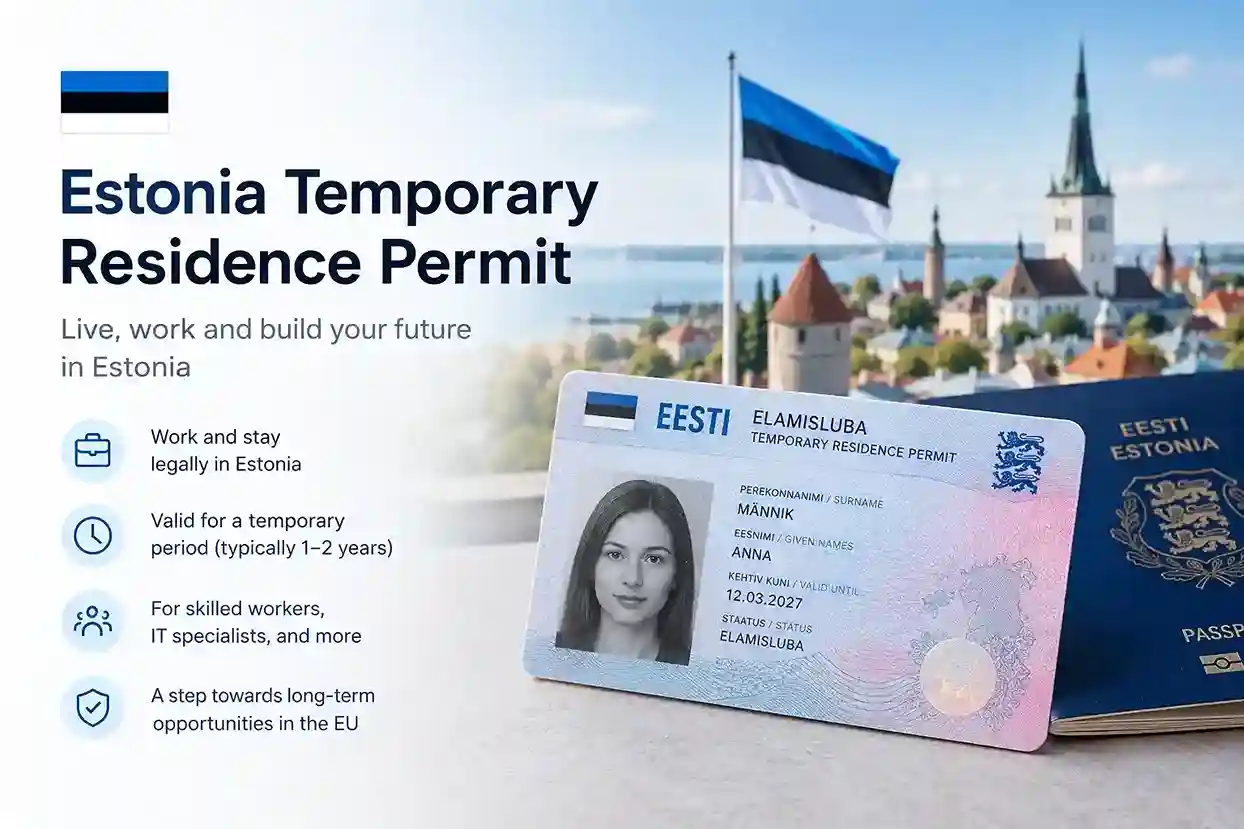
KEY TAKEAWAYS: Estonia Temporary Residence Permit
- The Estonia temporary residence permit for employment is issued by the PPA for up to five years and is extendable for up to ten years at a time.
- The 2026 salary floor is 2,092 euro per month for skilled workers, 1,674 euro for start-up staff and 3,138 euro for EU Blue Card holders.
- The 2026 immigration quota is 1,292 slots, but ICT specialists, top specialists, Blue Card holders and start-up employees are exempt.
- Plan on up to 90 days for a PPA decision plus 30 days for the residence permit card, with state fees of 250 to 280 euro.
- Employers must hold Commercial Register activity, meet the salary criterion throughout, and secure Unemployment Insurance Fund approval unless exempt.
Navigating the new regulatory changes for the Estonia Temporary Residence Permit for Workers is essential for businesses looking to hire international talent. This comprehensive 2026 Employer Guide breaks down the latest compliance requirements including the new six-month business activity rule and updated salary thresholds to help you seamlessly secure work visas and scale your global workforce.
What is the Estonia temporary residence permit for employment?
The Estonia temporary residence permit, often shortened to the Estonia TRP, is a single document that lets a non-EU, EEA or Swiss national both live and work in Estonia. The Police and Border Guard Board (PPA) issues it under the Aliens Act. There is no separate work permit in Estonia, so the right to work is built into the residence permit itself.
- One permit, two rights. The Estonia TRP combines residence and work authorisation in one document. Your employee does not need a separate work permit to start their role.
- Issued for up to five years. The permit is granted for up to five years, or the length of the contract if that is shorter. It can then be extended for up to ten years at a time.
- A path to permanent residence. After five years of continuous legal residence, your employee can become eligible for long-term resident status. That stability helps with retention.
- Family can follow. Spouses and minor children can apply for dependent residence permits, so your employee can relocate with their household rather than alone.
- Access to Estonia's digital society. Permit holders gain access to Estonian healthcare, banking and e-services, which smooths the settling-in period for relocated staff.
For a full view of the managed service, see our Estonia temporary residence permit for employment page, which shows how each application is filed with the PPA end to end.
Who is eligible for the Estonia TRP, and which route fits your hire?
Eligibility for the Estonia Temporary Residence Permit for Employment depends heavily on your specific hiring grounds and compensation package. Estonia offers multiple pathways under a single permit system, each featuring distinct salary coefficients and quota regulations. Strategically selecting the correct route early in the process can eliminate annual immigration quota risks entirely.
- Skilled Worker (General Route): The standard pathway for non-EU talent. Employers must pay at least the Estonian average monthly gross wage (1.0x coefficient), and the position typically requires clearance from the Estonian Unemployment Insurance Fund.
- Start-Up Employee: Personnel joining an approved Estonian startup benefit from a reduced 0.8x salary threshold. This route is also completely exempt from the annual immigration quota.
- Top Specialist: Senior experts earning at least 1.5x the national average wage automatically bypass the immigration quota. They also skip the Unemployment Insurance Fund approval, significantly accelerating processing times.
- EU Blue Card: Highly qualified graduates earning 1.5x the average wage qualify for this quota-exempt permit, which offers enhanced professional mobility across EU member states.
- ICT Specialist: Information and Communications Technology roles are strictly exempt from the national immigration quota, providing a highly streamlined and reliable hiring route for tech employers.
What salary must each Estonia TRP route meet in 2026?
These rates apply to applications accepted from 5 March 2026 and are revised each spring by Statistics Estonia. Verify the current figure with the PPA before you file, and note that the annual immigration quota is set at 0.1 percent of the population.
Not sure which route your hire qualifies for? Our Estonia visa and work permit assessment screens eligibility before you commit to an offer.
What must your employee provide to qualify for Estonia TRP?
Beyond meeting salary thresholds, prospective hires must satisfy strict personal eligibility requirements evaluated by the Estonian Police and Border Guard Board (PPA). Incomplete documentation is a primary cause of processing delays; ensure these prerequisites are finalized before application submission.
- Verified Qualifications: The applicant must possess the exact educational background, relevant work experience, and professional skill sets that align with the position they are being hired for.
- Clean Criminal Record: A background check from their current country of residence is mandatory. This document must be properly apostilled and officially translated into Estonian or English.
- Valid Health Coverage: The employee must secure comprehensive health insurance valid within Estonia. Certain applications may also require a formal medical certificate.
- Valid Passport & Biometrics: Passports must carry at least one year of remaining validity. Unless exempt, applicants must provide biometric data (fingerprints and a photograph) during their appointment.
- Proof of Accommodation: Employees must document where they will reside in Estonia and officially record this address in the national Population Register upon arrival.
Relocating a whole team rather than one hire? Our guide on how to relocate international talent to Estonia covers the practical onboarding steps that sit around the permit.
What are the employer requirements for the Estonia TRP?
Sponsoring companies carry substantial compliance obligations throughout this process, with critical updates taking effect under 2026 regulations. Because the Police and Border Guard Board (PPA) scrutinizes the employer's status as rigorously as the applicant's, applications should be treated as a joint responsibility.
- Estonian Commercial Registration: Your corporate entity must be formally registered in the Estonian Commercial Register prior to sponsoring any employee's work residence permit.
- Demonstrated Economic Activity: Under the updated 2026 compliance framework, employers must prove active and genuine business operations in Estonia for a minimum of six consecutive months prior to application.
- Salary Threshold Compliance: Sponsoring employers are legally required to meet or exceed the relevant route’s salary floor, which is adjusted and published every spring by Statistics Estonia.
- Unemployment Insurance Fund Clearance: Standard employment routes require prior recruitment authorization from the Estonian Unemployment Insurance Fund. Highly skilled roles including Top Specialists, EU Blue Card holders, startup employees, and ICT personnel are explicitly exempt.
- Employment Registration & Recordkeeping: The employment contract must be officially registered in the national Employment Register, and thorough documentation must be maintained for potential labor compliance audits.
For the rule changes that affect sponsors this year, read our Estonia immigration updates guide for HR teams, which tracks the 2026 reforms in one place.
Which documents are required for the Estonia TRP application?
A complete, correctly legalised document set is the single biggest factor in a smooth application. Missing or untranslated papers are a frequent reason for rejection. Build the file in two halves, employee and employer.
- Employee identity documents. These include a valid passport, a completed application form and a digital colour photo that meets PPA specifications.
- Qualification and employment evidence. Your employee provides educational certificates and the signed employment contract that meets Estonia's salary standard.
- Background and health records. A criminal record certificate, a medical certificate where required and valid health insurance all form part of the file.
- Employer documents. You supply the Commercial Register extract, proof of economic activity and the Unemployment Insurance Fund approval where it applies.
- Legalisation and translation. All foreign documents must be apostilled or legalised, then translated into Estonian or English by a certified translator.
Jobbatical prepares and checks every document before filing. Explore our full Estonia relocation services to see what support your team gets at each stage.
How does the Estonia temporary residence permit application process work?
A complete, correctly legalised document set is the single biggest factor in ensuring a smooth application process. Missing, incomplete, or untranslated paperwork represents a primary cause of official rejection. Employers and applicants should construct the application file in two synchronized halves:
- Employee Identity Documents: Requires a valid passport (minimum one-year validity remaining), a fully completed official application form, and a digital color photograph adhering to strict Police and Border Guard Board (PPA) specifications.
- Qualification & Employment Evidence: The applicant must provide accredited educational certificates, professional credentials, and a signed employment contract that satisfies Estonia's statutory salary coefficient requirements.
- Background & Health Documentation: Includes an official criminal record certificate from the candidate's residence, valid health insurance compliant with Estonian standards, and medical certificates where required.
- Employer Corporate Filings: The sponsoring company must supply a recent Commercial Register extract, verifiable proof of six-month economic activity, and Unemployment Insurance Fund recruitment approval (where applicable).
- Legalisation & Translation Requirements: All foreign-issued documents must be properly apostilled or legalized, followed by official certified translations into either Estonian or English.
If your employee needs to start sooner, short-term employment registration can bridge the gap while the residence permit is processed.
Where do you apply, and how does the appointment process work for Estonia temporary residence permit application?
Applications for the Estonia Temporary Residence Permit for Employment can be submitted either domestically or internationally, with the location directly impacting processing fees and scheduling workflows. Because in-person biometric collection is strictly required, securing an appointment early in the planning process is essential.
- Application via Estonian Missions Abroad: Overseas candidates can submit their complete application file at an official Estonian embassy or consulate in their current country of residence prior to relocating.
- Application via Domestic PPA Service Offices: Foreign nationals already residing in Estonia under a valid legal basis can file or transition their residency status at a local Police and Border Guard Board office.
- Advance Appointment Scheduling: Mandatory appointments must be booked in advance through the central PPA self-service portal, where available slots fill quickly during peak operational periods.
- Mandatory Biometric Collection: Applicants are required to appear in person to submit biometric data, including digital fingerprints and facial photographs, unless statutory exemptions apply.
- D-Visa Integration Strategy: Employers can utilize a long-stay D-visa concurrently, enabling international talent to legally enter Estonia and commence work while their temporary residence permit application is actively processed.
For entry before the permit is granted, see our Estonia D-visa long-stay service and how it fits the hiring timeline.
How long does the Estonia temporary residence permit take to process?
While statutory processing timelines are defined by Estonian law, overall operational duration depends heavily on application readiness. Employers should build in adequate buffer times, as annual quota caps and appointment bottlenecks can introduce significant delays.
- Statutory Processing Timeline: The Police and Border Guard Board (PPA) has a legal limit of up to 90 days to issue a decision on a residence permit application once formally accepted.
- Residence Card Fulfillment: Following approval, the physical residence permit card (TRC card) is produced and issued within 30 calendar days.
- Expedited Fast-Track Options: Top Specialists and startup personnel can leverage short-term employment registration, granting legal work authorization within a few business days.
- Strategic Quota Management: Because the national immigration quota frequently exhausts early in the calendar year, submitting quota-subject applications during Q1 mitigates the risk of quota-based rejections.
- Realistic Planning Buffer: Sponsoring employers should allocate a minimum of two to three months from initial document assembly to card issuance, extending this buffer for quota-restricted roles.
Planning past the first term already? Our Estonia residence permit renewal service keeps your employee compliant beyond the initial five years.
How much does the Estonia temporary residence permit cost?
While the official state fee is a fixed expense, the total financial commitment includes several variables. Document legalisation, certified translations, and required medical examinations can significantly increase the total investment depending on the candidate’s country of origin. Employers should budget for the complete relocation package rather than just the base application fee.
- Domestic State Fee: Submitting a residence permit for employment application directly to the Police and Border Guard Board (PPA) within Estonia incurs a standard state fee of €250 under the 2026 schedule.
- Foreign Mission State Fee: For applications filed internationally at an approved Estonian embassy or consulate, the state fee is set at €280 for 2026.
- Permit Extension Costs: Renewing or extending an existing employment residence permit from within Estonia also requires a €250 state fee as of 2026.
- Ancillary Relocation Expenses: Sponsoring employers must proactively budget for additional compliance costs, including mandatory document apostilles, certified official translations, essential medical clearances, and international criminal background certificates.
What are the Estonia temporary residence permit application fees in 2026?
State fees rose sharply for 2025 and remain in force for 2026. Confirm the current fee with the Police and Border Guard Board before you pay.
For a full breakdown of state fees across every permit type, read our Estonia immigration fees guide for 2026.
What compliance obligations do employers face after approval of Estonia temporary residence permit application?
Receiving approval is not the finish line. Under Estonian immigration law, employers must ensure that the employment relationship remains strictly aligned with the original permit conditions, and any deviations must be promptly reported. Treat regulatory compliance as an ongoing operational duty rather than a one-time administrative task.
- Report Employment Changes: Any modifications to the employee’s role, salary, or sponsoring employer must be formally notified to the authorities, as the temporary residence permit is legally bound to the specific conditions under which it was granted.
- Maintain Salary Thresholds: Compensation must continuously remain at or above the specific route’s statutory salary coefficient throughout the entire validity period of the permit, not just during the initial application phase.
- Track the 90-Day Transition Rule: Should the employment contract end, the residence permit generally remains valid for an additional 90 days. This critical grace period allows the employee to transition to a new employer or arrange their legal departure.
- Prepare for the A2 Language Exam: Foreign talent residing in Estonia for five years on a permit issued after July 16, 2018, must successfully pass an A2-level Estonian language proficiency exam to qualify for a permit extension.
- Maintain Records for PPA Audits: Sponsoring employers must diligently keep all employment contracts, payroll evidence, and permit documentation on file, as the Police and Border Guard Board (PPA) can conduct compliance audits at any time.
Watching the rules evolve? Our analysis of Estonia's plan to allow more skilled foreign professionals explains where quota exemptions are heading.
Ready to file your employee's Estonia temporary residence permit?
The route you choose decides whether the quota is a problem or a non-issue, so the smartest move is to screen eligibility before you make the offer. Get the salary band and exemption right, start the documents early, and the rest is process. If you want the filing, legalisation and compliance tracking handled end to end, book a demo and our Estonia specialists will map the fastest route for your hire.
Disclaimer: Immigration rules change quite frequently; please verify with official sources or contact us for the latest info before making any decisions.
Frequently Asked Questions - Estonia Temporary Residence Permit for Employment

.svg)
.svg)