.svg)


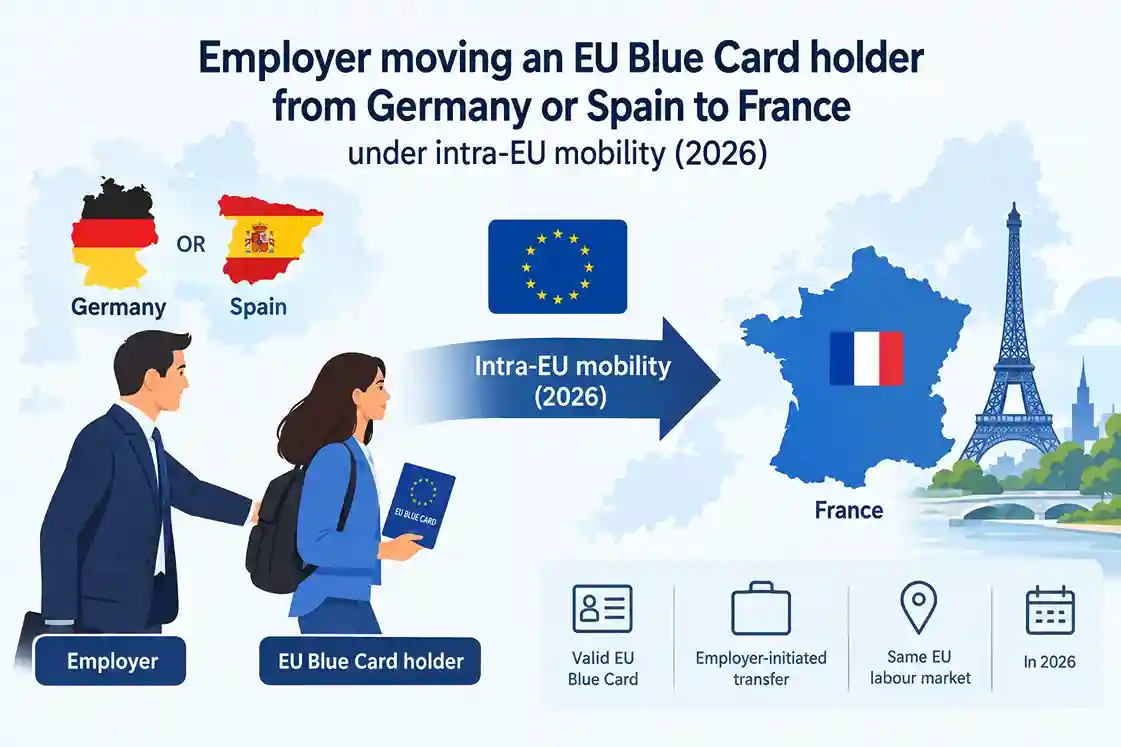
KEY TAKEAWAYS: Intra-EU Mobility for EU Blue Card Holders Moving to France
- Intra-EU mobility lets an EU Blue Card holder move to France without a new consular visa, once they have held the issuing state's card for 12 months.
- Germany issues about 72% of all EU Blue Cards, so most transfers to France start there; the UK, Denmark and Ireland sit outside the scheme.
- The French contract must pay at least €59,373 gross over a minimum six months, whatever the employee earned before.
- The employee enters on the existing card and files through ANEF within one month; the préfecture must decide within 30 days.
- Employers must keep payroll and tax records audit-ready, as France has increased URSSAF scrutiny during Blue Card processing.
If your Munich-based engineer is relocating to your Paris office and already holds a German EU Blue Card, your corporate mobility strategy changes. Rather than filing a new consular application, employers can leverage intra-EU mobility under the recast EU Blue Card Directive. This efficient transfer route allows an existing EU Blue Card holder to relocate to France without restarting the initial visa process, utilizing a fast-tracked timeline immediately upon arrival. This guide details the EU Blue Card transfer process, covering eligible source countries, core application requirements, actionable steps, and the crucial employer compliance duties for a seamless relocation.
How Does Intra-EU Mobility Work for EU Blue Card Holders Moving to France?
Intra-EU mobility allows an existing EU Blue Card holder to relocate to a second member state under simplified rules. For France, this eliminates the consular visa requirement and accelerates processing. Two mobility options exist in 2026, and selecting the right framework dictates your transfer strategy:
- The 12-month rule unlocks this simplified route: If your professional has held an EU Blue Card elsewhere for at least 12 months, they qualify for a streamlined transfer to France. For subsequent intra-EU moves, this requirement drops to six months. Satisfying this holding period successfully converts a standard application into an intra-EU mobility case.
- Short-term mobility permits stays of up to 90 days: Per an April 2026 decree, EU Blue Card holders can work in France for 90 days within any 180-day window without a separate French work permit. The home-country card must remain valid throughout. This route optimally supports short-term projects, client deliverables, or trials before permanent relocation.
- Long-term mobility governs permanent transfers: Once an employee officially joins a French payroll, they apply for the French EU Blue Card, replacing their previous permit. Designed for relocations exceeding 90 days, this comprehensive transfer process officially establishes the employee’s French residence record.
- This route bypasses the consular stage: Standard candidates must secure a long-stay visa from abroad. Intra-EU mobility applicants skip this entirely, entering France on their existing credential and filing locally post-arrival. Eliminating the consular step significantly accelerates the overall transfer timeline.
- Secondments might not require a Blue Card transfer: If the employee remains on their home-country payroll while posted to France, the Intra-Corporate Transferee (ICT) route often works better. Make your decision based on who pays the employee, not their physical location. Always align your corporate immigration route with the payroll structure.
New to the French card itself? Our France EU Blue Card guide covers eligibility and the first-time process in full, so this article stays on the transfer.
Which Countries Do EU Blue Card Holders Move to France From?
The vast majority of intra-EU transfers to France originate from a select few member states, primarily due to concentrated EU Blue Card issuance. Germany alone represents the overwhelming majority. Identifying the issuing member state is critical, as it ultimately determines whether the streamlined mobility route is available for your corporate relocation:
- Transferring an EU Blue Card holder from Germany to France: Germany dominates issuance, granting 56,252 cards in 2024 (roughly 72% of the EU total), making it the primary origin for French relocations. A German Blue Card held for 12 months unlocks direct mobility into France, bypassing the consular visa. However, the employee’s new contract must meet France's specific €59,373 salary threshold.
- Moving an EU Blue Card holder from Spain to France: Spain remains an active issuer granting 1,924 cards in 2024 and serves as a frequent starting point for transfers. Holding a Spanish EU Blue Card for 12 months secures access to the same simplified French route. Because the previous Spanish salary does not transfer over, the French salary minimum applies entirely.
- Relocating EU Blue Card holders from the Netherlands, Portugal, or other participating states: All 25 participating EU nations, including Poland and Hungary, issue mobility-eligible credentials. While volumes are lower outside Germany, the framework operates identically: 12 months of prior validity allows for a French application within one month of arrival. Always verify the issuance date on the employee’s national card.
- Transferring an employee from the UK to France: The UK never participated in the EU Blue Card scheme and is no longer an EU member. Consequently, UK-to-France relocations cannot leverage intra-EU mobility and require a standard, first-time application including a long-stay visa. Employers must process UK-based professionals exactly like other third-country nationals from day one.
- Moving staff from Denmark or Ireland to France: Because Denmark and Ireland opted out of the EU Blue Card directive, neither nation issues this specific permit. Employees relocating from these countries must follow the standard first-time immigration route into France, similar to a UK transfer. Always verify the issuing country before assuming intra-EU mobility applies.
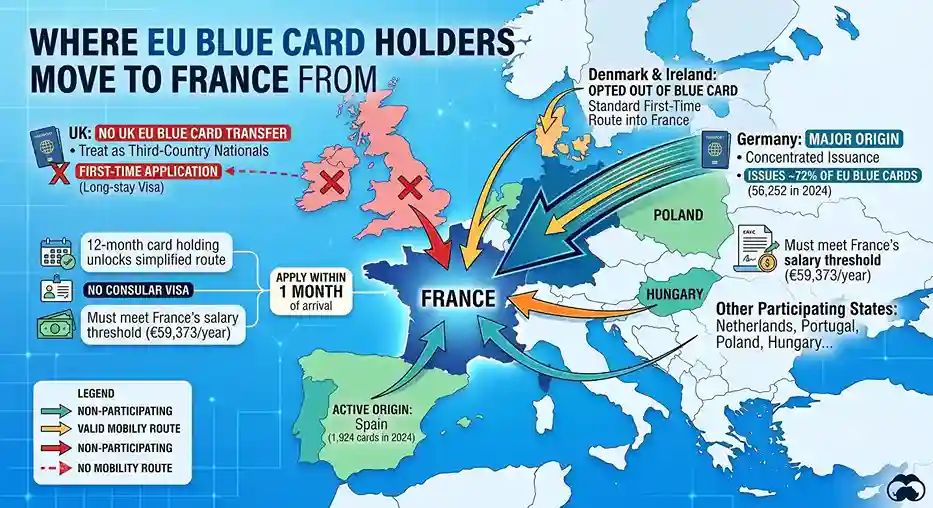
Where Do EU Blue Card Holders Move to France From?
Source: Eurostat, EU Blue Cards issued in 2024. Denmark and Ireland also do not issue the EU Blue Card.
For staff moving from the UK, Denmark or Ireland, the first-time route applies; our France residence permit service sets out that consular process.
What Are the Requirements for an Intra-EU Mobility Transfer to France?
An intra-EU transfer does not inherit your employee's German or Spanish terms. France independently evaluates its own conditions for the new arrangement, and each requirement must be satisfied before the préfecture issues the card. Missing a single requirement closes the mobility route entirely.
- A qualifying prior holding period: The employee must have held their EU Blue Card in the issuing state for at least 12 months, or six months for a second move. Unlocking intra-EU mobility requires meeting this duration threshold; otherwise, the transfer is refused and defaults to a first-time application.
- A valid card during relocation: The original Blue Card must remain valid throughout the move and, for short-term mobility, across the entire 90-day work period. An expired or surrendered card breaks continuity, making expiry date tracking against the relocation timeline critical.
- A French salary meeting statutory thresholds: The new French contract must offer at least €59,373 gross annually in 2026, or roughly €47,498 for select STEM shortage roles. Previous foreign earnings do not count, as authorities assess only the new French contractual figure.
- A contract duration of at least six months: France mandates a minimum six-month highly qualified contract for the Blue Card. Shorter terms do not qualify and block the mobility route, requiring employers to build a six-month minimum floor into the job offer.
- Proof of qualifications or professional experience: Applicants need a university degree lasting at least three years, five years of comparable experience, or three years within the last seven for certain ICT and managerial roles. Employers must match all evidence to the role before filing.
Intra-EU Mobility Transfer Requirements for France (2026)
Our France EU Blue Card service confirms the current thresholds and qualification rules before you commit to an offer.
Are There Country-Specific Requirements for Different EU Nations?
HR teams often anticipate a complex maze but discover a streamlined shortcut. France does not enforce different regulations for a German permit versus a Spanish one. Under the recast EU Blue Card Directive, French immigration requirements remain consistent regardless of the issuing member state, with the primary procedural differences occurring in the origin country:
- France applies uniform rules across all issuing states: Whether the EU Blue Card originates in Germany, Spain, Poland, or Hungary, French authorities evaluate the exact same criteria: the 12-month holding period, continuous card validity, the €59,373 salary threshold, and a six-month minimum contract. With no separate requirements based on nationality, corporate relocation planning remains consistent.
- EU Blue Card scheme participation is the key variable: While 25 EU member states issue the credential, Denmark and Ireland opted out, and the UK is entirely outside the EU. An active card from a participating nation unlocks intra-EU mobility to France, whereas non-participating countries require standard processing. Always verify scheme participation before initiating a transfer.
- The 12-month holding period is calculated in the issuing state: This mandatory duration is measured based on where the credential was granted, meaning France evaluates the issuance date on the original German or Spanish card. While national validity periods vary, the 12-month threshold remains fixed. Always calculate timelines using the permit itself, not the passport.
- Origin-country exit procedures vary by nation: Relocation requires local compliance, such as address de-registration (Abmeldung) in Germany or town-hall de-registration (padrón) in Spain. Although these are home-country obligations rather than French prerequisites, completing them ensures a clean immigration record for the transfer. Execute these administrative steps near the relocation date.
- France automatically notifies the issuing state of its decision: The local préfecture must inform both the applicant and the original Member State of the final outcome within 30 days. This automatic information exchange is built directly into the directive, meaning your employee avoids manual handover tasks. A compliant origin record ensures a frictionless processing experience.
What Differs by Issuing Country?
Running the same move into another market? Our EU Blue Card intra-EU mobility to Spain guide covers the mirror process into Spain.
What Steps Must Employers Take to Move an EU Blue Card Holder to France?
The intra-EU mobility route reverses the traditional corporate immigration workflow. Your employee travels first and files locally from within France, triggering a strict statutory deadline upon arrival. Employers must proactively coordinate these steps to prevent compliance delays during the EU Blue Card transfer:
- Confirm eligibility before initiating relocation: Verify the issuing member state, the 12-month holding period, and ensure the French job offer exceeds €59,373 on a minimum six-month contract. Finalize these prerequisites before booking travel, as an in-progress transfer failing eligibility is costly to reverse.
- Draft a compliant French employment contract: The finalized French contract anchors the application and must strictly satisfy salary and duration mandates. Future bonuses or anticipated raises cannot compensate for a deficient base salary. Ensure the documented base figure meets the legal threshold from day one.
- Enter France using the existing EU Blue Card: Eligible professionals bypass the French long-stay visa requirement, entering France directly on their active credential. Eliminating the consular appointment removes the slowest bottleneck of a standard immigration application.
- Submit via the ANEF portal within one month: The formal residence permit application must be filed through the French ANEF system within one month of the employee's arrival. Missing this strict deadline risks defaulting to a first-time application process. Track the exact entry date and file promptly.
- Monitor the 30-day préfecture processing timeline: For active EU Blue Card transfers, French authorities must issue a decision within 30 days of receiving a complete file, compared to 90 days for standard cases. Complex files may incur a 30-day extension, but the official filing receipt typically authorizes work while the decision is pending.
The residence permit costs €300 plus a €50 stamp duty on collection, per France's official Business France talent portal; mobility applicants avoid the separate €99 visa fee.
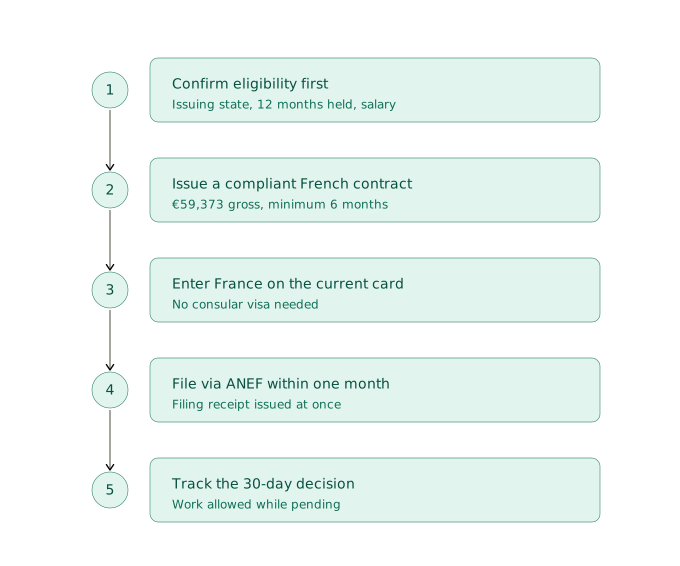
How Long Does an Intra-EU Mobility Transfer to France Take?
The accelerated timeline is the primary advantage of this corporate immigration route. While a first-time French EU Blue Card can take months largely delayed by the consular visa phase the intra-EU mobility transfer compresses the process into weeks. By eliminating slower bureaucratic steps, the local préfecture operates on a strict, fixed processing deadline:
- The préfecture mandates a 30-day decision timeline: For active EU Blue Card holders transferring from another member state, French law dictates a final decision within 30 days of receiving a complete application. This 30-day statutory cap applies universally across the EU. Complex applications may incur a single 30-day extension, but no further delays.
- Professionals can commence work almost immediately: The recast directive permits EU Blue Card holders to begin working in France concurrently with their application submission. The official French filing receipt generally authorizes employment while the final decision remains pending. Maintaining continuous labor market access delivers a significant practical advantage for corporate operations.
- Submit the local application within one month: Relocating employees enter France using their existing credential and possess exactly one month to file via the ANEF portal. Submit documents during the initial days following arrival to trigger the 30-day decision clock immediately. Any administrative filing delays directly extend the overall transfer completion date.
- Eliminate the consular visa processing stage: Standard first-time candidates frequently endure multi-week waits for a long-stay visa before crossing the border. Intra-EU mobility applicants completely bypass this requirement. Eradicating this external consular appointment generates the most substantial time savings throughout the entire corporate relocation workflow.
- Forecast a one-month timeline instead of a quarter: Practically, a fully compliant intra-EU mobility application progresses from arrival to approval in roughly 30 days, compared to 90 days for standard authorizations. Complex cases might extend to 60 days. Incorporating a single month of buffer time ensures your HR team avoids unexpected compliance delays.
Intra-EU Mobility Transfer Timeline for France
For the full first-time timeline, including the consular stage that mobility skips, see our France EU Blue Card guide.
What Compliance Duties Follow an Intra-EU Mobility Move to France?
The corporate mobility transfer does not end when the new permit arrives. France enforces ongoing compliance duties for the intra-EU mobility route, and immigration authorities frequently audit employer records. Treat these compliance obligations as a core component of the relocation strategy rather than an administrative afterthought:
- Maintain home-state card validity for short-term work: During a 90-day short-term mobility assignment, the employee's original EU Blue Card and home employment contract must remain active. If either credential lapses, the authorization to work in France immediately ceases. This strict requirement primarily impacts secondments managed on a home-country payroll.
- Register the French residential address promptly: Relocating professionals must provide a valid French address proof during filing and update this record upon moving. Submitting outdated or missing documentation triggers an automatic refusal to process the application. Ensure all residential proof documents are dated within the last six months.
- Prepare for payroll and tax record scrutiny: French authorities increasingly audit employer labor and tax compliance (such as URSSAF) during the EU Blue Card transfer process. Maintaining clean, up-to-date corporate records is essential for a successful mobility application. Resolve any administrative gaps before submitting the formal file.
- Submit family permits in parallel: Spouses and dependent children qualify for the Talent-Famille residence permit, which grants immediate rights to live and work in France. Filing these dependent applications alongside the primary candidate avoids redundant processing cycles. Proactively budget for these accompanying family permits within your relocation workflow.
- Track renewals and the permanent residence clock: The French EU Blue Card remains valid for up to four years, requiring renewal applications between two and four months prior to expiration. Time spent in the previous EU member state counts toward the five-year threshold for EU long-term residence, provided the final two years occur in France. Monitor this cumulative timeline meticulously from day one.
Post-Transfer Compliance Deadlines for France
If the person is being seconded rather than localised, an ICT permit may be the cleaner route; our Germany ICT card guide explains that path and its notification rules.
What Should Employers Check Before an Intra-EU Mobility Transfer to France?
The whole transfer turns on three checks you can make today, before your employee packs a box. Confirm the issuing state and the 12-month holding period, confirm the French contract clears €59,373 over at least six months, and fix the one-month filing deadline to the planned arrival date. Clear those, and the 30-day préfecture route carries the rest.
Book a demo to run EU Blue Card transfers to France with full visibility across every case.
Disclaimer: Immigration rules change quite frequently; please verify with official sources or contact us for the latest info before making any decisions.
Frequently Asked Questions: Intra-EU Mobility for EU Blue Card Holders Moving to France

.svg)
.svg)