
KEY TAKEAWAYS
- A Blue Card holder can work in Spain for up to 90 days in any 180-day period with no new permit; anything longer needs a Spanish Blue Card application within one month of entry.
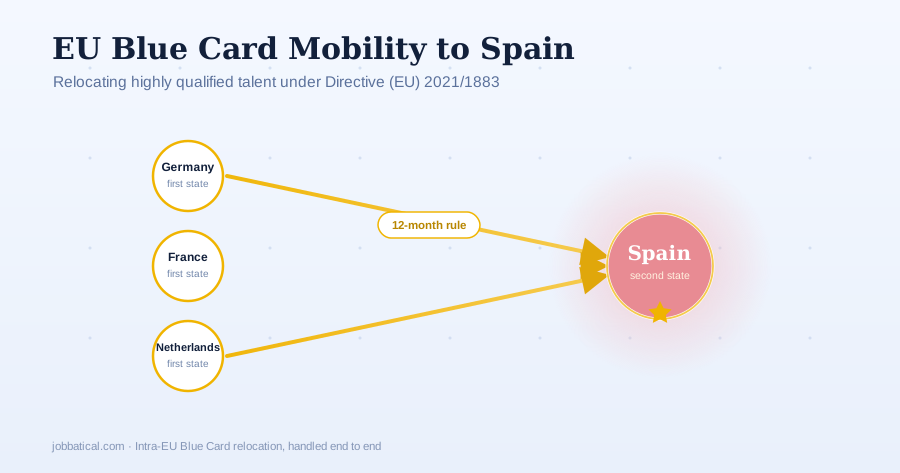
- The 12-month rule is the gate: your employee must have held a Blue Card in the first Member State for at least 12 months (or 6 months each across several states) to skip the labour market test.
- In-country filing via the UGE-CE runs 20 to 45 working days with positive administrative silence; consular filing takes 1 to 3 months. File in-country wherever possible.
- Get the A1 certificate and Beckham Law timing right. The Beckham election must be filed within 6 months of Spanish Social Security registration.
- Previous Blue Card residence in Germany, France or the Netherlands counts toward Spain's 5-year EU long-term residence, so your talent does not restart the clock.
Your engineer in Munich has held a German EU Blue Card for 14 months. Now your Madrid office needs them. Do you start a fresh visa process from zero? No. Directive (EU) 2021/1883 gives Blue Card holders a mobility right that most HR teams underuse, and moving your talent to Spain the wrong way can cost you six weeks and a working employee.
This guide walks through EU Blue Card intra-EU mobility to Spain the way you actually need it: the rule that unlocks the move, the filing decision that sets your timeline, and the compliance traps that create real risk.
Understanding EU Blue Card Intra-EU Mobility to Spain
Intra-EU mobility is the right of an existing EU Blue Card holder to move to a second Member State for highly qualified work under a simplified procedure. Spain applies this under Directive (EU) 2021/1883, which it transposed through Ley 11/2023.
The key point for you: your employee does not re-enter the system as a new applicant. Their track record in the first country carries weight.
Short-Term vs. Long-Term Mobility Under Directive (EU) 2021/1883
Two different rights sit under the same directive. Mixing them up is where teams stumble.
Short-Term Business Mobility (Up to 90 Days)
A Blue Card holder from another Member State can enter Spain and carry out business activity for up to 90 days in any 180-day period. No special authorisation. This covers project visits, client work, and short assignments. It does not cover a permanent Spanish role.
Long-Term Intra-EU Mobility (Moving After 12 Months)
For a real relocation, your employee must apply for a Spanish EU Blue Card within one month of entering Spain. They can start working in Spain while the application is pending, provided the mobility conditions are met. This is the route for a genuine move, and it is where the 12-month rule bites.
The 12-Month Rule: When Can Non-EU Talent Relocate to Spain Without Starting From Scratch?
The 12-month rule is the gate for simplified mobility. Your employee qualifies to move to Spain without a fresh labour market test if:
- They have legally held an EU Blue Card in the first Member State for at least 12 months
- They have resided in several Member States for at least 6 months in each.
Clear the threshold and Spain cannot apply a new labour market test. That is the practical prize: faster processing and no competing-worker check. Honestly, most companies wait too long to confirm this. Check the employee's original Blue Card issue date before you promise anyone a start date.
How to Relocate an Employee to Spain via Blue Card Mobility
Here is the sequence that keeps your employee working and your compliance clean.
Step 1: Initiating Authorization via the Ministry of Inclusion (UGE-CE)
The Spanish Blue Card is processed by the UGE-CE, the Large Companies and Strategic Groups Unit inside the Ministry of Inclusion, Social Security and Migration. This is the same specialist team that handles the Highly Qualified Professional permit, so the standards are high and the document review is strict.
You, as the employer, file the authorisation with a valid Spanish job offer for highly qualified employment. Assemble the dossier carefully; a signing or formatting error in the responsible declaration is a top cause of correction requests and delay.
Step 2: Transitioning In-Country vs. Applying via Consular Channels
This one decision sets your whole timeline.
Filing route comparison
File in-country wherever the mobility rules allow it. It is faster, and positive administrative silence means approval is presumed if the UGE-CE does not decide within the statutory window. If your employee must apply from abroad, add the consular visa timeline to the plan and brief them early.
Step 3: Document Assembly, Biometrics & Booking the TIE Appointment
Once the UGE-CE approves, the clock starts on the physical card. Your employee applies for the Tarjeta de Identidad de Extranjero (TIE) within 30 days of entry. The card is usually collected 30 to 45 days after the biometrics appointment.
Book the appointment as soon as approval lands. Appointment scarcity, not the approval itself, is the usual bottleneck in Madrid and Barcelona. (Plan around it, not through it.)
Step 4: Local Registration, Social Security Onboarding & Obtaining the TIE
Three local steps run in tight sequence after arrival:
- Empadronamiento: municipal registration at the town hall, which establishes the official Spanish address.
- Social Security registration: handled by you as employer; this activates the employment relationship and starts the Beckham Law clock.
- TIE: the physical residence card, applied for within 30 days of entry.
The order matters. Empadronamiento often feeds the TIE appointment, and Social Security registration triggers the tax election deadline.
For the wider onboarding picture, see our Spain social security number HR guide.
Compliance & Risk Management in Cross-Border Intra-EU Onboarding
The permit is the easy part. The compliance layer is where employers get exposed.
Managing Employment Continuity & Tax Residency Transition (Beckham Law)
The Beckham Law is Spain's special expat tax regime. It taxes Spanish employment income at a flat 24% up to €600,000 per year, with income above that at 47%, and largely exempts foreign-source income for up to six years.
Two conditions decide eligibility. Your employee must not have been a Spanish tax resident in the previous five years. And the election must be filed within 6 months of Spanish Social Security registration. Miss that window and the benefit is gone for good. Put the deadline in the onboarding checklist, not in someone's memory.
Avoiding Off-Boarding Gaps: Maintaining Legal Work Status During the Switch
The real danger in a country switch is a status gap. If the employee resigns the first-country role too early, or the Spanish authorisation lags, they can fall out of legal work status.
The mobility rules let a qualifying Blue Card holder start work in Spain while the Spanish application is pending. Use that bridge deliberately. Do not off-board the German or French contract until the Spanish employment relationship is live and the application is filed. Coordinate the two end dates; do not leave them to chance.
Social Security Coordination (A1 Certificates vs. Local Spanish Contributions)
This is the most misunderstood piece. An A1 certificate keeps your employee in the home-country social security system, but only during a genuine posting, and only for up to 24 months.
A permanent relocation with a Spanish employment contract is not a posting. It means Spanish contributions from day one. Using an A1 to avoid Spanish contributions on a real move is a compliance error that can trigger back-payments and dual liability.
Posting vs. relocation: which social security applies
If in doubt, treat a country move for a Spanish role as a relocation, not a posting.
Long-Term Retention: EU Blue Card Mobility & Spain Permanent Residence
Mobility is not just a relocation tool. It is a retention tool, because of how residence time accrues.
Counting Previous EU Residence Toward Spain Permanent Residence (5-Year Rule)
EU long-term residence, under Directive 2003/109/EC, needs five years of legal residence. For most permits, that means five years in one country. The Blue Card is different.
The Blue Card scheme lets holders cumulate legal residence across Member States toward the 5-year threshold. So your employee's time in Germany or France can count toward Spanish EU long-term residence. They do not restart from zero when they land in Madrid. That is a powerful retention message for senior international hires.
Cumulative Stay Rules Across Member States (Germany, France, Netherlands to Spain)
The reality is that cumulation has conditions. In practice, the holder generally needs a qualifying period of Blue Card residence in the Member State where they finally apply, plus continuous legal residence overall, with limited absences allowed.
For a hire who has moved Germany to Netherlands to Spain, map the full residence history early. Confirm which periods count and whether any gap breaks continuity. Get this right and you can show a two-year Spain hire that they are already most of the way to permanent status.
To compare the end states, see our guide on Spain permanent residency versus citizenship, and for the mechanics of the permit itself, our how to get permanent residency in Spain guide.
Disclaimer: Immigration rules change quite frequently; please verify with official sources or contact us for the latest info before making any decisions.
Frequently Asked Questions : EU Blue Card Mobility to Spain

.svg)
.svg)