

KEY TAKEAWAYS : Residencia Permanente España
• For non-EU employees, permanent residence in Spain is filed as residencia de larga duración on form EX-11; residencia permanente in the strict sense applies to EU, EEA and Swiss nationals.
• Core requisitos: five years of legal continuous residence, no criminal record in Spain or any country of residence in the last five years, and no public order concerns.
• Absences are the main failure point: up to six continuous months, ten months in total across five years, or 18 months if the absences are work-related.
• File in the two months before the current permit expires; that keeps your employee working legally until the decision, which is due within three months.
• Once granted, sponsorship-linked renewals end and only the TIE card needs refreshing every five years.
How to Apply for Permanent Residency in Spain: A Guide for Employers
When non-EU employees hit the five-year mark in Spain, HR teams often default to renewing their current work permits. However, upgrading them to Spain permanent residency saves your company from endless sponsorship administration and renewal cycles.
Here are the essential Spain permanent residence requirements and process details for 2026 that your HR and mobility team needs to get right about the permiso de residencia permanente en España: who files, what counts as five years, and how early to start.
┈┈┈┈┈┈┈┈┈┈┈┈┈┈┈┈┈┈┈┈┈┈┈┈┈┈┈┈┈┈┈┈┈┈┈┈┈┈┈┈┈┈┈┈┈┈┈
What a permiso de residencia permanente en España means for your non-EU employees?
For non-EU workers, permanent residence is legally known as residencia de larga duracion. This status grants indefinite living and working rights equal to Spanish citizens under Royal Decree 1155/2024.
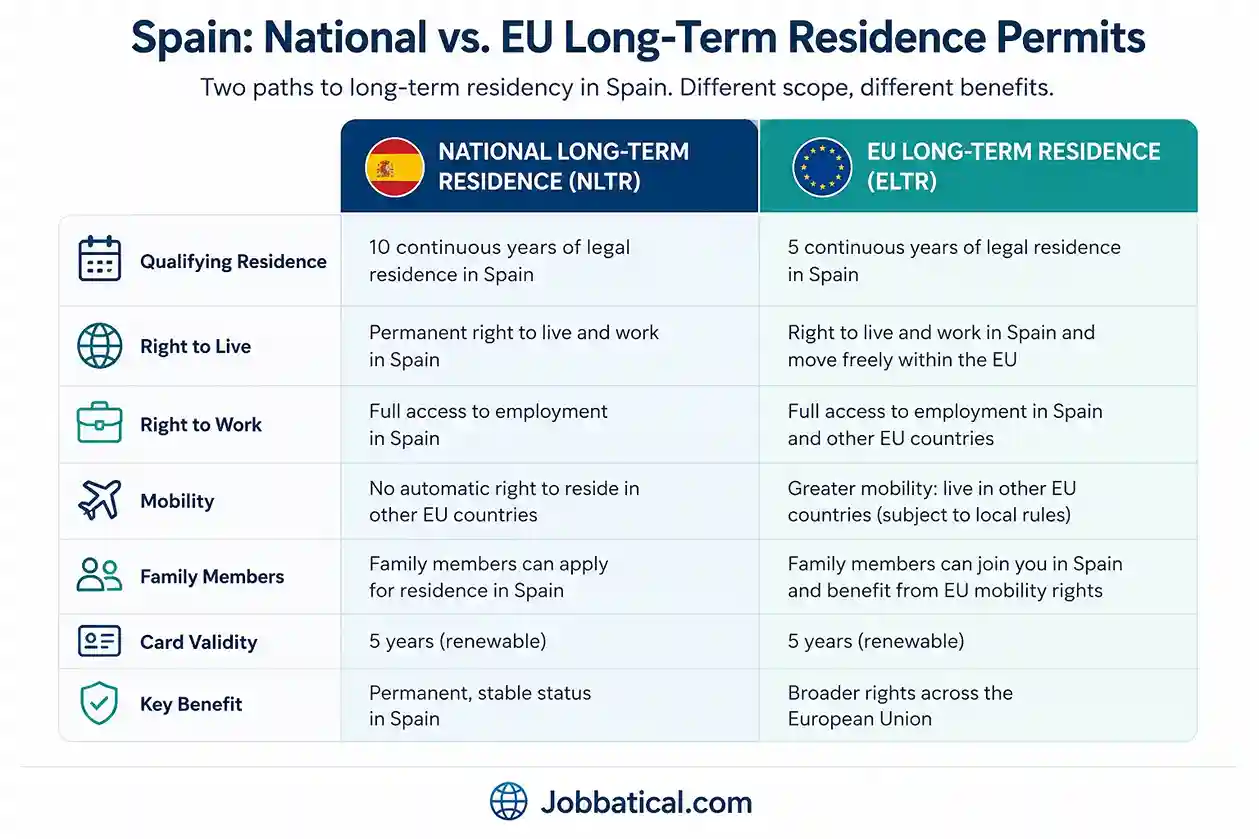
Spain Permanent Residency vs Long-Term Residence
- Status differences: EU, EEA, and Swiss citizens apply for standard permanent residence, while non-EU hires must specifically apply for larga duracion.
Crucial details for the 2026 Spain PR process:
- Required paperwork: Non-EU employees must file form EX-11 to secure their long-term residence.
- Appointment accuracy: Booking the wrong appointment type at the immigration office or using EU forms will cause weeks of processing delays.
- Employer benefits: Transitioning eligible staff to long-term status permanently removes the need for future company sponsorship and reduces your HR workload.
For the wider RD 1155/2024 reforms that reshaped permit durations and the 10-year long-term residence card in 2025, see our Spain work permit reforms guide for employers.
┈┈┈┈┈┈┈┈┈┈┈┈┈┈┈┈┈┈┈┈┈┈┈┈┈┈┈┈┈┈┈┈┈┈┈┈┈┈┈┈┈┈┈┈┈┈┈
Larga duración vs larga duración-UE: which permit your employee should file?
Choosing the right long-term Spain visa depends on your employee's future mobility within your company:
- Larga Duracion (National PR): Best for employees staying in Spain indefinitely. It processes faster because it does not require a financial means test or private health insurance.
- Larga Duracion-UE (EU PR): Best for employees you might transfer to another EU office. It grants easier mobility across the EU, but requires health insurance and proof of financial means (roughly €900 monthly for a two-person household in 2026).
If your company runs entities in several EU countries, the UE variant is worth the extra documents. For everyone else, the national permit is faster to assemble.
┈┈┈┈┈┈┈┈┈┈┈┈┈┈┈┈┈┈┈┈┈┈┈┈┈┈┈┈┈┈┈┈┈┈┈┈┈┈┈┈┈┈┈┈┈┈┈
Residencia permanente España requisitos: what your employee has to prove
The long-term residency requirements (residencia permanente España requisitos) are much simpler than first-time work permit filings. To qualify, your employee must prove:
- Eligible nationality: Must not be a citizen of the EU, EEA, or Switzerland.
- Continuous residency: Must have five years of legal, uninterrupted residence in Spain immediately before applying.
- Clean criminal record: Must have no criminal offenses in Spain or any country they lived in over the past five years.
- Immigration standing: Must have no entry bans, security risks, or public health concerns.
- Application fee: Must pay the government processing fee using Modelo 790 code 052.
While early PR access exists for specific pensioners or individuals born in Spain, standard corporate mobility planning should always center on the five-year continuous residency rule.
┈┈┈┈┈┈┈┈┈┈┈┈┈┈┈┈┈┈┈┈┈┈┈┈┈┈┈┈┈┈┈┈┈┈┈┈┈┈┈┈┈┈┈┈┈┈┈
Spain Permanent Residence Absence Rules and 5-Year Continuity
Exceeding allowed time outside Spain is the primary reason long-term residency applications are rejected. Immigration authorities automatically check passport border data during application review.
- Single absence limit: Individual trips outside Spain must not exceed six continuous months.
- Total absence limit: Cumulative time outside Spain must not exceed 10 months total over the five-year period.
- Work travel extension: Total allowed absence increases to 18 months if travel was required for work, provided you submit formal assignment letters and travel records.
- Force majeure exceptions: Unforeseen medical or personal emergencies abroad are evaluated individually by Extranjeria.
For a full breakdown of how overseas assignments and business travel affect the five-year count, and how EU Entry/Exit tracking now records every trip, see our guide to Spain residency and employee absences.
┈┈┈┈┈┈┈┈┈┈┈┈┈┈┈┈┈┈┈┈┈┈┈┈┈┈┈┈┈┈┈┈┈┈┈┈┈┈┈┈┈┈┈┈┈┈┈
Time spent in Spain on study, volunteering, or training stays does not count fully toward the five-year continuous residence requirement for residencia de larga duracion.
- Student visa calculation: Time spent on a study permit counts at 50 percent of its duration.
- Calculation example: Three years on a student visa equals 1.5 qualifying years. Combined with three years on a standard work permit, the total is 4.5 years, which falls short of the five-year requirement.
- HQP permit calculation: All time spent on a Spain Highly Qualified Professional permit counts at 100 percent toward permanent residency.
┈┈┈┈┈┈┈┈┈┈┈┈┈┈┈┈┈┈┈┈┈┈┈┈┈┈┈┈┈┈┈┈┈┈┈┈┈┈┈┈┈┈┈┈┈┈┈
Spain PR Application Documents (Solicitud Residencia Permanente España)
Employees file the Spain permanent residency application directly as the legal applicant. Companies do not act as formal sponsors, but HR must ensure employees receive necessary internal documentation on time.
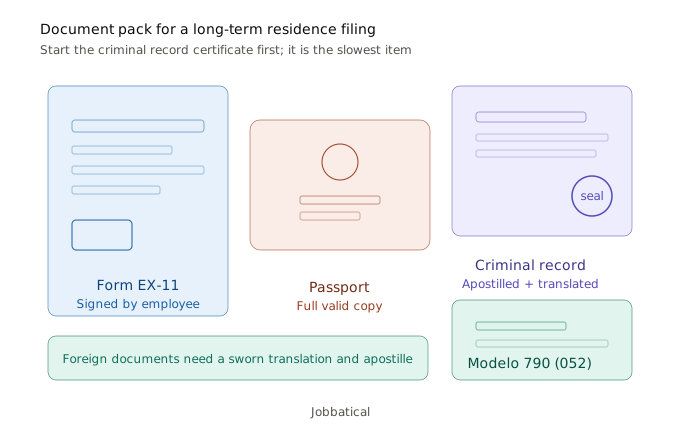
- Form EX-11: Completed and signed official application form EX-11
- Passport copy: Full copy of a valid passport or travel document.
- Fee payment: Proof of tax payment using Modelo 790 code 052.
- Criminal record certificates: Clean background checks from the origin country and any country lived in during the past five years.
- Schooling reports: Mandatory proof of enrollment for dependent children of compulsory school age.
- EU PR add-ons: Proof of fixed income and health insurance for Larga Duracion-UE applicants.
- Document legalization: Foreign documents require an apostille or consular legalization and a sworn Spanish translation. Request criminal records first, as processing takes six to eight weeks.
┈┈┈┈┈┈┈┈┈┈┈┈┈┈┈┈┈┈┈┈┈┈┈┈┈┈┈┈┈┈┈┈┈┈┈┈┈┈┈┈┈┈┈┈┈┈┈
Where to Submit the Spain Permanent Residence File
- Online via Mercurio: Filing through the Mercurio electronic office avoids long appointment wait times at local immigration offices.
- Oficina de Extranjería: In-person filing at the local immigration office in the province where the employee resides.
- Spanish consulate: Submission from abroad at the consulate covering the applicant's residence location.
┈┈┈┈┈┈┈┈┈┈┈┈┈┈┈┈┈┈┈┈┈┈┈┈┈┈┈┈┈┈┈┈┈┈┈┈┈┈┈┈┈┈┈┈┈┈┈
Application Timing and Work Rights (Como Solicitar Residencia Permanente en España)
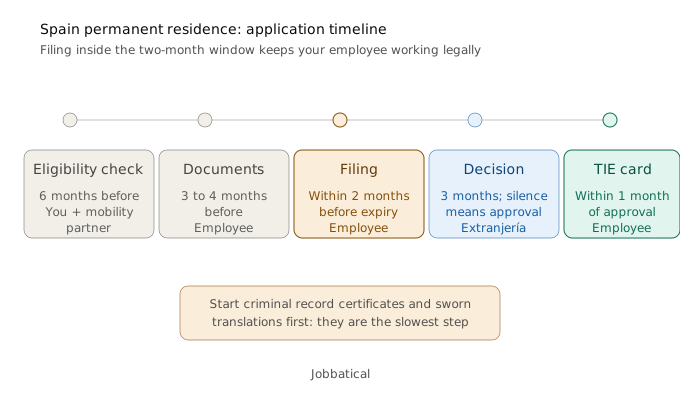
- Ideal filing window: Apply during the two months immediately before the current permit expires to automatically extend existing work authorization.
- Late filing grace period: Applications are accepted up to three months after permit expiration, but late filings can trigger administrative penalties.
- Buffer timeline: Begin gathering documents three months prior to expiration to account for international background checks, legalizations, and translations.
┈┈┈┈┈┈┈┈┈┈┈┈┈┈┈┈┈┈┈┈┈┈┈┈┈┈┈┈┈┈┈┈┈┈┈┈┈┈┈┈┈┈┈┈┈┈┈
Application timeline for a permiso residencia permanente
Silence after three months works in your favour, but you still need the written resolution and the card for your right-to-work file.
Related Read:
New to the TIE step? Our guide to NIE and TIE requirements in Spain explains form EX-17, the biometrics appointment, and what your employee needs to bring.
┈┈┈┈┈┈┈┈┈┈┈┈┈┈┈┈┈┈┈┈┈┈┈┈┈┈┈┈┈┈┈┈┈┈┈┈┈┈┈┈┈┈┈┈┈┈┈
What changes for you once your employee holds a permiso residencia permanente
- No more sponsorship-linked renewals. Compare that with the two-year cycle on Spain's work and residence permit routes, and the admin saving is obvious.
- Full labour mobility. Your employee can change role, move to self-employment or join a competitor without an immigration filing. Retention now rests on your offer, not their permit.
- Card renewals replace permit renewals. The TIE is renewed every five years as a document refresh, filed in the two months before it expires. It is not a fresh eligibility test.
- Status can still be lost. Extended absences from the EU can end long-term status, and there is a separate recovery procedure to get it back. Check the thresholds before approving a long overseas assignment.
- Family cases stay separate. Dependants hold their own permits, and long-term status for the employee does not update them automatically. See the rules on the 5-year residence permit for family members.
Some employees will ask about citizenship next, usually after ten years of residence, or two years for nationals of Ibero-American countries and a few others. The difference between Spanish permanent residence and citizenship is worth reading before you answer, because the two carry different obligations.
Related Read:
By contrast, employees still on a work permit need a formal change-of-employer filing before switching jobs; here is how that process works in Spain.
┈┈┈┈┈┈┈┈┈┈┈┈┈┈┈┈┈┈┈┈┈┈┈┈┈┈┈┈┈┈┈┈┈┈┈┈┈┈┈┈┈┈┈┈┈┈┈
Where mobility teams lose time on these cases
- No five-year tracker. Eligibility dates sit in permit records, not renewal reminders, so the window opens and closes unnoticed.
- Treating it as a renewal. Different form, different appointment, different documents. A standard permit renewal and a long-term filing are not interchangeable.
- Untracked business travel. Absence totals are the top reason these files fail, and travel data usually lives outside HR.
- Late document requests. Criminal record certificates, apostilles and sworn translations cannot be compressed.
- Province blind spots. A Valencia case and a Barcelona case run on different appointment realities.
If you have more than a handful of employees approaching year five in Spain, build a tracker with: name, permit type, first legal entry date, qualifying years including any 50% student time, and total days outside Spain. This view helps you track accurately filing needed per year and whose renewal should be prioritized.
How Jobbatical helps with Residencia Permanente en España cases
Jobbatical tracks eligibility dates, absences and filing windows across your whole Spanish population, with local experts handling Spain residence permit cases at provincial Extranjería offices and the UGE.
Jobbatical . Jobbatical’s Employee Renewals and Compliance Tracking Module streamlines the process with centralized residence permit renewal tracking, visa expiry alerts, GDPR-compliant document storage, and HR dashboards for seamless compliance management.
Disclaimer: Immigration rules change quite frequently; please verify with official sources or contact us for the latest info before making any decisions.
┈┈┈┈┈┈┈┈┈┈┈┈┈┈┈┈┈┈┈┈┈┈┈┈┈┈┈┈┈┈┈┈┈┈┈┈┈┈┈┈┈┈┈┈┈┈┈
Frequently Asked Questions: Spain Permanent Residence for Employees

.svg)


.avif)
.svg)